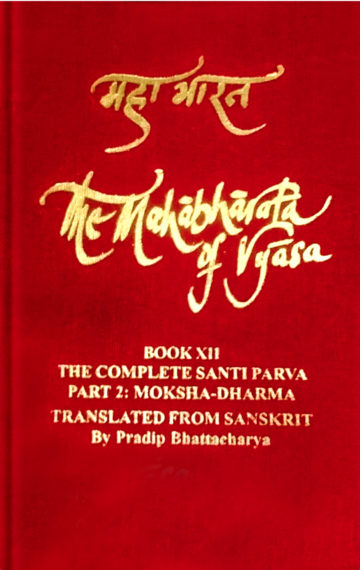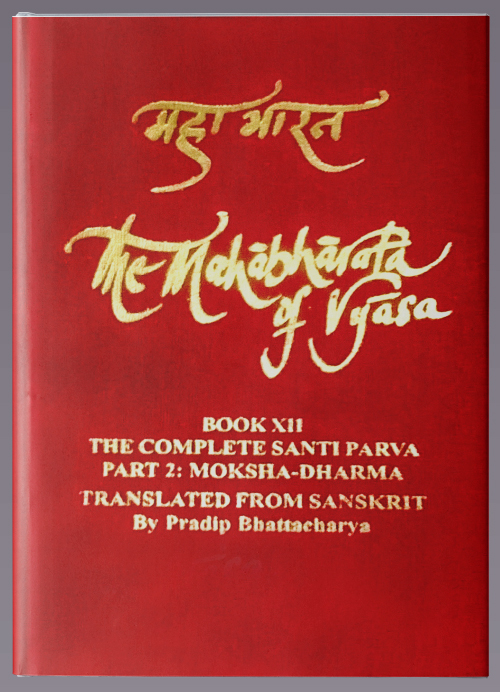
The Mahabharata of Vyasa: Mokshadharma Parva, translated from the Sanskrit, Writers Workshop, Kolkata, 2016.
This is the first English translation of the Moksha-Dharma Parva in free verse. Distinctive ślokas have been reproduced by Dr Bhattacharya in Sanskrit.
Book Review :
“It is indeed very brave of Bhattacharya as this is the toughest section of the epic, containing the essence of Vyasan philosophy…The depth of research that has gone into this translation is amazing. The additional stories and verses he found have been included…providing the reader with the ‘full ragbag version.’ This has lent the book a unique comprehensiveness. A difficult and colossal job, well done! …he has succeeded in communicating the meaning of the concepts difficult to comprehend. One moves easily with the easy flow of his language. His poetry is excellent. It is rich yet simple. One never stumbles while going along. It has the easy flow of a river and the cadence of raindrops, and that makes the translation so attractive.” Shekhar Sen, The Sunday Statesman, 25.12.2016.
Kevin McGrath in the Journal of Vaishnava Studies [Volume 26, No. 1/Fall 2017] writes:
“Pradip Bhattacharya is the foremost Sanskrit scholar in India today in the field of Mahābhārata Studies … [He] captures well the extremely complex dramatic quality of so much of Bhīṣma’s vast monologue in which the old warrior imitates the hundreds of different voices who inhabit and who express the narrative; this great event of mimēsis is fully conveyed by the translation wherein Bhīṣma the poet enacts innumerable characters and voices.
The prophets Nārada and Bhṛgu play significant roles in this section of the Great Bhārata as does Kṛṣṇa himself at times. There are also many episodes that are given in the style of faunal allegory where animal speech and behaviour are important components of communication. The great Naranārāyaṇīya, which comes at the end of the book is beautifully translated and finely captures the tone and flavour of that long anthem which lies at the heart of early Hinduism.
At times the author frequently leaves within his translation certain words in the Sanskrit which brings to the text a much larger authenticity and authority and where the intrinsic vitality of the original language effects—both sonorously and linguistically—a quality that might evade perfect translation. This is a crucial aspect of the book’s effectiveness as a medium not simply of specific communication but also of cultural significance …
This wonderful, thoroughly well-composed, and masterful book is faultlessly printed and handsomely bound and will become a uniquely useful reference text for those non-Sanskritists who work in both Mahābhārata Studies and in the field of Divinity; it is surely to become a matchless title on the shelves of any library of theology. This mighty work will long remain as one of Pradip Bhattacharya’s most renowned and paramount contributions to current Indology, both in Asia and in the West.”
Satya Chaitanya in Religions of South Asia [11.2-3, 2017] says:
“While Bhattacharya’s translation is basically in verse, he has translated the prose in the original into prose, which makes this the only verse-and-prose sloka-by-sloka translation of the Parvan. The translation is a monumental piece of work as well as a superb literary achievement. One of the unique aspects of the translation is the retention of Sanskrit words that are in the Oxford English Dictionary … A new reader finds this rather unsettling, but once you are used to it, you discover it has a charm of its own, giving the entire work a surreal quality. And of course, it avoids, as the translator points out, the need for annotations, colophons and dovetailing explanations …
Bhattacharya’s mastery of the English language is astounding. With amazing fluidity, the mighty torrent of the translation flows on for 1077 pages, carrying us with it.”
Indrajit Bandopadhyaya in Indologica Taurinensia remarks:
“The parvan stands out as unique in its advocacy of Liberal Varṇa System (portraying non-Brāhmiṇ characters like Sulabhā, prostitute Piṅgalā and Śūdras as qualified for higher merit and social status through wisdom), and carries the important and interesting message that understanding Gender Relation or Evolutionary Nature of Gender is essential for Prajñā leading to Mokṣa. Yudhiṣṭhira learns all these theoretically from grandfather Bhīṣma, who is then on his Bed of Arrows. This is not without significance. Bhīṣma’s physical life-in-death or death-in-life is apt parallel and metaphor for Yudhiṣṭhira’s mental state. Yudhiṣṭhira and his brothers and Draupadī qualify to gain knowledge on Mokṣa-Dharma only after their growing realization through dialogues, debates, experiences and feelings that victory in war has been futile, and Kurukṣetra War is as much external as internal. Yet, at the end of Śānti-Parvan, theoretical knowledge does not suffice, and the Pāṇḍavas and Draupadī emerge Dynamic in their quest for more quests – that sets the stage for further of Bhīṣma’s advice in Anuśāsana Parvan. The message that emerges from Mokṣadharmaparvan is that, one has to actually attain Mokṣa; mere theorizing is only furthering Bandhana …
Bhattacharya has done an invaluable job to English readership by providing four episodes found in Haridās Siddhāntavāgiś (Nibandhana-Bhogavatī, Nārada, Garuḍa and Kapilā Āsurī narratives) and many verses not found in the Gorakhpur edition. Of these, the Kapilā Āsurī Saṃvāda at Section 321-A (p-815) is only found in Siddhāntavāgiś edition (vol. 37, pp. 3345-3359). Just as in archaeology, every piece of human-treated rock delved from earth is beyond value, I would say that every unique variation or every narrative in Mahābhārata recensions is of similar value particularly in marking a curious interaction point between Classical and Folk Mahābhārata – that no serious Mahābhārata scholar can ignore.
Bhattacharya deserves kudos for bringing into light the stupendous work and name of Siddhāntavāgiś, an almost forgotten name even to most Bengalis, and an unknown scholar to most Mahābhārata scholars or readers, almost eclipsed by the other popular Bengali translator Kālī Prasanna Siṃha.”
Get the Book Details Here : Mahabharata Of Vyasa