Sanjaya narrating the war to blind Dhritarashtra, painted by Daud, Razmnama 1599.
nārāyaṇaṃ namaskr̥tya naraṃ caiva narottamam
devīṃ sarasvatīṃ caiva tato jayam udīrayet
“Namaskar-ing Nārāyaṇa and Nara, best of men
and devi Sarasvatī, then is Jaya uttered.”
So exhorts Krishna Dvaipāyana Vyāsa, dark island-born editor and master raconteur, who weaves a bewildering skein of threads creating the many-splendoured web of the Mahabharata from which there is no escape for the audience then and the reader now. The millennia separating us have not, surprisingly enough, dimmed the magic of his art that had entranced Janamejaya and later Śaunaka. Here is stunning evidence of the power it exerts:-
“Shells were exploding over Leningrad. Enemy bombs were falling on the streets stirring up clouds of dust. On one of those spring days during the siege, Sanscrit language was being heard in the building of the Academy of Sciences on the Neva River embankment, in a room overlooking the side that was safer during the artillery strikes. First, in the original, and then in translation, Vladimir Kalyanov, a specialist on India, was reading Mahabharata, a wonderful monument of Indian literature, to his colleagues, who remained in the besieged city. He had started the translation before the war. He translated during the hard winter of 1941, with no light, no fuel and no bread in the city. Two volumes of books—one published in Bombay and the other in Calcutta—were lying on the table in the room. In the dim light of a wick lamp, he was comparing these two editions of Mahabharata, trying to find the best and the most accurate translation of the Sanscrit into Russian.
“When, after the war the first book of Mahabharata—Adi Parva was published in Leningrad, Jawaharlal Nehru, Prime Minister of India, noted with great satisfaction that, even during the hardest times, the translation of the Indian epic into Russian was never interrupted.”[2]
What is it in this epic-of-epics, eight times larger than the Iliad and the Odyssey combined—denounced as “a literary monster” by Winternitz and as “monstrous chaos” by Oldenberg—that appeals so irresistibly to the modern man in search of his soul, when the audience for which it was composed—the enthroned monarch and the forest-dwelling sage—has long since sunk into the dark backward and abysm of time?
Here we find a storyteller par excellence laying bare, at times quite pitilessly, the existential predicament of man in the universe. Passions do, indeed, spin the plot and we are betrayed by what is false within. Then, as now, there is no need to look for a villain manoeuvring without.[3]
If we resonate in empathy with sunt lacrimae rerum, the sense of tears in human things, we also thrill with joy on meeting the indomitable spirit of woman in an epic that is misconceived as celebrating male chauvinism. Whether it is Śakuntalā or Draupadī proudly asserting their integrity and berating cowardly husbands and elders in open court; or Devayānī demanding that Kaca return her love, forcing a bewildered monarch to wed her and then imperiously brushing aside a lust-crazed husband; or Kuntī refusing to pervert herself into a mindless son-producing machine to gratify the twisted desires of a frustrated husband—time and again it is woman standing forth in all the splendour of her spirited autonomy as a complete human being that rivets our attention and evokes our admiration.
The Mahabharata resembles a Russian doll, or a Chinese box. Stories pop up one after another, one tale nested within another…and yet another. We find not only layers of narrative frameworks but also leitmotifs, archetypes and underlying themes that weave together the seemingly disparate conglomerate of folk-tales, heroic legends, genealogies, myths, parables, mantric invocations and philosophical discourses. The structure is reminiscent of a bricoleur’s bricolage, a patchwork quilt, a kāṁthā.
The primary invocation that does not mention Vyāsa could well be his. The second version that the Vulgate and Jaimini’s version provide add Vyāsa to the three to be namaskar-ed, which is precisely what Vaiśampāyana does before starting his narration. Later, he explicitly glorifies his guru as Nārāyaṇa on earth.[4] Immediately thereafter (sloka 10)[5] he mentions that Janamejaya has resolved on holding a horse-sacrifice following the mahayajña, which would be the sarpasattra. This mention of the aśvamedha is the link to the Harivaṁśa, the appendix to the Mahabharata.
The first point to realise is that while Vyāsa is the composer, he is not the narrator, nor is Sauti. The outermost framework is an omniscient narrator’s who sets the stage with the entrance of Ugraśravā Sauti, the rhapsode, into the forest of Naimiṣa where Śaunaka, the Bhārgava sage, is performing a twelve-year-long sacrifice. It is this anonymous teller-of-tales who recounts the exchanges between Sauti, Śaunaka and his entourage of priests. Sauti himself is conflating two sources: what he heard Vaiśampāyana narrate to Janamejaya in the presence of Vyāsa; and what he has learnt from his father Lomaharṣaṇa, whom Vyāsa taught the Purana. But who utters the last sloka of the Svargārohaṇa Parva? Is it Sauti, or the nameless inheritor of the tradition? And, in the very first chapter, who has composed the riveting plangent lament of Dhṛtarāṣṭra, eyeless in Hastināpura?
Narrators in the epic are legion. It is not only the professional bards, Sauti et al, who recite the epic, but also Brahmins like Lomaṣa, Mārkaṇḍeya and, of course, Vaiśampāyana. It is not, as Van Buitenen argues, that “baronial-bardic lore” was giving way to a tradition of wandering reciters of Brahminic lore. Vaiśampāyana, a Brahmin, recited the epic before it was picked up by Sauti the sūta. Sauti’s narration is only the second Russian doll or Chinese box housing within it a series. Each layer alternates between direct narration in response to a query, often incorporating a question-and-answer encounter, and a dialogue. The impact, therefore, is varied and, in the dialogue-encounters, even dramatic. The most voluminous of these narrations is Bhīṣma’s, incorporating a host of subsidiary narrators in the Udyoga, Śānti and Anuśāsana Parvas, with Duryodhana and Yudhiṣṭhira asking the questions. The other major tellers-of-tales are Lomaṣa and Mārkaṇḍeya in the Vana Parva responding to Yudhiṣṭhira.Nārada appears as a common narrator in many parvas. In the midst of it all, Vyāsa pops in-and-out of the narrative, shaping the course of events at critical junctures. He is the only epic poet who kills off a huge number of his own characters—the war-widows—by motivating them to drown themselves to rejoin their dead husbands.
I propose to restrict myself to the first book, the Ādi Parva. If, later in the epic, Vyāsa shows us what man has made of man, here, in the very first book, he plumbs the depths of the humiliatingly petty pre-occupations of the Creator’s noblest creation. Indeed, the dilemmas the characters find themselves enmeshed in cannot even be glorified as “tragic.” Perhaps, that is why we find the epic so fascinating—for, how many of us are cast in the heroic mould? We do not have to strain the imagination to reach out and identify with lust-driven Yayāti or Śāntanu mesmerised by riverside nymphs. We need no willing suspension of disbelief to understand why the Brahmin Droṇa should sell his knowledge to the highest bidder, or why Drupada does not protest too much when his daughter is parcelled out among five brothers who had routed him in a skirmish.
The first two sections introduce Sauti who, in response to specific queries of the sages gathered at Naimiṣa, provides a list of contents, Dhṛtarāṣṭra’s lament, the figuring forth of the epic as an organic tree image, the Puranic touch about creation and genealogy, the epic’s composition, the benefits of listening to it, the origin of samantapancaka and the definition of akṣauhiṇī. Abruptly, section 3 introduces Janamejaya, the canine motif and the leitmotif of a curse. Janamejaya then leaves to annex Takṣaśilā where he will institute the snake-holocaust. The stories about three disciples, replete with Vedic echoes, are slipped in adroitly by Sauti. Is he pandering to the audience of sages eager for Brahminical wonders? Perhaps; but not just that. After the story of Upamanyu, he re-introduces Janamejaya along with Pauṣya who make Veda their acharya. Pauṣya is the link to the next tale, that of Uttaṅka. Cunningly, Sauti weaves in the thread of revenge that, like Śeṣa penetrating and upholding the globe, wraps round the massive epic corpus. Uttaṅka, seeking vengeance against Takṣaka, motivates Janamejaya to institute the snake-holocaust. That becomes the setting for the recital of the Mahabharata in the presence of its composer, the king’s great-great-grandfather.
Reaching section 4, we find that it is a new beginning altogether! Here is Sauti appearing before the rishis and Śaunaka for the first time. It is as though the previous three sections have been stitched on top of this. Here, then, we have yet another anonymous narrator who gives pride of place to Śaunaka as a parallel to Janamejaya the original “onlie true begetter” of the epic.[6] One of these anonymous rhapsodes forming the successive outer frames modified the second sloka of the invocation to glorify Vyāsa that occurs in the Vulgate, which is also the version found in Jaimini’s Aśvamedha Parva: devīṃ sarasvatīṃ vyāsaṃ tato jayam udīrayet.
The Pauloma and Āstīka parvas that follow are Sauti’s composition of Brahminical stories in response to Śaunaka’s specific request for Bhārgava genealogy, drawing upon Puranic lore learnt from his father Lomaharṣaṇa (13.6-8 CE). Yet, he shrewdly brings his audience back to his main interest, the epic, by weaving in the story of Ruru who hears the tale of Janamejaya’s snake sacrifice from his father Pramati. Note the thematic brilliance of introducing the concept of ahimsa and making it the peg upon which to hang the epic of maha-carnage.
The anonymous narrator tells us that by the time of Sauti’s visit Vyāsa had already arranged the Vedas (1.55) and composed the Purana and the Mahabharata (1.17-20). He is drawing upon Sauti’s statement to Śaunaka embedded 53 sections later introducing Vyāsa, born on an island in the Yamunā to Kālī and Śakti’s son Parāśara, being the first arranger of the Vedas in four divisions and a seer-poet (kavi) who continued Śāntanu’s line (54.2-6). Sauti, true to his heritage as son of the Purana reciter Lomaharṣaṇa, begins with a majestic account of creation that echoes the Rig Veda, followed by a genealogy (1.29-50):
“At first, there was no light,
no radiance, only darkness;
then was born the Egg of Brahma,
exhaustless and mighty seed of life.”
Sauti provides basic information regarding the varied traditions of narrating the epic (1.53): beginning with Manu; or from the story of Āstīka; or from the episode of Uparicara; or all the way through. Further, the composition had both condensed and detailed editions in response to audience requirements (1.52).
Very realistically, he proceeds to recount the problem faced by Vyāsa when he wanted to teach the epic to his pupils and how it was solved. To help him out, Brahmā pays a visit and there is a delightful touch of sly humour as Vyāsa sets about thoroughly convincing the Pitāmaha of the encyclopaedic nature of his work. By the time he has finished, Brahmā hastily declares, “It shall be a kāvya no poet in this world will equal” (1.73) and vanishes. An extremely significant clue is lost when kāvya is rendered as “poem”. The word comes from kavi which, like the Celtic-Teutonic “vates,” means “seer,” one who pierces through appearance to the reality, the truth hidden behind. To render this as “poem” deprives Brahmā’s statement of its implication and ruins the logical correlation with the previous statement (1.72): “I am aware that you have revealed the Word of Brahman in the language of truth.” The Mahabharata, therefore, is “revealed truth” and it reveals the Divine Word. “The mystery of the Vedas, and other mysteries, I have explained”, says Vyāsa (1.62). Towards the end of this parva, in sloka 265, Sauti states why Vyāsa chose this particular form: “But the Veda fears men of small learning, for they distort it.” Hence, Vyāsa couched the secrets of the Veda in the guise of stories in the Mahabharatato be passed on in easily memorable fashion to everyone, even the uninitiated, who could thus gain access to some of the esoteric spiritual truths hidden in the forgotten symbolic language of the Vedas. This is well exemplified in the stories in the Pauṣya Parva and in the stories of the quest for amṛta, the nectar of immortality.[7]
To overcome the problem of teaching the vast epic to his pupils, Vyāsa calls on Gaṇeṣa, the remover of obstacles. This Gaṇeṣa-Vyāsa encounter, omitted in the Bhandarkar edition, is an excellent instance of Sauti’s delicate wit. Gaṇeṣa agrees to act as Vyāsa’s amanuensis on one condition: his pen must not stop even for a second. And a very sensible proviso it is, otherwise he could well be stranded with Vyāsa through much of eternity! Vyāsa agrees, but with a stipulation of his own: “Stop wherever you don’t understand” (1.79). To gain breathing space, Vyāsa dictated some profoundly abstruse verses numbering 8800 that became notorious as the Vyāsa-kūṭa puzzling even the all-knowing gods. Several scholars mistakenly cite this as the original length of the composition.
Sauti is quite a poet. He describes the contents of the epic in terms of a vivid tree-image which deserves closer reading because of the sections he picks out for mention. Sauti omits much of the Ādi Parva,and the Sauptika, Anuśāsana, Mahāprasthānika and Svargārohaṇa Parvas. Out of the sprawling Ādi Parva, Sauti picks out the Pauloma and the Āstīka sections, calling them the roots, and very rightly so. The former satisfies Śaunaka’s query about the Bhṛgu-genealogy while leading on to the snake-sacrifice that constitutes the substance of the latter and is the occasion for the recital of the epic by Vaiśampāyana. The third section of the Ādi Parva that Sauti mentions is the Sambhava, described as the trunk of the epic, for it contains the entire history of the Kuru race starting from Duṣyanta, going right up to the return of the Pāṇḍavas to Indraprastha and the amorous exploits of Arjuna during his voluntary exile, thus fairly establishing them as the centre of interest. The Sabhā and the Āraṇya (Vana) Parvas are termed perches for birds in this epic-tree. Both deal with the forest. Then, from the latter, Sauti perceptively picks out the Araṇi section for particular mention as the “organic knot” with the memorable confrontation of Yudhiṣṭhira with Death. Sauti goes on to describe the Virāṭa and the Udyoga Parvas as the pith, where the Pāṇḍavas gather their forces for war. The Bhīṣma and Droṇa parvas, concerned with the Kuru patriarch and the guru common to both parties, are the main branch and the leaves. One contains the Gītā; the other has the killing of Abhimanyu and Yudhiṣṭhira’s sole lie. What is arresting is the curious description of the Karṇa Parva as the lovely flowers of the tree, which indicates the regard Sauti has for this most tragic of heroes, deprived of birthright, mother’s love and his brothers, compelled to fight them because of his dedication to the honour of his word. Why call the Śalya Parva the fragrance of these flowers? Because here is the tragic death of Duryodhana. The Strī and the Aiṣīka Parvas, the cool shade of the tree, provide the catharsis after the holocaust with lamentation in extenso. The Śānti Parva is the great fruit, bringing the closure of “calm of mind, all passion spent.” The Āśvamedhika Parva, with the Anugitā and the half-golden mongoose who subverts all conquests of the Pāṇḍavas, is the ichor flowing through the tree. The Āśramavāsika Parva, where the old generation passes away in the forest, is the site where the tree grows. That is not just another poetic metaphor just for the sake of extending the tree-image, but hints at the environment in which Puranic civilization was cultured, a profound exposition of which is given by Rabindranath Tagore in his essay, “Tapobhumi”.[8] The curious description of the Mausala Parva is difficult to understand. The Sanskrit is mausalaḥ śrutisaṃkṣepaḥ, i.e. “the Mausala is the quintessence of śruti (the Vedas)”. It narrates the self-destruction of the mighty Yādavas with the participation of their protector Krishna, together with his passing and that of Balarāma and Arjuna’s realisation that in the absence of Krishna he cannot fight even ordinary dacoits wielding clubs. Without contact with the Divine, man by himself is nothing. With that realisation, the Pāṇḍavas are told by Vyāsa that it is time to leave the world behind and seek the Divine. Perhaps it is for this philosophic insight that Sauti describes this parva as so very important.
Completing this image, Sauti adds a remark that is yet another indication of his profession. This epic, he says, is a source of livelihood to illustrious poets (1.92). He is referring to wandering rhapsodes like himself who, like the medieval minstrels and troubadours of Europe, the tale-tellers of Baghdad and the bards of Rajputana, literally lived off such tales of great heroes, savants, gods and nymphs.
By way of relating the major features of the epic in the Anukramanikā Sauti picks out the glory of the house of Kuru, the virtue of Gāndhārī, the wisdom of Vidura, the constancy of Kuntī, the divinity of Krishna, the rectitude of the Pāṇḍavas and the wickedness of the Dhārtarāṣṭras. That is how the epic appeared to the narrator and the millennia have not brought about much change in audience-perception, except that the efforts of Rabindranath Tagore, Ramdhari Singh Dinkar, Buddhadeb Bose, Shivaji Sawant, Dipak Chandra, P.K. Balakrishnan, Gurudutt and Narendra Kohli have created an exaggerated impression concerning the role of Karṇa, investing him with the halo of a superman which the text of the Mahabharata does not support.
Sauti now tells us a very important fact (1.101-107): Vyāsa brought the epic before the world only after the deaths of his three sons—Dhṛtarāṣṭra, Pāṇḍu and Vidura (1.96). Thus, we are made aware that Vyāsa is actually presenting before us the biography of his family. Further, originally, the Mahabharataconsisted of 24,000 slokas, leaving aside the fringe episodes, which Vyāsa composed after arranging the Vedas. He added a list of contents running to 150 slokas. This he taught his son Śuka and four disciples (Vaiśampāyana, Sumanta, Paila and Jaimini), directing each to publish his own rendition. Vaiśampāyana’s, meant for humanity, is the only one recited in the presence of the composer himself. The other editions are lost, but for Jaimini’s Aśvamedha Parva which is very different from Vaiśampāyana’s composition in both matter and form.[9] Later, Vyāsa composed another version running to 60 lakh slokas of which 1 lakh are known in the mortal world while 30 lakh are in the world of gods, 15 lakh in the sphere of the ancestors and 14 lakh in the abode of Gandharvas, each with its distinct narrator. Nārada recites it to gods, Asita-Devala to ancestors, Śuka to Yakṣas, Rakshasas and Gandharvas and Vaiśampāyana to humanity. In other words, the extent of the composition is adjusted to the demands of the audience. At the close of this, we find another delightful touch individualising Sauti, who, after mentioning that Vaiśampāyana recited one lakh slokas to the world of men, adds, “I might add that I, Sauti, have also recited one lakh slokas” (sloka 107), of which he is quite justifiably proud.
At the end of the Mahabharata, Sauti tells us that Vyāsa composed this jayo nametihaso, “history named Victory, Jaya,” to celebrate the glory of the Pāṇḍavas and other Kshatriyas and because he desired to establish dharma (Svargārohaṇa, 5.39, 41). Further, that its composition took three years (Vulgate sloka 48), repeating what Vaiśampāyana stated when he began his detailed narration (Ādi section 56 CE). This “publication” must have taken place after the death of the Pāṇḍavas, which is the subject matter of the last parva. The text closes after Janamejaya’s snake-sacrifice has been wrapped up and he returns from Takṣaśilā to Hastināpura. Sauti provides two meanings of the title in sloka 271: it is about the “maha” birth of the Bharata dynasty; it is “maha”- profound, “maha”-heavy (“bhāra”), encyclopaedic.
Slokas 108 and 109 are crucial because they define Sauti’s moral perspective. Once again he uses the organic tree image. The Dhārtarāṣṭras and Pāṇḍavas are described in terms of giant trees, one born of passion, the other of Dharma; the root of the one is the weak-minded Dhṛtarāṣṭra, that of the other Krishna, Brahmā and Brahmins.
Now, in just twenty-eight verses (1.110-138) Sauti provides a succinct resume of the Kuru-Pāṇḍava story unrivalled for its brevity. He is possibly following the model provided by Vaiśampāyana (section 55 CE, 61 Vulg.) as his initial response to Janamejaya’s request. There it is Vaiśampāyana, not Vyāsa, who makes that extraordinary claim which many a scholar has erroneously cited as an instance of Vyāsa’s bloated ego (55.33):-
O Bharata-Bull, on Dharma, Artha,
Kama and Moksha
what is here may be elsewhere; what is not here
is nowhere else.
Sauti repeats this verse in the Svargārohaṇa Parva (18.5.38) and tells us that Vyāsa taught it to his son along with four fatalistic verses about the constant flux inherent in worldly life.
Sauti’s resume is followed by the exquisite self-exculpatory lament of Dhṛtarāṣṭra with its haunting refrain tadā nāśaṃse vijayāya saṃjaya, “Then I no longer prophesied victory, O Saṃjaya”. This lovely passage does not recur where it logically should, after the victory of Pāṇḍavas in the Śalya Parva, or thereafter. In a master stroke of narrative art, Sauti appears to have taken it out and placed it here. Who is its composer? Presumably, it is Vyāsa, but it could well be Sauti’s own.
Notice how unerringly the keynote is struck early in the first section itself. After a bird’s eye view of the plot, the two major characters are featured: the narrator Saṃjaya and the audience Dhṛtarāṣṭra. The device of the blind king is surely a master-stroke. Unlike Priam who is able to see each of the Greek heroes Helen identifies from the ramparts of Troy, Dhṛtarāṣṭra, eyeless in Hastinapura, is dependant entirely on Saṃjaya—as are we—for the sights and sounds of the apocalyptic war. Unlike Sauti and Vaiśampāyana, Saṃjaya is an active participant-cum-reporter, as is Vyāsa. The four war books are in Saṃjaya’s voice which Vyāsa appears to have “recorded”, including the Gītā. Moreover, up till the Strī Parva, these are said to constitute the Bhārata, a term not used thereafter for the other parvas. Would this be the Kshatriya epic Jaya that became Mahabharata with Brahminical additions of the subsequent parvas?[10]
Saṃjaya’s omnipresence, seeing all, hearing all, including the unspoken thoughts, is shared by our anonymous narrator of the outermost frame. It is that narrator who has to be the explanation for that intriguing passage at the end of the Udyoga Parva where Krishna takes Karṇa away for a talk in secret. At this stage Saṃjaya has no superhuman faculty, yet he describes the secret discussion to Dhṛtarāṣṭra. What is more, despite coming to know of Karṇa’s true identity, Dhṛtarāṣṭra does not inform Duryodhana about it. What more evidence do we require of the hand of the anonymous narrator having left its mark?
The lament consists of a record of the chief achievements of the Pāṇḍavas following their escape from the house-of-lac, but the chronology is garbled, as would be natural in someone whose entire kin has been slaughtered. Thus, instead of beginning with the house-of-lacquer episode, Dhṛtarāṣṭra begins with Arjuna’s winning of Draupadī, an episode that disturbed him profoundly, as is shown when he repeats it after four slokas. After all, it secured for the exiled Pāṇḍavas the alliance of the powerful Pāñcālas—traditional rivals of Hastināpura—and immediately led to their being welcomed back by Dhṛtarāṣṭra. He mentions two other matrimonial alliances: that of Arjuna with Subhadrā, forging an alliance with the Yādavas, and that of Arjuna’s son with Virāṭa’s daughter, thus providing the Pāṇḍavas with yet another major ally in the Matsyas, who are related through their grandmother Satyavatī. One would have expected a reference to Bhīma’s rakshasan affair with Hiḍimbā, since Dhṛtarāṣṭra gives Ghaṭotkaca two whole slokas. Another event repeated twice is the slaying of Jayadratha (1.191, 196) despite the presence of Droṇa and Karṇa and other mighty warriors.
Some of the verses in this lament offer revealing insights into the secret of the Pāṇḍavas’ success. The fact that kingdom-bereft Yudhiṣṭhira continued to receive the support of his brothers and that they faithfully followed him into exile is one of these. What a master-stroke of strategy it was on the part of Vyāsa and Kuntī to insist, defying social norms, that Draupadī should be the common wife of all five brothers. This forged a nexus of unbreakable unity that their opponents sought in vain to break and which formed the foundation of their ultimate victory. The other factor is that holy men followed the Pāṇḍavas into exile in the forest, thereby ensuring that thirteen years of exile did not result in a regression to brutish instincts but rather led to a refinement of the spirit through this constant association with ascetics.
As Buddhadeb Bose points out, Yudhiṣṭhira turns this entire period of forest-exile into a quest for the secret of inner peace and the key to prevent destructive conflicts in life. This pointer is reinforced in sloka 166 where Dhṛtarāṣṭra refers to the questioning of Yudhiṣṭhira by the Dharma-yakṣa over the corpses of his four brothers. Another important insight is offered by slokas 151 (Vidura arranging the escape of the Pāṇḍavas from the lacquer house) and 176 (Krishna and Bhīṣma advising the Pāṇḍavas and Droṇa blessing them), showing the internal weakness of the Dhārtarāṣṭras with their main pillars of strength, Bhīṣma and Droṇa emotionally ranged with their enemies, culminating in revealing the manner of their deaths to the Pāṇḍavas and not killing a single one of them despite slaughtering thousands. Sloka 186 reveals the bitterness of the blind monarch that neither Droṇa nor Bhīṣma could kill one of the Pāṇḍavas despite all their prowess. Sloka 165 betrays his deep-seated hatred of Bhīma, as he laments that Karṇa had him in his power and let him escape with a few insults. Another interesting feature is that the only references Dhṛtarāṣṭra makes to unjust fighting are the killings of Droṇa and Duryodhana but not that of Karṇa, despite the indignation that this usually arouses in readers, including Tagore, Dinkar and Sawant. On two occasions, in slokas 198 and 201, Dhṛtarāṣṭra bewails the fruitless misdirection of infallible weapons (Karṇa uses India’s śakti missileagainst Ghaṭotkaca instead of Arjuna and Aśvatthāmā misuses the Nārāyaṇa weapon) not because they were misused but because thereby none of the Pāṇḍavas was killed.
Dhṛtarāṣṭra is quite obviously astonished and not a little piqued that so insignificant a warrior as Nakula should have worsted Aśvatthāmā in battle, making his chariot run around in circles (sloka 200), and that the innocuous Yudhiṣṭhira should have defeated Duḥśāsana, Kṛtavarmā and Aśvatthāmā and finally slain the redoubtable Śalya (slokas 204-205). There is no expression of horror or even regret over the planned burning-alive of the Pāṇḍavas in the lacquer-house despite the assertion “I made no distinction between my sons and the sons of Pāṇḍu” (sloka 142). Rather is he full of sorrow that they escaped because of Vidura, his step-brother and chief advisor.
Only thrice, in slokas 155, 180 and 210, do we find Dhṛtarāṣṭra voicing sentiments of horror or sorrow regarding the sufferings of Pāṇḍavas. Of these, the first is the attempted disrobing of Draupadī, menstruating husbanded-yet-unprotected (rajasvalam nāthavatim anāthavat) in public by Duḥśāsana. This remarkable epithet is a unique summing-up of Draupadī’s plight, which has been explored inimitably by Shaoli Mitra in her riveting one-woman performances, Nathavati Anathavat and Katha Amrita Saman.[11] However, there is a curious twist to it because the next sloka, 156, expresses the king’s sorrow that Duḥśāsana “was foiled in his efforts to strip Draupadī,” whereupon, “what was there for me to look forward to, Saṃjaya?” In other words, Duḥśāsana’s reprehensible act would have been redeemed in his father’s eyes if it had not been a failure! [12] From these outbursts, it is clear that even after the decimation of his entire progeny, the prajñā chakṣu, prophetic-visioned, monarch has not learnt anything.
The second voicing of regret is for the killing of Abhimanyu, but it is also qualified by sloka 190 where he laments that this led to Arjuna’s vow of saindhava to kill Dhṛtarāṣṭra’s son-in-law Jayadratha. The only unqualified expression of sorrow for the Pāṇḍavas occurs in sloka 210 concerning the slaughter of the sleeping Pāñcālas and the sons of Draupadī, which Dhṛtarāṣṭra describes as “horrible” (vibhatsa). Sloka 211 could also be construed similarly, concerning Aśvatthāmā killing the child in Uttarā’s womb.
It is, indeed, a remarkably self-revealing lament of the blind monarch’s true feelings: blinded by love for his sons, hypocritically always trying to appear fair in his treatment of the Pāṇḍavas (sloka 142), but all along longing for their annihilation and going on hoping against hope until the bitter end when Vyāsa and Krishna curse Aśvatthāmā.
The lament is also supremely ironic, for the drama includes an astounding peripeteia. The man who had given up all hope of victory is the one who is the ultimate victor. Yuyutsu, Dhṛtarāṣṭra’s sole surviving son by a Vaiśya maid, becomes regent of the empire. The wheel has turned full circle.
This, however, is not the only ironical feature. Dhṛtarāṣṭra starts narrating these incidents to Saṃjaya in order to show him that “I am indeed a man with prophetic vision”. Yet this blind king, who claims to be a Teirisias, having ostensibly given up hope of success as early as the escape of the Pāṇḍavas from the lacquer-house, persists in chasing a will-o’-the-wisp right till the killing of Uttarā’s unborn child. Is there a hint that he was hoping for Aśvatthāmā success so that his son Yuyutsu could become emperor when the progeny-less Pāṇḍavas left? Unlike another blind king Dyumatsena, who lost his kingdom and got it back as his daughter-in-law Sāvitri’s boon, it is the burden of Sisyphus that weighs down the blind king, who compulsively goes on hoping for ultimate success, struggling against what he knows to be inevitable: the annihilation of all his dreams.
The lament is important not only for its rich irony and its poetic cadences. It is the only place in the epic where we are given the entire struggle as seen through the blind eyes of the defeated king. Hence, it is worthwhile to enumerate the incidents that stand out in Dhṛtarāṣṭra’s memory as key events in the long drawn struggle for supremacy. Though not chronologically in sequence, the verisimilitude of the narrative art cannot be questioned as events flash before the inner eye disparately:
The vows of Duryodhana, Karṇa, and Śakuni; Duryodhana mocked by the Pāṇḍavas in Indraprastha; the game of dice; Arjuna winning Draupadī and the Pāñcālas joining the Pāṇḍavas; Arjuna abducting and marrying Subhadrā; Arjuna gratifying Agni and defeating Indra in the burning of Khāṇḍava forest; the escape from the house of lacquer; Bhīma killing Jarāsandha bare-handed; Rājasūya celebrated by Pāṇḍavas; Duḥśāsana outraging Draupadī’s modesty in public and failing to disrobe her; Yudhiṣṭhira losing his kingdom in the dice game but not being abandoned by his brothers; holy men following Yudhiṣṭhira into exile; Arjuna obtaining the Pāśupata weapon from Śiva, other weapons from Indra and routing the Kālakeyas and Paulomas; Arjuna visiting Indra’s abode and defeating the Asuras;Bhīma leading the Pāṇḍavas unscathed into the forbidden land of Kubera; Arjuna rescuing the sons of Dhṛtarāṣṭra from the Gandharvas; Dharma-yakṣa questioning Yudhiṣṭhira (like the protagonist playing chess with Death in Ingmar Bergman’s “The Seventh Seal”); the Dhārtarāṣṭras failing to track down the disguised Pāṇḍavas in Virāṭa’s court; Arjuna routing the Kaurava heroes single-handed in Virāṭa’s kingdom; Kīcaka slain by Bhīma; Uttarā’s marriage with Abhimanyu;Yudhiṣṭhira , though exiled, able to raise seven armies; Krishna seeking the welfare of the Pāṇḍavas; Nārada declaring Krishna and Arjuna to be Nara and Nārāyaṇa of Brahmā’s realm; Krishna coming on a peace-mission and returning disappointed; Duryodhana’s failure to imprison Krishna who revealed to them all creation in himself; Kuntī consoled by Krishna; Bhīma, Droṇa and Krishna advising and blessing the Pāṇḍavas; Karṇa refusing to fight as long as Bhīṣma remained in the fray; Krishna, Arjuna and the Gāṇḍīva together;Krishna revealing his universal form to Arjuna; Bhīṣma not killing a single Pāṇḍava and revealing the manner of his death to the Pāṇḍavas; Arjuna cutting down Bhīṣma, using Śikhaṇḍī as a shield;Arjuna slaking Bhīṣma’s thirst;Vāyu, Indra and Sūrya helping the Pāṇḍavas and wild beasts terrorising the Kauravas;Droṇa unable to kill the Pāṇḍavas; Arjuna slaying the suicide-warriors; Abhimanyu’s prowess and his slaying; Arjuna’s successful implementation of the saindhava vow; Krishna watering Arjuna’s horses while he fought-off all opponents single-handed; Sātyakī cutting through Droṇa’s elephant army to join Arjuna and Krishna; Karṇa releasing Bhīma despite having him at his mercy; Karṇa using Indra’s weapon against Ghaṭotkaca; the slaying of Droṇa; Nakula defeating Aśvatthāmā; Aśvatthāmā misusing his weapon and failing to kill the Pāṇḍavas; Bhīma drinking Duḥśāsana’s blood; Karṇa slain by Arjuna; Yudhiṣṭhira defeating Duḥśāsana, Kṛtavarmā and Aśvatthāmā and killing Śalya; Sahadeva slaying Śakuni; Duryodhana hiding in the lake and his unjust killing; the slaughtering of the Pāñcālas and Draupadī’s sons; Aśvatthāmā wounding the child in Uttarā’s womb, being cursed for it, and his weapon being repulsed by Arjuna.
It is significant that Arjuna is mentioned most often (28 times in the 68 slokas of the lament), Krishna following close behind (18 times). Yudhiṣṭhira occurs 7 times and Bhīma 5 times. It is Arjuna, not Bhīma, whom Dhṛtarāṣṭra sees as the nemesis, having acquired celestial weapons and the help of Krishna. On his own side, Dhṛtarāṣṭra mentions Bhīṣma the most (8 times) and then Karṇa (7 times). These figures reveal who dominated the blind monarch’s imagination. His own heroes do not even reach double figures in his own estimation!
Saṃjaya’s concluding advice to console the king is the conventional observation that Fate and Time are ruthless destroyers, so why should the wise man sorrow? But this trite sentiment is expressed in lovely cadences and looks forward to the apotheosis of Krishna in the Gītā:
Cosmic Time Kala brings everything.
Being and non-being,
Pleasure and pain.
Kala creates and Kala destroys,
Kala is the fire and Kala the extinguisher,
Kala is the god of good and evil.
Kala cuts us down and Kala creates anew,
Kala is awake when all things sleep.
Kala stands straight when all things fall.
Kala shuts in all and will not be shut.
Is, was, and shall be are Kala’s children.
O Reason! Be witness! Be stable!” (Slokas 244-248)
We recall the calm resignation of The Wanderer, where the Anglo-Saxon bard muses,
“Everything is full of hardship in the kingdom of earth; the decree of fate changes the world under the heavens—So spoke the wise man in his heart and sat apart in thought. Good is he who holds his faith.”
Time becomes a leitmotif in the epic, reaching its shattering climax in the awesome vision Arjuna is granted in the Gītā.
Sauti speaks of the benefits obtainable from a devoted perusal of the epic. In a series of exquisite similes he extols its greatness. He stresses what Brahmā told Vyāsa: that in this epic the Supreme Truth has been revealed (slokas 253-257) and that is why to read it with the proper attitude is to be freed from sin. What this attitude should be has been described by Vasiṣṭha to Rāma in the twelfth section of the Mumūkṣa-khaṇḍa of the Yoga-Vāsiṣṭha-Rāmāyaṇa:
“Be still to attend to knowledge by keeping your mind fixed in yourself and, being freed from pride and passion, incline yourself to pure truth.”
Thereby the listener will achieve that mystic and intuitive state in which he is able to grasp the inner significance of the stories he hears in this epic.
Vaiśampāyana, responding to Janamejaya’s request to recite the history of his ancestors, mentions that Vyāsa took three years, regularly rising early, to complete the work (56.32 CE; 62.66 Vul.) and that it is called Mahabharata as it is about the glorious birth of the Bharata dynasty (56.31 CE; 62.53 Vul). Janamejaya’s six questions are of great interest, posing as they do what puzzles the reader even today (my translation):-
For what purpose did those tigers among men,
innocent, mighty,
calmly allow themselves to be victimised
by the wicked? 5
How did thousand-elephants-strong mighty
wolf-waisted Bhīma,
though afflicted, control his anger
O best of Brahmins? 6
How that Draupadī-Kr̥ṣṇā, afflicted by
the wicked, the sati
though able, did not burn the Dhārtāṣṭras
with her terrible eyes? 7
How, in the perverse dice-game, the two sons
of Prithā and Mādrī
followed the tiger among men being cheated
by the wicked? 8
How did dharma-knowing, finest of
dharma-upholders,
the son of Dharma, Yudhiṣṭhira ,
undeservingly suffer
so many humiliations patiently? 9
How, with Kr̥ṣṇa as charioteer, did
Pāṇḍava Dhanañjaya
(who) alone with his arrows sent whole armies
to the next world (so suffer?) 10
These provide us with anchoring points in the midst of the oceanic epic, the issues to ponder upon and seek answers to.
From the point of view of cultural history, slokas 268-270, which close the parva, are significant. Here occurs the apotheosis of the Mahabharataas, weighed against all the Vedas by the gods, it is found to exceed them in substance and seriousness. This, along with the statement that Vyāsa wrote the epic after he had arranged the Vedas into four parts, and the invocations to Agni by the śārñgakas in the Khāṇḍavadahana parva that occur in the Rig Veda (X.142) show the break with the Vedic period while indicating that the Rigvedic age extended up to the composition of the epic. With this, the Puranic culture is firmly established and the Vedas become more and more objects of remote veneration, understood by fewer and fewer people, and considered chiefly as texts for performance of sacred rituals. Their hidden depths were plumbed anew and the inner truth brought to light only by another rishi, a seer-poet of our times, Sri Aurobindo.
Looking back at the Ādi Parva, a multitude of salient features—thematic, stylistic and eschatological—swim into one’s ken. There is the recurrent motif of Lust in Action with its attendant theme of the Quest for Immortality. Initially, they emerge as two separate themes in the Churning-of-the-Ocean, Garuda, and the Kaca-Devayānī episodes, which coalesce in the existentially tragic figure of Yayāti. Inheriting the taint of lust from his father Nahuṣa, Yayāti sums up in himself the entire experience of the self-destructive poison of lust, with its initial violence and sensual orgiastic bliss, seeking in vain to gorge itself to satiation until the body is worn out. Yet, the flames of desire continue to lick the spirit into fresh agonies of torment, forcing Yayāti into the very apotheosis of lust in replacing his worn-out senses by the vibrantly youthful body of his son, only to discover that lust is insatiable. Yayāti’s life, indeed, is an interesting study in hubris that culminates in a veritable peripeteia as he is flung down from heaven in a total reversal of situation. He who prided himself on being the most generous donor (even giving away his daughter to earn unprecedented merit) is forced to accept gifts of merit from his own grandchildren and daughter to win back his place in Svarga. This blood-taint hounds his dynasty as its nemesis, virtually wiping it out. It kills Pāṇḍu. The Pāṇḍavas are his foster-children by unknown surrogates, veritable parvenus aspiring to the ancestral throne. The Yādavas, his descendants by Yadu, massacre one another in suicidal frenzy.
Yet another pattern is that of the disqualified eldest son beginning, again, with Yayāti whose elder brother Yati becomes a sage. Of Yayāti’s five sons it is the youngest, Puru, who becomes the dynast. Next it is Rikṣa, Ajamīḍha’s youngest son, who founds the Hastināpura dynasty. Of Pratīpa’s sons, the Brahmins challenge the eldest Devāpi’s right to the throne because of his skin-disease. Like Puru, the youngest son Śāntanu becomes king. Then, instead of Devavrata, his eldest son, it is the youngest, Vicitravīrya, who ascends the throne.
At this stage, the theme of the disqualified eldest is interwoven with an interesting set of parallels: Bhīṣma-Vyāsa and Satyavatī-Kuntī. Both Bhīṣma and Vyāsa are born of Ganga and Satyavatī respectively before the dynastically crucial Śāntanu-Satyavatī marriage. Both are unmarried and deeply involved with the Kurus, one as protector, the other as surrogate-dynast. Satyavatī is a Niṣāda and through her son Vyāsa she starts a dynasty with Dhṛtarāṣṭra who is mixed-caste (mother a princess, father a sage of mixed-caste). This dynasty is nipped in the bud by Kuntī’s progeny. Like her grandmother-in-law, Kuntī has a pre-marital son who is discarded after birth. Here Parallelism dovetails into Pattern, for Karṇa, the eldest Kaunteya, cannot inherit because of his illegitimacy; nor can Vyāsa, Satyavatī’s eldest. In relation to the Pāṇḍavas, he stands much in the same relationship as Bhīṣma to the Śāntvanas. The parallel is stressed deliberately in the repeated confrontations between the two, culminating in Karṇa’s sulking Achilles-like in his tent so long as Bhīṣma leads the armies. Eight Pāṇḍava sons are killed and Kuntī’s dynasty continues only through Parīkṣit, Arjuna’s grandson via his junior wife Subhadrā, a Yādava, thereby restoring the throne to the line of Yadu, Yayāti’s eldest disinherited son. Moreover, Indraprastha/Khāṇḍavaprastha too goes to another Yādava, Vajra, great-grandson of Krishna.
An allied trope is the difficulty in begetting successors. Beginning with Bharata who had to adopt Bharadvāja, it recurs with Śāntanu who discards the eminently eligible Devavrata only to have his sons by Satyavatī die prematurely and childless. The engendering of Dhṛtarāṣṭra and Pāṇḍu is itself a traumatic affair and both are physically challenged. Pāṇḍu, cursed to die in intercourse, cannot beget children. Gāndhārī aborts her inordinately long pregnancy out of sheer frustration. The Pāṇḍavas lose all their sons. Their grandson Parīkṣit has to be resurrected by Krishna, just as Gāndhārī’s aborted foetus is saved by Krishna Dvaipāyana Vyāsa.
From the stylistic view-point, there are such highlights as the all-prose Pauṣya parva and the dynastic account after Saṃvaraṇa-Tapatī; the story of Yayāti almost wholly in dialogue-form; the exquisite poetry of the Āstīka parva that evokes archetypal memories:
There is a mountain called Meru,
a flaming heap
of splendour.
Sunlight falls on it
and scatters
at the summit.
It is golden: it glitters:
gods and gandharvas
live on it.
It cannot be measured:
men of adharma
cannot come near it…
Mind cannot
Conceive of it. (I.17.5-8)
There are the majestic Vedic chants in the Pauṣya, Pauloma and Khāṇḍavadahana parvas addressed to Agni, the mystic fire of the Rig Veda.
The Vyāsan technique—or perhaps the raconteur Sauti’s—is to present the pith of the matter first, allowing details to be drawn out gradually through answers to questions skilfully interposed at critical stages of the narrative.
“…like a knitter drowsed
Whose fingers play in skilled unmindfulness
The Will has woven with an absent heed…”[13]
This is precisely the technique that Saṃjaya—the original war-reporter-cum-warrior—employs in the war books, always beginning at the end, with the death of the commander-in-chief, and then providing details in response to the blind interlocuter’s queries.
The Ādi Parva carries Vedic mythology on to a new stage where Indra has been reduced just to being king of the gods, worsted by the bird Garuda and the men Krishna and Arjuna, powerless to protect Takṣaka who seeks sanctuary, paying the price of arrogance by being imprisoned in a cave by Śiva and forced to take birth on earth. He is no longer the mighty rescuer of the celestial herds stolen by the Paṇis, riving open Vṛtra or Vala to release the celestial streams of light. Even Viṣṇu does not play much of a role here, the accent having shifted to a new duo of divine sages: Nara and Nārāyaṇa. By identifying Krishna and Arjuna with them, beginning with the invocatory verses, the new myth is given more ‘body’ and appeals more powerfully to the popular imagination. As the epic unfolds, it reveals more and more of an infusion of a devotional strain orientated towards Śiva and Krishna, particularly in the discourses of Bhīṣma lying on his bed of arrows. The day of Vedic Indra, Agni and Varuṇa is past and the Puranic Śiva-Viṣṇu rivalry is implied through the strenuous attempts to make each extol the greatness of the other in the Śānti and Anuśāsana Parvas. Moreover, the presence of Śiva looms large right from the first book when he makes five Indras reincarnate as the Pāṇḍavas with Śrī as their common wife. By his boon to Ambā and Drupada the birth of Śikhaṇḍi occurs to kill Bhīṣma. He empowers both Arjuna and Aśvatthāmā. It is Rudra Kapardin, Krishna tells Arjuna (Śānti Parva, 330.69-70), who strode before him in war slaying foes.
How does the Ādi Parva leave us where the story of the Kurukṣetra War and the Pāṇḍava-Kaurava conflict are concerned? The seeds of the fratricidal feud are sown during the childhood sports, culminating in the lacquer-house episode. In the meantime, a new figure has been introduced: Karṇa, who will figure prominently in the coming feud. The Droṇa-inspired attack on Drupada has sown a deep hatred of the Kurus in the defeated king that moves him to seek alliance with the Pāṇḍavas as a counterpoise against the Dhārtarāṣṭras and Droṇa. The interregnum—the Hiḍimb, Citraratha and Baka episodes—is the training ground for the future inheritors of Kuru renown. Simultaneously these events span the time-gap and convey the sense of the long duration of the exile. The marriage with Draupadī and the coming of Krishna provide the Pāñcāla-Yādava-Pāṇḍava triangular alliance to oppose the Kurus at Hastināpura on the Gaṅgā even more effectively with the establishment of a new kingdom at Khāṇḍavaprastha on the Yamunā, the original site of the Candravaṃśa kingdom.
At the end, when Krishna is killed by Jarā, we realise that “ring composition” is the over-arching technique used by Vyāsa. Krishna’s chief opponent was Jarāsandha, who was made whole by the rakshasi Jarā. Krishna engineered Jarāsandha’s killing and is himself killed by the hunter Jarā. Further, the ādivamsāvataraṇa, the original descent of the generations, was set in motion because earth pleaded to be relieved of her burden. With the suicidal Yādava carnage, the lifting of that burden is completed. Saramā, the celestial bitch, and Janamejaya enter the narrative simultaneously in the first book. Janamejaya’s great grand-uncle Yudhiṣṭhira exits the world-stage followed by Dharma-as-dog. The canine curse dooming the snake-sacrifice fructifies at the end of the 18th book with Āstīka’s successful intercession on behalf of the Nāgas who had entered the narrative early in the first book. Along with the Niṣādas and Rakshasas, the Nāgas run throughout the narrative as a substratum.
Finally, Sauti addresses Śaunaka once more wrapping up his recitation (Svargārohaṇa, 5.58). The wheel has turned full circle! But he leaves us agape with Vyāsa’s astonishing exclamation, again a question that has puzzled audiences over the millennia:-
ūrdhvabāhur viraumy eṣa na ca kaś cic chr̥ṇoti me
dharmād arthaś ca kāmaś ca sa kimarthaṁ na sevyate
“I raise my arms and I shout
But no one listens!
From Dharma come Profit and Pleasure—
Why is it not practised?” (5.49 CE)
In the final analysis,“The story’s the thing, catching conscience of commoner and king.”[14]
[1] Based on Pradip Bhattacharya, Narrative Art in the Mahabharata: the Ādi Parva, Dev Publishers, New Delhi, 2012.
[2] http://www.300.years.spb.ru/eng/3_spb_3.html?id=5
[3] George Meredith, “Love’s Grave”, The Oxford Book of English Verse, ed. A.T. Quiller-Couch, Clarendon, 1919.
[4] kr̥ṣṇadvaipāyanaṁ vyāsaṁ viddhi nārāyaṇaṁ prabhum
ko hy anyaḥ puruṣavyāghra mahābhāratakr̥d bhavet
dharmān nānāvidhāṁś caiva ko brūyāt tam r̥te prabhum—XII.334.9 (CE)
[5]vartatāṁ te mahāyajño yathā saṁkalpitas tvayā
saṁkalpitāśvamedhas tvaṁ śrutadharmaś ca tattvataḥ–XII.334.10 (CE)
[6] A similar textual phenomenon occurs in the Sabhā Parva where, after Duḥśāsana failed to strip Draupadī, ‘The people shouted, “The Kauravyas refuse to answer the question,” and condemned Dhṛtarāṣṭra’ (II.61.50). This refers to Draupadī’s question to the assembly at 60.44, repeated at 62.13, which remains unanswered till the end. The audience neither censures the king for countenancing the attempted stripping, nor criticises Duḥśāsana for making the attempt. Even more puzzling is everyone’s silence about the unending stream of cloth, whether emanating from Dharma or Krishna. Instead, Vidura’s speech, which follows, states that Draupadī is awaiting a reply to her question, weeping like an orphan (II.61.52). Vidura would have been the first to protest against any attempt to disrobe Draupadī publicly and to extol her miraculous escape in response to her appeal to Krishna. He refers neither to Vikarṇa’s response in support of Draupadī nor to Karṇa rebuking him and directing that she be stripped. It is as though these speeches have not happened at all. The sequence of events indicates that originally there was no hiatus between Draupadī’s query and Vidura’s exhortation to the assembly to provide an answer. The failed disrobing that we find in-between has been stitched on, not woven into the texture.
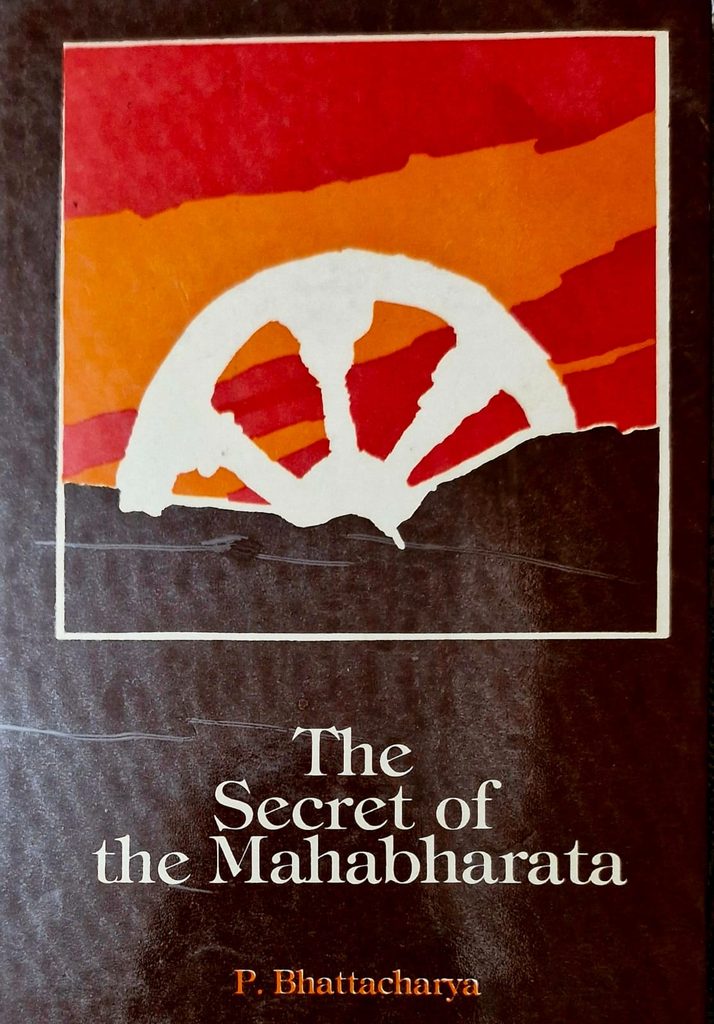
[7] P. Bhattacharya, The Secret of the Mahabharata, Parimal Prakashan, Khadkeshwar, Aurangabad, 1984.
[8] “The Forest of Ascesis”, in Human Values: The Tagorean Panorama by S.K. Chakraborty & P. Bhattacharya, New Age International, New Delhi, 1996.
[9] Its first English translation by Shekhar K. Sen, ed. P. Bhattacharya, was published by Writers Workshop, Kolkata, in 2009. Further, some parts of the Jaimini Bhārata exist in Grantha script in the Government Oriental Manuscripts Library, Chennai, relating to his version of the Ramayana, containing material not found in the Vaiśampāyana edition.
[10] Kevin McGrath, Jaya: performance in epic Mahabharata, Harvard, 2011.
[11] Saoli Mitra, Five Lords yet none a Protector and Timeless Tales, Stree, Kolkata, 2004.
[12] This is the only reference in the epic to the attempted stripping other than in the Sabhā Parva, which raises the suspicion that the lament is an interpolation cf. P. Bhattacharya, Annals of the BORI vol.LXXXVI, 2005, pp.149-152 and in K.K. Chakravarty, ed. Text and Variation in the Mahabharata, Munshiram Manoharlal, Delhi, 2009, pp. 89-99.
[13] Thomas Hardy, The Dynasts, 1903, “Fore Scene”.
[14] P. Lal, The Complete Ādi Parva, Writers Workshop, Calcutta, 2005, p.6. Most extracts are from this translation which follows the Vulgate and not the shorter Bhandarkar Critical Edition.

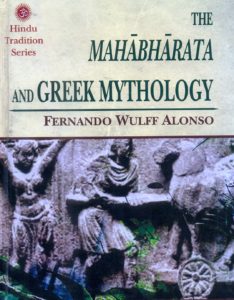
by an East India Company officer arguing that the Ramayana story was strongly influenced by the Iliad. Other than Megasthenes’ references to Indians carrying banners of Heracles and worshipping Dionysus, the Greek scholar Dios Chrysostom (40-120 AD) mentions translations of the Iliad in India. The Roman Claudius Aelianus (175-235 AD) reiterated this (e.g. the Trojan horse becoming Bhasa’s wooden elephant in Pratigya Yaugandharayana). In 1871 A.F.Weber, refuting M.H.Fauche’s proposition (supported by A.Lillie in 1912) that Homer had used the Ramayana as a guide, claimed that it was merely Buddhist legends grafted on to borrowings from Homer, an argument that W.T.Telang vigorously refuted. Weber cited Odysseus’ archery feat to win Penelope as having influenced the archery contests of Rama and Arjuna, ignoring that Rama breaks the bow and Arjuna does not shoot rivals dead. J.Lallemant argued in 1959 that the Mahabharata (MBH) influenced the Aeneid. In 1961 G.Duckworth argued that Turnus’ portrayal was based upon Duryodhana. In 1968 G.Dumezil put forward his theory of an Indo-European tri-functional ideology illustrated by the Pandavas (the dharma-king, the warrior, the grooms). Now, a Spanish professor in the University of Malaga has built up a strong case that the Homeric cycle and other Greek myths were adapted for the MBH.