• Skip to main content
  • Skip to footer

Pradip Bhattacharya

Indologist, Mahabharata scholar

  • BOOKS
    • MAHABHARATA
      • The Mahabharata of Vyasa – Moksha Dharma Parva
      • The Jaiminiya Mahabharata
      • The Jaiminiya Ashvamedhaparva
      • The Secret of the Mahabharata
      • Themes & Structure in the Mahabharata
      • The Mahabharata TV film Script: A Long Critique
      • YAJNASENI: The Story Of Draupadi
      • Pancha Kanya: the five virgins of India’s Epics
      • Revisiting the Panchakanyas
      • Narrative Art in the Mahabharata—the Adi Parva
      • Prachin Bharatey ebong Mahabharatey Netritva O Kshamatar Byabahar
    • LITERATURE
      • Ruskin’s Unto This Last: A Critical Edition
      • TS Eliot – The Sacred Wood, A Dissertation
      • Bankimchandra Chatterjee’s Krishna Charitra
      • Shivaji Sawant’s Mrityunjaya: A Long Critique
      • Subodh Ghosh’s Bharat Prem Katha
      • Parashuram’s Puranic Tales for Cynical People
    • PUBLIC ADMINISTRATION & MANAGEMENT
      • Leadership & Power: Ethical Explorations
      • Human Values: The Tagorean Panorama
      • Edited Administrative Training Institute Monographs 1-20. Kolkata. 2005-9
      • Edited Samsad Series on Public Administration. Kolkata, 2007-8
    • COMICS
      • KARTTIKEYA
      • The Monkey Prince
    • HOMEOPATHY
      • A New Approach to Homoeopathic Treatment
  • BOOK REVIEWS
    • Reviews in The Statesman
      • Review : Rajesh M. Iyer: Evading the Shadows
      • Review : Bibek DebRoy: The Mahabharata, volume 7
      • Review :The Harivansha – The Significance of a Neglected Text
      • Review : Battle, Bards and Brahmins ed. John Brockington
      • Review : Heroic Krishna. Friendship in epic Mahabharata
      • Review : I Was Born for Valour, I Was Born to Achieve Glory
      • Review : The Complete Virata and Udyoga Parvas of the Mahabharata
      • Review : Revolutionizing Ancient History: The Case of Israel and Christianity
    • Reviews in BIBLIO
    • Reviews in INDIAN REVIEW OF BOOKS And THE BOOK REVIEW New Delhi
    • Reviews in INDIAN BOOK CHRONICLE (MONTHLY JOURNAL ABOUT BOOKS AND COMMUNICATION ARTS)
  • JOURNALS
    • MANUSHI
    • MOTHER INDIA
    • JOURNAL OF HUMAN VALUES
    • WEST BENGAL
    • BHANDAAR
    • THE ADMINSTRATOR
    • INDIAN RAILWAYS MAGAZINE
    • WORLD HEALTH FORUM, WORLD HEALTH ORGANIZATION, GENEVA
    • INDIA INTERNATIONAL CENTRE QUARTERLY
    • ACTUALITIES EN ANALYSE TRANSACTIONNELLE
    • THE HERITAGE
    • TASI DARSHAN
  • STORIES, ESSAYS & POSTS
    • Chakravyuha by Manoranjan Bhattacharya
    • The Head Clerk. A short story.
    • BANGLADESH NEW-BORN: A MEMOIR
  • GALLERY
  • PROFILE
    • About the Author
    • IN THE NEWS
      • Epic discovery: City scholars find lost Mahabharata in Chennai library – The Times of India (Kolkata)

admin

THE EPIC AND THE NATION

October 15, 2023 By admin

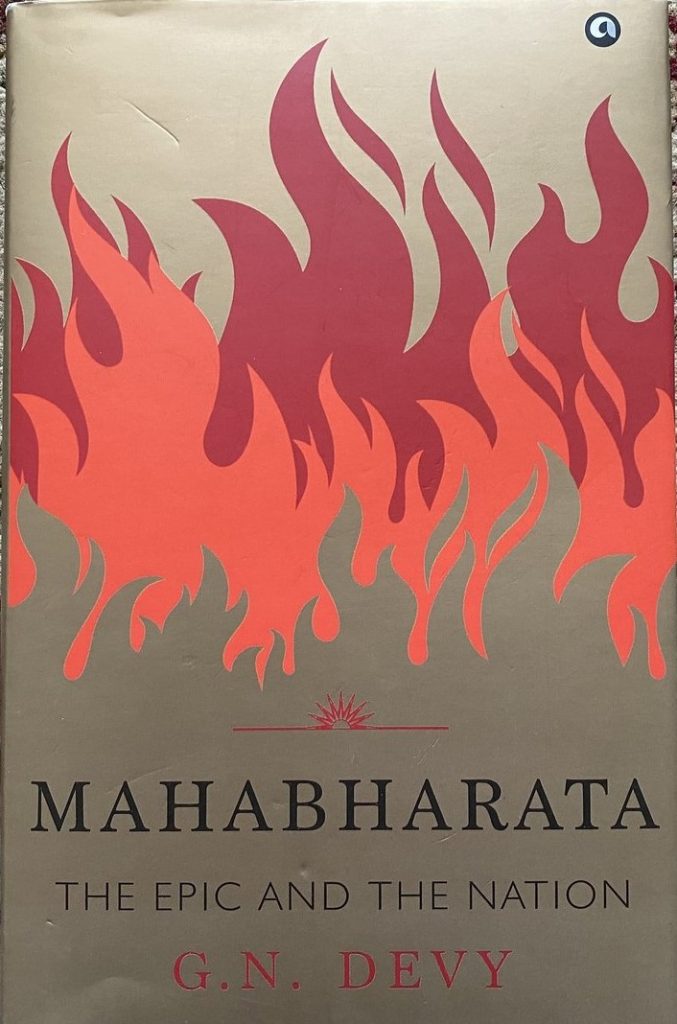
G.N. Devy: Mahabharata: The Epic And The Nation. Aleph, New Delhi, 2022, pp.142, Rs.499.

It is a testimony to the firm foundations upon which the Mahabharata (MB) rests in India that the traumatic Covid pandemic, which generated so many new phenomena, led Professor G.N. Devy to ruminate on the significance of Vyasa’s mahakavya for the country. His proposition: while the myths we live by lie in the Ramayana and the MB, the West draws upon religious texts, not epics. He asks, why has the caste-split land yet to become anation, “a substantially homogeneous people, despite its exposure to the epic for thousands of years?”

Devy covers an extensive expanse from genetics (David Reich’s Who We are and How We Got Here) to linguistics (David Anthony’s The Horse, The Wheel, and Language, Maheswar Neog’s Essays on Assamese Literatures) to literary theory. For him, Indo-Iranians entered the subcontinent with the horse-and-chariot and mingled with Out-of-Africa southerners to produce the MB culture, shifting from pastoral to agrarian, urban and feudal society. MB combined the mythic and historical pasts as a history marked by “assimilation, synthesis, combination, acceptance and moving forward without exclusions (p.72).” Its great success lies in “making alive two powerful symbols, the wheel and the horse…for future generations.” (p.93). “Its mesmerising appeal is its ability to use history to enliven myth…a veritable mine of ideals of courage, moral truth and liberation.”

Devy’s dissertation rises to several peaks. He is one of the few who realise that the MB was a watershed in socio-political thought. Wandering rhapsodes (sutas) brought to the general public, including the depressed classes and women, scriptural ideas, mystic insights and philosophical ruminations that had been the privilege of priesthood and royalty so that “It became the non-Brahmin’s book of religion (p.106).” To Devy the MB embodies our civilization’s “great negative capability” (p.109), comfortable with multiple beginnings, no definite end, many diverse strands of life and thought, no rigidity of caste structure. We meet bloody Brahmins (Parashurama, Drona, Kripa, Ashvatthama); Kshatriya Vishvamitra becomes a Brahmin, creates new celestial bodies, has Vasishtha’s son killed by turning a raja into a rakshasa, even steals a dog’s haunch from an untouchable for food. None of the protagonists are true-blooded Kshatriyas. After Parashurama’s massacres of Kshatriyas, the class was regenerated by Kshatriya women approaching Brahmins. The Lunar Dynasty itself progresses through Raja Yayati’s sons by Brahmin Devayani and Asura Sharmishtha. Vyasa, born of sage Parashara forcing himself on a fisher-girl, engenders Dhritarashtra and Pandu. The Pandavas’ fathers are unknown, as Duryodhana scoffs publicly. Therefore, Arjuna’s quandary over engaging in a war leading to miscegenation is entirely questionable and ought not to need elaborate philosophical discourse to be dispelled. Devy feels this concern was inserted later because the story brings together tribes, cultivators, herdsmen, “descendants of the society that had created Sindhu culture…a new language, better methods of warfare, and a different pastoral culture.” He refers to the Andhra “Vyasa community that has preserved its genetic identity through strict endogamy over the last 3000 years” as an example of the obsession with avoiding caste-intermixing. His claim about the Gita being “seamlessly woven into the epic-text” is questionable because at its end the Bhishma Parva continues seamlessly from where the text was interrupted by the Gita.

The MB did not avoid contemporary philosophical debates as Devy claims (p.78). Gleaning is explicitly extolled over Vedic yajna, a righteous meat-seller and a housewife over an ascetic Brahmin. Character, not birth, makes a Brahmin. Preservation of life and social order is preferred to blind adherence to truth. The eight-fold path of moderation is voiced and there are references to Jains and Charvakas too. Yudhishthira’s grand horse-sacrifice is shamed by a mongoose who glorifies a gleaner’s gift instead. To cap it all, in a supreme tour-de-force, Yudhishthira himself reviles the gods as well as Dharma itself in the final book.

A peak insight of Devy’s is that Kunti is an unparalleled heroine in the literary world. Kunti, her abandoned son Karna and her nephew Krishna occupy the heart of the story. She ushers Vedic gods into the Mbh (p.60). However, Devy overlooks how it is Kunti’s Yadava blood that rules after the Kurukshetra War, not the Kuru dynasty. Parikshit, grandson of Arjuna and his maternal Yadava cousin Subhadra, rules in the Kuru capital Hastinapura, not the elder Yudhishthira’s son Yaudheya or Bhima’s Sarvaga. Vajra, Krishna’s great-grandson, rules in Indraprastha of the Pandavas. Satyaki’s grandson Yugandhara rules near the Sarasvati and Kritavarma’s son in Martikavat, both Yadavas. So, was Krishna’s game-plan to replace Kuru by Yadava hegemony?

Devy points out that Arjuna alone, Rama-like, strings the Kindhura bow Shiva gave Drupada (vide the Southern recension). As Brihannada he parallels Shiva’s Ardhanarishvara (male-female) form as well as his dancer role. Not only does he become a eunuch, but he also hides behind trans-gender Shikhandi to kill Bhishma. Arjuna sees the trident-wielder preceding his arrows and felling the targets in Kurukshetra. Actually, Shiva’s presence is heralded early when Indra insults Shiva and Parvati playing dice and is condemned to take human birth along with four previous Indras.

Devy provides an important insight: the two towering figures on either side, Bhishma and Krishna, both 8th sons, do not fight for themselves but for the Dhartarashtras and the Pandavas respectively. Further, blessings, curses and supernatural interventions are used as devices (deus ex machina) to move the plot along. Even demons intervene to dissuade Duryodhana from committing suicide. Vyasa himself intervenes often in person to change the course of events.

Devy does sink into some troughs though. Ganesha snapping off a tusk to transcribe Vyasa’s dictation is not in the MB (p.10), nor is Gandhari making Duryodhana’s body invulnerable (p.68). What the MB does have is Shiva making Duryodhana’s torso adamantine and Parvati making his lower part lovely and delicate as flowers. Satyavati’s son by Shantanu was Chitrangad, not Chitravirya. Kunti is not chosen to wed Pandu but chooses him (p.59) and is not born because of any blessing (p.71). Jayadratha did not expose himself to Draupadi in the dice-game-hall (fn p.70); that was Duryodhana. Bhrigus are not Kshatriyas but Brahmins (p.61). Nowhere does the MB state that Varuna as Vayu became Bhima (p.60). How is Saranyu equated with Cerberus the three-headed dog guarding hell (p.35)? Saranyu is not the dark, as Devy writes in one place, but the dawn as he correctly states elsewhere. It is not that no attempts have been made to collect regional translations for comparison (p.21). In 1967 M.V. Subramanian ICS documented variations from Vyasa in the South Indian languages plus Bhasa, Bhatta Narayana, Magha and Bharavi. The IGNCAshould now cover all regional languages. The 11 pages long genealogy at the end fails to engender a sense of “a seamless combination of myth and history” as claimed.

Devy overlooks the remarkable motif of the Yadavas, descendants of the disinherited eldest son Yadu, ultimately regaining dominion. Nahusha’s eldest son Yati turns sanyasi, so the younger Yayati inherits Khandavaprastha. He disinherits four elder sons (Yadu etc.) in favour of the youngest Puru. In Hastinapura, Pratipa’s eldest son Devapi is disinherited because of a skin ailment.The younger Shantanu is enthroned. He bypasses his eldest son Bhishma for the younger stepbrothers. The elder Dhritarashtra being blind loses the throne to his step-brother Pandu. Yudhishthira, the eldest, is tricked into exile by his younger cousin Duryodhana who rules. Another key feature missed is the theme of parricide and fratricide is—a reason for the narrative’s continuing appeal through the ages.

Devy accepts Abhinavagupta’s assertion that the MB’s prevailing emotion is “shanta, empathetic detachment”. In World of Wonders (2022) Hiltebeitel argued convincingly that it is an epic of wonder, adbhuta being the rasa mentioned most frequently. Devy’s identification of Yama with Dharma is questionable. Kunti does not summon Yama for a son, as he claims (p.51), but Dharma as Pandu wants his first son to be beyond reproach. All of Yudhishthira’s interactions are with Dharma, not Yama. It is Dharma whom Animandavya curses to be born as a Shudra (Vidura). Yama as god of death first appears in section 199 of the Adi Parva as the butcher-priest in a yajna of the gods, because of which humans do not die. Only in section 9 is Dharma called the god of death who resurrects Ruru’s snake-bitten wife Pramadvara, raising the speculation that he got identified with Yama.

Devy misses the backdrop of the divine plan (as in the Trojan War) to rescue earth from proliferating demonic rulers. Gods take human birth to engineer a massively destructive war whereafter they merge into their original selves. There is no cycle of rebirth here, which distinguishes the MB from religious texts.The MB articulates the concept of four “yugas” (like the Hellenistic four ages) of which Vyasa calls Kali the best when bhakti fetches swift salvation, without the intensive ascesis and elaborate sacrificial rituals of earlier eras. Devy proposes that the MB war keeps the kala-chakra, wheel of time, in perpetual motion. It is not a war to preserve ritualistic dharma. Balarama’s strange aloofness from the fratricide at Kurukshetra and Prabhasa, despite being the avatar of Shesha and a white hair of Vishnu’s, goes unnoticed.

With the expanse and depth of Devy’s reading, not mentioning Sukthankar’s profound insights in On the Meaning of the Mahabharata is strange. Further, as Devy pinpoints Yudhishthira and Yama as the composition’s main focus, the omission of Buddhadeb Bose’s masterly portrayal of Yudhishthira as the true hero in The Book of Yudhishthira is puzzling.

Devy concludes that the MB “unites us as a nation through a similarly perceived past, not through a similarly perceived collective self…not in any imagined territorial national space…(but) in Time…the never-stopping kala chakra…a great spirit of acceptance of all that is.” Vishnu’s couch, the infinite coils of Shesha, and Krishna’s discus, both symbolise Cosmic Time and its endless revolutions.

The appeal of the MB, however, is not limited to India. Even when shells and bombs were exploding in the streets during the siege of Leningrad in 1941, Vladimir Kalyanov was translating the MB into Russian in the Academy of Sciences on the Neva River embankment by the dim light of wick lamps, with no light, no fuel and no bread in the city. Nehru admired that nothing interrupted the work even during the hardest of times.

[This was published in a slightly altered form in The Book Review issue of October 2023, pages 21 to 23

Filed Under: BOOK REVIEWS, IN THE NEWS, MAHABHARATA Tagged With: Book Reviews, Mahabharata

The Anushasana Parva: The Book of Instructions

October 7, 2023 By admin

This is Book 13 of the Mahabharata, and the most complete English translation, in verse and in prose carefully following the original, published on 5th October 2023 by Dr. Ananda Lal from www.writersworkshopindia.com

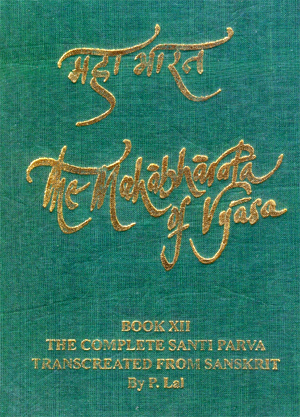
The project that Prof. P. Lal began in 1968 and was unable to complete (he could publish only 16 of the 18 books before passing away) is now complete. My translation of the complete Mokshadharma Parva came out in 2016.

My guru-dakshina to my Acharya is complete.

https://www.facebook.com/553071972/videos/837756184467669/

Filed Under: BOOKS, IN THE NEWS, MAHABHARATA Tagged With: Anushasana, Mahabharata

APPROACHING THE ADI-KAVI

September 10, 2023 By admin

APPROACHING ADI-KAVI VALMIKI[i]

Pradip Bhattacharya

The Department of Comparative Literature of Jadavpur University founded by the litterateur Buddhadeb Bose in 1956 was the first such in India.  It has now embarked upon an ambitious project: a series of research publications in four categories, viz. Texts, Contexts, Methods; Indian and Asian Contexts; Literature and Other Knowledge Systems; and Lecture Series. The overpriced slim volume under review belongs to the last category. From the editors’ Introduction it seems that Goldman did not deliver this lecture but sent it as a written contribution. This is a pity, because documented interaction with an audience would have made it a far more significant publication. This extremely well-written “lecture” is not much more than an introduction for beginners, albeit a very competent one, to Valmiki’s work and hardly falls under the rubric of “research”.

The Ramayana (R) presents specific hurdles before the modern reader: it depicts a civilization of circa the first millennium BCE far removed from us; its language is ancient Sanskrit, which is not easily accessible. Further, Sanskrit did not have a principal script universally used. The R has spawned widely varying versions in almost all languages and different scripts of South and Southeast Asia “from Afghanistan to Bali” and is depicted in varied media. Surprisingly, Goldman makes no reference to the Belgian priest Camille Bulcke’s encyclopaedic Hindi study of these variations.[ii]

Adopting the linguist Kenneth Pike’s terms emic (subjective) and etic (objective), Goldman identifies two types of group-approaches to the R. In the former, fall variations in Indian languages and media. The latter is consists of scholarly studies in various disciplines world-wide, including translations in non-Indian languages.

Goldman asserts that the presumption of a single divinely inspired composer disseminating his composition through twin rhapsodes who recited it in toto before the public is a myth. The text would have undergone changes on the lips of differing bards and redacteurs owing to lapses in memory and improvisations responding to the changing audience and place. We can witness this phenomenon today in the “Pandavani” folk retellings of the Mahabharata (M) in Central India. Those Ramayana rhapsodes were given the collective name, “Valmiki”. Thus, like many Western Mahabharata scholars who dismiss Vyasa as a myth, Goldman denies the existence of Valmiki.

Further, he denies the possibility of so bulky a work being transmitted orally from Afghanistan to Bali without being reduced to writing, as evinced by innumerable manuscripts in circulation through South and Southeast Asia from about the end of the first millennium CE. Errors and changes occurred while copying a manuscript into different scripts. Thus, between the Northern and the Southern Indian script recensions only about one third are identical. Moreover, within each recension there are regional variations depending on the script in which the copies have been made.

A very important clarification Goldman provides is that the Baroda critical edition of “India’s National Epic” does not represent the original, but seeks to present an archetype constructed out of the best manuscripts that would be nearest to the period of the oldest available manuscripts. The abundance of textual variants poses a major problem in trying to assess the poem’s original form. Goldman hazards a guess that the R was produced around 500-100 BCE, while its oldest manuscripts go back only to the 12th or 13th centuries CE. So we have over 1700 years of no written record of the R. Therefore, “the etic reconstruction of the Ramayana’s genetic history is naturally going to be at odds with its emic receptive history of the work.” While to scholars it is a bardic poem orally performed and transmitted, to its audience it is the work of a single composer, the first poet (adi–kavi), who was a contemporary of Rama in mythical times. An avatar of Vishnu, he descended on earth to destroy demonic oppressors of sages and establish a golden age lasting millennia. Thus, according to the emic view, “it is a chapter of divine history rendered in a new form, that of poetry.” Raising the stimulating question, is the R “a poetic history or a historical poem”, Goldman leaves it hanging in the air. It would have been very interesting to study the reactions of the audience, had this been a live lecture.

Looking into the nature of the R vis-à-vis the M, Goldman notes that the former is far more poetic and emotional than the latter. The predominant emotion of the R is “karuna rasa”, pathos, whereas for the M a new emotion was added by the critic Anandavardhana (c. 9th century CE), “shanta rasa”, worldly-detachment or serenity. Earlier, the poet Bhavabhuti (c. 8th century CE), had asserted that “karuna” is the only rasa. However, in his last work Alf Hiltebeitel has argued very persuasively that the M’s rasa is “adbhuta-wonder”. Where the R holds up a mirror for rulers and families, the M portrays the incredibly complex ramifications of dharma in society and the individual.

Besides ignoring the story of Rama recounted in the M, Goldman has not noticed another structural similarity between the two mahakavyas that young Ramayana aficionado Saikat Mandal has pointed out. The Tilaka commentary on R by Nagoji Bhatta or Ramavarma (1730-1810) glosses the Uttarakanda as the “khila” (supplement) of the R just as the Harivamsha is of the M. The significance of this needs exploration.

Goldman expatiates at length on how the R records the inception of Valmiki’s composition, which is “a later addition to the fully developed work” for establishing it as the divinely inspired first poem. Its list of seven of the eight “rasas” shows it to be later than Bharata’s treatise, Natyashastra. Goldman goes on to show how the R differs from the Homeric epics in characteristics such as rapidity, being plain and direct in syntax, language and thought. He finds Valmiki hyperbolic, using rhetorical figuration aplenty, highly formulaic and repetitive, unlike Homer’s directness. The literary quality of the R is complicated, being a poem to delight while also being a chronicle. Goldman could have noted how, in all these features, the R is similar to the M and also different, as discussed at length by Sri Aurobindo in “Vyasa and Valmiki”.

Further, the R has grammatical forms that violate Panini’s rules and could be seen as poetic flaws. Its first and seventh books are of a later date, in less refined language. Goldman quotes at length from Homer and Valmiki to exemplify his arguments and to show how adept the latter is in portraying beauty in persons and in nature, including the frightful. Pursuing Abhinavagupta’s view of rasadhvani, Goldman analyses how the raw emotion of grief is sublimated by Valmiki to make karuna rasa the major aesthetic flavour of poetic composition, transmuting shoka (grief) to shloka (verse). The climax is reached in ending with Sita’s descent into the depths of the earth, leaving Rama desolate.


[i] Robert P. Goldman: Reading with the Rsi—a cross-cultural and comparative literary approach to Valmiki’s Ramayana. Orient BlackSwan, Hyderabad, 2023, pp. xvii+54, Rs.385/-

[ii] English translation The Rama Story by Pradip Bhattacharya published in 2022 by the Sahitya Akademi.

Filed Under: BOOK REVIEWS, IN THE NEWS, Ramayana Tagged With: Goldman, Homer, Mahabharata, Ramayana, rasa, Valmiki, Vyasa

An Epic of Wonder, not of War and Peace

March 30, 2023 By admin

Alf Hiltebeitel: World of Wonders: The work of Adhbutarasa in the Mahabharata and the Harivamsa. Oxford University Press, 2022, pp. 343.

When Akbar commissioned a Persian rendering of the Mahabharata (MB), he named it Razmnama, the Book of War. Centuries earlier, however, the Kashmiri aestheticians had argued that the dominant flavour (“rasa”) of MB is shanti, peace, with its stable emotion (“sthayi bhava”) of “vairagya”, detachment. Alf Hiltebeitel, the most prolific scholar on MB, who passed away in January 2023, presents a challenging thesis in his most recent foray, namely that neither the heroic (“vira”), as generally presumed, nor peace (shanti), but rather wonder (“adhbhutam, ashcarya”) is the primary flavour along with its stable emotion of surprise (“vismaya”). He is building on a realisation recorded in the last chapter of his earlier book, Freud’s Mahabharata, about the replenishing of Draupadi’s garment (referring to it anachronistically as “sari” repeatedly) being termed the greatest wonder in the world, “adhbhutatamam loke”. His search of the electronic text for the cluster “adbhutam-ashcharya-vismaya,” in MB and the Harivamsha (HV) confirmed the preponderance of the wondrous and showed that HV is part of the epic, not a mere appendix. He finds roughly 592 occurrences of “adbhutam-ashcharya” and 339 of “vismaya-vismita” distributed fairly evenly across both HV and MB. It is this dominant “rasa” that makes for the unity of the epic.

Hiltebeitel points out that the last three books of MB, with a total of eighteen chapters (like the Gita’s and the 18 books ot the epic), expose us to a series of rude shocks, presenting “unexpected outcomes”. The deaths of Krishna and Balarama, the submergence of Dvaraka, the looting of Arjuna’s caravan that destroys his heroism, Yudhishthira’s condemnation of dharma and the gods after his vision of hell and Janamejaya’s last question are analysed in detail. After Vaishampayana has explained that every hero (the women are not mentioned) merged into his original identity, Janamejaya was highly astonished (“vismito ‘bhavad atyartham”). The dominant flavour “wonder” and its stable emotion “surprise” are repeatedly evoked. The epic ends with the “Bharata Savitri” of the concluding statement by Vyasa “of wondrous deeds” to his son Shuka.

Varying perceptions about MB existed contemporaneously with the Kashmiri aestheticians of the 9th and 10 centuries CE. The first regional retelling of MB saw it as a heroic narrative, which is why Peruntevanar made Krishna his hero in the Tamil Paratavenpa (9th century CE) and Pampa had Arjuna crowned king at the end after Yudhishthira’s abdication in the Kannada Vikramarjunavijaya (10th century CE). Hiltebeitel finds that the “adbhutam” clusters are fairly evenly distributed in both MB and HV, missing only from Book 17 (the Great Departure). He concludes that the element of surprise is as evident as the didactic and other elements like Krishna and the divine plan, Vyasa’s role, the snake sacrifice, the ending of Janamejaya’s tale, Sauti and Shaunaka.

The two lists of contents identify sections as “wondrous”, not referring to any other “rasa”. Vyasa’s miraculous summoning of the dead in Book 15 is described as exceptionally and uniquely wondrous, while Books 5, 8 and 4 are called particularly “adbhutam”. Before Hiltebeitel, no had one noted these. Analysing the occurrences in each book he finds that Book 3 (Forest Exile), is the most wonder-laden book. Among the four war books, the largest wonder-cluster occurs in the Book of Drona while the Book of Karna is the only one of them to be described in the list of contents as “full of meanings and wonders” and to devote an adbhutam-cluster to Karna. In the Bhishma Parvan they are applied to Arjuna; in the Mokshadharmaparvan they occur in the Shuka story and the Narayaniya, and in the Anushasana Parvan in the Uma-Maheshvara dialogue.

In most of the wonder passages the focus is mostly on the three Krishnas: Krishna (Books 5-9), Vyasa (Book 1, alternating with Krishna in Books 10-13 and dominating in 14-15, 17-18), Krishna (Book 16) and Draupadi (end of Book 1 to Book 4). The others focussed upon are Arjuna, Karna, Bhima and Shiva. It is the three dark Krishnas who represent, writes James Fitzgerald, “wondrous realities of the world.”

Most episodes in Book 14 (the horse-sacrifice) have the wondrous quality. Vyasa’s pupil Jaimini’s version of the book is chock-full of magic and marvels, which is possibly why Akbar chose this to be translated into Persian for his Razmnama instead of Vyasa’s original composition and why regional Mahabharatas often do the same. This book culminates in the utterly surprising debunking of the horse-sacrifice by the episode of the mongoose. This Ashvamedha Parva is surpassed by the “very great wonder” of Book 15, as the list of contents describes the Forest Ashram. Here Vyasa not only conjures up all the dead heroes, but also gets all the widows to commit suicide in the river to meet their husbands, ridding the new monarchy of the sound of endless lamentation Much earlier he had made his mother and two sisters-in-law leave the world too. Nowhere in any epic world does the epic’s composer kill off so many of his characters himself.

Hiltebeitel commits a major mistake in glossing Satyabhama as Kamsa’s sister (p. 259). On p. 289 the printer’s gremlin is very much in evidence (“Virad”, “Vior”, “vita”, “Vi”, “amring the en”, “Vieap’s” etc.), p. 292 (“amatamanthana”) and footnotes 161 (“collerium”) and 162 (“Markakrsnadeya”). Footnote 191 refers to “Haberman” who is missing from the references.

At the very beginning of HV Shaunaka praises the MB for its extremely wondrous deeds and amazing discourses. HV is replete with amazing revelations of Krishna’s divinity to Akrura et.al. that tie-up with Narada’s visions in MB’s Narayaniya. Hiltebeitel notes that the 36 clusters of surprise and wonder in HV “speak the same language as the MB”, not that of bhakti rasa. Both works stress “devotion to the vigorous heroic deity in the same world of wonders and not on his being at the centre of the devotions of his parents, sons, friends, lovers, or admiring sages.” It is by looking at MB and HV as works of literature and not primarily as theological and ethical texts that their wonders and surprises work, hinting at “a below-the-surface sense of sacrificial beauty.”

Hiltebeitel explores this aspect through the conflagration set off by Krishna’s Vaishnava energy during his ascesis and by that of Shiva when Uma covers his eyes, that consume life on the Himalayas. The same Vaishnava tejas decapitates Shishupala, whose energy merges into Krishna. The production of amrita by churning the ocean that destroys all life on Mount Mandara, mingling their “rasas” and by the Nara-Narayana duo killing asuras is analogous to this. In HV the acme is Krishna uplifting Mount Govardhana and simultaneously becoming the mountain as Indra drenches it, just as he did Mount Mandara. The Govardhana incident would have been a far more appropriate cover than the Kalighat painting depicting Krishna with Yashoda milking a cow. Hiltebeitel shows how HV is original in “thematizing an aesthetic of sacrifice” in which the Earth becomes “sacrificially beautiful…it is through her that all forms of life and death flow meaningfully together.” The Harivamsha Parva closes emphasizing that Krishna is the sole wonder and that all wonders emerge from Vishnu, the most blessed. HV is as much an adbhutarasa text as MB and is part and parcel of the epic.

Filed Under: BOOK REVIEWS, IN THE NEWS, MAHABHARATA Tagged With: Hiltebeitel, Mahabharata

DRAUPADI THE GODDESS VIRA-SHAKTI

March 16, 2023 By admin

Alf Hiltebeitel: The Cult of Draupadi: Mythologies from Gingee to Kurukshetra Vol.1 (Motilal Banarasidass, Delhi, pp.487, Rs.200/-)

The 1980s witnessed a remarkable resurgence of Indian mythology in literary, theatrical and academic spheres. If in literature we saw the gripping Hindi dodecalogy of Ram Kumar Bhramar on the Mahabharata while novels on the epic came in Bengali from Kalkut and Dipak Chandra, in Oriya from Pratibha Ray, in Kannada from S.L. Bhyrappa, and in English from Maggi Lidchi Grassi and Elaine Aron, on the stage the agony of Draupadi, five-husbanded-yet-husbandless, was unforgettably brought home in Shaoli Mitra’s one-woman performance, Nathavati anathavat. In academia, Dr. Alf Hiltebeitel produced the first volume of his profound study of the cult of Draupadi in 1988 which is now finally available in an Indian edition from Motilal Banarsidass.

Tracing the South Indian cult of Draupadi to Gingee (it also exists in Sri Lanka, Fiji and Singapore), Hiltebeitel launches an elaborate investigation into how it incorporates dimensions of a multiplicity of cults relating to village goddesses, heroes, lineage/caste/boundary deities, possession and even those of the supreme triad of the Hindu pantheon: Brahma, Vishnu, Shiva. The Draupadi cult is a fascinating combination of the folk and the classical traditions, which the scholar investigates chiefly through the Terukkuttu dramas (street plays) reaching out to the classical and vernacular epic traditions as well as analogous cults for further insights. To provide a focus for this considerably involved phenomenon Hiltebeitel inspiredly seizes upon an 18 verse invocatory song sung at the beginning and the end of Draupadi festivals. It is the ramifications of these 18 verses that are brought out painstakingly in the study, of which this is only the first volume.  

Hiltebeitel finds that Draupadi is actually a multi-form of Durga and Kali as Vira Shakti/Vira Panchali with her virginity repeatedly stressed. In this aspect, her power is destructive and dangerous even to her husbands. Her children are born out of drops of blood pierced out of Bhima’s hand with her nails as she returns after nocturnal foraging. Like her sister-goddess Ankalamman, whose cult shares the same region, Draupadi roams Kali-like in forests and crematoria. The Telegu tradition has Krishna explain to Bhima that Draupadi is the primal Shakti whom he had promised to satiate with human flesh and that is why he has arranged the Kurukshetra War, during which she roams the battlefield at night consuming corpses. Sensing that Krishna has lent part of his energy to Bhima to solve his problem of satisfying her sexually, Draupadi demands that Krishna now marry her, which he promises to do in future as Jagannatha of Puri. To Hiltebeitel it remains a mystery how this promise is kept.

However, the answer is available in Charolette Vaudeville’s 1982 paper on ‘Krishna and the Great Goddess’ in The Divine Consort  which notes that Ekanamsa/Subhadra/Durga is found in the consort’s position, that is the left side, of Jagannatha when the icon of Baladeva is absent, and that the original temple in Puri was occupied by Maha-bhairavi Adishakti under the name Vimala-devi. Draupadi’s Shakti aspect is conclusively established at the end of the Terukkuttu cycle in the stance Draupadi takes atop Duryodhana’s thigh or chest, like Durga atop Mahishasura, pulling out his intestines while Krishna braids her hair. The 18-day war covered by the Terukkuttu cycle marks the end of a festival that can, therefore, be said to recapitulate the Navaratri or Vijayadashami festival of Durga. 

In Draupadi’s victory a critical role is played by the folk-figure of Pottu Raja/Pormannan, the Buffalo-demon/king turned devotee, who brings her the five instruments required for her victory. A unique feature of the cult is the icon of the Muslim devotee Muttal Ravuttan who is analogous to the Marathi Khandoba. Draupadi defeats Muttal is after he has imprisoned the Pandavas and becomes the guardian of the north. Another fascinating instance of local myth-making is the second birth of Draupadi invoked by King Cunitan (Sunitha), a descendant of the Pandavas, to save the kingdom from the hundred-headed demon Rochakan/Acalamman. As the demon has the boon that whoever cuts off his hundredth head will die if it touches the ground, Pottu Raja agrees to hold it forever. At the spot where Draupadi disappeared after killing the demon, the Gingee temple was built with a figure of Pottu Raja before it holding the demon’s head. Hiltebeitel perceptively notes how the cult splits into two the functions of Bhairava: the role of the dog who keeps the blood of Brahma’s head from touching the ground and the position of kshetrapala go to Muttal Ravuttan; the all-destroying Brahmic head stuck to his hand goes to Pottu Raja, keeping in hold the destructive power and reminding us of the severed head of the buffalo-demon Mahisha.  

The Terukkuttu cycle also reveals a different facet of Krishna. His overwhelming concern is that the Pandavas fulfil their war vows without being upstaged by their sons who are seen as rakshasic. Hence, he brings about the deaths of Aravan (Iravan), Ghatotkacha, Abhimanyu ‘ each of whom would have destroyed the Kaurava army in a day ‘ and of Draupadi’s five sons.

There are a couple of issues that remain unresolved in Hiltebeitel’s thesis. On page 323, he speaks of the coalescence of serpent and elephant in Aravan’s ancestry by making out that Ulupi belongs to the line of Airavata ‘the elephant mount of Indra.’ This is incorrect. This Airavata is the name of a serpent and is not identical with Indra’s mount, as the Adi Parva of the epic makes abundantly clear while listing the major serpents. On page 397, he expatiates on the theme of flawed caste-character of the five Kaurava generals, which certainly cannot apply to Bhishma and Shalya. He does not provide any evidence for the alleged rakshasic nature of Draupadi’s sons. Again, on page 288 he states that only Villi has the nelli (myrobalan) episode in which Draupadi’s desire for a sixth husband is exposed. However, this occurs also in the Bengali Mahabharata composed by Kashiram Das where, using a mango, Krishna gets Draupadi to confess her desire for Karna as her sixth husband. While elaborating the South Indian myths about Krishna’s role in Karna’s death he does not take into account the rich myths regarding the last moments of Karna prevalent in the vernacular traditions in western and eastern India which enhance his nobility to sublime heights as in the Bengali play Nara Narayana by Kshirodeprasad Bidyabinode and in Shivaji Sawant’s epic Marathi novel Mrityunjay. 

These, however, hardly detract from the major contribution made by Dr. Hiltebeitel to the understanding of our own mythic traditions ‘about which our own intelligentsia are criminally insouciant’, as kept alive even in the twenty first century through the folk theatre, which is swiftly dying out in the absence of financial support. Enriched with 34 invaluable plates recording key events in Terukkuttu performances and a number of maps laying out the cult territory, this thesis ought to awaken the South Zone Cultural Centre to the need of reviving our dying tradition by providing the necessary support. Otherwise Draupadi the goddess might again have to bewail her fate as nathavati anathavat, ‘many-husbanded yet husbandless’!

Filed Under: BOOK REVIEWS, IN THE NEWS Tagged With: Draupadi, Hiltebeitel, Mahabharata

Book Review of Fr. Camille Bulcke’s THE RAMA STORY: ORIGINS AND GROWTH (2022)

March 5, 2023 By admin

Trans. (from Hindi) by Pradip Bhattacharya. Delhi: Sahitya Akademi. Hardbound.

ISBN: 9789355481108

Oshin Vipra Sagar, Avinash Kumar

Kalākalpa, Vol. VII, No. 2(2023)

With some variation, the story of Rama is told not just across different parts of the Indian subcontinent but also in Southeast Asia with just as much fervour. Not to forget, Ram and his supposed birthplace have become a part of the politico-religious fabric of India over the last few decades. Therefore, a historical inquiry into the story of Rama is a pertinent endeavour now more than ever. However, no systematic historiographical work on Rama’s tales was available for general readers and academics alike until a Belgian Jesuit priest Father Camille Bulcke accomplished the task of comprehensively tracing the origin and development of the narratives around Rama in his magnum opus “Ramkatha: Utpatti Aur Vikas” published in 1950. The work, however, remained accessible only to readers and researchers proficient in Hindi. The translation by Pradip Bhattacharya bridges that gap for the anglophone public through his work ‘The Rama Story: Origins and Growth’, published by Sahitya Akademi in August 2022.

Pradip Bhattacharya’s ambitious translation has surveyed the major available editions of Father Bulcke’s original work. He has taken into cognisance the printer’s gremlins (in the 16th ed.) and tried his best to critically examine the errors and omissions before producing his translation based primarily on the third edition of Bulcke’s work published in 1971 by Hindi Parishad Prakashan, Allahabad University. Bhattacharya also acknowledges the original writer’s lack of awareness of his predecessors’ work relating to Ramayana at large such as those by Akshoy Kumar Maitreya, who, for example, has dealt with the subjects Bulcke deals with (say, Ramayana’s relationship with Greek and Buddhist stories) or Rajasekhara P.Basu’s ‘Surpanakha Reminiscences’ and ‘the Rule of Rama’ or Kumudini’s ‘Sita’s Letters.’

Father Bulcke’s omissions of the verse number and translation of Sanskrit verses too, have been supplemented in the translated work by Bhattacharya, making it fairly corroborated and accessible. Nonetheless, the translator has ensured that they stay true to the original and preserve its appearance while addressing the need to rectify some inconsistencies in referencing style.

‘The Rama Story: Origins and Growth’ wholeheartedly follows the structure of Bulcke’s “Ramkatha: Utpatti Aur Vikas”, wherein the work is divided into four main parts, each corresponding to the four major stages of the evolution and expansion of the Rama story. The first part (consisting of chapters 1 to 5) concerns itself with the extant ancient literature such as the Vedic, Buddhist and Jain corpus – scrutinising the references to the Rama story they present. The first chapter reviews the Vedic literature for the presence of characters like Iksvaku, Dasaratha, Janaka, and Sita as the presiding deity of agriculture while also presenting an apparent absence of Rama in the corpus. The second chapter examines the three recensions of Valmiki’s Ramayana and attempts to gauge the time of its composition historically. It also disambiguates the identity of the author of Ramayana, the poet Valmiki and sheds light on the various Valmikis. The third chapter brings some fascinating insights to the table regarding the timeline of Valmiki’s Ramayana with reference to the other epic of the subcontinent, i.e., the Mahabharata (hence, Mb). Verses from the primary text of Mb have been used to illustrate how the composers of Mb were aware of Valmiki and his work – while maintaining a distinction between the stories of Bharata and the Mahabharata. At the same time, the readers are also provided with quantitative cues to the popularity of the Rama story: for example, how approximately fifty references to Rama or characters related to his story are found in Mb.

In part two of the work, chapter 6 critically examines the origins of the story of Rama: addressing the problematic nature of “Dasaratha Jataka” and the question of the authenticity of the Pali “Jatakakathavannana.” In the consecutive chapter, the discussion follows through on the matter by taking into consideration the views of scholars such as Dr. Weber, Jacobi and Dineshchandra Sen. Chapter 8 and 9 remarks on the main interpolations in Valmiki’s Ramayana and how the concept of the ‘avatar’ contributed to its wide dispersal.

The third part of the book provides an overview of the wide and deep penetration of the Rama story across medieval literature from the subcontinent across Sanskrit, modern Indian languages, and other Asian languages. In this part, chapter 10 elucidates on the development of Rama-bhakti and the Rama stories in Puranic literature (Harivamsa, the Mahapuranas and the minor Purana) as well as the sectarian Ramayanas and other religious literature from the period. The subsequent chapter 11 traces and maps the Rama story across an elaborate list of Sanskrit belle letters beginning with Raghuvamsa, Setubandha and covering about 17 major works, including epic poetry and plays, while further covering some minor works. Chapter 12 of the work is divided into two parts: the first discusses the Ramayana across Southern languages of Tamil, Telugu, Malayalam, and Kannada, including the tribal tales related to Rama from the region; the second discusses the Rama story in the literary works produced in northern Indian languages as well as Sinhalese. The two parts of this chapter correspond to Bulcke’s rough categorisation of linguistic groups as Dravidian and Aaryan, which could be better titled in the translation to be technically more accurate and not appear anachronistic. The last part, chapter 14, discusses the Rama story abroad in the Tibeto-Khotanese, Indonesian, Indo-Chinese (Vietnamese), Siamese and Burmese traditions while briefly touching upon the Western narratives.

The fourth and final part of the book expounds on the growth of the Rama story spread over seven Kandas (Bālakāṇḍa, Ayodhyakāṇḍa, Araṇyakāṇḍa, Kiṣkindakāṇḍa, Sundarākāṇḍa, Yuddhakāṇḍa, Uttarakāṇḍa) in chapters 14-20. It ends with concluding remarks in the 21st and the last chapter of the volume. This part of the book, from pg. 341 to pg. 892 amounts for the bulk of the volume that closely engages in dissecting the minutest details of themes and episodes of each Kanda and the variations of each, if any, across the three recensions of Valmiki’s Ramayana.

As for relevant original additions, Bhattacharya (supplementing Bulcke’s original list) brings to the readers an organised exhaustive bibliography comprising ancient texts as well as modern works across Indian and foreign languages in Appendix I. Appendix II sheds light on the story wherein Rama had to shoot an arrow at Hanuman on Viswamitra’s command, an intriguing episode relating to Rama that Bulcke skipped in his almost encyclopaedic work. In Appendix III, Bhattacharya elucidates on the large yet relatively less-known Ramayana frescoes in the Silver Pagoda at Phnom Penh, Cambodia, commissioned between 1903-04. The frescoes depict the Khmer story of Rama being abducted by Ravana’s nephew Waireab and his rescue by Hanuman. Finally, in Appendix IV, he reviews Paula Richman’s ‘Questioning Ramayana’ and Amreeta Syam’s ‘Kaikeyi.’

Overall, the book is worth all the attention at present and for times to come. Priced at INR 1500/- this 990-page book is a comprehensive wellspring of information on the narratives surrounding the character of Rama, which historically traces their antiquity while critically examining its growth through the ages.

Filed Under: BOOK REVIEWS, IN THE NEWS, Ramayana Tagged With: Bulcke, Ramayana

  • « Go to Previous Page
  • Go to page 1
  • Go to page 2
  • Go to page 3
  • Go to page 4
  • Go to page 5
  • Interim pages omitted …
  • Go to page 19
  • Go to Next Page »

Footer

Recent Posts

  • স্মৃতি ও গল্প
  • Review of “The Mahabharata of Vyasa: The Complete Anuśāsanaparvan”, translated from Sanskrit by Pradip Bhattacharya, Writers Workshop, Kolkata, 2023, pp. 1254, Rs. 3000/-
  • Navina Chandra Roy: Founder of the Brahmo Samaj of Lahore

Tags

Bangladesh Bankimchandra Bengali Bhishma boloji Book Reviews Bulcke Critical Edition Desire Dharma Draupadi Draupadi Dream Trust Drona Essays glb Grantha script Harivansha Hiltebeitel Homer Indraprastha Jaimini Jaiminiya Mahabharata. Journal Kalpataru Karna krishna Mahabharata McGrath memoir Mokshadharma Murshidabad News novel P. Lal Panchakanya popularity Ramayana refugee Satya Chaitanya shakuni Sri Aurobindo Statesman Vande Mataram video Yudhishthira

Follow Me

  • Facebook
  • Linked In
  • Twitter

CONTACT ME

Search

Archives

  • November 2025 (1)
  • October 2025 (1)
  • July 2025 (1)
  • June 2025 (1)
  • May 2025 (1)
  • September 2024 (3)
  • May 2024 (3)
  • February 2024 (1)
  • October 2023 (2)
  • September 2023 (1)
  • March 2023 (4)
  • February 2023 (1)
  • January 2023 (1)
  • September 2022 (1)
  • August 2022 (2)
  • July 2022 (1)
  • June 2022 (2)
  • February 2022 (1)
  • January 2022 (2)
  • November 2021 (1)
  • September 2021 (5)
  • January 2021 (2)
  • December 2020 (1)
  • September 2020 (1)
  • July 2020 (3)
  • June 2020 (1)
  • March 2020 (1)
  • January 2020 (2)
  • December 2019 (13)
  • October 2019 (1)
  • September 2019 (1)
  • August 2019 (2)
  • April 2019 (2)
  • March 2019 (4)
  • February 2019 (1)
  • January 2019 (2)
  • December 2018 (1)
  • November 2018 (4)
  • October 2018 (2)
  • September 2018 (2)
  • August 2018 (4)
  • July 2018 (4)
  • June 2018 (5)
  • April 2018 (3)
  • March 2018 (2)
  • February 2018 (1)
  • January 2018 (1)
  • November 2017 (2)
  • October 2017 (7)
  • August 2017 (1)
  • July 2017 (2)
  • June 2017 (11)
  • May 2017 (19)

Copyright © 2025 Dr. Pradip Bhattacharya