• Skip to main content
  • Skip to footer

Pradip Bhattacharya

Indologist, Mahabharata scholar

  • BOOKS
    • MAHABHARATA
      • The Mahabharata of Vyasa – Moksha Dharma Parva
      • The Jaiminiya Mahabharata
      • The Jaiminiya Ashvamedhaparva
      • The Secret of the Mahabharata
      • Themes & Structure in the Mahabharata
      • The Mahabharata TV film Script: A Long Critique
      • YAJNASENI: The Story Of Draupadi
      • Pancha Kanya: the five virgins of India’s Epics
      • Revisiting the Panchakanyas
      • Narrative Art in the Mahabharata—the Adi Parva
      • Prachin Bharatey ebong Mahabharatey Netritva O Kshamatar Byabahar
    • LITERATURE
      • Ruskin’s Unto This Last: A Critical Edition
      • TS Eliot – The Sacred Wood, A Dissertation
      • Bankimchandra Chatterjee’s Krishna Charitra
      • Shivaji Sawant’s Mrityunjaya: A Long Critique
      • Subodh Ghosh’s Bharat Prem Katha
      • Parashuram’s Puranic Tales for Cynical People
    • PUBLIC ADMINISTRATION & MANAGEMENT
      • Leadership & Power: Ethical Explorations
      • Human Values: The Tagorean Panorama
      • Edited Administrative Training Institute Monographs 1-20. Kolkata. 2005-9
      • Edited Samsad Series on Public Administration. Kolkata, 2007-8
    • COMICS
      • KARTTIKEYA
      • The Monkey Prince
    • HOMEOPATHY
      • A New Approach to Homoeopathic Treatment
  • BOOK REVIEWS
    • Reviews in The Statesman
      • Review : Rajesh M. Iyer: Evading the Shadows
      • Review : Bibek DebRoy: The Mahabharata, volume 7
      • Review :The Harivansha – The Significance of a Neglected Text
      • Review : Battle, Bards and Brahmins ed. John Brockington
      • Review : Heroic Krishna. Friendship in epic Mahabharata
      • Review : I Was Born for Valour, I Was Born to Achieve Glory
      • Review : The Complete Virata and Udyoga Parvas of the Mahabharata
      • Review : Revolutionizing Ancient History: The Case of Israel and Christianity
    • Reviews in BIBLIO
    • Reviews in INDIAN REVIEW OF BOOKS And THE BOOK REVIEW New Delhi
    • Reviews in INDIAN BOOK CHRONICLE (MONTHLY JOURNAL ABOUT BOOKS AND COMMUNICATION ARTS)
  • JOURNALS
    • MANUSHI
    • MOTHER INDIA
    • JOURNAL OF HUMAN VALUES
    • WEST BENGAL
    • BHANDAAR
    • THE ADMINSTRATOR
    • INDIAN RAILWAYS MAGAZINE
    • WORLD HEALTH FORUM, WORLD HEALTH ORGANIZATION, GENEVA
    • INDIA INTERNATIONAL CENTRE QUARTERLY
    • ACTUALITIES EN ANALYSE TRANSACTIONNELLE
    • THE HERITAGE
    • TASI DARSHAN
  • STORIES, ESSAYS & POSTS
    • Chakravyuha by Manoranjan Bhattacharya
    • The Head Clerk. A short story.
    • BANGLADESH NEW-BORN: A MEMOIR
  • GALLERY
  • PROFILE
    • About the Author
    • IN THE NEWS
      • Epic discovery: City scholars find lost Mahabharata in Chennai library – The Times of India (Kolkata)

admin

Kavi Sanjay’s Mahabharata

January 19, 2020 By admin

MAHABHARATA IN TRANSLATION
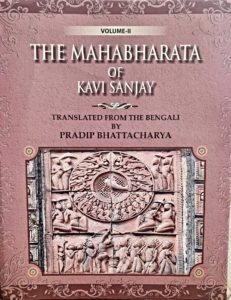
The Mahabharata of Kavi Sanjay
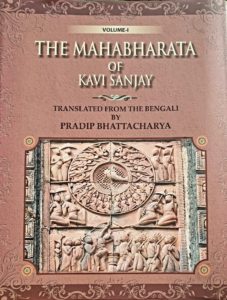
PRADIP BHATTACHARYA, trans. from Bengali, The Mahabharata of Kavi Sanjaya, Volumes I & II, Das Gupta & Co., Kolkata, 2019, pp. 637, Rs. 1495/-

While Kaliprasanna Sinha (1841-1870) is the most renowned and popular Bengali translator of Mahabharata in prose, Haridas Siddhantavagish is more known to researchers, and Kashiram Das’s 16th-century retelling, Kashidasi Mahabharata, is the most popular rendering in verse, few know that there had been Kavi Sanjaya in the 15th century, who can be considered the Adi Kavi of Bengal in the Mahabharata genre of translation and retelling. This is surprising given that the Kavi has his place secured in the cultural history of Bengal courtesy Munindra Kumar Ghosh’s edited ‘Kavi Sanjaya Birochito Mahabharata’ published by Calcutta University in 1969, restoring Sanjaya’s Mahabharata written in unique poyar metre (each line of the rhymed couplet consisting of eight syllables followed by a caesura and six syllables) in panchali form. Despite Ghosh’s historic effort, evidently, Sanjaya has not been much in Mahabharata discourse, either academic or popular, until now. After fifty years of his work, Dr. Pradip Bhattacharya resurrects him from slipping into the recesses of cultural memory once again, but to a wider world audience this time through his verse-by-verse English translation, perhaps re-confirming the ironic dictum that Bengalis do not wake up to their glories without the involvement of English.

Bhattacharya’s new venture—a project sanctioned by West Bengal Government’s Higher Education Department through the Netaji Institute of Asian Studies— comes in two hard-bound volumes, beautifully encased in dignified brown overtone, and printed on quality paper. Volume-I contains 7 parvans: Adi (Book 1) to Drona (Book 7), and Volume-II the rest. Kavi Sanjaya has innovations after Shalya Parvan (Book 9): Gada Parvan (10), Daho Parvan (14) and Sthan parvan (16).

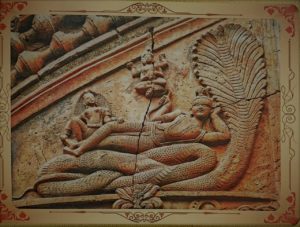
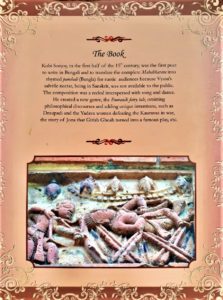
Images of terracotta panels depicting Mahabharata episodes as cover design — Arjuna hitting the fish target at Draupadi’s svayamvara on the front cover, sheshashayi Narayana as frontispiece and Arjuna piercing the ground to quench Bhishma’s thirst on the back cover— from terracotta temples of Bankura-Bishnupur (West Bengal) aptly add to the ambience. They also act as Bhattacharya’s hint-commentary on the possible cultural interaction of the literary and terracotta genres, and of Sanjaya’s possible influence on the terracotta sculptor-poets of the 16th-17th centuries. One may even read them symbolically: Arjuna piercing the target as Bhattacharya’s statement of having achieved a gargantuan task, and Arjuna quenching Bhishma’s thirst as his optimism to quench the never waning thirst of Mahabharata lovers for amrita drops from the Mahabharata Ocean.

An appendix of Arjuna’s ten names from Prof. P. Lal’s Virata Parvan transcreation serves the purpose of reference, comparison with Sanjaya’s verses, Bhattacharya’s contextualizing his work and also his tribute to Prof. P. Lal through remembrance.

Bhattacharya has done a very interesting experiment with spellings of nouns and consonant sounds. Bengali, a language with Magadhi Prakrit as her ‘mother’, often has ‘o’ pronunciation of consonants that Sanskrit renders as ‘a’ ; often has a stop at the end-consonant of a word, no difference in pronunciation between ‘v’ and ‘b’, and absence of the sibilant ‘s’ which is pronounced as ‘sh’. Retaining spellings of Sanskrit words as found in the Oxford English Dictionary, Bhattacharya spells proper nouns in tune with Bengali pronunciation. Thus, Mahabharata is Mohabharot, Kavi Sanjaya is Kobi Sonjoy, Vyasa is Byas, Vana Parvan is Bono Porbo, Drona is Dron, Amba is Omba etc. Even his own name on the second title page is Prodeep Bhottacharjyo. This is unique for an English translation. Indeed, he has provided the ‘flavour of the Bengali pronunciation’ as claimed.

Bhattacharya has taken all precautions against any possible confusion from this experimentation. Other than providing footnotes and clarifications for every such usage on every page, he takes care to eliminate any residual confusion with his Bengali ‘flavoured’ spelt nouns by listing them with their corresponding Sanskrit transliteration along with brief explanations in a detailed glossary.

In the Preface, Bhattacharya provides valuable information and analysis on the historicity of Sanjaya and his Mahabharata, as also on interesting aspects of its content like variations from Vyasa’s Mahabharata, complete with a comparative analysis of the variations of Sanjaya’s and Kashiram Das’ Mahabharatas. His observation that ‘some of (Kashiram’s variations) must have been taken from Kobi Sonjoy’ is a clue for future research to situate Sanjaya historically and understand the import of his work.

Locating Sanjaya is important not only to understand his time, but also to understand the significance of modern Mahabharata works and studies including Bhattacharya’s work of reviving him in English. Bhattacharya has rightly pointed out that Mahabharata re-emerged with prominence in cultural discourse through literature in the 15th-16th centuries in a somewhat synchronized fashion in eastern and southern India. Kavi Sanjaya’s venture is paralleled by Kumara Vyasa in Kannada, Sarala Das in Odiya, Rama Sarasvati in Assamese, and Ezhuthachan in Malayalam. Only the last is a complete translation, but all are characterized by free thinking and imagination in incorporating materials from local lore or innovations, and in leaving out most philosophical discourses of Vyasa’s Mahabharata.

Obviously, something happened in the cultural sky of Bengal and India then that Mahabharata needed to be rediscovered. Bhattacharya’s tentative suggestion that it might be the felt need to assert indigenous identity in the context of Muslim invasion holds merit. It definitely ‘calls for further study’ as he suggests, particularly so if we see how the Mahabharata fascination continues in the next centuries and almost dominates the consciousness of all key figures of the Bengal/Indian Renaissance of the 19th century.

Looking back into Indian history, we find how Mahabharata has been remembered during every crucial historical juncture, or ‘golden age’. Starting from Bhasa (4th cent. BCE), through the Satavahana Queen Goutami-Balashri’s Nashik-Prashasti Inscription (149 CE), Vishakhadatta’s Mudrarakshasa ( 4th century CE), Gupta Inscriptions, Ravikirti’s Aihole Inscription of Pulakeshin II (610–642 CE), the Indonesian Bharata–Yuddha (1157 CE) of Mpu Sedah and Mpu Panuluh and Emperor Akbar’s commissioned Persian translation Razmnama (three editions 1584-1617) show the great impact of Mahabharata in India and beyond.

Inheriting this brilliant tradition, Sanjaya’s Mahabharata assumes the miniature replica of the melting pot with mingled ingredients of Ramayana and Mahabharata tradition, and influences of Buddhism, Jainism, Vaishnavism and Shaktaism. For example, Sanjaya makes King Nala the grandson of Rama’s son Kusha, thereby bringing together Ramayana and Mahabharata. Here he is in the direct tradition of Vyasa’s Mahabharata where we have Markandeya’s Ramayana, Hanuman’s interaction with Bhima, and Rama’s bloodline Brhadbala dying by Abhimanyu’s hand.

Just as Sanjaya creates and narrates a new parvan (Gada parvan), one is startled to find that Al-Biruni’s India (973–1050 CE) too mentions Gada parvan as Book 9. Could there be any connection between Al-Biruni and Sanjaya’s source despite their distance in space and time (5 centuries), or is it a glorious coincidence?

Again, Sanjaya’s Ashvamedhaparvan, which largely follows the Jaiminiya Mahabharata, provides an interesting variation in that Bokrodonto instead of Baka Dalbhya steals the horse so that he can meet Krishna. In the ancient Jain Sutrakrtanga (1.6), Dantavakra is the best of Kshatriyas as a parallel to Mahavira the best of sages. Whether Sanjaya’s giving such importance to Bokrodonto (Dantavakra) is owing to Jain influence would be an interesting query for researchers. After all, the Jain community known as Saraks, though isolated and separated from the main body of the Jain community following Bakhtiyar Khalji’s invasion, still maintained a significant presence in Bihar, Bengal, Orissa and Jharkhand.

Sanjaya’s Karna is born from Kunti’s ear, thus getting the name Karna. The same narrative is found in the Bheel Bharata and folk narratives in other parts of India.

Sanjaya’s most dramatic innovation is introducing Draupadi as a warrior. In Drona Parvan, following Abhimanyu’s death, Draupadi leads an all-woman army of Yadava women including Subhadra, Uttara, Krishna’s queens and Revati against the Kaurava army at night and routs them, though finally sparing the key figures for their male counterparts to fulfil their vows. In a series of wish-fulfilling dramas, Draupadi defeats Drona, Ashvatthama and Duryodhana, and whirls about Duhshasana by his hair, avenging her similar humiliation at his hands in the Kuru Sabha. Similarly, Subhadra ties up Jayadratha’s hands and feet and has him kicked unconscious by maids. Jayadratha seems to be at the worst receiving end from Sanjaya. Earlier too, in Vana Parvan, after Bhima had rescued Draupadi from Jayadratha, Draupadi’s maids had kicked him. Uttara beheads Duhshasana’s son Rudradev who killed Abhimanyu. Here, Sanjaya is undoubtedly influenced by the Shakta tradition and represents women as Shakti evoking the imagery of Mahishasuramardini. Or, he might be remembering two marginalized episodes of Vyasa’s Mahabharata in which Draupadi exerts physical prowess and hurls her molesters Jayadratha and Kicaka to the ground. While Vyasa does not name Duhshasana’s son, Sanjaya’s naming him Rudradev gives a face to the faceless killer of Abhimanyu and has an ironic humanitarian dimension.

Sanjaya’s Adi Parvan has Janamejaya charging Vyasa with failure to prevent the fratricidal battle. This dramatic situation of Vyasa-Janamejaya interaction as the narrative frame has a curious parallel in Peter Brook’s Mahabharata (1989) which begins with Janamejaya and Vyasa interacting. Peter Brook introduced folk elements in his Mahabharata. It seems, the ‘folk mind frame’ of creative artists, perhaps, visualizes dramatic situations in similar ways.

Kavi Sanjaya, of Bharadvaja Gotra, was a resident of Laur village in present Bangladesh. While in Vyasa’s Mahabharata, Pandu and Indra’s friend Bhagadatta is ruler of Pragjyotishpur, Sanjaya hails him as him as ruler of Vanga-Desh including Laur. The exalted place accorded to him might point to a Bhagadatta cult in the region covering present day Assam and Bangladesh because, as evident from the Nidhanpur copperplate inscription, the Kamarupa king Bhaskaravarman (7th century CE) eulogized Bhagadatta as Deva and traced his ancestry to Bhagadatta’s successors.

Like the character Ahiravana in Krittibas’ Ramayana, Sanjaya creates a character named Viveka, Sudhanva’s infant son, who vanquishes Krishna, Pandavas and Hanuman. Finally, on his grandfather Hongshodhvoj’s request, Viveka surrenders to Krishna. In Bengali, ‘bibek’ connotes conscience. Besides, in the Yatra (folk-theatre) tradition, there is a character called ‘Bibek’, conscience-personified. Given that the fratricidal Kurukshetra War did not bring peace and joy to Yudhishṭhira’s mind owing to qualms of conscience, whether Sanjaya’s introduction of Viveka is an echo-metaphor for Viveka-conscience, or Bibek of Yatra tradition with the role of conscience might be another interesting point of query.

In the same Ashvamedhaparvan, Sanjaya introduces the story of King Niladhavaja’s wife Jana (Jvala in Jaimini) who, failing to incite his brother against Arjuna for avenging her son Prabir’s death, immolates herself, transforms into an arrow and enters Babhruvahana’s quiver. Later Babhruvahana kills Arjuna with that arrow, and Jana’s revenge is accomplished. Girish Chandra Ghosh, the father of Bengali theatre, wrote a powerful play ‘Jana’ in 1894 with her as the central character.

The cultural interaction of early Bengali literature and Yatra is quite evident in that, the Krishna Jatra genre, evolved through the devotional singing and dancing of the followers of the Krishna Bhakti movement, was inspired by Rasa-lila and dramatic poetry like Jayadeva’s Gita Govinda (12th century), Chandidas’ Srikrishna Kirtan15th century) and later further propelled by Chaitanya Mahaprabhu’s mystic Krishnaism. There is also Nata Gita, an operatic folk drama form in medieval Bengal, filled with singing, dancing and music sans dialogue, which provided an early model for the Krishna Jatra.

One unique aspect of Sanjaya’s Mahabharata pointed out by Bhattacharya is that his narration is interspersed with Lachadi couplets of twenty syllables accompanied by dance, to be sung in various ragas and raginis such as Basant, Kamod, Bhatiyal, Shri, Barari and Pathamanjari. Obviously, dramatic elements abound in Sanjaya’s Mahabharata. This is further evident from the narrative twists. In Mausala Parvan, Kavi Sanjaya has Arjuna accompany Krishna at the end, and true to Yatra appeal and high drama, Sanjaya’s Krishna breathes his last while resting his head on his best friend Arjuna’s lap.

Bhattacharya’s easy flowing English, constantly reminding us of the richness of Bengal’s culture, makes a pleasant and illuminating read.

At the end, one would certainly agree that Bhattacharya’s translated volumes merit an imperative place in libraries and collections for serious researchers of Indian and Bengal history and for Mahabharata-lovers and lay readers alike.

Indrajit Bandyopadhyay

Associate Professor

Department of English

Kalyani Mahavidyalaya

West Bengal
Filed Under: BOOK REVIEWS, IN THE NEWS, Kavi Sanjay, MAHABHARATA Tagged With: MAHABHARATA IN TRANSLATION

Women of the Mahabharata

January 8, 2020 By admin

Rinku Kalsy interviewed me and others on the women of the Mahabharata.

Here is the video link –> https://vimeo.com/64069030

Filed Under: IN THE NEWS, MAHABHARATA

The First Bengali Mahabharata

December 27, 2019 By admin

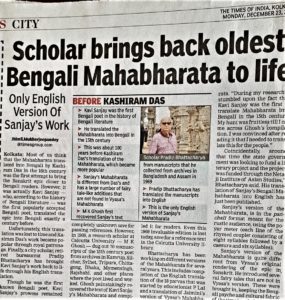
My English translation in free verse line-by-line of Bengal’s Adi Kavi, Sanjay’s Bengali version of the Mahabharata has been published by Dasgupta & Co., 54/3, College Street, Kolkata-700073, boiwala.dasgupta@gmail.com, in 2 volumes, A-4 size. Sanjay created fascinating tales, the most striking of which is his account of Draupadi and the Yadava ladies attacking the Kaurava army after Abhimanyu was slaughtered and utterly routing them, including Drona, Karna, Duhshasana, Duryodhana!

https://timesofindia.indiatimes.com/city/kolkata/scholar-brings-back-oldest-bengali-mahabharata-to-life/articleshow/72931293.cms

KOLKATA: Most of us think that the Mahabharata translated in ..

Read more at:
http://timesofindia.indiatimes.com/articleshow/72931293.cms?utm_source=contentofinterest&utm_medium=text&utm_campaign=cppst

Filed Under: BOOKS, IN THE NEWS, MAHABHARATA Tagged With: Bengali, Kavi Sanjay

Brilliant Translation of Mokshadharma Parva: review by Prof. Satya Chaitanya

December 22, 2019 By admin

https://www.boloji.com/articles/51356/brilliant-translation-of-mokshadharma-parva

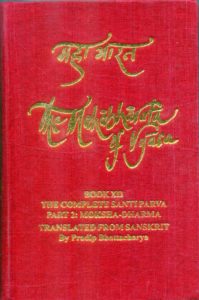
The Mahabharata of Vyasa: Book XII, The Complete Shanti Parva. Part 2: Moksha-Dharma
Translated From Sanskrit by Pradip Bhattacharya. Writers Workshop, Kolkata. 2015

All human pursuits have for their end, said ancient India, either one or a combination of the four ultimate human goals: the common good [dharma], wealth [artha], pleasure [kama] and spiritual freedom [moksha]. The Mahabharata is an enquiry into these four human goals in the context of the grand family saga of the Bharatas. While in general the focus of the other parvas of the epic is on the narration of the story with sagely and worldly wisdom thrown in here and there, the Shanti Parva focuses almost entirely on philosophical enquiries into the human condition and discusses how life could be lived happily and meaningfully both as an ordinary individual and as a person responsible for the welfare of others, such as a king, keeping dharma as the guiding light.

The Shanti Parva is voluminous and consists of nearly fourteen thousand verses of which the biggest chunk is the Mokshadharma Parva, which centrally concerns itself with the highest of the four dharmas, moksha. It is this parva that Dr Pradip Bhattacharya has brilliantly translated into English.

Dr Bhattacharya’s is the first ever verse to verse translation of the Mokshadharma Parva and forms a huge volume of 1077 pages, excluding the appendixes.

Mokshadharma Parva has devotion, yoga, meditation, dispassion, the ascetic way of life and other forms of spirituality for its subject matter. We would expect the spirituality that a book like the Mahabharata teaches us to be conventional. But far from it! One of the most fascinating aspects of the parva is that, while it does speak of conventional spirituality, much of its teaching is irreverent to tradition and takes very unconventional stands. The very second chapter has a son teaching spirituality to his father! Later the brahmana Jajali who has become proud of the frightful asceticism he has performed for years is sent to the merchant Tuladhara to learn from him, reversing traditional roles completely!

We have another story of role reversal in the Mokshadharma Parva in which a woman teaches the highest spirituality to a man – a story that introduces to us one of the most fascinating spiritual teachers in the entire Indian spiritual lore: the great yogini Sulabha. This great master of yoga arrives at the court of King Dharmadhvaja Janaka, reputed to be an awakened man, and using her yogic powers enters the king’s head to debate with him about what true yoga is from within him. Towards the end of the discussion the yogini explains why she did not engage him in the debate in the open court in the presence of his ministers and courtiers: so that the king would not shamed before them!

The king begins the discussion and claims, giving numerous reasons, that he is an enlightened man. Sulabha counters all his arguments and ends the debate by declaring bluntly that he is no master but just a pretender.

You are not liberated
yet you are proud of being
liberated, O King! You should be prevented
by your well-wishers, as
the unconscious indeed is from drugs.

She also tells him:

You have heard, but not listened to the scriptures,
I think, or else
heard false scriptures, or you heard what seems like
scriptures, or heard otherwise.

Sulabha’s main argument is that Dharmadhvaja has not developed anasakti, detachment while being engaged, the true mark of enlightenment, something the Bhagavad Gita would completely agree with. Sulabha points out to Janaka that he is still attached to his body, his gender, caste, position as king and so on. How can such a man be liberated, she asks?

She tells him:

Fallen from the householder’s order, you
have not obtained
hard-to-reach moksha and stay in between
the two, merely
talking about moksha.

Yogini Sulabha would be an ideal teacher for our age of Kali when in the world of spirituality pretentions are more common than true achievements and knowledge of books is considered enlightenment!

We have several Gitas in the Mokshadharma Parva. In the short sparkling Bodhya Gita, a great sage in another role reversal declares that his gurus are a prostitute, an arrow smith, a young girl and so on:

Pingala, the osprey, the snake, the bee
searching in the woods,
the arrow-maker and the virgin, these six
are my gurus.

Apart from the Bodhya Gita, the Parva has other Gitas like the Manki Gita, Parashara Gita, Hamsa Gita, Sampaka Gita, Harita Gita, Vritra Gita and so on, each enriching the Parva in its own way.

As the Upanishads do, the spirituality of the Parva holds heaven in contempt. Rejecting heaven, the Parva equates it to hell in comparison with moksha, spiritual liberation. All acts leading to heaven are declared as ultimately worthless because they only keep you wandering within the world of bondage.

The Parva rejects animal sacrifice. Though hermit spirituality too is discussed, the stress is on what can be practiced living the family way of life. In fact, one of the questions Yudhishthira asks is if a man living with his wife at home can climb to the highest peaks of spirituality – a question that is very pertinent to himself and to all of us. In response, we are told the fascinating story of Suvarchala who asks her father to find a husband for her who is both ‘blind and not blind’ at the same so that she can live with him a life of the highest spirituality.

We have in the Parva a Brahmin svayamvara, the self-choice ceremony in which a woman chooses a husband for herself, usually limited to royal families!

The women of the Parva are all brilliant, be it Suvarchala who tells her father she would choose her husband by herself, Yogini Sulabha who using her yogic powers enters Janaka’s head to debate with him, the wife of Nagaraja who teaches her anger-prone husband the importance of managing anger, or anyone else.

Among the numerous rare gems we can find in the Mokshadharma Parva is the story of Gautama’s and Ahalya’s son who is only mentioned by the name Chirakari, Slow-to-Act, who has been asked by his father to chop off the head of his mother as a punishment for committing adultery, a story in which reversing convention, slowness is praised rather than speed in action. Reflecting on his father’s order, Chirakari says to himself:

No shade is there like the mother, no refuge
is there like the mother,
no protection is there like the mother,
no beloved
is there like the mother.

The chapter has Chirakari telling us:

There is no offence in women. Man indeed
offends. Held guilty of
offence in every work, a woman
does not commit offence.

This first ever complete verse translation of the Mokshadharma Parva by Bhattacharya is an invaluable contribution to Indological studies in general and Mahabharata studies in particular. As translation, it is a monumental piece of work as well as a superb literary achievement. For Bhattacharya, though, it is more than these: it is his gurudakshina, his sacred offering to his guru, Prof. P. Lal, who had over a period of several decades ‘transcreated’ in a unique verse form and self-published the entire Mahabharata except the Mokshadharma Parva before he passed away. With this volume, the transcreation is complete – though Bhattacharya claims he has not trascreated it but has only translated it, following as closely as possible the master’s style.

A unique aspect of the translation is the retention of Sanskrit words that are in the Oxford English Dictionary. An example for this could be found in the parva-opening question itself in which Yudhishthira asks, “O Pitamaha-Grandfather, you have….” A new reader would find this as somewhat unsettling, but once you are used to it, you discover it has a charm of its own, giving the entire work a surreal quality. And of course, it avoids, as the translator points out, the need for annotations, colophons and dovetailing explanations. The rest of the Mahabharata transcreated by Prof. P. Lal follows this style and for that reason it is appropriate that Bhattacharya too follows the style.

While no disrespect is meant to the existing, time-honoured monumental complete prose translation of the epic, for which the entire world should forever be indebted to K.M. Ganguli, for the purpose of bringing out the precision, beauty and brilliance of Bhattacharya’s translation, I would like to compare one verse in the two translations.

Death is that by which the world is assailed. Decrepitude encompasses it. Those irresistible things that come and go away are the nights (that are continually lessening the period of human life). When I know that Death tarries for none (but approaches steadily towards every creature), how can I pass my time without covering myself with the garb of knowledge? – K.M. Ganguli

Death wounds the world,
Decay besieges it,
Days and nights fall away,
How do you not understand this?
 – Pradip Bhattacharya

Incidentally, Bhattacharya’s translation is not only much more poetic, it is also closer to the original Sanskrit.

While Bhattacharya has tried to walk in the footsteps of his revered guru and inspiration Prof. P. Lal whose monumental work of transcreating the Mahabharata into verse he is continuing in the Mokshadharma Parva, he explains in the Preface to the book why he has “tried to translate rather than transcreate, keeping to the original syntax as far as possible without making the reading too awkward”: He is not a poet like Prof. Lal. I believe this is the translator’s humility speaking – I found the poetry of the translation splendid. It constantly reminded me of Kimon Friar’s superb English translation of Nikos Kazantzakis’s 33,333-lines magnum opus Odyssey: A Modern Sequel.

Following Prof. Lal who chose to give no list of contents and no section headings to his Mahabharata transcreation work saying ‘the suta does not need them,” Dr Bhattacharya in the Mokshadharma translation too gives no list of contents or section headings.

Memorable verses of the parva have been reproduced in Sanskrit – which I found very useful and felt added great value to the book partly because of my love for Sanskrit, partly because the original Sanskrit verses reproduced are such that they register practically on their own in your memory. Besides, several of these verses are already widely known and are either in full or in part integral parts of all Indian languages.

The thoroughness of Bhattacharya’s work and the immense depth of his research deserve appreciation by all Mahabharata lovers. Such thoroughness and depth would not have been possible without the translator’s profound love for the Mahabharata which could be guessed from the fact that he has authored several books on the epic, each a major contribution to understanding the beauty of the Mahabharata, each bringing out the rarest gems lying on the bed of the vast ocean that the epic is. Rather than just picking up any one particular text of the Mokshadharma Parva and translating it, what he has done, as he himself explains, is to collate the editions published by the Gita Press [Gorakhpur, 9th edition,1980] , Aryasastra [Calcutta, 1973] and that edited by Haridasa Siddhantavagisa Bhattacharya with the Bharatakaumudi and cross checked with Nilakantha’s Bharatabhavadipa annotations [Bishwabani Prakashani, Calcutta 1939] cross-checked with Kaliprasanna Sinha’s Bengali translation [Hitavadi Karyalaya, Calcutta 1866], the first English translation by K.M. Ganguli [1883-1896] and the shorter Bhandarkar Oriental Research Institute edition. As a result of the inclusion of passages from Siddhantavagisa Bhattacharya and the collation with the other works just mentioned Dr Bhattacharya’s work makes this the most complete translation of the Mokshadharma Parva ever.

Two maps have been appended to the translation, one of Aryavarta at the time of the Mahabharata and the other of the India of that time, both helpful in correlating the events of the epic with their geographical locales, particularly for those not sure of them. Also appended are three reviews of Prof Lal’s transcreations of three parvas of the epic: the Karna Parva, the Stri Parva and Shanti Parva Part 1 [Rajadharma]. The long review of Karna Parva brings out the excellence of the transcreation of the parva. In his review of Prof. Lal’s Stri Parva, The Book of Women, appended to the book, Dr Bhattacharya points out how Prof Lal’s poetic transcreation of the parva succeeds in capturing the screaming anguish of the original text whereas earlier prose translations fail to do so. The appended review is also noteworthy for correlating the Stri Parva with Euripides’ Trojan Women. I found the third appendix of special interest since it is a review of the Rajadharma, Principles of Governance, section of the Shanti Parva, the Sanskrit text of which I have been using extensively for years in business schools where I have been teaching Indian leadership philosophy to Management students, corporate officers and bureaucrats.

I first came across Writers Workshop books in the Public Library in Chennai in 1975 and was immediately captured by their uniqueness, superiority and distinct appearance. They were all hardbound, had a distinctively Indian touch to them, and, as I later learnt, they were printed in small hand-operated presses and manually bound. Mokshadharma Parva published in 2015, forty years later, follows the same admirable tradition which sets it apart from mass-produced, commercially marketed, books.

Bhattacharya’s mastery of the English language is astounding. With amazing fluidity, the mighty torrent of the translation flows on for nearly eleven hundred pages, carrying you with it effortlessly, making you realize what the boundless ocean called the Mahabharata truly is and revealing the rare jewels lying in its profound depths.

Dr Bhattacharya’s translation is a superb example for what encyclopedic knowledge, hard work, superb literary talent, total commitment and tireless energy can achieve. The work is a masterpiece of Sanskrit translation, an inspiration for all translators not only from Sanskrit to English but from any language to any other language. As a translator Bhattacharya eminently succeeds in achieving all the aims he sets for himself and gives the English reading world that cannot read the Mahabharata in original Sanskrit a wonderful gift that that is as close to the original as is possible.

Filed Under: BOOK REVIEWS, IN THE NEWS, MAHABHARATA Tagged With: Mokshadharma, Satya Chaitanya

Dharma Rejected in the Mahabharata!

December 22, 2019 By admin

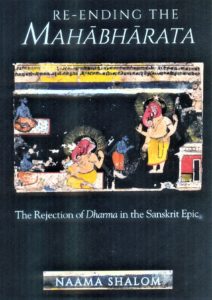
Re-ending the Mahabharata

Naama Shalom, Re-ending the Mahabharata: The Rejection of Dharma in the Sanskrit Epic. Albany: State University of New York Press, 2017. 266 pages.


This is an important work, being the first study to focus solely on how the Mahabharata ends. Naama Shalom’s thesis is that instead of extolling Dharma—the general presumption—the last book actually denounces it in the persona of Yudhishthira. She uses the word garh (condemn) as a “Mahabharata search engine” to achieve three goals: unravel the thematic structure; survey its doubts about dharma; and define how dharma operates in different contexts. Exploring the paradox of dharma’s “garhification” (denunciation) is the agenda.

Shalom shows how re-tellers of the epic altered the ending to provide a pleasant closure. Of them, only three epitomes, all medieval, deal with the ascent to heaven: Kshemendra, Amarachandra, and Agastya in the eleventh, thirteenth, and fourteenth centuries CE. Earlier adaptations neglect the last book, possibly because it is deemed too unsettling. She analyzes the stance adopted by the three Kashmiri Sanskrit aestheticians Anandavardhana, Abhinavagupta, and Kuntaka (ninth to eleventh centuries CE). The first two stress that the ending creates the rasa (emotional experience) of shanti through rejection of the rasas of heroism, wonder, and horror created earlier, thus dissociating it from the rest of the epic. Kuntaka condemns the ending as a prime example of a faulty conclusion that future poets should alter.

Dharma is referred to by both Bhıshma the patriarch and Yudhishthira the son of Dharma as very subtle, as secreted within a cave, hence difficult to determine. At crucial junctures there is doubt about what it is. Shalom does not explore the fact that only three persons are never troubled by such doubts: Krishna, Dharma’s avatar Vidura, and Bhıma. The first two die miserable deaths. Yudhishthira abandons dying Bhıma but will not abandon a dog. Then he rejects Svarga, electing to stay in horrific Naraka with the siblings and the wife he had abandoned. The confusion this ending creates, Shalom argues, has to date not been explored.

Reviewing the research, she concludes that the ending formed part of the epic from at least the third century CE as in the damaged Spitzer Manuscript where the seventeenth and eighteenth serials in the parva-list are intact, though the Mahāprasthānika and Svargārohaṇa parvas are not mentioned. Here she refers to the initial Jaya epic of 8,800 verses, while in fact this is the number of riddling slokas.

She claims to have discovered “a hitherto unknown retelling” entitled Bhārataprabandha by the Malayali poet Melputtur Narayana Bhatta (ca. 1550–1650 CE), which includes the Svargārohaṇa. However, Kalamandalam Eswaranunni, A.Harindranath and A.Purushothaman have edited scholarly editions with detailed explanations and introductions, self-published from 2014 to the present. Bhatta is the only re-teller who has Yudhishthira denounce Indra, Dharma, and the other gods for the illusion of hell.

Shalom concludes that the epic does in fact reach an organic resolution, being a tapestry into which many “garh” episodes are interwoven. Part of this tapestry is the disrupted sacrifice motif introduced in the beginning. The core of the thematic matrix is the examination of what constitutes right action through experimentation with the concept of dharma. She argues that finally Dharma turns in on itself through self-denunciation (Dharma’s son condemns Dharma) voiced by its protagonist Yudhishthira, which scholars have previously overlooked.

Is a later, more “sophisticated” audience uncomfortable with the unabashed existential stance of Vyasa instead of appreciating its nuances, as Shalom claims? Perhaps not. Her study is heavily influenced by Emily T. Hudson’s one-sided Disorienting Dharma: Ethics and the Aesthetics of Suffering in the Mahabharata (Oxford University Press, 2013), showing no awareness of James Hegarty’s balanced exploration of the topic in Religion, Narrative and Public Imagination in South Asia: Past and Place in the Sanskrit Mahabharata (Routledge, 2012).

Being so focused on validating her claim, Shalom overlooks the Bhārata Sāvitrī of four slokas at the end containing Vyasa’s final message. Is he a voice in the wilderness, ignored by all, shouting aloud with upraised arms “From Dharma flow Profit and Pleasure; why is dharma not practised?” In the very next verse he stresses that dharma must not be discarded; for, while joy and sorrow are fleeting, dharma and the jīva–ātman alone are eternal, not the body. The composer himself thus reasserts Dharma’s validity after its “garhification.” And a host of phantom listeners are listening, their stillness answering his cry.

This compelling work needed a good editor. The argument running to 174 pages is supplemented by 50 pages of elaborate endnotes, much of which should have been included in the text. The reader is irritated having to flip back and forth frequently between them. Moreover, there is avoidable repetition: each chapter begins with a summary and ends with a conclusion, both repeating in brief what will be/has been stated. However, Shalom’s book will stimulate fresh thinking about the enigmatic ending of the Mahabharata and as such open up fresh avenues of research.

International Journal of Hindu Studies (2019) 23:355, https://doi.org/10.1007/s11407-019-09268-x

Filed Under: BOOK REVIEWS, IN THE NEWS, MAHABHARATA Tagged With: Mahabharata, Shalom

Mausala: How are the Mighty Fallen!

December 5, 2019 By admin

P. Lal: The Complete Mausala Parva of the Mahabharata transcreated from Sanskrit,
Writers Workshop, Kolkata, Rs.150 (hardback)


Vyasa’s narrative art is spread across a broad spectrum. Besides operating within a series of frameworks—boxed within one another like Russian dolls or Chinese boxes—it changes suddenly from the dialogical question-and-answer method to the administration of sudden shocks. The war books, for instance, invariably begin with Sanjaya reporting that the current general of the Kaurava army is dead and then entering into a detailed flashback narrative. The Mausala Parva suddenly reverts to that style, shaking us out of the somnolent depression of the preceding Ashramavasika Parva that closed with Yudhishthira continuing to rule the kingdom “somehow” after losing his elders in a forest-fire 15 years after the great war. Now we are told that 36 years after the war Yudhishthira receives the shocking news of the slaughter of the Yadavas and, unbelievably, of the death of Balarama and Krishna. Gandhari’s curse has come true. The internecine blood-letting did not end at Kurukshetra; it is paralleled at Prabhasa.

What sets the tragedy in motion is the supreme arrogance of the Vrishnis who find themselves the unrivalled power in the country following the fall of the established kingdoms and their eighteen armies. Traditionally, India has upheld the ideal of Brahma-tej (brahmanical virtue) being backed up by Kshatra-tej (the warrior’s heroism) as the foundation of society. Neither the Kauravas nor the Yadavas had any respect for the wisdom of sages. It is the act of mocking Vishvamitra, Narada and Kanva that brings crashing down upon the Yadavas the curse of destruction by an iron club birthed by Krishna’s handsomest son Samba. Ugrasena has the club ground to powder and thrown into the sea. Washed ashore, these ashes grow into adamantine reeds. The Vishnu Purana (5.37) adds a detail: one piece of the club defied all attempts to grind it and ended up in the belly of a fish. A hunter named Jara (old age) made it the head of an arrow which became the mortal dart for Krishna for whom, as with Achilles, the foot was the vulnerable spot. The Harivansha (Vishnu Parva, 103.27) informs that Jara was Vasudeva’s son from a Shudra wife and became a lord of Nishadas. Thus, as Krishna kills his cousin Ekalavya, so is he in turn slain by his cousin Jara. The destruction of the Yadavas is but a continuation of the fratricidal Kurukshetra war. Recalling that Satyavati was a Nishada, and through Vyasa her blood ran in the Kauravas, it is finally the Nishadas’ revenge on the architect of the Kurukshetra holocaust. But in terms of narrative art, the story has come full circle. According to Nilakantha, the 17th century commentator on the epic, Jara was a Kaivarta (fisherman). Sauti told us that one of the three beginnings of the Mahabharata is with the story of Uparichara Vasu and his children born of a fish, the daughter becoming Matsyagandha and the son the chief of the Matsyas. The story has come full circle.

Dr. A. Harindranath has pointed out that according to Hanumanatakam, Jara is the Ramayana’s Bali reborn to avenge the injustice done in his former life. In Ezhuttachchan’s Malayalam Bharatam Kilippattu, Krishna tells Jara, “I deceived you in the previous birth. This is your revenge for that. Now you can reside in heaven without any grief.” Satya Chaitanya finds that in the Oriya Sarala Mahabharata Jara is a Sabara tribal and a great devotee of Krishna. There is a battle between Jara and Arjuna, who is furious with him for killing Krishna by mistake. The battle between the two is stopped by a skyey voice announcing that Arjuna is the Ramayana’s Sugriva and Jara is Angada, while Krishna is Rama.

The Bhagavata Purana (canto 3) gives short shrift to the event, comparing it to the fire produced by bamboos rubbing against each other in a forest. It avoids Krishna’s participation in the killing, concentrating instead on his being reminded by the gods that he has stayed on earth for over a hundred years and ought to return to his heavenly abode. It does say that Krishna is aware that unless the Yadavas are wiped out—and they are too powerful to be destroyed by anyone but themselves—the earth’s burden will not be lightened. This clan has become asuric, drunk on its prosperity and power. Ironically, like Jarasandha, they have to be removed for the fledgling “dharma-rajya” of the Pandavas to put down firm roots.

Paul Dundas has pointed out that the Jain Bhagavati Sutra (7.9) provides a fascinating historical parallel to the “reeds massacre” in two battles in Mahavira’s time involving king Kuniya-Ajatashatru. One called “Mahasilakantaya samgama,” (battle of thorns-like-great-stones) was so intense that the touch of thorns, leaves and twigs was like blows from huge stones. The other was “Rahamusala samgama”, the battle of Kuniya’s chariot-fitted-with-clubs. The Mausala Parva’s powdered iron club that becomes deadly “trina” (grass/reeds) is analogous to the Jain sutra’s “kantaya” (thorns), as is the manic violence. It is believed that the Mahabharata was written around this time in the 6th-5th century BC.

Abruptly, after the sages curse the Yadavas, prohibition is promulgated. The Mahabharata is silent regarding the reasons. The Samba Purana tells of Narada, annoyed by Samba’s pride of his beauty, plying Krishna’s junior wives with liquor, creating a scenario that leads Krishna to believe that they are enamoured of his son. Krishna curses Samba with leprosy and his wives with being abducted by robbers—thus explaining Arjuna’s failure to protect them. The punishment of impaling the brewer of liquor along with his family is ineffective. Throughout the epic no lessons are learnt from the tale of Yayati the Lunar Dynast:

The Vrishnis perpetrated crimes,
shamelessly.
They mocked Brahmins
and pitris and gods…
Pouring wine in the food
prepared for mahatma Brahmins,
the Yadavas fed the wine-flavoured dishes
to vanara-monkeys…
They insulted gurus and elders…
Wives cheated on husbands,
and husbands cheated on wives.

Time (Kala), a major theme of the epic is personified by Vyasa for the first time, appearing as a shaven-headed, terrifying man of black-and-tawny complexion sneaking in and out of Yadava homes. This may well be a reference to Buddhist monks who shaved their heads and wore ochre robes, as the epic seeks to stand against the Buddhist (pashanda) and Jain (kshapanak) creeds. A grinning white-toothed black female (Kali) slinks into households, snatching away the auspicious wrist-threads. Krishna’s celestial discus, chariot and Garuda pennant disappear. Noticing the ill omens and recalling Gandhari’s curse, Krishna gives orders to go on pilgrimage to Prabhasa.

It is Balarama who, violating his own commands, starts drinking, followed by the rest. Earlier, in a drunken frenzy, Balarama has slain Rukmini’s brother Rukmi during a gambling match and then the Suta Lomaharshana. The massacre begins with drunken Satyaki abusing Kritavarma who had not only killed the sleeping Panchalas but also Satyabhama’s father Satrajit. Satyabhama bursts into tears and sits in Krishna’s lap, instigating him. Krishna glares at Kritavarma, and Satyaki beheads him and attacks indiscriminately. Unable to stop his drunken fury, Krishna does not intervene when others batter Satyaki and Pradyumna to an ignominious death with soiled pots and plates. Seeing his sons and brother Gada slain, Krishna snatches up a clump of eraka reeds that transform into an adamantine club with which he “slaughtered his entire clan…Demented with drink…Not one of them had the good sense to flee the carnage.” Balarama does not participate, just as he had avoided the Kurukshetra war. His alienation from Krishna followed the theft of the Syamantaka gem by Satadhanva.

Vyasa silently poses questions to which we still seek answers: the inglorious death of Purushottama Krishna at the hands of a mere hunter. Shravan Kumar and sage Kindam had at least been shot by royalty (Dasharatha and Pandu)! All traces of Dvaraka are submerged.

The volume has a preface by the trans-creator that is valuable for the insights offered, relating the massacre to the current times and asking, “What happens to the ‘maha’ of the Bharata is no one listens to the epic?” which is what bewilders both Vasudeva and Arjuna—why did the omnipotent Krishna do nothing to prevent the slaughter?

Although Mahabharata is the biography of his sons and grandsons, Vyasa’s is a ruthless gaze where it comes to revealing the pitiable plight to which the greatest of heroes is reduced. As Prof. Lal writes, “Karma is ruth-less…not callous; it is unsentimental. The laws of nature do not forgive…They grind slow, and very small. What about the laws of morality?…Vyasa does not say.” Invincible, ambidextrous Arjuna for whom Krishna’s love “was wonderful, passing the love of women,” fails to fight off lathi-wielding Abhiras who laugh at his vain efforts to protect the Yadava women. Utterly humiliated, he rushes to Vyasa who tells him he ought to realise that it is time to depart. It has been not a reign spanning epic dimensions, but a rule of just 36 years. Vyasa sends him back to Yudhishthira with these profound words, transcreated with memorable simplicity that will long ring in our ears:

“Cosmic Time Kala
is the seed
of the universe.
Kala is the giver,
and Kala is the taker…
He who rules
becomes he who is ruled.”

COMMENTS:

Alf Hiltebeitel: Your most recent piece on Mausala backfills the sparse Critical Edition account of the end of the Yadavas with so many informative narratives, from the Harivamsa on. A truly edifying and inspiring piece. Thanks so much.

Sorry to have missed you in New Delhi. Simon Brodbeck read your paper with great vigor and clarity, as only he can do. Since you were not there and the reading filled the allotted time, there was little discussion, but an elderly gentleman of your land arose at end to say the keshakarshana covers for both elements in the keshambarakarsana, with the ambarakarshana being too improptioutous to mention. It is an additional argument I have thought of making on the basis of attitudes among Draupadi cult performers, who treat the tuyil-urital very delicately, in begging Draupadi’s forgiveness on the side, as you know; and morever, it is not performed at some festivals simply because it is so inaspicious. In other words, Vyasa and his characters could (and I would say would have similar reasons to) be silent about it as a matter of delicacy and discretion. But I don’t often risk publically such an argumentum e silentio, so have kept my own silence on it till now. In the vein of your two most recent pieces on the Mbh’s closing books in Lal’s transcreation, though, where you mention parantheticlly that Yudhisthira did not mention the disrobing to Duryodhana in heaven, there particularly I think one has a good case for Yudhisthira keeping silent on this particular aspect of his old grievences. Moreover, he knows by now that this is something he would have to blame not on Duryodhana but on his elder brother Karna, with whom he wants to be and is about to be quasi-restored. Alf Hiltebeitel


Filed Under: BOOK REVIEWS, IN THE NEWS, MAHABHARATA

  • « Go to Previous Page
  • Go to page 1
  • Interim pages omitted …
  • Go to page 7
  • Go to page 8
  • Go to page 9
  • Go to page 10
  • Go to page 11
  • Interim pages omitted …
  • Go to page 20
  • Go to Next Page »

Footer

Recent Posts

  • POLICE FIRING AT ISLAMPUR IN MURSHIDABAD DISTRICT
  • PANCHAYAT & BUREAUCRACY RELATIONS
  • Mulk Raj Anand in Malda

Tags

Bangladesh Bankimchandra Bengali Bhishma boloji Book Reviews Bulcke Critical Edition Desire Dharma Draupadi Draupadi Dream Trust Drona Essays glb Grantha script Harivansha Hiltebeitel Homer Indraprastha Jaimini Jaiminiya Mahabharata. Journal Kalpataru Karna krishna Mahabharata McGrath memoir Mokshadharma Murshidabad News novel P. Lal Panchakanya popularity Ramayana refugee Satya Chaitanya shakuni Sri Aurobindo Statesman Vande Mataram video Yudhishthira

Follow Me

  • Facebook
  • Linked In
  • Twitter

CONTACT ME

Search

Archives

  • February 2026 (2)
  • December 2025 (1)
  • November 2025 (1)
  • October 2025 (1)
  • July 2025 (1)
  • June 2025 (1)
  • May 2025 (1)
  • September 2024 (3)
  • May 2024 (3)
  • February 2024 (1)
  • October 2023 (2)
  • September 2023 (1)
  • March 2023 (4)
  • February 2023 (1)
  • January 2023 (1)
  • September 2022 (1)
  • August 2022 (2)
  • July 2022 (1)
  • June 2022 (2)
  • February 2022 (1)
  • January 2022 (2)
  • November 2021 (1)
  • September 2021 (5)
  • January 2021 (2)
  • December 2020 (1)
  • September 2020 (1)
  • July 2020 (3)
  • June 2020 (1)
  • March 2020 (1)
  • January 2020 (2)
  • December 2019 (13)
  • October 2019 (1)
  • September 2019 (1)
  • August 2019 (2)
  • April 2019 (2)
  • March 2019 (4)
  • February 2019 (1)
  • January 2019 (2)
  • December 2018 (1)
  • November 2018 (4)
  • October 2018 (2)
  • September 2018 (2)
  • August 2018 (4)
  • July 2018 (4)
  • June 2018 (5)
  • April 2018 (3)
  • March 2018 (2)
  • February 2018 (1)
  • January 2018 (1)
  • November 2017 (2)
  • October 2017 (7)
  • August 2017 (1)
  • July 2017 (2)
  • June 2017 (11)
  • May 2017 (19)

Copyright © 2026 Dr. Pradip Bhattacharya