• Skip to main content
  • Skip to footer

Pradip Bhattacharya

Indologist, Mahabharata scholar

  • BOOKS
    • MAHABHARATA
      • The Mahabharata of Vyasa – Moksha Dharma Parva
      • The Jaiminiya Mahabharata
      • The Jaiminiya Ashvamedhaparva
      • The Secret of the Mahabharata
      • Themes & Structure in the Mahabharata
      • The Mahabharata TV film Script: A Long Critique
      • YAJNASENI: The Story Of Draupadi
      • Pancha Kanya: the five virgins of India’s Epics
      • Revisiting the Panchakanyas
      • Narrative Art in the Mahabharata—the Adi Parva
      • Prachin Bharatey ebong Mahabharatey Netritva O Kshamatar Byabahar
    • LITERATURE
      • Ruskin’s Unto This Last: A Critical Edition
      • TS Eliot – The Sacred Wood, A Dissertation
      • Bankimchandra Chatterjee’s Krishna Charitra
      • Shivaji Sawant’s Mrityunjaya: A Long Critique
      • Subodh Ghosh’s Bharat Prem Katha
      • Parashuram’s Puranic Tales for Cynical People
    • PUBLIC ADMINISTRATION & MANAGEMENT
      • Leadership & Power: Ethical Explorations
      • Human Values: The Tagorean Panorama
      • Edited Administrative Training Institute Monographs 1-20. Kolkata. 2005-9
      • Edited Samsad Series on Public Administration. Kolkata, 2007-8
    • COMICS
      • KARTTIKEYA
      • The Monkey Prince
    • HOMEOPATHY
      • A New Approach to Homoeopathic Treatment
  • BOOK REVIEWS
    • Reviews in The Statesman
      • Review : Rajesh M. Iyer: Evading the Shadows
      • Review : Bibek DebRoy: The Mahabharata, volume 7
      • Review :The Harivansha – The Significance of a Neglected Text
      • Review : Battle, Bards and Brahmins ed. John Brockington
      • Review : Heroic Krishna. Friendship in epic Mahabharata
      • Review : I Was Born for Valour, I Was Born to Achieve Glory
      • Review : The Complete Virata and Udyoga Parvas of the Mahabharata
      • Review : Revolutionizing Ancient History: The Case of Israel and Christianity
    • Reviews in BIBLIO
    • Reviews in INDIAN REVIEW OF BOOKS And THE BOOK REVIEW New Delhi
    • Reviews in INDIAN BOOK CHRONICLE (MONTHLY JOURNAL ABOUT BOOKS AND COMMUNICATION ARTS)
  • JOURNALS
    • MANUSHI
    • MOTHER INDIA
    • JOURNAL OF HUMAN VALUES
    • WEST BENGAL
    • BHANDAAR
    • THE ADMINSTRATOR
    • INDIAN RAILWAYS MAGAZINE
    • WORLD HEALTH FORUM, WORLD HEALTH ORGANIZATION, GENEVA
    • INDIA INTERNATIONAL CENTRE QUARTERLY
    • ACTUALITIES EN ANALYSE TRANSACTIONNELLE
    • THE HERITAGE
    • TASI DARSHAN
  • STORIES, ESSAYS & POSTS
    • Chakravyuha by Manoranjan Bhattacharya
    • The Head Clerk. A short story.
    • BANGLADESH NEW-BORN: A MEMOIR
  • GALLERY
  • PROFILE
    • About the Author
    • IN THE NEWS
      • Epic discovery: City scholars find lost Mahabharata in Chennai library – The Times of India (Kolkata)

Kavi Sanjay

Kavi Sanjay’s Mahabharata reviewed by Shekhar Sen

July 22, 2020 By admin

The Mahabharata of Kavi Sanjay, Pradip Bhattacharya (tr), Vol. I and II, Dasgupta & Co. Pvt. Ltd, 2019, p.637, Rs. 1495.

Kavi Sanjay translated the Mahabharata into Bengali in the early part of the 15th century sitting in a village in the eastern-most part of the country. It was a path-breaking effort – he brought the epic within the reach of the common man breaking the Brahminical shackle of Sanskrit and that he did without any royal patronage. Around the same time Krittibas did the same with the Ramayana, with royal patronage. After 600 years this historically important work is brought to the attention of a greater readership by Dr. Pradip Bhattacharya by translating it into English for the first time, thereby rendering a yeomen’s service to the history of Bengali literature.

In fact the 15th century saw an efflorescence in the field of vernacular literature throughout the country. It was also a period when the Bhakti movement was at its peak. Annamacharya, Jakanna, Dhurjati, Mallana, Atukuri Molla, Pedanna, Pothana, Srinatha, Thimanna, Thirumalamma (Telugu), Chamarasa, Purandaradasa, Niyaguna Sirayogi, Kumara Vyasa (Kannad), Bhalan, Padmanabha, Sridhar Vyas (Gujarati), Ananta Dasa, Jasobanta Dasa, Sarala Dasa (Odiya), Pitambara Dvija, Sankaradeva, Gopala Mishra (Assamese/Kamrupi), Kanhupatra (Marathi), Namboothiri (Malayalam), Bhagat Paramanand (Punjabi), Pipa (Rajasthani), Vidyapati (Maithili), Krittibas, Sanjay (Bengali), Kabir, Ravidas, Surdas (Hindi), quickly followed by Kanaka Dasa, Lakshmisha (Kannad), Mirabai, Tulsidas (Hindi) and many others in the 16th century – all of them wrote copiously in local languages and dialects, giving up Sanskrit though many were adept in Sanskrit.

Those were the days when literature meant only Sanskrit literature. Brahmins were the guardians of literature and they would not allow any vernacular trespass in this domain. In fact, the pundits despised those who made any attempt to write in vernacular. It was considered to be a sin to write in any vernacular Language. In Bengal they even cursed the vernacular writers/listeners, Ashtadashapuranani Ramasya charitani cha I Bhashayam Manavah SrutvaRaurabam Narakam Brajet II (By listening to the eighteen Puranas and Rama’s story in vernacular, man goes to the hell named Rauraba.) Needless to say that till this time they had royal patronage.

But slowly the ambience changed with the advent of Muslim rulers. They wanted to hear the stories contained in Sanskrit literature, not in Sanskrit but in local languages which they could understand. The Hindu royalty too, therefore, found it politically correct and safe to follow suit. This is how a supportive ambience was slowly created in which vernacular literature flourished.

There was, however, a difference. Most of the vernacular authors did not follow the Sanskrit text verbatim. They discarded what they thought was not necessary for the edification of their intended audience – the royalty, because they would not appreciate and the common man, usually the illiterate and rustic, because they would not understand. So, all the didactic portions were edited out. On the other hand, they included folk stories people were familiar with, customs they knew and stories born out of the author’s own imagination which they would appreciate. They dug deep into social memory, borrowed copiously from oral traditions, from stories they heard from itinerant rhapsodes and their social environment and inserted all this into their work including stories they themselves created. Krittibas introduced Veerbahu, Taranisen, Mahiravan in his Ramayana; Sarala Das included more than 150 folk stories in his Odiya Mahabharata and Sanjay too did the same. It was indeed a matter of great courage to change the content of the epics and write in vernacular in a hostile ambience.

Kavi Sanjay wrote his Mahabharata in early 15th century. It was popular in East Bengal but not very well-known in the western part. Dinesh Chandra Sen (1866-1939), the famous historian of Bengali Literature, following a hunch that the Mahabharata must have been translated in Bengali somewhere in the 150-year hiatus between Krittibas and Kashiram Das, set out in search of that and after a lot of arduous travelling, discovered the oldest Bengali translation of the epic, Kavi Sanjay’s Mahabharata in Srihatta in East Bengal. Along with that he also found many other manuscripts, e.g., Mahabharata of Kabindra Parameshwar, Nityananda Ghosh, Rameswar Nandi, etc. He bought the manuscript and handed it over to the Government of Bengal. From this time onwards (1892-93) Sanjay’s Mahabharata became known in the western part of Bengal too.

However, most probably this translation did not become popular. One does not find much mention of this book in the contemporary literary discussions or domestic story-telling. One reason could be the vast popularity of Kashidashi Mahabharata and Kaliprasanna Singha’s Mahabharata in Bengali prose. By the time Sanjay made his appearance in Calcutta, the readership was already captured by these two and Sanjay could not find a place in the world of Bengali readers. The second reason perhaps was the language of Sanjay. It was old Bengali mixed with words of the local dialect of East Bengal. It was necessary for Sanjay to use such a language which his rustic audience could easily follow. The people of the western part of Bengal must have found it quite difficult to negotiate. Dinesh Chandra Sen himself writes, “The rustic language and the complications of the vibhaktis (case-ending/verb-inflection) is irritating in many places and the patience of reading it from beginning to end can only be found in an immensely patient reader.” Therefore Kavi Sanjay’s Mahabharata once again receded from public memory and remained in some libraries as resource material for research scholars.

Given this background, Dr. Pradip Bhattacharya’s translation of this Bengali classic into English is extremely important on many counts. First, he has resurrected this path-breaking work of Bengali literature and has once again brought it out to public attention. Being the first-ever Bengali translation of the epic, Sanjay’s Mahabharata certainly deserves this exposure. Secondly, Bhattacharya has successfully handled the very difficult task of translating Sanjay’s language. Wading through the words of this work, which are not only unfamiliar but also unavailable in extant dictionaries, is not an easy task. Bhattacharya has done it through 600+ pages. A creditable performance indeed! Thirdly, by presenting this classic in English he has brought it to the attention of a larger readership. This will go a long way to help in the field of research on the history of Bengali literature. It is pertinent to mention here that this is the first ever English translation of Sanjay’s Mahabharat.

Kavi Sanjay retold (not really translated) the story of Mahabharata in Bengali for illiterate village folk “because Vyasa’s salvific nectar, being in Sanskrit, was not available to the public,” quotes Bhattacharya. However, nothing much is known about Sanjay. Whatever little information we have about him is gathered from his ‘bhonitas’ (end-verse of each section). He was a resident of Laur village in Sunamganj subdivision of Srihatta district in north-eastern Bengal. Though Bhattacharya says, “Sonjoy was a Brahmin pundit of Bharadvajagotra”, Sanjay himself has not claimed to be a Brahmin. He has merely mentioned in one of the bhonitas that he was born in the celebrated Bharadvajavamsha (family). Some non-Brahmin families in Bengal also belong to the Bharadvajagotra. Dinesh Chandra Sen notes, “A very old Vaidya family belonging to the Bharadvaja clan still exists in Bikrampur.”

Sanjay’s Mahabharata appears to be an enigma. Many manuscript versions seem to be available and being handwritten, there are differences possibly due to the mistakes of the copyists. Dinesh Chandra Sen observes, “Like the Ramayana of Krittibas, a pure version of Sanjay’s Mahabharata is very rare. I had seen only one with the late Akrur Chandra Sen.” He however has not mentioned whether the copy he obtained for the Government of Bengal from Sri Anantaram Sharma of Srisulagram was an authentic one or not.  Dr. Manindra Kumar Ghosh studied about 70 manuscripts from Kamrup, Silchar, Srihatta, Tripura, Chattagram, Mymensingh, Dhaka, Rajshahi, Comilla and their surroundings, i.e., modern Assam and Bangladesh, before composing his edition. This was published by Calcutta University in 1969. The book under review by Bhattacharya is the English version of this edition. While Bhattacharya’s tremendous effort serves a broader purpose of attracting the attention of the larger non-Bengali readership, it is necessary to make a serious effort to bring this remarkable work of Sanjay to the notice of the Bengali-speaking people. Only Calcutta University can be expected to do it with the vigour it deserves.

As mentioned earlier Kavi Sanjay did not really translate the epic. The main frame of the epic remains the same but the tapestry Sanjay weaves contains different hues. He just retold the story of the Mahabharata in his own style in Bengali for the entertainment of his village audience. For that he employed various methods because of which it has become quite different from the Vyasan version. All philosophical and didactic portions, as noted earlier, were removed in their entirety. As Bhattacharya says, “…he pursues a single thread to tell the tale, omitting the numerous ancillary stories and philosophical discourses that litter Vyasa’s composition, while adding inventions of his own.” Consequently we find that in Sanjay’s composition the Vana Parva, Stree Parva, Sauptika Parva, Shanti Parva, Anushasana Parva, Maushala Parva, etc are very short. In fact, the Shanti Parva is covered in just three pages (87 verses), Anushasana Parva in three and a half (97 verses) and Sauptika Parva also in three and a half (112 verses). Similar differences exist is almost all Parvas. Secondly, we find that Sanjay’s Mahabharata has 21 chapters instead of 18. He has added 4 new chapters, namely, Gada Parva, Aishik Parva, Daho Parva and Sthana Parva and has excluded Mahaprasthanika Parva. These new Parvas are just parts of the preceding Parvas. Therefore the reason for this division is not clear at all. Moreover, one notices that though the Mahaprasthanika Parva has been excluded, the contents of the Parva are included in the Svargarohana Parva. This gives rise to another confusion. The Mahaprasthanika Parva is omitted in the latest edition of Sanjay’s Mahabharata edited by Dr. Manindra Kumar Ghosh. Apparently, such was not the case to begin with. The copy collected by Dinesh Chandra Sen did have a Mahaprasthanika Parva. At one place he observes, “In the Bharata authored by Sanjay, the Vana Parva is completed in 4 pages, Anushasana Parva in 3 pages, Mahaprasthanika Parva in 3 pages and Sauptika Parva in 5 pages; consequently in most places the descriptions are very brief.” Another interesting observation – the sale deed of the manuscript (bought by Dinesh Chandra Sen) describes the book as “This eighteen book Bharat…is completed in 789 pages…”. So, that manuscript had eighteen chapters including the Mahaprasthanika Parva. Dr. Ghosh examined more than 70 manuscripts. Did he not find any that fits this description? It may be interesting to note that another 15th century Mahabharata in Odiya by Sarala Das also had Parvas named Gada Parva and Aishika Parva. Perhaps a line of communication existed even in those early times since both Bengal and Orissa were parts of the same political entity, named, Panchgauda.

Kavi Sanjay is highly inventive. His work is littered with stories which are not available in Vyasa. The source of these stories is not known. Many authors and researchers surmise that he must have collected these from the Magadhi Bhats, the travelling raconteurs who sang the stories of old kings, the Puranas, the Ramayana and the Mahabharata as they travelled through the countryside. On many occasions these stories took on local colours which changed their entire complexion. We can perhaps discuss some of his departures here.

Sanjay’s Mahabharata begins neither with Naimisharanya nor with the story of Sarama. It begins with Takshaka gifting his daughter, Sharada to Parikshit, with the hope that the king would protect him from Garuda. Later, Takshaka goes on to kill his son-in-law.  Quite dramatic. The Brahmin Kashyapa whom Takshaka bribes not to save Parikshit, is turned into a folk character, a snake-bite-curer, Ojha Dhanvantari of Shankhapur.

Janamejaya marries Kankabati against the advice of Vyasa. Queen Vapushtama of Vyasa is nowhere to be seen. A new story is introduced here – Janamejaya insults sage Rishyasringa and by his curse suffers from bhagapida (Syphilitic sores). On Vyasa’s advice, he listens to a recital of the epic by Vaishampayana and is cured. The Dushyanta-Shakuntala story is based on Abhijnana Shakuntalam of Kalidasa and the Shantanu-Ganga story draws upon the Mahabhisha-Jahnavi narrative of Devi Bhagavata Purana. Here, Shantanu is Kuru’s son, not Pratipa’s. Shiva berates Ganga and forces her to marry Shantanu.

The most interesting departure is in the story of Chitrangad and Vichitravirya. Chitrangad dies, not in a battle with Gandharva Chitrangad, but of consumption. Vichitravirya, curious to find if Bhishma hid women in his palace, violates his injunction not to enter his palace in his absence and is crushed to death by Bhishma’s jousting partner, a thousand-eyed elephant!

Sanjay’s Karna is born out of Kunti’s ears and that is why he is named Karna. In the burning of Khandava episode, four survive, namely, sage Lomasha, Surabhi, Danavendra (Mayadanava) and Vishvakarma. Except Mayadanava, the other three are Sanjay’s invention. There is no mention of Takshaka’s son Ashvasena and sage Mandapala and his four sons, survivors in Vyasa’s Khandava conflagration.

In Sabha Parva Sanjay spins another interesting folk-tale. Arjuna, while going to Lanka during his journey of conquest, meets Hanuman. Since Rama had already broken the bridge, Arjuna builds one with arrows. Hanuman, thinking that the bridge would not be able to bear his weight, climbs on to it and is astonished to find that the bridge does not collapse. Then to his amazement he finds that Narayana himself is supporting the bridge. On their return from Lanka, after getting a large tribute from Vibhishana, Hanuman gifts Arjuna a terrifying flag featuring himself. In Vyasa, Hanuman never meets Arjuna but gives an assurance to Bhima that he would be present on the flag of Arjuna during the war and deliver murderous roars which would make the enemy weak and help the Pandavas destroy their enemies.

Sanjay invents another story in which Duryodhana sends Drona to the Pandavas to ask for fruits of a tree that does not grow on earth and he would curse them if they fail. Due to their collective merit, a tree grows on Yudhishthira’s palm and they present its fruit to Drona.

In Udyoga Parva Sanjay brings in Kakalilasur, an asuric crow perhaps, who, perched on a tree in Kurukshetra, tells his son that he has seen many battles in different ages and has observed that those who take the eastern side of the field, wins, e.g., the battles between Rama and Ravana, Durga and Mahishasura, Kaurava–Pandava, etc. Bhima, resting under that tree, hears it and during the battle, the Pandavas take the eastern side.

In Bhishma Parva, right at the beginning, is the story of Lata, the Brahmachandal (Brahmin outcaste). Another of Sanjay’s wonderful inventions in which he has fused the stories of Vyasa’s Ekalavya and Skanda Purana’s Barbareek. Srimadbhagavat Gita is replaced by a small 36-verse section describing Arjuna’s vishada and Krishna’s advice.

But one of the highlights of Sanjay’s creativity flashes out in the Drona Parva. After Abhimanyu’s death, a terribly distraught Draupadi leads the Yadava women in a fearsome nocturnal attack against the Kauravas. Krishna’s wives, daughters-in-law, Revati, Uttara, Subhadra, etc join the battle. Uttara prays and a full moon lights up the battle-field. Draupadi displays tremendous prowess with bow, sword and mace. She knocks Drona, Kripa and Ashvatthama unconscious, thrashes Duryodhana and Duhshasana but does not kill them because of the vows of Bhima and Dhrishtadyumna. Uttara kills Rudradeva, Abhimanyu’s killer (not named in Vyasa). Subhadra has Jayadratha bound and kicked by her maids. Many Kaurava heroes are slain in the battle. Having soundly routed the Kauravas, they return to the camp and scoff at the Pandavas for failing to protect Abhimanyu. This heroic performance is repeated in Ashvamedha Parva after Bibek routs the Pandava host but the women are defeated there by the young Bibek because of his vaishnava bhakti. It is a remarkable tale and as Bhattacharya comments, “These Amazonian women are unique to Kobi Sonjoy’s imagination.”

Karna Parva has a new story of Shiva destroying the three aerial fortresses of Tarakaksha, Makaraksha and Vidyut. Shalya Parva is divided into two parts, Shalya and Gada. Gada Parva deals entirely with the Bhima-Duryodhana battle. Similarly Sauptika Parva too is bifurcated into Sauptika and Aishika, the latter describing mainly the Brahmashir episode. Ashvatthama disappears after the Sauptika in Vyasa but in Sanjay we find him in Daho Parva participating in the cremation of the dead and in Sthana Parva too going to his dwelling by the Raja’s command: “Bidur, Sudhorma, Oshvotthama and Dhononjoy,/by the raja’s command went to their own dwellings.”Stree Parva too has been divided in to two, Stree and Daho. The logic of these divisions is not clear.

Sanjay has been particularly ruthless in dealing with Vyasa’sShanti Parva and Anushasana Parva. Two of the largest Parvas of Vyasa have been reduced to just 7 sections, 3 in Shanti Parva and four in Anushasana. Also, all four episodes of Sanjay’s Anushasana are from Vyasa’s Ashvamedha Parva and the three of Shanti Parva, with some deviations, are from Vyasa’s Stree and Shanti Parva. In between Shanti and Anushasana Sanjay has slipped in a two-page Sthana Parva, (could be a scribal error for snana) describing the consecration of Yudhishthira, complete in 56 verses. This too is a part of Vyasa’s Shanti Parva.

The Ashvamedha Parva in Sanjay is not of Vyasa but of Jaimini. This is the largest chapter of the book. Of course, he has written it in his own style again, editing, excluding, including, changing names and sequences, etc. This Parva, being very large with too many deviations, calls for a more detailed discussion.

Jaimini’s Ashvamedha Parva is completed in 5147 verses, whereas Sanjay’s has only 4649. Jaimini’s sacrificial horse is white, “as bright as cow’s milk or Kunda flower or moonlight or snow.” Its tail should be yellow and ears, black. Sanjay’s horse is very colourful – “Golden-hued horse, back copper-coloured,/ four hooves white, ears yellow-hued,/ Dark face, tail of deep black colour/…on the forehead, white, moon-like glow.”

Sanjay brings in Radha when Yudhishthira addresses Krishna as “Radhakanto.” She is not there in Vyasa. Radha comes into ancient lore in Brahmavaivarta Purana later.

At several places Bhima ‘pranams’ Krishna. In Vyasa and Jaimini he does not as he is elder to Krishna. In Sanjay, Surya gives his own chariot to his grandson Vrishaketu, driven by his own charioteer, Arun, during the Anushalva battle. In Jaimini, Arun just brings a divine chariot to Vrishaketu. After this, for some reason, Sanjay goes back to Vyasa to include the story of Parikshit’s birth which Jaimini excludes.

During the tour of conquest, Jaimini’s Queen Jvala, wife of Niladhvaja of Mahishmati, is renamed as Jana by Sanjay, thereby creating an iconic character of Bengali drama. Dying, she becomes an arrow and enters Babhruvahana’s quiver, which he uses to slay Arjuna later. The story of her transformation into a death-arrow is more dramatic in Jaimini than in Sanjay. The story of Chandi turning into stone remains the same except that the sage Saubhari becomes Saurabhi and Uddalak, Udyan.

In the Hamsadhvaja episode, Sudhanva’s sister is named Kuvala by Jaimini. Sanjay changes it to Kuvalaya. Andhaka becomes Andhika. Vrishaketu claims Parashurama as his guru! Most interestingly, Sanjay introduces a third battle after the battles of Sudhanva and Suratha – a battle with Subeg. As an author he does have the liberty of inventing as many battles as he wants. The problem is that the king has no son named Subeg. Besides Sudhanva and Suratha, the king has three other sons, named, Sudorshon, Soborno and Suropati (Subala, Sama and Sudarshana in Jaimini). Sanjay could have chosen any name from these three. Obviously, it was a mistake on Sanjay’s part. He should have remembered that Subeg had already appeared in the story much earlier as Yauvanashva’s son and fought a great battle with Bhima, Vrishaketu and Meghavarna. In Jaimini, Sudhanva is the youngest son and in Sanjay he is the eldest.

The Jaimini horse hereafter enters the enchanted forest. But Sanjay’s horse goes to the country of Kirat-Jobon, Trigarta and Pragjyotishpur where Arjuna defeats Vajradatta, Bhagadatta’s son. In the enchanted forest Jaimini’s Brahmin Akritavrana remains un-named in Sanjay.

Jaimini built the story of Babhruvahana with a lot of imagination, poetic finesse and affection on Vyasa’s skeletal frame. Sanjay’s story is quite faithful to Jaimini in content but rather cut and dried in description and considerably edited. It is a simple, straightforward narration, unfortunately without the artistry of Jaimini. Also, it does not have the story of Kusha-Lava’s battle with Rama and his brothers over the sacrificial horse – a striking example of Jaimini’s creative genius. The pomegranate-grove story of Ulupi too is excluded. Arjuna calls Chitrangada a veshya, prostitute, in Sanjay while in Jaimini he calls her a Vaishya woman, “a telling instance of erroneous transmission from oral recital to written text,” says Bhattacharya.

Interestingly, Sanjay has brought in Ekachakra as the dwelling place of the Rakshasa king, Bhishana, Baka’s son. It is quite possible since Bhima had killed Baka at Ekachakra. This possibility did not strike Jaimini. Medoha, the Brahmarakshasa mentor of Bhishana, remains un-named in Sanjay.

Sanjay’s story of Mayuradhvaja and Tamradhvaja, though shortened, remains the same as Jaimini’s. But while exiting from Mayuradhvaja’s city, his sacrificial horse too joins Arjuna’s and hereafter Arjuna travels with two horses in Jaimini. Sanjay’s Arjuna continues the journey with one horse.

In the next story, King Viravarma of Sarasvatapura and his daughter, Malini, have become Birobrahma and Rotnaboli in Sanjay and the kingdom has not been named. Yama, the lord of death, marries Rotnaboli/Malini. But the highly interesting description of the groom’s entourage consisting of all the diseases is entirely missing in Sanjay.

The story of King Chandrahasa of Kuntalapura is one of the highpoints of Jaimini’s work. Sanjay, for reasons unknown, has cut the story short ruthlessly. The king’s city is not named. His younger son (Padmaksha in Jaimini) is named Modon at one place and Pronoto at another. Madana is the name of the future brother-in-law of Chandrahasa in Jaimini. Most unfortunately the incident which is central to the entire story—Vishaya replacing the word visha (poison) with her name Vishaya in her father’s letter to her brother, Madana—is handled extremely shabbily thereby depriving the enthralling story of much of its essence.

Thereafter, the horse reaches the sage, Bokrodonto (Bakadalbhya of Jaimini). Here, too, Sanjay has excluded many interesting descriptions and completely edited out the exhilarating story of the many-faced Brahmas.

From there Jaimini’s horse goes directly to Sindhu, but Sanjay’s horse travels through many kingdoms—Magadh, Chedi, Kashi, Kirat, Jobon, etc.—and finally reaches Sindhu of Jayadratha. In Jaimini, the young king, un-named, dies out of fear on hearing of Arjuna’s arrival and is resurrected by Krishna but in Sanjay the young king fearlessly wages war against Arjuna.

Jaimini’s horse then goes back to Hastinapura but Sanjay brings it back to Champa. Here Sanjay records his biggest story, possibly his own creation, which he himself describes as “an impossible tale” – the story of Bibek, son of Sudhanva. Impossible indeed! As soon as he is born, without even being washed, Bibek, to avenge his father’s death, raises an army of “boys of his age”, trains them in archery, goes to battle and defeats all the vaunted generals of Arjuna’s army, including Arjuna himself, Bhima, Nakula, Sahadeva, Hanuman and finally, Draupadi’s female army. No weapon can hurt him as he is protected by the slime of his mother’s womb! This incredible story ends with his withdrawal from battle at the request of his grandfather, Hamsadhvaja. Not only that, he uses the Gorud (Garuda) weapon to release the enemy host from the Nagpash (snake-noose) and then the Varuna weapon to rain ambrosia to revive all the fallen soldiers.

From here the horse goes to the kingdoms of Ugrasen, Kuntibhoja, Panchal, and Gandhar before arriving at Hastinapura for the conclusion of the sacrifice. The yajna is then concluded without further ado. Sanjay does not drastically change the plot here. Krishna returns to Dvaraka, which in Jaimini he does not. The identity of the golden mongoose is not revealed here whereas in Jaimini he is Krodha (Anger), who, cursed by Jamadagni, had turned into a mongoose.

In Ashramavasa and Mausala Parvas Sanjay follows Vyasa faithfully except that, in Vyasa, Dhritarashtra, Gandhari and Kunti go to the hermitage of Rajarshi Shatajupa, king of Kekaya, but in Sanjay they go to Vyasa’s hermitage. In Vyasa’s Mausala, Krishna is on the ground, immersed in maha-yoga, when Jara strikes him. In Sanjay, he is lying on Arjuna’s lap on a branch of a Sal tree. There are some such departures.

Sanjay’s Swargarohana Parva is a merged version of Vyasa’s Mahaprasthanika and Swargarohana. Moreover, it is quite elaborate and has stories not available in Vyasa, namely, Draupadi’s abduction by Meghnada and her rescue, destruction of the Kiratas by Bhima, the Rudra women, Leelavati, the sages, etc. Sanjay names all the places where Draupadi and the Pandavas fall, e.g., Draupadi at Dvaipayon Tirtha, Sahadeva at Padmarag Stone Tirtha, and so on. In Sanjay’s story of the dog, Yudhishthira is completely bereft of the Vyasan compassion. He just boards Indra’s chariot and Indra puts the dog in after which Dharma reveals himself. Indra then takes him to Yama’s kingdom where he sees hell. Then he goes to the abodes of Brahma and Vishnu and finally to Shveta-dveepa where he meets his kin, becomes king and lives happily ever after, surrounded and served by friend and foe. With that “This magical, fairy-tale version of the Mahabharata” as Bhattacharya calls it, comes to an end.

Sanjay’s composition appears to be performance-based. It is interspersed with an interesting feature named Lachari, which Bhattacharya translates as Long or Lengthy Metre. Lachari involves couplets of twenty syllables, sung and accompanied by dance. The couplets are sung in various ragas and raginis of Indian classical music, such as, Basant, Kamod, Bhatial (Bhatiar), Shree, Barari and Pathamanjari. The ragas to be sung are indicated in the text itself [Lachari: Pothomonjori (Patamanjari) Raga], though some of the Lacharis are without such directions. Bhattacharya writes, “It is clear, therefore, that Sanjay’s composition was a recital interspersed with song and dance.” A form of Lachari or Lachadi is also known as Tripadi, a trinomial metre in Bengali and Sanskrit poetry.

Readers may find Bhattacharya’s translation somewhat difficult to follow. The syntax may appear a bit strange. That is probably because Bhattacharya is experimenting—he is trying to retain the flavour of Sanjay’s narration. Sanjay’s language, as said earlier, is difficult, bordering on irritating. In a translation it is not only important to deliver the content, it is also important to make an effort to create the ambience of the composition. An example from Bhattacharya’s translation will give an idea:

“Good and ill all the Dispenser makes us do,

to enquiry am I joined, tell all the time.” (Korno Porbo, 1/19)

However, after a while the reading gets easier and enjoyable as the reader gradually gets used to the syntax.

For the same reason he has brought in another innovation with regard to the spelling of the names. He has tried to retain the typical rounded off Bengali pronunciation of the names. He writes in the Acknowledgement, “In order to provide a flavour of Bengali pronunciation, the proper nouns have been spelled accordingly, except for Sanskrit words occurring in the Oxford English Dictionary…”. Therefore, here Sanjay is Sonjoy, Karna is Korno, Draupadi is Droupodi and Patamanjari is Pothomonjori. Perhaps as a consequence, Pradip Bhattacharya himself has become Prodeep Bhottacharjyo!

The translation is preceded by an Acknowledgement and Notes, a Preface in which he has traced a bit of literary history, described the background of the book and its author, compared Vyasa, Jaimini and Sanjay and Kashiram Das, Vyasa and Sanjay. At the end of the book, there is an explanation of Arjuna’s ten names and an exhaustive and helpful Glossary.

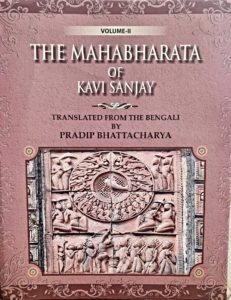
The two-volume book is very neatly produced. The printing of the double-column text is excellently executed. The paper used is of high quality. The two books are presented in a nicely conceived card-board box, with photographs of terracotta temple panels of Bengal printed on both sides of the box. The same photographs are reproduced on the front and back cover of the books, displaying two episodes from the epic – Draupadi Svayamvara and Arjuna piercing the earth and providing Bhishma with water. There is one more plate inside Volume 1 depicting Narayana lying on his Naga-bed. These are from Mondal Chhototaraf Temple of Hadal, Narayanpur and Jorbangla Temple of Bankura. However, the printers’ devils have not spared even a quality production like this book. They have a habit of creeping through the most vigorous proof correction.

The book is worthy of being in one’s collection, not only for the literary value of its content but also for the aesthetic quality of its presentation.

**********************

https://www.boloji.com/articles/51843/the-mahabharata-of-kavi-sanjay–a-review
Filed Under: BOOK REVIEWS, IN THE NEWS, Kavi Sanjay, MAHABHARATA

Kavi Sanjay’s Mahabharata

January 19, 2020 By admin

MAHABHARATA IN TRANSLATION

The Mahabharata of Kavi Sanjay
PRADIP BHATTACHARYA, trans. from Bengali, The Mahabharata of Kavi Sanjaya, Volumes I & II, Das Gupta & Co., Kolkata, 2019, pp. 637, Rs. 1495/-

While Kaliprasanna Sinha (1841-1870) is the most renowned and popular Bengali translator of Mahabharata in prose, Haridas Siddhantavagish is more known to researchers, and Kashiram Das’s 16th-century retelling, Kashidasi Mahabharata, is the most popular rendering in verse, few know that there had been Kavi Sanjaya in the 15th century, who can be considered the Adi Kavi of Bengal in the Mahabharata genre of translation and retelling. This is surprising given that the Kavi has his place secured in the cultural history of Bengal courtesy Munindra Kumar Ghosh’s edited ‘Kavi Sanjaya Birochito Mahabharata’ published by Calcutta University in 1969, restoring Sanjaya’s Mahabharata written in unique poyar metre (each line of the rhymed couplet consisting of eight syllables followed by a caesura and six syllables) in panchali form. Despite Ghosh’s historic effort, evidently, Sanjaya has not been much in Mahabharata discourse, either academic or popular, until now. After fifty years of his work, Dr. Pradip Bhattacharya resurrects him from slipping into the recesses of cultural memory once again, but to a wider world audience this time through his verse-by-verse English translation, perhaps re-confirming the ironic dictum that Bengalis do not wake up to their glories without the involvement of English.

Bhattacharya’s new venture—a project sanctioned by West Bengal Government’s Higher Education Department through the Netaji Institute of Asian Studies— comes in two hard-bound volumes, beautifully encased in dignified brown overtone, and printed on quality paper. Volume-I contains 7 parvans: Adi (Book 1) to Drona (Book 7), and Volume-II the rest. Kavi Sanjaya has innovations after Shalya Parvan (Book 9): Gada Parvan (10), Daho Parvan (14) and Sthan parvan (16).

Images of terracotta panels depicting Mahabharata episodes as cover design — Arjuna hitting the fish target at Draupadi’s svayamvara on the front cover, sheshashayi Narayana as frontispiece and Arjuna piercing the ground to quench Bhishma’s thirst on the back cover— from terracotta temples of Bankura-Bishnupur (West Bengal) aptly add to the ambience. They also act as Bhattacharya’s hint-commentary on the possible cultural interaction of the literary and terracotta genres, and of Sanjaya’s possible influence on the terracotta sculptor-poets of the 16th-17th centuries. One may even read them symbolically: Arjuna piercing the target as Bhattacharya’s statement of having achieved a gargantuan task, and Arjuna quenching Bhishma’s thirst as his optimism to quench the never waning thirst of Mahabharata lovers for amrita drops from the Mahabharata Ocean.

An appendix of Arjuna’s ten names from Prof. P. Lal’s Virata Parvan transcreation serves the purpose of reference, comparison with Sanjaya’s verses, Bhattacharya’s contextualizing his work and also his tribute to Prof. P. Lal through remembrance.

Bhattacharya has done a very interesting experiment with spellings of nouns and consonant sounds. Bengali, a language with Magadhi Prakrit as her ‘mother’, often has ‘o’ pronunciation of consonants that Sanskrit renders as ‘a’ ; often has a stop at the end-consonant of a word, no difference in pronunciation between ‘v’ and ‘b’, and absence of the sibilant ‘s’ which is pronounced as ‘sh’. Retaining spellings of Sanskrit words as found in the Oxford English Dictionary, Bhattacharya spells proper nouns in tune with Bengali pronunciation. Thus, Mahabharata is Mohabharot, Kavi Sanjaya is Kobi Sonjoy, Vyasa is Byas, Vana Parvan is Bono Porbo, Drona is Dron, Amba is Omba etc. Even his own name on the second title page is Prodeep Bhottacharjyo. This is unique for an English translation. Indeed, he has provided the ‘flavour of the Bengali pronunciation’ as claimed.

Bhattacharya has taken all precautions against any possible confusion from this experimentation. Other than providing footnotes and clarifications for every such usage on every page, he takes care to eliminate any residual confusion with his Bengali ‘flavoured’ spelt nouns by listing them with their corresponding Sanskrit transliteration along with brief explanations in a detailed glossary.

In the Preface, Bhattacharya provides valuable information and analysis on the historicity of Sanjaya and his Mahabharata, as also on interesting aspects of its content like variations from Vyasa’s Mahabharata, complete with a comparative analysis of the variations of Sanjaya’s and Kashiram Das’ Mahabharatas. His observation that ‘some of (Kashiram’s variations) must have been taken from Kobi Sonjoy’ is a clue for future research to situate Sanjaya historically and understand the import of his work.

Locating Sanjaya is important not only to understand his time, but also to understand the significance of modern Mahabharata works and studies including Bhattacharya’s work of reviving him in English. Bhattacharya has rightly pointed out that Mahabharata re-emerged with prominence in cultural discourse through literature in the 15th-16th centuries in a somewhat synchronized fashion in eastern and southern India. Kavi Sanjaya’s venture is paralleled by Kumara Vyasa in Kannada, Sarala Das in Odiya, Rama Sarasvati in Assamese, and Ezhuthachan in Malayalam. Only the last is a complete translation, but all are characterized by free thinking and imagination in incorporating materials from local lore or innovations, and in leaving out most philosophical discourses of Vyasa’s Mahabharata.

Obviously, something happened in the cultural sky of Bengal and India then that Mahabharata needed to be rediscovered. Bhattacharya’s tentative suggestion that it might be the felt need to assert indigenous identity in the context of Muslim invasion holds merit. It definitely ‘calls for further study’ as he suggests, particularly so if we see how the Mahabharata fascination continues in the next centuries and almost dominates the consciousness of all key figures of the Bengal/Indian Renaissance of the 19th century.

Looking back into Indian history, we find how Mahabharata has been remembered during every crucial historical juncture, or ‘golden age’. Starting from Bhasa (4th cent. BCE), through the Satavahana Queen Goutami-Balashri’s Nashik-Prashasti Inscription (149 CE), Vishakhadatta’s Mudrarakshasa ( 4th century CE), Gupta Inscriptions, Ravikirti’s Aihole Inscription of Pulakeshin II (610–642 CE), the Indonesian Bharata–Yuddha (1157 CE) of Mpu Sedah and Mpu Panuluh and Emperor Akbar’s commissioned Persian translation Razmnama (three editions 1584-1617) show the great impact of Mahabharata in India and beyond.

Inheriting this brilliant tradition, Sanjaya’s Mahabharata assumes the miniature replica of the melting pot with mingled ingredients of Ramayana and Mahabharata tradition, and influences of Buddhism, Jainism, Vaishnavism and Shaktaism. For example, Sanjaya makes King Nala the grandson of Rama’s son Kusha, thereby bringing together Ramayana and Mahabharata. Here he is in the direct tradition of Vyasa’s Mahabharata where we have Markandeya’s Ramayana, Hanuman’s interaction with Bhima, and Rama’s bloodline Brhadbala dying by Abhimanyu’s hand.

Just as Sanjaya creates and narrates a new parvan (Gada parvan), one is startled to find that Al-Biruni’s India (973–1050 CE) too mentions Gada parvan as Book 9. Could there be any connection between Al-Biruni and Sanjaya’s source despite their distance in space and time (5 centuries), or is it a glorious coincidence?

Again, Sanjaya’s Ashvamedhaparvan, which largely follows the Jaiminiya Mahabharata, provides an interesting variation in that Bokrodonto instead of Baka Dalbhya steals the horse so that he can meet Krishna. In the ancient Jain Sutrakrtanga (1.6), Dantavakra is the best of Kshatriyas as a parallel to Mahavira the best of sages. Whether Sanjaya’s giving such importance to Bokrodonto (Dantavakra) is owing to Jain influence would be an interesting query for researchers. After all, the Jain community known as Saraks, though isolated and separated from the main body of the Jain community following Bakhtiyar Khalji’s invasion, still maintained a significant presence in Bihar, Bengal, Orissa and Jharkhand.

Sanjaya’s Karna is born from Kunti’s ear, thus getting the name Karna. The same narrative is found in the Bheel Bharata and folk narratives in other parts of India.

Sanjaya’s most dramatic innovation is introducing Draupadi as a warrior. In Drona Parvan, following Abhimanyu’s death, Draupadi leads an all-woman army of Yadava women including Subhadra, Uttara, Krishna’s queens and Revati against the Kaurava army at night and routs them, though finally sparing the key figures for their male counterparts to fulfil their vows. In a series of wish-fulfilling dramas, Draupadi defeats Drona, Ashvatthama and Duryodhana, and whirls about Duhshasana by his hair, avenging her similar humiliation at his hands in the Kuru Sabha. Similarly, Subhadra ties up Jayadratha’s hands and feet and has him kicked unconscious by maids. Jayadratha seems to be at the worst receiving end from Sanjaya. Earlier too, in Vana Parvan, after Bhima had rescued Draupadi from Jayadratha, Draupadi’s maids had kicked him. Uttara beheads Duhshasana’s son Rudradev who killed Abhimanyu. Here, Sanjaya is undoubtedly influenced by the Shakta tradition and represents women as Shakti evoking the imagery of Mahishasuramardini. Or, he might be remembering two marginalized episodes of Vyasa’s Mahabharata in which Draupadi exerts physical prowess and hurls her molesters Jayadratha and Kicaka to the ground. While Vyasa does not name Duhshasana’s son, Sanjaya’s naming him Rudradev gives a face to the faceless killer of Abhimanyu and has an ironic humanitarian dimension.

Sanjaya’s Adi Parvan has Janamejaya charging Vyasa with failure to prevent the fratricidal battle. This dramatic situation of Vyasa-Janamejaya interaction as the narrative frame has a curious parallel in Peter Brook’s Mahabharata (1989) which begins with Janamejaya and Vyasa interacting. Peter Brook introduced folk elements in his Mahabharata. It seems, the ‘folk mind frame’ of creative artists, perhaps, visualizes dramatic situations in similar ways.

Kavi Sanjaya, of Bharadvaja Gotra, was a resident of Laur village in present Bangladesh. While in Vyasa’s Mahabharata, Pandu and Indra’s friend Bhagadatta is ruler of Pragjyotishpur, Sanjaya hails him as him as ruler of Vanga-Desh including Laur. The exalted place accorded to him might point to a Bhagadatta cult in the region covering present day Assam and Bangladesh because, as evident from the Nidhanpur copperplate inscription, the Kamarupa king Bhaskaravarman (7th century CE) eulogized Bhagadatta as Deva and traced his ancestry to Bhagadatta’s successors.

Like the character Ahiravana in Krittibas’ Ramayana, Sanjaya creates a character named Viveka, Sudhanva’s infant son, who vanquishes Krishna, Pandavas and Hanuman. Finally, on his grandfather Hongshodhvoj’s request, Viveka surrenders to Krishna. In Bengali, ‘bibek’ connotes conscience. Besides, in the Yatra (folk-theatre) tradition, there is a character called ‘Bibek’, conscience-personified. Given that the fratricidal Kurukshetra War did not bring peace and joy to Yudhishṭhira’s mind owing to qualms of conscience, whether Sanjaya’s introduction of Viveka is an echo-metaphor for Viveka-conscience, or Bibek of Yatra tradition with the role of conscience might be another interesting point of query.

In the same Ashvamedhaparvan, Sanjaya introduces the story of King Niladhavaja’s wife Jana (Jvala in Jaimini) who, failing to incite his brother against Arjuna for avenging her son Prabir’s death, immolates herself, transforms into an arrow and enters Babhruvahana’s quiver. Later Babhruvahana kills Arjuna with that arrow, and Jana’s revenge is accomplished. Girish Chandra Ghosh, the father of Bengali theatre, wrote a powerful play ‘Jana’ in 1894 with her as the central character.

The cultural interaction of early Bengali literature and Yatra is quite evident in that, the Krishna Jatra genre, evolved through the devotional singing and dancing of the followers of the Krishna Bhakti movement, was inspired by Rasa-lila and dramatic poetry like Jayadeva’s Gita Govinda (12th century), Chandidas’ Srikrishna Kirtan15th century) and later further propelled by Chaitanya Mahaprabhu’s mystic Krishnaism. There is also Nata Gita, an operatic folk drama form in medieval Bengal, filled with singing, dancing and music sans dialogue, which provided an early model for the Krishna Jatra.

One unique aspect of Sanjaya’s Mahabharata pointed out by Bhattacharya is that his narration is interspersed with Lachadi couplets of twenty syllables accompanied by dance, to be sung in various ragas and raginis such as Basant, Kamod, Bhatiyal, Shri, Barari and Pathamanjari. Obviously, dramatic elements abound in Sanjaya’s Mahabharata. This is further evident from the narrative twists. In Mausala Parvan, Kavi Sanjaya has Arjuna accompany Krishna at the end, and true to Yatra appeal and high drama, Sanjaya’s Krishna breathes his last while resting his head on his best friend Arjuna’s lap.

Bhattacharya’s easy flowing English, constantly reminding us of the richness of Bengal’s culture, makes a pleasant and illuminating read.

At the end, one would certainly agree that Bhattacharya’s translated volumes merit an imperative place in libraries and collections for serious researchers of Indian and Bengal history and for Mahabharata-lovers and lay readers alike.

Indrajit Bandyopadhyay

Associate Professor

Department of English

Kalyani Mahavidyalaya

West Bengal

Filed Under: BOOK REVIEWS, IN THE NEWS, Kavi Sanjay, MAHABHARATA Tagged With: MAHABHARATA IN TRANSLATION

The First Bengali Mahabharata in Verse and in Prose

March 17, 2018 By admin

Towards the end of the 13th century A.D. we notice a common literary feature emerging in eastern India that becomes very prominent by the 16th century not only in the east but also in the south. Vyasa’s Mahabharata was translated first into Bengali and then into Assamese, Oriya, Telegu and Kannada. The reasons for this remarkable synchronicity deserve further study. For the present, let us look at the picture in Bengal.

According to Dinesh Chandra Sen, the renowned historian of Bengali literature,  it was a Muslim ruler of Bengal, Sultan Nusrat Khan or Nasir Khan (1285?-1325) who commissioned the first translation of Mahabharata in Bengali entitled “Bharat Panchali.”[1] The work is not traceable but Kabindra Parameshwar states in his Bengali Mahabharata: “The glorious leader Nasrat Khan had the panchali[2] composed, the ultimate in merit.” However, history is ignorant of any sultan of Bengal by this name ruling for forty years at that time. After examining the evidence, Major General S.K. Sen suggests that the reference might actually be to Nasiruddin Nusrat Shah (1519-1531 AD) who succeeded his father Sultan Alauddin Hussain Shah of Bengal (1493-1519 AD). Nusrat Shah went to Chattagram (Chittagong) with general Paragal Khan as the king’s representative in 1515-1516. Paragal became governor there and got the Mahabharata translated by Kabindra Parameshwar, which came to be known as the Paragali Mahabharat. Hussain Shah was a distant ruler while Nusrat, the crown prince, was a powerful patron at hand in Chittagong as is evident from the verses of Shrikara. Kabindra would be referring to this Nusrat and to Srikara’s panchali, not to a distant ruler. Paragal’s son Chhuti Khan succeeded him as governor and got the Jaiminiya Ashvamedhaparva translated by Shrikara or Shrikaran Nandi which came to be known as Chhuti Khaner Mahabharat. Part of it was included in Kashiram Das’ Bengali Mahabharata (composed 1604-1610) and Krittibas’ Ramayana (c. 1st half of 15th century).

Kabi Sanjay is the first translator of the complete Mahabharata into Bangla for regaling rustic audiences, composed in payar metre in the first half of the 15th century, prior to the rule of Sultan Hussain Shah in Bengal. He precedes Chaitanya (1486-1533), unlike most other vernacular renderings of the epic, as there is no trace of Vaishnava bhakti in his work. His date is uncertain, but he might be a contemporary of Krittibas, the translator of the Ramayana (not later than the 15th century).[3] However, on the basis of language and style some scholars place him in the 17th century AD.[4] A resident of Laur in the Sunamganj subdivision of Shrihatta district in East Bengal, he belonged to the Bharadvaja gotra. An interesting point is that he praises Bhagadatta as the ruler of Laur and also calls him ruler of Bengal, although Vyasa’s Mahabharata does not do so, because Shrihatta was at one time part of Pragjyotishpura, the capital of Bhagadatta. While his version is almost unaffected by the devotional movement, it contains several unusual Shakta-influenced episodes. He departs quite freely from the Sanskrit epic’s contents, unlike Kashiram Das a later translator. The narration is interspersed with laachari to be sung and various ragas and raginis are indicated in the text such as Vasant, Kamod, Bhatiyal (not a raga, but the typical boatman’s song of Bengal), Shri, Barari, Pathamanjari.

Kabi Sanjay created a new genre, the Pauranik fairytale in his translation of the epic. The key elements are given below:-

  • Sanjay provides a novel start to the epic. Janamejaya (J) charges Vyasa with failure to prevent his ancestors from the fratricidal battle of Kurukshetra. Vyasa laughs and says that people do not listen to prohibitions. As an example he issues an injunction that to avoid misfortune J must not make Kantavati his chief queen, which is precisely what he proceeds to do. He also insults sage Rishyashringa who curses him to be afflicted with bhagapida, syphilitic sores, all over his body. Vyasa reappears and tells him that to be cured he should listen to the epic recited by Vaishampayana. That is why the recital begins. At the end of Svaragarohana parva, J is cured, rounding off the narrative.
  • In Astika parva he adds a new story of Takshaka, pursued by Garuda, marrying his daughter Sarada to Parikshit and thus escaping death. A folktale of the ojha (curer of snake-bite) of Shankhapura is added and a novel treatment of J’s serpent sacrifice.
  • The Shantanu-Ganga story is given a novel twist. Brahma curses Mahabhisha for his shameless ogling of Ganga’s nudity to be born a vanara. He worships Shiva who grants his wish to possess Ganga. Shiva commands Ganga who takes the vanara aside and tells him that first he must become hairless like her and can do so by entering fire. To persuade him she magically protects him when he tests a finger in a flame and remains unhurt. When he enters the fire she does not protect him and he dies. King Kuru is performing a sacrifice and finds a dry place overflowing with hot water which he and the sages cannot cross. The monkey’s corpse comes floating by and they use it as a bridge. Thereupon the vanara is liberated and is born as Kuru’s son, Shantanu. Shiva berates Ganga and forces her to wed Shantanu.
  • Amba’s love for Bhishma is a creation of Sanjay’s who makes of it a long love-story.
  • Chitrangad dies of TB. Vichitravirya violates Bhishma’s injunction against entering his palace in his absence and is crushed there by the elephant with which Bhishma used to wrestle daily to exercise.
  • Dhritarashtra plots with Duryodhana to build the house of lac.
  • In the Khandava conflagration the survivors are sage Lomasha, Surabhi the cow, Danavendra lord of demons and Vishvakarma.
  • The Rajasuya yagya is held because Pandu, insulted in Swarga, sends Narada to urge his sons to hold this sacrifice so that he can regain status. During the conquests, on his return from Lanka Arjuna encounters Hanuman. This becomes an interesting folk-tale.
  • Duryodhana and Drona send a band of fasting sages to Yudhishthira in exile but Krishna’s miracle saves the Pandavas.
  • In Udyoga parva a folktale is added about Kakalilasura.
  • In Bhishma parva the story of Brahmachandala is added and the beauty and valour of horses are elaborated at great length.
  • In Drona parva after Abhimanyu’s death Draupadi leads an army of women against the Kauravas. Karna refuses to fight them. Duryodhana is routed.
  • In Karna parva the story of Tarakaksha and Makaraksha is added.
  • Ashvamedhaparva mostly follows the composition of Jaimini, Vyasa’s disciple, omitting the retelling of the Rama story. Sanjay adds Yadava and Pandava women fighting the enemy when the Pandavas are defeated. He has Surya give Vrishaketu a chariot during the battle with Anushalva. Jaimini’s Jvala is turned into Jana and glorified in particular. She dies and turns into an arrow that lies in Babhruvahana’s quiver with which he kills Arjuna. Girish Chandra Ghosh, the father of Bengali theatre, wrote an extremely popular play, Jana, about her in 1894. The battle descriptions surpass Vyasa’s. The stories of Jana, Sudhanva, Babhruvahana, Chandi, Chandrahasa are magnificently related. Chandrahasa’s story has been substantially changed, especially Vishaya’s subterfuge in replacing the word visha (poison) with her name, Vishaya. Jayadratha’s son does not die of fear but fights bravely with Arjuna. Jaimini’s Bakadalbhya has become Bakradanta and he steals the horse so that he can see Krishna. Viravarma becomes Virabrahma and his daughter Malini becomes Ratnavati. Uddalaka is renamed Udyana in the story of Chandi and the curse is dispelled when both the horse and Arjuna touch the stone. The remarkable story of the many-faced Brahmas is absent. Sanjaya describes Chitrangada as a veshya, a prostitute, while in Jaimini Arjuna says that Babhruvahana must be a son of a vaishya. The description of the horse required for the sacrifice is different too and the parva ends with Krishna’s return to Dvaraka with the Yadavas which is a departure from Jaimini.
  • In Ashvamedhaparva Sanjay goes beyond Jaimini to invent the grand episode of Vivek, son of Sudhanva, who immediately after birth takes on Arjuna and Krishna to avenge his father’s death, routs Arjuna’s army, vanquishes Arjuna and Krishna, defeats Bhima, Nakula and Sahadeva and the combined army of Yadava and Pandava women. Finally, on his grandfather Hamsadhvaja’s request, Bibek surrenders to Krishna.
  • Certain incidents are taken from Vyasa: the Pandavas go to Kailasa with Krishna to obtain the wealth of Marutta, the story of Parikshita’s birth, Arjuna’s horse goes to Kirata and Yavana lands, Trigartya, Pragjyotisha, Chedi, Magadha, Kashipura, Deshartha, Nishada, Kirata again, the kingdoms of Ugrasena, Kuntibhoja, Panchala, Gandhara, etc.
  • Mausala parva has Arjuna accompany Krishna at the end and, as they rest together, Krishna is shot and killed.
  • Svargarohana parva has new tirthas come up where each Pandava falls. The route is along the Ganga. Meghanada Daitya tries to abduct Draupadi and is slain by Bhima.

In Bengal the influence Jaimini’s Ashvamedhaparva was felt most powerfully. According to Dinesh Chandra Sen, Sanjaya, Kabindra Parameshwar, Shrikara Nandi and almost all the later translators have recorded that they translated the Mahabharata following the Jaimini-Samhita. Little is taken from Vyasa, except a few references. Jaimini was a leader among the revivalists of Hinduism (Shankara came later). His disciple, Bhattapada, defeated the Buddhists in King Sudhanva’s court. Many ancient Bengali books contain references to the Jaimini Bharata.

In the early 16th century AD Kabindra Parameshwar translated the Mahabharata in brief (so that it could be heard in a single day) up to Stri Parva[5] under the patronage of Paragal Khan. This came to be known as the Paragali Mahabharata and also as Pandab Bijoy.[6] This includes basically the battle stories, especially in the Ashvamedhaparva which, as in Sanjaya, is taken from Jaimini. Most of the stories of the original epic are omitted.  

Dinesh Chandra Sen states that after this there are many translations of which the important ones are Dvija Abhirama’s Ashvamedhaparva, Ananta Mishra’s Ashvamedhaparva, Nityananda Ghosh’s Mahabharat, Dvija Ramchandra Khan’s Ashvamedhaparva, Kabichandra’s Mahabharat, Shashthibar Sen’s Bharat, Gangadas Sen’s Adi and Ashvamedhaparva, Rameshwar Nandi’s Mahabharata, Kashiram Das’s Mahabharat, Trilochan Chakravarty’s Mahabharat, Nimai Das’s Mahabharat, Dvija Krishnaram’s Ashvamedhaparva, Dvija Raghunath’s Ashvamedhaparva, Bhriguram Das’s Bharat, Dvija Ramkrishnadas’ Ashvamedhaparva and Bharat Pandit’s Ashvamedhaparva.[7] W.L. Smith[8] mentions complete Bengali versions of Ashvamedhaparva by Ghanashyam Das and Dvija Premananda and more recent versions by Rajaram Dutt (19th century), Kaliprasanna Vidyaratna (Jaiminibharata in verse, 1884). Chandranath Basu’s Ashvamedhaparva in free prose came out in 1317 B.S. i.e. 1910-11 AD.[9] Munindra Kumar Ghosh mentions Nandaram Das, Dvija Govardhan, Bhabani Das and Dvija Srinath among others. Asit Kumar Bandyopadhyay mentions the name of Dvija Haridas too. It is not clear whether these works are based on Vyasa or on Jaimini.

The most popular Bengali verse translation remains Kashiram Das’ Mahabharat which follows Jaimini’s Ashvamedhaparva. In him the influence of Chaitanya’s Vaishnavism is overwhelmingly perceptible. The work was a major influence on Bengali literature.

Kaliprasanna Singha (1840 or 1841 to 24 July 1870) authored the first prose translation of the Mahabharata. Educated in Sanskrit, Bengali and English, he left school in 1857 at the age of 16 and established the Vidyotsahini Theatre in his own house where he enacted Venisamhara. Encouraged by its success, in the same year he translated Kalidasa’s Vikramorvashiya. In 1858 he wrote the play Savitri-Satyavan and in 1859 Malati-Madhava. These plays were staged in his theatre with him in the main roles. Purana-sangraha, a collection of Puranic stories from the Mahabharata was published between1860-66. His greatest literary feat was translating the Mahabharata into Bangla in 17 volumes, for the first time in Bangla literature. The work was begun in 1858 with a team of seven pandits and completed in 1866, omitting and adding nothing. 3000 copies of each parva were printed, being unsure of the reception. He excluded Harivamsha as he found its composition to be plainly later than the epic. However, he had a plan to publish its translation along with those of the Puranas, as the title page indicates.

What the BORI editors of the critical text of the Mahabharata have done now, Kaliprasanna began at the age of 18 in 1858 all by himself, collating manuscripts from the Asiatic Society, Shobhabazar Palace, the collections of Asutosh Deb, Jatindramohon Thakur and his own great-grandfather Shantiram Singha’s collection in Kashi. He acknowledges with gratitude the help he received in resolving contradictions in the texts and making out the meaning of knotty Vyasakuta verses from Taranath Tarkavacaspati teacher at the Calcutta Sanskrit Vidyamandir. He records with profound gratitude that Ishvarchandra Vidyasagar began a translation of the epic and had published some parts of it in the Brahmo Samaj’s Tattavabodhini magazine, but stopped the work on hearing of Kaliprasanna’s project. Vidyasagar not only went through Kaliprasanna’s translation but supervised the printing and the work of translation in his absence. Kaliprasanna writes that he has no words to express the benefits Vidyasagar showered upon him. Apparently, Vidyasagar provided him seven pandits for the project.[10] Kaliprasanna gives special thanks to several friends viz. the famous poet Michael Madhusudan Dutt for promising to turn the best parts of the translation into Amritakshar metre and a play; the Purana expert Gangadhar Tarkabagish, Raja Kamalkrishna Bahadur, Jatindramohon Thakur, Rajendralal Mitra, Dvarkanath Vidyabhushan (editor of Somprakash), Rajkrishna Bandopadhyay (professor of Bengali literature in Presidency College), Nabinkrishna Bandopadhyay (former editor of Tattvabodhini), Dinabandhu Mitra (the playwright of Nil Darpan) and Kshetramohon Vidyaratan (editor of Bhaskar). Deploring the death of ten members of his team of translators, he thanks by name those engaged till the end and the proof readers (mentioning all their names).

Daily in the evening the translation, as it progressed, was read out to Raja Radhakanta Deb and other prominent leaders of Hindu society like Raja Kamalkrishna Bahadur and Rajkrishna Mitra. In villages, he writes, the translation is read out in important gatherings morning and evening. He pays a fulsome tribute to Kashiram Das’ translation in Bengali verse, regretting that details of his life and dates are not recorded anywhere. He leaves out discussion and summaries of Sanskrit literature based on Asiatic researches and Max Muller’s edition of texts to avoid any controversy that might harm the unrestricted acceptance of his translation.

The work took eight years to complete and was printed at his Tattvabodhini Press. It was provided to readers who wrote in, free of charge. Readers were advised not to send any postage stamps. In every district an agent was appointed to distribute the book so that it could be obtained without spending anything. It was and remains a unique project of making wisdom literature available without charging anything for it.

Many laughed his herculean effort to scorn, ascribing it to a quest for immortal fame by buying up pandits to translate. In response he merely stated that he had no craving for public fame, but only that should, by the grace of God, the Bengali language exist anywhere and this book fall into someone’s hands who might be able to make out its meaning and understand the pillar of glory of the Hindu race that was the Bharat, then all his labour would have been successful.[11]

Kaliprasanna dedicated his translation to Empress Victoria in gratitude for the British rescuing Bharatavarsha from the mortal clutches of the Mughals. He compared his offering to the gods offering the Parijat flower churned out of the ocean to Purandara-Indra. The intention behind the translation was a faith that it would redound to the country’s good. He hoped that Hindusthan would be lit up during her reign by hundreds of lamps of Sanskrit literature as it was during Vikramaditya’s reign by Kalidas etc. and in Queen Elizabeth’s reign by Shakespeare etc. to make her reign unforgettable.

Today one is surprised that there is no mention of the 1857 Mutiny although the translation was started the next year. The elite of Bengal were not enamoured of the aborted effort, preferring to proclaim their loyalty to the British Empress as vociferously as possible.

* This article draws heavily on the research by Maj.Gen. S.K.Sen VSM whose generous assistance is acknowledged with gratitude.

[1] Dinesh Chandra Sen, Bangabhasha O Sahitya, Gurudas Chattopadhyaya & Sons, Kolkata, 7th edn, 1st edn. 1896

[2] Rhyming verse that can be sung.

[3] Sen op.cit. and Munindra Kumar Ghosh, Kabi Sanjaya birachita Mahabharata, Calcutta University, 1969, p. 153

[4] Asit Kumar Bandyopadhyay, Bangla Sahityer Itivritta, Vol 1, Modern Book Agency, Kolkata, 2006, p. 462

[5] According to Munindra Kumar Ghosh up to Ashvamedhaparva, the later parvas being interpolations.

[6] Asit Kumar Bandyopadhyay, op. cit. p. 441-2

[7] Dinesh Chandra Sen, ibid, p. 455-456

[8] W.L. Smith, “The Jaiminibharata and Its Eastern Vernacular Versions,” Studia Orientalia, The Finnish Oriental Society, Vol 85, Helsinki, 1999, p. 402

[9] Asit Kumar Bandyopadhyay, op. cit. p. 434

[10] Binod Ghoshal, “Kaliprasannar Katha Amrita Saman,” Binodon supplement to Ananda Bazar Patrika, 20.8.2016, pp. 10-4.

[11] Binod Ghoshal, op.cit.

Filed Under: Kavi Sanjay, MAHABHARATA, Mahabharata, STORIES, ESSAYS & POSTS Tagged With: Bengali, Kaliprasanna, Kavi Sanjay, Mahabharata

Footer

Recent Posts

  • MEMORY OF 15TH AUGUST 1947
  • A.R.Orage on The Mahabharata
  • POLICE FIRING AT ISLAMPUR IN MURSHIDABAD DISTRICT

Tags

Bangladesh Bankimchandra Bengali Bhishma Book Reviews Bulcke Critical Edition Desire Dharma Draupadi Draupadi Dream Trust Drona Essays glb Grantha script Harivansha Hiltebeitel Homer Indraprastha Jaimini Jaiminiya Mahabharata. Journal Kalpataru Karna Kavi Sanjay krishna Mahabharata McGrath memoir Mokshadharma Murshidabad News novel P. Lal Panchakanya Ramayana refugee Satya Chaitanya shakuni Sri Aurobindo Statesman Vande Mataram video Vyasa Yudhishthira

Follow Me

  • Facebook
  • Linked In
  • Twitter

CONTACT ME

Search

Archives

  • June 2026 (1)
  • April 2026 (1)
  • February 2026 (2)
  • December 2025 (1)
  • November 2025 (1)
  • October 2025 (1)
  • July 2025 (1)
  • June 2025 (1)
  • May 2025 (1)
  • September 2024 (3)
  • May 2024 (3)
  • February 2024 (1)
  • October 2023 (2)
  • September 2023 (1)
  • March 2023 (4)
  • February 2023 (1)
  • January 2023 (1)
  • September 2022 (1)
  • August 2022 (2)
  • July 2022 (1)
  • June 2022 (2)
  • February 2022 (1)
  • January 2022 (2)
  • November 2021 (1)
  • September 2021 (5)
  • January 2021 (2)
  • December 2020 (1)
  • September 2020 (1)
  • July 2020 (3)
  • June 2020 (1)
  • March 2020 (1)
  • January 2020 (2)
  • December 2019 (13)
  • October 2019 (1)
  • September 2019 (1)
  • August 2019 (2)
  • April 2019 (2)
  • March 2019 (4)
  • February 2019 (1)
  • January 2019 (2)
  • December 2018 (1)
  • November 2018 (4)
  • October 2018 (2)
  • September 2018 (2)
  • August 2018 (4)
  • July 2018 (4)
  • June 2018 (5)
  • April 2018 (3)
  • March 2018 (2)
  • February 2018 (1)
  • January 2018 (1)
  • November 2017 (2)
  • October 2017 (7)
  • August 2017 (1)
  • July 2017 (2)
  • June 2017 (11)
  • May 2017 (19)

Copyright © 2026 Dr. Pradip Bhattacharya