Introduction

Disrobing Draupadi, CE vol. 2
The Critical Edition (CE) of the Mahabharata published by the Bhandarkar Oriental Institute (BORI), Pune (1933-1966) is generally regarded as the last word in arriving at the textual canon of the epic. Half a century later, however, enough justification exists for taking a hard look at its claim to provide the best manuscript version extant. The fact is, as Mehendale[1] points out, that the oldest manuscript by far— a 12th century, Nepali palm-leaf manuscript— was not available for study. Nor, admitted Sukthankar,[2] were Kannaḍa, Oḍīya and Nandināgarī manuscripts examined. Edgerton, editor of the Sabhā Parva of the CE, refers to a complete manuscript, a continuous roll in Devanagari, in the Bharat Itihasa Sanshodhaka Mandal of Pune, which he could not obtain for study.[3] The National Mission for Manuscripts has to find and document it for the revised edition of the Mahabharata.
The CE also did not take into account the earliest version of the epic in a foreign language: Abu Saleh’s Instruction of Princes (1026), an Arabic translation from the Sanskrit. Preceding the oldest manuscripts depended upon by the CE by centuries, this is an astonishing account of the Kurus and Pāṇḍavas as viewed from Sindh with no mention of Kr̥ṣṇa.[4] Had Ruben known of it, it would have added grist to his mill in arguing that originally the epic was Kr̥ṣṇa-less.[5]
Further, the editors did not study the Razmnama (1584), the Persian version of the epic (including Harivaṁśa) that Akbar commissioned, although it was contemporaneous with the manuscripts depended upon for the CE. Sukthankar was mistaken in rejecting it as merely a “free rendering of the original.”[6] Neither is it “an abridgement” as Adluri and Hiltebeitel claim.[7] A comparison with the CE would reveal the departures in the Persian version, which would throw light on the status of the text followed under Akbar’s direction. For instance, its Aśvamedha Parva follows Jaimini’s composition, not the Vaiśampāyana recital.[8] The scholars Akbar gathered for this massive enterprise formed an editorial board that was the precursor of the CE’s and included Debi Misra (author of Bhārata artha dīpikā ?) and Chaturbhuja Misra (author of Bhārata upāya prakāsaka bhārata tātparya prakāśikā) from Bengal, Satavadana, Madhusudana Misra (editor of Mahānātakam), Rudra Bhattacaraj and Sheikh Bhawan (a Dakhini Brahmin convert). The selection shows Akbar’s awareness of the existence of the Bengal, Northern and Southern recensions. His orders were to establish exactitude so that nothing of the original would be lost. The work was often read aloud to him, followed by discussions. Badauni records that once Akbar lost his temper on hearing certain passages and accused him of inserting his own bigoted views. Thus, the fidelity of the Persian version to the original was carefully verified.[9]
What the editors of the CE have done now, Kālīprasanna Siṁha did in Calcutta by the age of 30 for his Bengali translation of the Mahabharata(excluding Harivaṁśa, which he stated was clearly a much later composition) in 17 volumes (1858-1866) omitting and adding nothing. He had a team of 7 pundits. Manuscripts from the Asiatic Society, Shobhābāzār palace, the collections of Asutosh Deb, Jatindramohan Thākur and his own great-grandfather Shāntirāma Siṁha’s collection in Benares were collated. For resolving contradictions in the texts and making out the meaning of knotty slokas he was helped by Tārānātha Tarkavācaspati of the Calcutta Sanskrit Vidyamandir. Every evening the translation, as it progressed, was read out to prominent leaders of Hindu society.[10]
Thus, like the CE, both the late 16th century Persian version and the mid-19th century Bengali translation were prepared by collating Mahabharatamanuscripts from different regions. However, issues of repetition and inconsistency were not resolved in the Bengali translation. Without studying the Razmnama we cannot say what had been done there. One would expect that 20th century scholars would try to make good these lacunae. Instead, the CE contains contradictions that are the result of the rigid[11] application of the principle that whatever appeared in the largest number of manuscripts was to be included, irrespective of intra-textual consistency, which was rejected as “the realm of higher criticism.”[12] Yet, Sukthankar himself set aside his own cardinal principle when he chose to begin the CE text with the benedictory invocation, despite its absence from the entire Southern recension. His reason: all Hindu texts invariably began thus.[13] No one has dared to criticise this departure.
Some unresolved contradictions and repetitions
Bankimchandra Chatterjee argued in his masterly Krishnacharitra (1886-1892):
“Those that contradict each other, of them one must necessarily be interpolated…No writer indulges in unnecessary repetition or creates a situation of contradiction through such repetition.”[14]
A good example of repetition is the two occasions on which Arjuna prevents Kr̥ṣṇa from killing Bhīṣma at VI.55 (the third day) and VI.102 (the ninth day). Lexical analysis suggests that the latter is added on, whereas the context suggests that the former is the addition. The CE editor sought to resolve this by proposing that originally it was the third day that was the penultimate day of Bhīṣma’s command and, therefore, he fought for only 4 not 10 days. His arguments are far from convincing.[15]
A few of the unresolved internal contradictions in the CE are enumerated below which appear to be “passages, which were composed at a very early date and hence found time to creep into all versions,” writes Mehendale, but “the transmitters of the epic tradition…did (not) deliberately omit what they had received by tradition.” He explains that the CE retained these “since such contradictory passages occur uniformly in all the versions of both (North and South) recensions.” He adds that decisions about these “will be the task of later researchers who have to take recourse to higher criticism (emphasis mine).” [16]
- In the Ādiparvan (207.14), Arjuna visits Maṇalūra during his twelve-year long exile, while in the Āśvamedhikaparvan (77.46) it is named Maṇipūra. The former indicates southern influence as Southern manuscripts locate Maṇalūra near Madurai and make Citrāñgadā a Pānḍyan princess. One of these has to be emended as a scribal error by comparing with other references to Citrāñgadā.
- According to the Ādiparvan (116.31), Mādrī mounted her husband’s funeral pyre in the Himalayas. This is reiterated at 117.28. However, at the beginning of section 117 we find Kuntī and her sons entering Hastināpura with sages who have brought along the bodies of Pānḍu and Mādrī. Then, section 118 provides a description of their ornamented, anointed and perfumed bodies and states that Pānḍu’s body looked as if he were alive. So, the corpses had been preserved for over 17 days (117.27)? Surely, either the corpses had been cremated in the Himalayas or they were brought to the capital for funeral, remaining un-decomposed for over a fortnight. One of these accounts is an interpolation.
- In the Sabhāparvan (61. 35-38), Draupadī is dragged into the gaming hall and Karṇa directs Duḥśāsana, pānḍavānām ca vāsāṁsi draupadyāś cāpyupāhara, “Strip the Pānḍavas and Draupadī of their garments!” (61.38). Hearing this, the Pāṇḍavas cast off their uttarīya (upper garments). Duḥśāsana pulls at Draupadī’s single cloth in the midst of the assembly hall. However, almost nowhere subsequently is there any reference to the attempted stripping. We will examine this contradiction in depth.
The attempt to strip Draupadī
The CE omits Draupadī’s prayerto Kr̥ṣṇa for succour but not the miracle of unending garments. The Sabhāparvan editor, Edgerton, writes, ‘It is apparently implied (though not stated) that cosmic justice automatically, or “magically” if you like, prevented the chaste Draupadī from being stripped in public…later redactors felt it necessary to embroider the story.’[17] The CE text reads thus in van Buitenen’s translation[18] of II.61.40-42:-
“40. Then Duḥśāsana forcibly laid hold of Draupadī’s robe, O king, and in the midst of the assembly began to undress her.
41. But when her skirt was being stripped off, lord of the people, another similar skirt appeared every time.[19]
42. A terrible roar went up from all the kings, a shout of approval, as they watched that greatest wonder on earth.”
In the CE (II. 43-47) Bhīma vows to taste the blood of Duḥśāsana after he pulls at Draupadī’s sole cloth and a fresh one appears.
As she is dragged from the inner apartments, Draupadīappeals to Duḥśāsana to refrain (II.60.25), as she is menstruating (rajasvalāsmi) and is clad in just a single cloth (ekaṁca vāso). Duḥśāsana responds that regardless of whether she is menstruating, wearing a single cloth (ekāmbarā) or none (vivastrā), she is their prize and their slave, “And one lechers with slaves as the fancy befalls!” (van Buitenen, 60.27). As he shakes her about, there is a reference to half of her cloth slipping (patitārdhavastrā 60.28).[20] She pleads with Duḥśāsana again, “Don’t render me nude, do not debase me!” (mā māṁ vivastrāṁ kridhi mā vikārṣīḥ, 60.30). When she is dragged into the assembly hall, Bhīma notices that her upper cloth is slipping (strastottarīya, 60.47). This refers to the portion of her garment covering her torso and not to a separate cloth for the upper-half of the body since she is ekāmbarā. The painting commissioned specially for the CE shows, in the background, four Pāṇḍavas bare-bodied and Arjuna seated with his back to the scene, naked; in the foreground Duḥśāsana pulls at a single cloth wrapped around Draupadī.[21]
In the “Vulgate,”[22] Draupadī calls out to Govinda, Kr̥ṣṇa, Keśava Dvārakāvāsin, Ramānātha, Janārdana Vrajanātha and Gopījanapriya, the last two epithets indicating a post-Harivaṁśa addition by a poet familiar with Kr̥ṣṇa’s childhood dalliance with the milkmaids of Vraja as Bankimchandra Chatterjee noted back in 1886.[23] Kr̥ṣṇa springs up from his bed in Dvārakā and rushes on foot, deeply moved by Draupadī’s appeal, which reaches him telepathically.[24] This recurs when she, faced with Durvāsā’s untimely demand for food in the forest, invokes Kṛṣṇa. Referring to these two passages Sukthankar comments, “They undoubtedly represent a later phase of Kṛṣṇa worship.”[25] Some vernacular versions elaborate this further along the lines of the gopī–vastraharaṇa episode in the Bhāgavata Purāṇa (X.22): so long as Draupadī clutches on to her sole covering there is no response to her outcries; it is only when she lets go and lifts her hands in total surrender that the miracle occurs.
How Draupadī’s modesty was saved is hinted at in verse 544* in the footnotes of the CE, which might be the earliest interpolation:
“Yājñasenī cried out for rescue to Kr̥ṣṇa, Viṣṇu, Hari and Nara. Then Dharma, hidden, the magnanimous, covered her with a multitude of garments.”
This is repeated in 553*:
“Thereupon hundreds of garments of many colours and whites appeared, O lord, due to the protection of Dharma.”
These refer back to II.60.13 where, when summoned to the dicing hall, Draupadī reflects, “In this world Dharma alone is supreme. Observed, he will bring peace.”
The enigmatic statement gives rise to many speculations, one of which possibly led to the interpolated passage bringing in Kr̥ṣṇa as saviour along the lines of yato dharmas tataḥ kr̥ṣṇo yataḥ kr̥ṣṇas tato jayaḥ (VI.41.55). Further, the god Dharma incarnated as Vidura who was the first to protest against the dice-game and the summoning of Draupadī before the assembly. Does he, Dharma-incarnate, clothe her? Significantly, later in the Udyogaparvan when Kr̥ṣṇa reminds Saṁjaya of her sufferings, he refers to her casting piteous glances all around the hall to find only kṣattā Vidura as her protector, nānyaṁ kṣatturnāthamadr̥ṣṭaṁ kañcit, who alone spoke in condemnation, ekaḥ kṣattā dharmyāmarthaṁ bruvāṇo (V.29.33, 34). Or shall we imagine ‘Dharma’ as referring to the outraged sensibilities of the assembly who throw off their upper garments to cover Draupadī, as narrated in Ayyanappilla Asan’s Malayali Bharatam Pattu (c.1500 CE, contemporary with the CE’s manuscripts)?[26] Ultimately, as Duḥśāsana tires, evil omens erupt—jackals howl and asses bray—whereupon Gāndhārī and Vidura succeed in persuading Dhṛtarāṣṭra to intervene.
Hiltebeitel (2001)[27] argues that Kr̥ṣṇa’s intervention to protect Draupadī’s modesty is very much envisaged in the CE, citing two verses from the Udyogaparvan in which Draupadī, exhorting Keśava (V.80.26), and Kr̥ṣṇa speaking to Saṁjaya (V.58.21), refer to her appeal, “O Govinda,” for rescue. He admits that neither Draupadī nor Kr̥ṣṇa mentions the attempted stripping. If, then, Draupadī was not being stripped, why should Kr̥ṣṇa have intervened miraculously? Moreover, when they meet for the first time after the dice-duel in the forest-exile, Draupadī specifically mentions having been manhandled, kr̥ṣyeta (III.13.60), and “dragged around in their hall with my one piece of clothing” while menstruating (stridharminī vepamānā śoṇitena samukṣitā / ekavastrā vikriṣtāsmi duḥkhitā kurusamsadi // III.13.68), being “molested,” parikliśyantīm (III.13.107) and “laid hold of by my hair” kacagrahamanuprāptā (III.13.107, 109). However, she makes no mention of any attempt to strip her. Kr̥ṣṇa responds that, had he been present, he would have prevented the fraudulent dice-game, but he was far away battling Śālva who had sacked Dvārakā (III.14.1). He mentions neither any attempt to strip her, nor any appeal from her reaching him—telepathically or otherwise. In his 1976 study on the burning of the forest, Hiltebeitel wrote that the CE is not to be followed blindly.[28] Here he is doing precisely that.
Other Evidence
- At the very beginning of the Mahabharata in the Anukramanikā Parvan, Dhṛtarāṣṭra laments that Draupadī was dragged into the assembly hall but does not mention any attempt to strip her:-
yadāśrauṣaṁ draupadīm aśrukaṇṭhīṁ; sabhāṁ nītāṁ duḥkhitām ekavastrām /
rajasvalāṁ nāthavatīm anāthavat; tadā nāśaṁse vijayāya saṁjaya //
“When I heard that Draupadī, tears in her throat, had been dragged into the assembly hall grieving, in a single garment, and she in her period, while her protectors stood by as though she had no one to protect her— then, Sanjaya, I lost all hope of victory.” (I.1.106, van Buitenen).
- Nor does he refer to Bhīma’s vow to drink Duḥśāsana’s blood. Arguing that the vow is a subsequent addition, Bhatt writes that this is “wonderfully supported by the omission of the event from the summary of the Karṇa Parvan given in the well-known Parva-saṅgraha Parvan.”[29]
- In the Virāṭaparvan, Draupadī, while lamenting her condition before Bhīma, refers only to a prātikāmin (servant/messenger) dragging her into the hall by her hair and being called a dāsī (IV.17.2).
- Aśvatthāmā refers to the incident (IV.45.11-12) while reprimanding Karṇa for boasting: “Likewise, where was the battle in which you won Kṛṣṇā? In her single garment she was dragged into the hall, miscreant, when she was in her month, ekavastrā sabhāyām nītā duṣṭakarmaṇā rajasvalā” (van Buitenen).
- Arjuna upbraids Karṇa: “You watched how evil men molested(kliśyamānāṁ) the Princess of Pāñcāla in the assembly hall” (IV.55.4), but he does not mention the ultimate outrage of his command that she be stripped, or even to his abusing her as a prostitute.
- In the Udyogaparvan (V.29.31, 33) when Kr̥ṣṇa mentions to Saṁjaya the atrocities suffered, he refers only to Duḥśāsana dragging menstruating Draupadī into the hall before elders.
- Whenever Yudhiṣṭhira recounts the sufferings they have undergone, he always mentions Draupadī having been dragged by her hair, but never to any attempt to strip her. In his message to Duryodhana through Saṁjaya, he refers only to her hair being violated in the hall, keśeṣva dharṣayat (V.31.16).
- When Kr̥ṣṇa and the Pāṇḍavas consult before the peace-embassy (V.70-79) they do not mention avenging any attempted stripping. Of them, Arjuna alone speaks of Draupadī’s trials and this is limited to “how that fiend molested Draupadī in the middle of the hall” parikliṣṭā sabhāmadhye (V.76.18).
- Even when Draupadī herself, furious with everyone favouring peace, lists her sufferings (V.80. 24, 26), “grabbed by the hair and molested in a men’s hall” (sāham keśagraham prāptā parikliṣtā sabhām gatā) and states how she invoked Govinda mentally for succour (trāhi māmiti govinda manasā kaṁkṣito’si me), she does not mention any attempt to strip her, although that would have been the sharpest goad to spur them into battle.
- In his embassy to the Hastināpura court when Kr̥ṣṇa tells Dhṛtarāṣṭra all the suffering Duryodhana has imposed on the Pāṇḍavas, including dragging Draupadī into the court (V.93.58), he makes no mention of the attempt to strip her, which would have been the greatest crime.
- When Kr̥ṣṇa rebukes Duryodhana during the peace embassy, enumerating all his ill deeds, he refers to his abusing and maltreating (vinikr̥tā) the queen of the Pāṇḍavas (V.126.8-9), but makes no mention of the supreme outrage of attempting to strip her.
- Kuntī, listing her sorrows to Kr̥ṣṇa several times over, laments that her greatest sorrow is Draupadī being abused verbally and molested (parikliṣṭā), dragged into the assembly hall draped in a single cloth while menstruating, but does not mention any attempt at stripping her daughter-in-law, which would surely have been the greatest torment by far (V.88.50, 56; 85-86; 135.15-18, 21).
- Ghaṭotkaca, assailing Duryodhana, charges him for dragging and insulting Draupadī in her period in a single garment in the assembly-hall, with no mention of attempted stripping (VI.87.26).
- The Karṇaparvan begins with the Kauravas musing over how they dragged and demeaned Draupadī. Dhṛtarāṣṭra tells Saṁjaya how his son had the wife of the Pāṇḍavas violently brought into the assembly where Karṇa abused her as “Wife of slaves” (dāsabhāryeti VIII.5.79). Although at different stages in the battle Dhṛtarāṣṭra, Bhīma, Duḥśāsana and Kr̥ṣṇa all recall the dragging and insulting of Draupadī, none refers to any attempt to strip her.
- In the Karṇaparvan verses relegated in the CE to footnotes (VIII.61.934* and 935*), when Bhīma rips off the arm with which Duḥśāsana boasts he had dragged Draupadī by her hair, neither refers to the grosser outrage of attempting to strip her.
- When Kr̥ṣṇa recounts Karṇa’s misdeeds to goad Arjuna into killing him, he refers to single-cloth-clad, menstruating Draupadī being summoned to the sabhā and mocked (VIII.67.2-3), but does not refer to Karṇa instigating any stripping, which would have surely been the sharpest goad to spur him on.
- Bhīma enumerates Draupadī being dragged by her hair among the sufferings imposed by Shakuni, Duryodhana and Karṇa but not any attempted disrobing (Vulgate, VIII.83.46).
- At the end of the war, when Yudhiṣṭhira provokes Duryodhana to emerge from Dvaipāyana lake, he mentions Draupadī being verbally abused and dragged, but says nothing about any attempted disrobing (IX.30.187*).
- Bhīma, while kicking Duryodhana’s head, refers only to single-garment-draped Draupadī being mocked in the hall, not to any attempted stripping (IX.58.4).
- Even at the very end, in the Svargārohaṇaparvan, Yudhiṣṭhira, outraged on seeing Duryodhana in heaven, refers to his having caused Pāñcālī to be afflicted, parikliṣṭā (XVIII.1.9) in the sabhā, but nothing more.
Adluri and Hiltebeitel peremptorily dismiss the evidence of the passages involving Duryodhana as “karmically irrelevant” because of a philosophical proposition “that blame-casting must necessarily be agent-specific in a karmic universe.” This is resorting to the same “higher criticism” which they frown upon instead of tackling the contradictory evidence. They also feel that some of the others are “broadly worded enough to include an allusion to the disrobing,” though they do not explain this.[30]
Textual disconnect
Satya Chaitanya’s study of the sequence of events brings to light a major hiatus in the text.[31] A similar disconnect can be found in the Bhīṣmaparvan where the text-block VI.95.4-23 repeats the portion at 16.11-20+42.2, indicating an adding-on of verses 16.21 to 42.1.[32] In Draupadī’s case, after Duḥśāsana failed in his attempt, ‘The people shouted, “The Kauravyas refuse to answer the question,” and condemned Dhṛtarāṣṭra’ (II.61.50). This refers to Draupadī’s question to the assembly (II.60.44), repeated at II.62.13, which remains unanswered in the epic. Strangely enough, the audience neither censures the king for allowing the attempted stripping, nor criticises Duḥśāsana for making the attempt. Even more puzzling is everyone’s silence about the unending stream of cloth, whether emanating from Dharma or Kṛṣṇa. Instead, Vidura’s speech, which follows, states that Draupadī is awaiting a reply to her question, weeping like an orphan (II.61.52). Surely, Vidura would have been the first to protest against any attempt to disrobe Draupadī publicly and to extol her miraculous escape in response to her appeal to Kr̥ṣṇa? It is significant that he refers neither to Vikarṇa’s response in support of Draupadī nor to Karṇa rebuking him and directing that she should be stripped. It is as though these speeches have not happened at all. We have noted above that even Kr̥ṣṇa, while listing Karṇa’s misdeeds, does not mention his having ordered the disrobing (VIII.67.2-3). The sequence of events indicates that originally there was no hiatus between Draupadī’s query and Vidura’s exhortation to the assembly to provide an answer. Whatever we find now, in-between, is a subsequent addition.
There are three parallel accounts of Draupadī’s coming to the dicing hall in chapter 60, which need to be reconciled.[33]
- Duryodhana sends the prātikāmin to fetch her but she sends him back with a question to Yudhiṣṭhira.
- Duryodhana sends him again to tell her to come and state her case in person. She, thereupon, expresses her faith in Dharma.
- Now in slokas 14-15 Yudhiṣṭhira sends his trusted attendant to her, whereupon she appears in the hall.
- But in sloka 16 onwards Duryodhana asks the prātikāmin to fetch her and, on his hesitating, orders Duḥśāsana to do so. He, then, drags her by her hair into the hall.
The accounts at 3 and 4 are contradictory and the latter has possibly been added subsequently along with Bhīma’s blood-drinking vow for greater dramatic effect.[34]
What happens thereafter?
- When Draupadī herself speaks, after Karṇa bids Duḥśāsana take her away to the Kaurava apartments, she voices her bewilderment at being dragged into the assembly but utters not a word about any attempt to strip her, which is most unnatural. Nor does she refer to Kṛṣṇa’s response to her prayer and the abject failure of the attempt to disrobe her (II.62.1-14), about which Hiltebeitel is insistent.
- Subsequently, disturbed by the ominous howling of beasts, when Vidura and Gāndhārī press Dhṛtarāṣṭra to intervene, neither refers to any attempted disrobing (II.63.24).
- Dhṛtarāṣṭra rebukes his son for his wicked speech to dharmapatni Draupadī, but not for any heinous attempt to strip her.
- Even the vow that Bhīma makes refers to her hair having been touched, parāmr̥śya (II.62.34), while Nakula’s vow mentions her being verbally abused, yairvācaḥ śrāvitā rukṣāḥ (II.68.43). Neither refers to any attempt to disrobe her, which would surely have been the gravest provocation for swearing vengeance.
- When Draupadī proceeds on exile, she is described as wearing a bloodstained cloth (II.70.9). If Kṛṣṇa or Dharma had continuously replaced what Duḥśāsana kept pulling away, how could she still be wearing this cloth stained with menstrual blood?
- In the last chapter of the Sabhāparvan Dhṛtarāṣṭra laments that they “dragged the wretched Draupadī to the middle of the hall…clothed in her single garment, stained with blood…Duryodhana and Karṇa threw biting insults at the suffering Kr̥ṣṇa” (van Buitenen II.72.12-18). There is no mention of what should have been the greatest crime: the attempted disrobing and its miraculous failure.
- Dhṛtarāṣṭra also tells Saṁjaya (II.72.19-20) that the Bharata women and Gāndhārī cried out in anguish and Brahmins did not perform the sandhyā rituals on the day of the dice game, furious with the dragging of Draupadī. Again, there is no reference to disrobing.[35]
- In the Vanaparvan, Saṁjaya repeats his master’s word parikarṣaṇe to describe the outrage but makes no mention of disrobing.
- P. L. Vaidya, editor of the CE’s Karnaparvan, held that a verse referring to her being stripped (VIII.85.15) was an interpolation and left it out of the CE text.[36]
Hiltebeitel has overlooked two confirmations of stancein the Śalyaparvan. J. D. Smith[37] pointed out to me that as “Bhīma is gloating after fulfilling his vow to overthrow Duryodhana and tread on his head,” he says,
“Those who brought the menstruating Draupadī and who made her naked (avastrām) in the assembly—see those Dhārtarāṣṭras slain in battle by the Pāṇḍavas because of the torture on Yājñasenī.” (IX.58.10)
Yet, in an earlier verse (IX.58.4), while kicking Duryodhana’s head, Bhīma refers only to Draupadī clad in a single garment being mocked in the hall, not to any attempted stripping. Smith acknowledges that a contradiction exists, but is helpless because of the principle followed by the CE: “…it is strange that Bhīma says this at this point and does not say anything similar after fulfilling the more relevant vow against Duḥśāsana. But again, this is what the text actually says.”[38]
Secondly, earlier on in the same parvan (IX.4.16-17) Duryodhana tells Kr̥pācārya that there is no point in seeking peace because,
duḥśāsanena yat kr̥ṣṇā ekavastrā rajasvalā
parikliṣṭā sabhāmadhye sarvalokasya paśyataḥ
tathā vivasanāṁ dīnāṁ smaranty adyāpi pāṇḍavāḥ
na nivārayituṁ śakyāḥ saṁgrāmāt te paraṁtapāḥ
“Wearing a single cloth and covered in dust, dark Draupadī was wronged by Duḥśāsana in the middle of the assembly hall under the eyes of the entire world. Even today the Pāṇḍavas still remember how she was naked (vivasanām) and wretched (dīnām); those enemy-destroyers cannot be turned from war.”[39]
This is the solitary reference retained in the CE to Draupadī having been stripped naked (not to an attempt to strip her), but it is devoid of any mention of re-clothing. That implies that she remained naked thereafter and there was no miracle of endless garments. On the other hand, all recensions of the text agree that she proceeds on exile wearing a bloodstained garment.
This prompts examination of the annotations, which reveals that some manuscripts have vimanasā (dejected, bewildered) instead of vivasanā. Vimanasā is textually more consistent with Duryodhana’s description of her condition in the earlier line(parikliṣṭā), but the editors of the CE did not accept this reading that is more consistent with what has gone before and comes after. Thus, they ended up with a text that renders Draupadī naked without any re-clothing.
There has been no attempt to reconcile these contradictions although the overwhelming evidence is weighted against any incident of trying to disrobe Draupadī.
Collateral Evidence
- The earliest post-Mahabharata evidence is in the plays of the first Sanskrit dramatist Bhāsa: Dūtavākyam, Dūtaghaṭotkacam and Ūrubhangam (c. 4th century BC-1st century CE?).
- In the first, Duryodhana displays to Kr̥ṣṇa a vivid painting of the dice-game showing draupadī keśāmbarākarṣaṇam, “Draupadīdragged by the hair and garment” (prose passage following sloka 6) and duḥśāsano draupadīm keśa haste grihītavān, “Duḥśāsana seizing Draupadī’s hair in his hand” (prose passage preceding sloka 7). Kr̥ṣṇa exclaims, draupadī keśadharṣaṇam “Draupadī’s hair being violated!” In 1916 Winternitz, comparing Bhāsa’s Dūtavākyam with the Mahabharata, demonstrated that Kr̥ṣṇa’s reclothing of Draupadī was an interpolation introduced after the 4th century CE.[40]
- In the second play, Ghaṭotkaca upbraids Duryodhana saying, śirasi na tathā bhrātuḥ patniṁ spriśanti niśācarāḥ, “nor do night-wanderers (Rākṣasas) ever touch the brother’s wife on the head” (sloka 47), referring to her having been dragged by her hair. This is an echo of what he says in the Bhīṣmaparvan VI.87.26.
- In the third play, Duryodhana says, yat kriṣṭa karanigrahāncitakacā dyūte tadā draupadī, “How Draupadī was dragged by the hair in the dicing” (sloka 63).[41]
- Rājaśekhara’s Bālabhārata (c. 10th century CE) is unaware of the re-clothing of Draupadī by Kṛṣṇa.[42]
- Neither the Vaishnava Bhakticult’s Bhāgavata,nor the appendix to the epic, Harivaṁṣa, mentions any attempted stripping, despite their focus on the miraculous deeds of Kṛṣṇa. The former refers only to the heinous act of the Kuru lady being dragged by her hair (keśabhimarśam) in the assembly hall but not to Kṛṣṇa rescuing her miraculously from being stripped (I. 86; I. 15.10; III.1.7; XI.1.2.).
- In the Devi Bhāgavata Purāṇa Janamejaya refers twice only to Draupadī being dragged by her hair (IV.1.36 and 17.38), using the word dharṣitā (IV.1.38), which also means “violated”, for what Kīcaka did to her. Yudhiṣṭhira uses the same word while giving Saṁjaya his message, keśeṣvadharṣayat (Mahabharata, V.31.16).
- It is later, in the Śiva Purāṇa (c. 11th century CE) that we find a reference to the incident (III.19.63-66). Here the stream of garments is the result of Durvāsā’s boon to Draupadī for having torn off part of her dress to protect the sage’s modesty when his loincloth was swept away in the Ganga.[43] Kr̥ṣṇa plays no role in this. There is also the popular tale of Draupadi binding up his bleeding finger with a strip of her garment because of which he provides her an endless stream of cloth in the dicing hall.[44]
- Satya Chaitanya[45] has pointed out that the Jaiminīya Aśvamedhaparvan again a late work (c. 10th-12th century AD), carries a reference to the disrobing (2.62). Here Kr̥ṣṇa pays the Pāṇḍavas a surprise visit as they are wondering how to go about the horse-sacrifice. Draupadī says that they ought not to be surprised because earlier Kr̥ṣṇa had appeared to save them from Durvāsā and, “Before that, Hari appeared in the form of clothes in the assembly(vastrarūpī sabhāmadhye) to save me from shame.”[46] We have noted above Sukthankar’s rejection of both incidents as interpolations.
Adluri and Hiltebeitel have sought to bolster their argument in favour of the disrobing episode by citing a painting of the incident possibly by Nainsukh (c. 1760/65). On the other hand, the much older sculpture in the Hoysaleshwar temple in Halebidu (c. 12th century) reproduced below only depicts Draupadī being held by her hair, one woman approaching her while another restrains the male tormentor.[47]
We do not find any depiction of the dice game in sculpture or painting after this until we come to Akbar’s Razmnama (1598-99). It is here that, for the first time, the stripping of Draupadi is portrayed. That is why comparing its text with the Sanskrit manuscripts is so important.
Conclusion
To sum up, intra-textual evidence supporting the attempt to strip Draupadī is available in only two passages in the Śalyaparvan (IX.4.16-17 and IX.58.10), of which the former has a more consistent variant reading available. Even these do not refer to her being re-clothed, whether by Kr̥ṣṇa or otherwise. The passages upon which Hiltebeitel depends refer only to her having invoked Govinda in her distress, but not to any disrobing-and-re-robing. With overwhelming consistency (at least 27 times), the text refers only to her being dragged by her hair into the royal assembly-hall while in her period, wearing a single bloodstained cloth and being insulted. She leaves on exile wearing the same bloody garment. Further, there is no mention of the attempted disrobing in early Sanskrit literature. It is only a couple of late texts that mention the attempt and how it was aborted miraculously.
Both the internal and the external evidence, therefore, indicate that the incident of attempted stripping that has ruled the popular imagination so powerfully, featuring on stage, in paintings, films and television as the fuse that detonated the explosion destroying the Kshatriya clans, is a later addition by one or more highly competent redactors.[48] That would imply that the three verses (II.61.40-42) retained in the CE, quoted at the beginning of this paper, are part of the interpolation that the editors rejected.
Janamejaya, who is listening to the recital, is familiar with only one version in which Draupadī was dragged, not stripped (cf. the Devi Bhāgavata Purāṇa above). That is why he never questions Vaiśampāyana about the contradictory accounts about how Draupadī was outraged.[49] How is this “the kind of ideologically motivated, idiosyncratic” approach that Adluri and Hiltebeitel condemn so vehemently?[50]
Revising the Critical Edition
The first scholar to have expressed serious reservations about the CE was Sylvain Levi, the doyen of French Indologists, who argued in favour of using the Nīlakaṇṭha text showing all other variants alongside.[51] Madeleine Biardeau, the leading French scholar, questions Sukthankar’s basic premise that the Śārada version is the genuine product just because it is the shortest and apparently earliest. She writes, “I do not give much heuristic value to the reconstituted text of the critical edition of Poona.”[52] She felt the editors were blindly devoted to an outdated German philological approach. She is the first to ask bluntly why the text should be dated between 4th c. BC and the end of the 4th c. AD, as maintained by so many. Georges Dumezil preferred the Calcutta edition to the CE.[53]
Wendy Doniger, calling the CE “no text at all,”[54] urges that “any structural analysis of the epic would of course demand all available variants of the text.”[55] Mincing no words she writes, “The critical edition…is like Frankenstein’s monster, pieced together from various scraps of different bodies; its only community is that of the Pune scholars, the Frankensteins.”[56]
Julius Lipner criticizes the imposition of the Western paradigm of a “critical edition” based upon a supposed “original version” since “popular oral tradition…which is the very lifeblood of Hinduism, does not work in this way…the text itself transcends the critical edition both as sacred narrative…and as a seed-bed for the literary imagination.”[57]
Arvind Sharma comments, “…it is clear that, at every step, the idea of a critical text seems to go against the grain of the tradition— it is an example of pratiloma Indology.”[58]
Simon Brodbeck has pointed out the basic flaw in the assumption of the CE, viz. that scribes only add to and do not subtract from texts they copy. There is a case for re-examining the decisions of the CE’s editors about both including as well as leaving out passages.[59]
Alf Hiltebeitel has argued strenuously that Belvalkar, editor of the CE’s Shanti Parva, made a mistake in following the Malayalam manuscripts to alter the frame narrative as well as splitting a section into two, changing the Nārāyaṇīya portion’s 18 sections (an epitome of the MB’s structure, like the Gita) to 19.[60]
Instead of regarding the CE as sacrosanct and arguing that we ought to accept that the epic knows of two versions of the outrage Draupadī suffered, we surely need to weigh the comparative evidence delineated above and then decide which way the scales dip. It is time to re-examine the CE adopting the “higher criticism” route. Even Brockington, who has subjected both epics to minute analysis under the lexical microscope, has come to a conclusion that echoes the “higher criticism” approach.[61]
Use has not been made of the valuable guidance available in Sri Aurobindo’s notes written in 1902. He approached the epic “from the point of view mainly of style and literary personality, partly of substance” deferring “questions of philosophy, allusion and verbal evidence” and ignoring “the question of minute metrical details on which they (Western scholars) base far-reaching conclusions.”[62] Submitting everything to the ultimate test of style, he identified that the Sabhāparvan carries “the hand of the original poet…that great and severe style which is the stamp of the personality of Vyāsa” and stated that, except for certain passages, the Virātaparvan and Udyogaparvan were also Vyāsa’s work.[63] As an example he quotes from the former (IV.16.9) Draupadī’s outcry to the sleeping Bhīma,
uttiṣṭhottiṣṭha kiṁ śeṣe bhīmasena yathā mr̥taḥ /
nāmr̥tasya hi pāpīyān bhāryām ālabhya jīvati //
He writes, “The whole personality of Draupadie breaks out in that cry, her chastity, her pride, her passionate and unforgiving temper, but it flashes out not in an expression of pure feeling, but in a fiery and pregnant apophthegm. It is this temperament, this dynamic force of intellectualism blended with heroic fire and a strong personality that gives its peculiar stamp to Vyasa’s writing and distinguishes it from that of all other epic poets.”[64] Similar is Kr̥ṣṇa’s exhortation in the Udyogaparvan (V.73) for shaking Bhīma out of his pacifist mood.
It is remarkable that this selection of verses on stylistic criteria as pristine Vyāsa is matched by their inclusion in the CE many decades later on the basis of manuscript evidence. Surely, where two approaches agree, there is adequate justification for giving equal weight to each. Brockington has urged the need for “a coordinated approach to a particular text. This is where in particular the future lies…different approaches can be combined in order to provide greater illumination.”[65]
Sri Aurobindo pointed out that there is also the hand of an inferior poet clearly visible who delights in the miraculous and whose style is highly coloured.[66] This stylistic difference is apparent in the Sabhāparvan in the portion beginning with Vikarṇa’s speech and ending with the miraculous re-clothing of Draupadī. In addition, we have to take into account Kr̥ṣṇa’s assertion —consistently borne out in the epic—that he can do all that a man can, but the miraculous is beyond him:-[67]
ahaṁ hi tat kariṣyāmi paraṁ puruṣakārataḥ /
daivaṁ tu na mayā śakyaṁ karma kartuṁ kathaṁ cana // V.77.5
Incidents like those involving Durvāsā in the forest and the re-robing of Draupadī are inconsistent with this. “If we find grave inconsistencies of character…we are justified in supposing two hands at work.”[68] Therefore, on the grounds of both style, content and textual consistency, the incident is liable to be considered as the work of a different, later, poet. In 1916 Winternitz showed that Kr̥ṣṇa’s re-clothing of Draupadī was an interpolation.[69] In 1949, in a different way, G.H. Bhatt argued for the same conclusion at the 15th All-India Oriental Conference, Bombay.[70]
L. M. Singhvi,[71] writing in 2008, recommended “another encyclopedic project of preparing a comprehensive Mahabharata Bibliography in all the Indian languages as well as other European and Asian languages.” Strongly endorsing the views of Bankimchandra and Sri Aurobindo regarding the stylistic layers in the Mahabharata, he urged:-
The rigid exclusion and abandonment of the Ugrasrava recension and some of the later additions and accretions would be ruinous. What we need is a continuous discourse of scholarship and a host of scholarly guides to tell us of the architectonics of the Mahabharata and the historical and literary background of different accretions, additions and interpolations…. (that) represent the history as well as legend and myth of India and the confluence of the so called classical and the folk. The interwoven tapestry of MB made it a veritable people’s Epic reflecting the social and cultural reality of different periods of Indian history and different perceptions of the Indian people at different stages.”
An example of the need for this is seen in Hiltebeitel’s comment in Dharma (2011) that Ashvaghosha’s reference in Buddhacharita to Karalajanaka is “unknown and uncertain,”[72] whereas a discourse with this king exists in the Mokshadharma Parva of the MB in the Haridāsa Siddhāntavāgīśa edition[73] which the CE has not covered. In his recent book on nonviolence in the MB Hiltebeitel (2016) uses the story of rishi Parnada in deer form and the gleaner Satya which is not in the CE, taking it from “the northern Vulgate of the seventeenth-century compiler Nilakantha.” He even suggests that the tale was inserted by Nilakantha, concluding that with such “improvisations” the MB “both as text and tradition…puts both ahimsa and gleaning into the consciousness and unconscious of Hindus.”[74] That reminds us of Sukthankar’s insertion of the invocatory benediction into the CE violating his own editorial principles.
Surely, the CE is not beyond all question! Even with the Bible, after the Authorised Version (1604-11) there was the Revised Version (1881-94) followed by further revised editions. It is the German philological approach to the Bible that was adopted in preparing the CE, labelling the others as “Vulgate” as in the case of the Biblical project. The central problem lies in mapping the inter-relationships among manuscripts. Wendy Phillips-Rodriguez has put forward a fascinating schema called “uprooted trees” like the Gita’s cosmic tree whose roots are upwards and branches downwards. Through this paradigm she finds that the southern manuscripts are more widely dispersed than the northern, indicating their independent evolution. This upside-down tree model opens up the study of the epic’s variations as having “an independent cultural value”. Very pertinently she asks, “Why privilege one version over the others?”[75] The variations are separate interpretations, and the study of how each evolved will enable greater understanding of the cultural roots of the epic.
The Revised Edition announced by the BORI, however, raises concerns.[76] Their website states:-
“Revisions to the edition will be limited to incorporating the addenda and corrigenda for each volume into the text and either correcting or pointing out minor errors in the editor’s apparatus or comments (e.g., misprints, dittographies, confusion of manuscript sigla, etc.). The edition will not undertake to revise the constituted text nor will it emend the form of the edition.”[77]
However, it is time to take another look at the CE taking into account not only the many manuscripts left out, but also the contents of the adaptations in Arabic and Persian that pre-date or are contemporary with the manuscripts, as well as ancient commentaries that have much to reveal regarding the state of the text. The findings of Mehendale, Dhavalikar, Bhatt and Brockington should not be ignored. The Mahabharata is the national epic of India and the largest in the world. National resources must be made available for this challenging and critical project.
Bibliography
Primary
Asan, Ayyanappilla. 1988. Bharatham Pattu (A Mahabharata retelling in Malayalam before Ezhuttacchan, with commentary by Dr. P.K. Narayana Pillai). Kottayam: National Book Stall. Extracts at http://mahabharata-resources.org/variations/vastraharana_BP.html
Chatterjee, Bankim Chandra. 1991. Kr̥ṣṇa Charitra. P. Bhattacharya (trans.). Calcutta: M.P. Birla Foundation.
Jaiminīya Aśvamedha Parva. 2008. S.K.Sen (trans., ed. P. Bhattacharya). Kolkata: Writers Workshop.
Mahabharata, Book Two, The Great Hall. 2006. Paul Wilmot (trans.). New York: Clay Sanskrit Library & New York University Press.
Mahabharata, Book Nine, Shalya, Volume One. 2005. Justin Meiland (trans.). New York: Clay Sanskrit Library & New York University Press.
Mahabharata: The Book of the Assembly Hall. 1975. J.A.B. van Buitenen (trans.). Chicago: University of Chicago Press.
The Mahabharata, Volume 2. 2010. Bibek DebRoy (trans.). New Delhi: Penguin Books.
The Sabhāparvan. 1944. Franklin Edgerton (ed.). Poona: Bhandarkar Oriental Research Institute.
Secondary
Adluri. Vishwa ed. 2013. Ways and Reasons for thinking about the Mahabharata as a Whole. Pune: Bhandarkar Oriental Research Institute.
Adluri, V. and Hiltebeitel, A. 2017 in press. “Redressing the Undisrobing of Draupadī,” in Indology’s Pulse: Arts in Context: Essays Presented to Doris Meth Srinivasan Felicitation in Admiration of Her Scholarly Research. Edited by Gerd J. R. Mevissen, Arundhati Banerji, Vinay Kumar Gupta, Corinna Wessels-Mevissen. New Delhi: Aryan Books International.
Bandyopadhyay, Indrajit. 2013. “Mahabharata: Draupadi’s Single Garment, and Disrobing in Dice Game Sabha,” http://www.boloji.com/index.cfm?md=Content&sd=Articles&ArticleID=14497 accessed on 22.06.2017.
Bhattacharya, P. 2003. “Was Draupadī ever disrobed?” Annals of the Bhandarkar Oriental Research Institute, LXXXVI: 149-152
- 2005. Review of Brockington’s Epic Threads at www.boloji.com/index.cfm?md=Content&sd=Articles&ArticleID=3919
- 2009. “The Mahabharata in Arabic and Persian”, www.boloji.com/index.cfm?md=Content&sd=Articles&ArticleID=752
- 2010. “The first Bengali Mahabharata in prose and verse”, www.boloji.com/index.cfm?md=Content&sd=Articles&ArticleID=7371
- 2012. “Problems with the Critical Edition: the attempted disrobing of Draupadi”. Presented at the 15th World Sanskrit Conference. New Delhi, 5-10 January 2012.
- 2016. The Mahabharata of Vyasa: Mokshadharma Parva, translated from the Sanskrit. Kolkata: Writers Workshop.
Bhatt, G.H. 1951. “The Draupadīvastraharaṇa Episode: An interpolation in the Mahabharata.” 15th All-India Oriental Conference, Bombay, 1949. Journal of Oriental Research XVIII, Part III, pp. 170-178.
Biardeau, Madeleine. 1997. “Some remarks on the links between the Epics, the Puranas and their Vedic sources,” in Studies in Hinduism, ed. G. Oberhammer. Vienna: Austrian Academy of Sciences.
Brockington, J.L. 1998. The Sanskrit Epics. Leiden: E.J.Brill.
_________ 2000. Epic Threads. G. Bailey & M. Brockington (eds.). New Delhi: Oxford University Press.
__________(ed.) 2012. Battle, Bards and Brahmins. Delhi: Motilal Banarsidass.
Brodbeck, Simon. 2013. “Some textological observations on the analytic and synthetic modes,” in Adluri 2013.
Chaitanya, Satya. 2005. “Was Draupadī disrobed in the dice hall of Hastinapura?” www.boloji.com/hinduism/094.htm, accessed 22.10.2013.
Dange, S.A. 2001. Myths from the Mahabharata, vol. 2. New Delhi: Aryan Books International.
Deb Roy, Bibek. 2010. The Mahabharata vol. 2. New Delhi: Penguin Books.
Dhavalikar, M.K. 1992. “Draupadī’s Garment,” Annals of the Bhandarkar Oriental Institute, Amr̥tamahotsava volume, LXXII & LXXIII (1991 &1992): 523-526.
Doniger, Wendy. “How to escape from the Curse.” London Review of Books 32/19:17-18.
Harindranath, A. http://mahabharata-resources.org/variations/vastraharana_BP.html
Hiltebeitel, A. 1988. The Cult of Draupadī. New Delhi: Motilal Banarsidass.
____________2001. Rethinking the Mahabharata. Chicago: University of Chicago Press.
____________2011. Reading the Fifth Veda. Leiden: Brill
____________2011. Dharma. New Delhi: Oxford University Press.
____________2016. Nonviolence in the Mahabharata. Oxford: Routledge.
Lipner, J.J. 2010. Hindus: Their Religious Beliefs and Practices. 2nd edn. London: Routledge: 148-149.
Mehendale, M.A. 1986. “Draupadī’s Question.” JOIB. XXXV. Nos 3-4. Mar-June: 179-194.
_______________2001. “Urubhanga and the critical edition of the Mahabharata,” in Madhu-vidya. L.D. Institute of Indology. Ahmedabad: 91-97.
_______________2005. “Did Bhima vow to drink Duḥśāṣana’s blood?” ABORI. 86: 93-97.
_______________2009. “The Critical Edition of the Mahabharata: its constitution, achievements and limitations.” In K.K. Chakravarty(ed.), Text and Variations of the Mahabharata. New Delhi: Indira Gandhi National Centre of Arts & Munshiram Manoharlal.
Meiland, Justin. 2005. Mahabharata, Book Nine, Shalya, Volume One. New York: Clay Sanskrit Library, New York University Press.
Menon, K.P.A. 1996. Complete Plays of Bhāsa, vol. I. Delhi: Nag Publishers.
O’Flaherty, W.D. and J. Duncan M. Derrett, eds., 1978. The Concept of Duty in South Asia, New Delhi: Vikas.
Phillips-Rodriguez, Wendy 2012. “Uprooted Trees: a way around the dilemma of recension,” in Brockington, J.L. Battle, Bards and Brahmins, pp. 217-229.
Sen, S.K. 2008. Jaiminiya Ashvamedha Parva (ed. Pradip Bhattacharya). Calcutta: Writers Workshop.
Sharma, Arvind. 2008. http://arvindsharma.wordpress.com/2008/04/21/25-against-the-critical-edition-of-the-mahabharata/#_ftn25_1 accessed 22.10.2013.
Singhvi, L.M. 2008: “Mahabharata: texts and contexts in a perspective”. In Neo Indika, Bharatayan, essays in honour of P.D. and S.S. Halvasiya, vol. 1. Ed. Dr Vasudev Poddar. Kolkata: Rai Bahadur Vishweshwarlal Motilal Halwasiya Trust, 15 India Exchange Place, 700001.
Sri Aurobindo. 2007. The Mahabharata: essays and translations. Pondicherry: Sri Aurobindo Ashram.
Sukthankar, V.S. 1933. “Prolegomena,” Ādi Parva. Poona: Bhandarkar Oriental Research Institute.
______________1957. On the meaning of the Mahabharata. Bombay:Asiatic Society.
[1] Retired from the Indian Administrative Service as Additional Chief Secretary, Government of West Bengal. Author and Editor of 33 books. PhD on “Narrative Art in the Mahabharata.” International HRD Fellow (Manchester). Member, Board of Governors, IIM Calcutta. An earlier version of this paper was presented in the 15th World Sanskrit Conference, New Delhi, 2012, which the editors did not include in the papers for publication as it questioned the CE. This paper was published in Indologica Taurinensia, Vol. 43-44, 2017-18
[1] Mehendale 2009: 5; 21 note 5. Adluri and Hiltebeitel (2017) assert, “Sukthankar did examine the Nepali manuscript and found that it confirmed his reconstruction,” but do not cite any evidence to controvert Mehendale’s statement.
[2] Sukthankar 1933: vi.
[3] Edgerton, “Introduction,” p. xxii quoted by Mahadevan T.P. “The Southern recension,” p. 105, in Adluri, Vishwa ed. 2013. Ways and Reasons for thinking about the Mahabharata as a Whole. Pune: Bhandarkar Oriental Research Institute.
[4] Bhattacharya 2009.
[5] Brockington 1998: 55.
[6] Sukthankar 1933: xxviii. Quoted in Adluri and Hiltebeitel. 2017.
[7] Adluri and Hiltebeitel 2017 ibid.
[8] Sen, S.K. 2008.
[9] Jaiminiya Aśvamedhaparva 2008: 69; Bhattacharya ibid.
[10] Bhattacharya 2010.
[11] Adluri and Hiltebeitel, op.cit. plead for the word, “rigorous” instead
[12] Edgerton 1944: xxxiii.
[13] Sukthankar 1930: 268-69 quoted by Adluri and Hiltebeitel 2017 in press.
[14] Chatterjee 1991: 61-62.
[15] Brockington 1998: 146.
[16] Mehendale 2009: 15.
[17] Edgerton 1944: xxix.
[18] van Buitenen 1975: 146.
[19] Why “skirt”? The Sanskrit is vasana and vastram. Deb Roy’s “garment” (2010, p. 235) is accurate.
[20] van Buitenen mistranslates this as “her half skirt drooping.”
[21] It is not a skirt-cum-stole ensemble as van Buitenen’s translation has it, but a single cloth whose upper part covers the torso, as the sari does today.
[22] Imported from Biblical scholarship referring to the popular Sanskrit text.
[23] Chatterjee 1991:113, 247.
[24] Wilmot 2006: 68.45. p. 449.
[25] Sukthankar 1942: xiii note 1.
[26] Asan 1988: 222
[27] Hiltebeitel 2001: 246-259.
[28] Brockington 1998: 139.
[29] Bhatt 1951: 172.
[30] Adluri and Hiltebeitel op.cit.
[31] Satya Chaitanya 2005.
[32] Brockington 1998: 147
[33] Bhatt 1951: 176-177
[34] Mehendale 2005 shows the vow is an interpolation.
[35] Satya Chaitanya, ibid.
[36] Bhatt 1951: 174
[37] Professor of Sanskrit at Cambridge and author of the abridged Penguin translation of the Mahabharata. He maintains the online digital text of the CE.
[38] J.D. Smith, personal communication.
[39] Meiland 2005: 77.
[40] Brockington 1998: 258 note 53; Dhavalikar 1992: 523.
[41] Menon 1996: 266-677, 274, 332, 411.
[42] Brockington 1998: 490
[43]Dange 2001:231.
[44] Hiltebeitel 1988: 226-27.
[45]Satya Chaitanya op.cit.
[46] Jaiminīya Aśvamedha Parva 2008: 90.
[47] Indrajit Bandyopadhyay 2013.
[48] Bhatt 1951: p. 178: “The examination of the whole evidence available…leads us to the irresistible conclusion that the Dv. (Draupadīvastraharaṇa) episode did not form part of the original epic…”
[49] I am indebted to Simon Brodbeck for this insight.
[50] They write, referring to me: ‘uses the self-designation “mythographer,”’ “ideologically motivated, idiosyncratic… unphilosophical and unthinking approaches,” “vapid arguments,” “most senseless examples” in Adluri & Hiltebeitel op.cit.
[51] Levi, Sylvain. 1929. Review of the CE in Journal Asiatique 215: 345-48, quoted in Hiltebeitel 2011, p. 17.
[52] Biardeau 1997: 85-86.
[53] Hiltebeitel op.cit. p. 17.
[54] O’Flaherty, W. D. 1978:22 quoted in Hiltebeitel 2011: 16.
[55] O’Flaherty, W.D. 1978 ibid.
[56] Doniger, Wendy. “How to escape from the Curse.” London Review of Books 32/19:17-18 quoted in Hiltebeitel 2011 ibid.
[57] Lipner 2010: 148-149.
[58] Sharma 2008
[59] Brodbeck 2013.
[60] Hiltebeitel 2011: 192-4
[61] Bhattacharya 2003 on Brockington 2000.
[62] Sri Aurobindo 2007:11-13, 68. Western Indologists have even dated the epic from the single occurrence of words like suranga (from the Greek suringks?), antakhim (Antioch?) and roma (Rome?) cf. CE 02028049a antākhīṁ caiva romāṁ ca yavanānāṁ puraṁ tathā.
[63] Sri Aurobindo 2007: 28. He brings out the features distinguishing Vyāsa’s style at length with examples.
[64] ibid. p.47.
[65] Brockington 1998: 525.
[66] Sri Aurobindo 2007: 13.
[67] Chatterjee 1991: 210
[68] Sri Aurobindo 2007: 12.
[69] Note 30 above.
[70] Note 23 above.
[71] Singhvi 2008: “Mahabharata: texts and contexts in a perspective”. Neo Indika, Bharatayan, essays in honour of P.D. and S.S. Halvasiya, vol. 1. Ed. Dr Vasudev Poddar. Rai Bahadur Vishweshwarlal Motilal Halwasiya Trust, 15 India Exchange Place, Kolkata-700001.
[72] Hiltebeitel 2011: 636 n. 34.
[73] Bhattacharya 2016.
[74] Hiltebeitel 2016: 31.
[75] Phillips-Rodriguez, Wendy 2012: 228
[76] The editors are V. Adluri of Hunter College USA and J. Bagchee of Freie Universität Berlin.
[77] http://www.bori.ac.in/Mahabharata-Project-Revised-Second-Edition.html accessed on 19th June 2017.

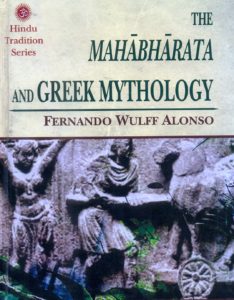 by an East India Company officer arguing that the Ramayana story was strongly influenced by the Iliad. Other than Megasthenes’ references to Indians carrying banners of Heracles and worshipping Dionysus, the Greek scholar Dios Chrysostom (40-120 AD) mentions translations of the Iliad in India. The Roman Claudius Aelianus (175-235 AD) reiterated this (e.g. the Trojan horse becoming Bhasa’s wooden elephant in Pratigya Yaugandharayana). In 1871 A.F.Weber, refuting M.H.Fauche’s proposition (supported by A.Lillie in 1912) that Homer had used the Ramayana as a guide, claimed that it was merely Buddhist legends grafted on to borrowings from Homer, an argument that W.T.Telang vigorously refuted. Weber cited Odysseus’ archery feat to win Penelope as having influenced the archery contests of Rama and Arjuna, ignoring that Rama breaks the bow and Arjuna does not shoot rivals dead. J.Lallemant argued in 1959 that the Mahabharata (MBH) influenced the Aeneid. In 1961 G.Duckworth argued that Turnus’ portrayal was based upon Duryodhana. In 1968 G.Dumezil put forward his theory of an Indo-European tri-functional ideology illustrated by the Pandavas (the dharma-king, the warrior, the grooms). Now, a Spanish professor in the University of Malaga has built up a strong case that the Homeric cycle and other Greek myths were adapted for the MBH.