Dharma destroyed, destroys; Dharma preserved, preserves
Adikavi Valmiki, the first poet, and Mahakavi Vyasa, the seer-poet, both put māyā at the core of the crises in their epic compositions. In the Ramayana it is the illusory māyā–mriga, golden deer. In the Mahabharata it is the Maya-sabhā, hall of illusion and Shakuni’s māyā in throwing the dice. In both the illusion is created by a demon: the rakshasa Māricha becomes the golden deer enchanting Sita; shape-shifter Rāvana as a mendicant abducts her; māyā-expert Vidyujjhiva creates Rama’s head to deceive her; Indrajit kills a māyā-Sita; the daitya Maya creates the magical hall that humiliates Duryodhana; and Dvāpara Yuga as Shakuni cheats with dice. This is taken to an extreme eschatological view in the Mokshadharma sub-parva of the Shanti Parva, that the world is a sphere of illusion and the failure to pierce through its appearance to the transcendent reality lying beyond turns it into a vale of misery and anguish. Thomas Carlyle would put forward the same proposition centuries later in Sartor Resartus (1836).
Dey Sarkar’s is the first book-length study[1] of the second book of the Mahabharata. Running to just 2511 slokas it lights the fuse setting off the huge conflagration of Kurukshetra. He conducts a veritable forensic autopsy under multiple lenses over five chapters: the hall of illusion; from ritual to legalized ruin; Draupadi’s paradox; dharma falling apart; and, finally, the catastrophe of justice. Jurisprudence lies at the core of this study arguing that by sticking to the letter of the law instead of acting according to its spirit, the state invites its own demise. Dey Sarkar draws a fine analogy from Shakespeare’s Merchant of Venice where Portia uses the letter of the law to frustrate Shylock’s vengeance. As Vidura warns those present in the dicing assembly-hall (8.81):
“When dharma pierced by adharma
appears before an assembly,
if the assembly-members don’t extract that thorn,
that thorn pierces them.”
This is when the royal court degenerates into “the Hollow Crown”, a fine concept Dey Sarkar borrows brilliantly from Shakespearean tragedy. Like Camelot and King Arthur’s Round Table, Hastinapura disintegrates despite having the most valiant warriors. Very juridically, Vidura apportions the guilt: a quarter each to the perpetrator (kartāram), the silent members of the assembly (sabhāsada) and half to the ruling king (II.68.79). Dey Sarkar unaccountably introduces a quarter to the witnesses (sākshiṇām), which is in the Manusmriti (8.19) version and is not found in the Critical Edition of the Mahabharata. This is a recurring problem in his analysis: he does not follow a particular recension but chooses at convenience the vulgate, the critical edition and compositions other than the Mahabharata such as Venisamhāra.
The second book of the Mahabharata features two halls, Maya–Sabhā and Dyuta–Sabhā. The first filled with māyā (illusion), is built by the eponymous Maya, architect of the anti-gods, in fourteen months covering five thousand square cubits. Dey Sarkar consistently spells “Maya” as “Maayaa” to convey the illusory nature. For him, the illusory nature of the hall provides “the perfect aesthetic mask for the Adharma that followed,” arguing that when the edifice of power is founded on illusion, the justice dispensed “will inevitably be a phantom” (p.129). It is very interesting that nothing is heard of the Maya-Sabhā hereafter and the Pandavas never return to Indraprastha.
This illusory hall is doubly so: it is built in Indraprastha (Indra’s settlement), Indra being the Rigvedic deity famous for his mastery of illusion. It is ironic that the demon architect Maya should build a hall of illusion in a place named after Indra, the bane of demons and master-magician. In its centre he made a pool,
“where floated lilies with leaves of gems
and stalks of precious stones…
gold-leafed flowers…
golden tortoises and fish,
steps of crystal descended to its edges…
all around it
were slabs of expensive marble,
inlaid with pearls.” –3.31-33.[2]
Its parallel lies in the Ramayana (IV.51) where, for apsara Hema, Maya-dānava created within a cave silvern houses, golden trees, fish and tortoises in a limpid pool. Indra, master-sorcerer, killed Maya the illusionist.
In Indraprastha many kings mistaking the still, pellucid pool for land fell in, as does Duryodhana later. He also takes solid floor to be a pool, an open door to be a wall, and a wall to be a door, evoking scornful laughter from the Pandavas (except Yudhishthira and Draupadi) and servants. By appointing Duryodhana as custodian of all gifts offered in the rājasuya sacrifice, Yudhishthira fomented his jealousy. Duryodhana mentions rich gifts brought by Romakas (from Rome), China (soft woollen blankets and silk cloth), Kushans, and, very interestingly, tribes from the Hindu Kush and Himalayan foothills bringing gold dug up by ants which Megasthenes refers to as the Dardistan area. To Dhritarashtra, Duryodhana exaggerates his humiliation, stating that Bhima, Krishna, Arjuna laughed out loud and Draupadi and other women giggled at his discomfiture.[3] Gross humiliation and greed for wealth lead to his following Shakuni’s plan of holding a gambling match to capture all the wealth of Indraprastha. The opulence of Artha and the greed of Kama, desire, overlay the eroded fabric of Dharma, whereas the philosophical concept is that their foaming current must be contained within the twin banks of the other two purushārthas (goals of humanity) viz. Dharma and Moksha. Dey Sarkar points out how in Shakespeare’s Richard II ambition without ethics spells ruin, as does Tolkien’s One Ring driven by the desire to control others.
We recall that at Bhishma’s instance Dhritarashtra gave the Pandavas half the kingdom, sending them to the wilderness of Khandavaprastha. This paralleled their earlier banishment to Varanavata to be burned alive in its inflammable house-of-lac. Khandavaprastha was the abandoned capital of their renowned ancestor Yayati which they renovated into a glorious settlement. Here Yudhishthira performed the rājasuya yajna despite being warned by Narada and Vyasa that this ritual usually led to a bloody war. Therefore, he vowed to avoid discord with his cousins at any cost.[4] To it he adds another vow: never to refuse a challenge. That is why he agrees to the two dice games though aware that gambling leads to quarrels (58.10) and being warned by Vidura that gambling is the root of ruin (58.11). The Rig Veda has a dramatic injunction against gambling (10.34.9-10, my translation):
“Downward they roll,
upward they spring!
Handless, they force the man with hands
to serve them.
Cast on the board,
like lumps of magic charcoal,
cold themselves,
they burn the heart to ashes.
The gambler’s wife is left
forlorn and wretched:
The mother mourns the son
who wanders homeless.
In constant fear, in debt,
and seeking riches,
he frequents by night
the home of others.”
Before the game begins Yudhishthira announces, “challenged, I play. I never refuse. I have vowed this” (59.18). He seems to welcome the forest exile, away from the onerous duties of ruling a kingdom. As Dey Sarkar writes, it is “a legally self-inflicted sentence.” When he proceeds to lose stake after stake, the excuse he advances for persisting to gamble is that he has surrendered to fate, abdicating his own responsibility as an individual. Exactly in the same way Dhritarashtra spurns Gandhari’s pleas against the second gambling match, saying that everything is in the hands of fate, not his.
Thegambling hall is constructed in Hastinapura under Dhritarashtra’s instructions. It is two miles square, with a thousand pillars inlaid with gold and lapis lazuli and archways of crystal (56.17). However, it ceases to be a mere gambling-hall when the blind monarch sits there with his chief counsellor Vidura and the elders (the patriarchs Bhishma and Bahlika, the gurus Drona and Kripa). Then it becomes a royal court which is supposed to rest on the foundation of dharma: equity in justice. Gambling leads to “desacralisation of the court,” writes the author, turning it into “a profane space of ruin.” However, how can the gambling hall be called a desecrated yajnashalā, hall of sacred sacrifice, as Dey Sarkar repeatedly does? There is absolutely no hint of any connection with a yajna in this parva.
However, the reference brings up an interesting parallel that has not been noticed. In Daksha’s yajna when he abuses Shiva and the assembled gods and sages remain silent (as the elders of Hastinapura do on witnessing the assault on Draupadi), Sati condemns such great ones for not following true Dharma and countenancing gross abuse of Shiva. Such inaction, she declares, makes them guilty of the same sin,[5] which is what Vidura says in apportioning the guilt for wrongdoing in a royal court (II.68.79). After this, Sati commits suicide. What follows can certainly be described as cosmic retribution in Dey Sarkar’s terms. Daksha’s head is torn out and thrown into the yajna-fire. We can compare this to Duhshasana’s gruesome fate. Bhrigu’s moustache and beard are plucked, Bhaga’s eyes are gouged out, Pushan’s teeth are knocked out, Indra and the Maruts are soundly thrashed, the silent women are terrified. Such brutal overthrow overtakes the Kauravas in Kurukshetra. The presiding priests cannot speak the sacred slokas, their sacred utensils are shattered. We should note that Hastinapura has no royal priest and no yajnas are described but for the solitary Vaishnava yajna that Duryodhana performs to match Yudhishthira’s Rajasuya yajna. He has no respect for sages, even scorning rishi Maitreya by slapping his thigh in response to his advice and gets cursed thereby.
Bhishma’s response to Draupadi’s strident demand to be told whether she has been rightly won or not lays bare the atrophied dharma of the Kaurava court (II.69.14-15). Dharma, he says, is too subtle for him to determine accurately. Here Draupadi, called “Panchali” (puppet) becomes “a liminal subject” with woman’s autonomy challenging the prevailing patriarchy. Dey Sarkar writes, “Her body serves as the proxy for the vanished realm of Indraprastha.” Draupadi’s questioning “serves as a de facto writ of habeas corpus in the supreme court of the realm.” The consequence is “social entropy.”
Bhishma says that while an un-free man cannot stake another’s wealth, a wife is always considered dependent on her husband. Moreover, he points out, Yudhishthira does not say Shakuni cheated, so it is very confusing. “I don’t know what to say,” he declares.
“What a mighty man sees
as dharma in the world
becomes dharma as the strong dictate,
while that of others
gets crushed underneath.”
In other words, “might is right,” establishing the destructive Piscean Law, matsya-nyāya, where the strong devour the weak.
Dey Sarkar calls it “a Hobbesian crisis of authority” where dharma without danda, the rod of punishment, is ineffective. That is why Yama-Dharma is pictured rod in hand. Danda-less Vidura, Dharma’s avatar, is utterly ineffective. This crisis of jurisprudence when quibbling over legalities prevails over Dharma is compared to the discussions of Plato and Confucius on the links between justice and power. The episode holds up a mirror to society that is a warning for all time of what happens when justice is bypassed for selfish reasons hiding behind legalism. Dey Sarkar, in a very felicitous turn of phrase, describes the episode as “an Ontological Sunset” foreshadowing the impending darkness of the Kali Yuga.
However, he uses a rather awkward phrase, “Brilliant Barbarism” to describe this ruinous divorce of intellect that has been commodified from morality; “the hegemonic intellect (of the court) was bankrupt.” This is the effete dharma that Bhishma, Drona, Kripa and the blind king are fostering, abandoning the Vedic law of equity that prevailed earlier. The conduct of the Kuru elders is a warning that for justice to prevail tradition needs to be questioned so that the letter of law does not supersede the spirit. Dey Sarkar argues that Yudhishthira’s obsessive clinging to his vow not to refuse a challenge (also to avoid discord at any cost) is also part of this outmoded individualistic code of conduct. We see this in Arjuna too in the Karna Parva when he draws his sword to kill Yudhishthira for bidding him to relinquish the Gandiva bow to someone else. It is Krishna who ingeniously devises how he can keep his vow and not kill his elder brother.
However, in the forest exile Yudhishthira confesses that he persisted in gambling out of greed, hoping to seize Duryodhana’s kingdom. Thus, both protagonist and antagonist are driven by the same destructive passion of greed. Dvapara Yuga, born as Shakuni, casts the loaded dice of fate on behalf of Kali Yuga, born as Duryodhana. The very first chapter of the Mahabharata portrays Duryodhana as a giant tree of envy and rage whose crooked branches are Shakuni and the root is unwise Dhritarashtra. Unlike Raja Bharata, eponymous founder of the clan, who disinherited his nine sons finding them unfit to rule, Dhritarashtra obsesses over Duryodhana which leads to the uprooting of the dynasty.
Dey Sarkar begins with Einstein’s statement, “I…am convinced that He does not throw dice,” juxtaposing it with Hawking’s assertion, “Not only does God play dice, but…he sometimes throws them where they cannot be seen.” That takes us to the Adi Parva, chapter 197, where arrogant Indra, challenging Shiva dicing with Parvati, is cursed along with four of his predecessors to be born as the Pandavas. Shiva also sends down Shri as Draupadi, their common wife and cause of the destruction of Kshatriyas. He has vengeful Ambā be reborn as Shikhandini, change gender to become Shikhandi and kill Bhishma, while yajna-fire-born Dhrishtadyumna kills Drona, thus removing two major guardians of the effete dharma. The demons tell suicidal Duryodhana in the forest that Shiva created his adamantine torso, while Parvati crafted his captivating flower-soft lower half. After the rājasuya yajna Vyasa warns Yudhishthira that after 13 years he will be the cause of the complete annihilation of all Kshatriyas and that he will dream of Shiva gazing southwards, the realm of the manes. Krishna tells Arjuna that it was trident-wielding Shiva who preceded the arrows he shot and killed his opponents. It is Shiva who helps Ashvatthama massacre the Panchalas and the sons of Draupadi. In the cosmic dice-game sometimes the loser wins, sometimes the winner. “Life is a mingled yarn, good and ill together”[6] which Carlyle’s protagonist Diogenes Teufelsdröckh (“God-born-Devil’s-dung”) epitomises in Sartor Resartus.
In his forensic examination, Dey Sarkar concentrates on what happens to Draupadi. He argues that her stripping transforms a family feud over property into a moral war for righteousness itself where no compromise is possible: “Draupadi’s body becomes the cartography of vulnerability, a living map upon which the Kauravas attempt to ink their new, absolute empire.” Queen Draupadi is sought to be stripped down “to a somatic object.” Dey Sarkar argues that where the guardians of law and her husbands fail to uphold dharma, despite young Vikarna rising to her defence (which the author felicitously terms “the road not taken”), cosmic justice intervenes as an endless stream of multi-coloured cloth, foiling the attempt to strip her, providing “the cloak of justice”. With five husbands, yet unprotected, nathavati anathavat, her modesty is preserved by Dharma (according to the Critical Edition) or Krishna (the vulgate). He argues that where the ruler abdicates his role as protector (which is what “kshatriya” means) cosmic justice intervenes by uprooting that dynasty: “The war was the cosmic debt-collector,” and Draupadi is a “war builder,” an architect, not a victim of events. By rescuing her husbands from slavery she ensures that they remain “disgraced warriors-debtors to a woman.”
However, Dey Sarkar is mistaken in asserting that Draupadi maintained her husbands’ disinheritance (p.84). Actually, she refuses to accept a third boon after getting Yudhishthira freed from slavery and the others being given back their chariot and weapons, saying that as free men they know how to win prosperity. Dhritarashtra asks Yudhishthira to return to rule his kingdom with his wealth, i.e. whatever he lost is being restored (73.2). Therefore, Dey Sarkar is mistaken in asserting that “her husbands depart the court not as reinstated monarchs.”
Dey Sarkar does not tackle the contradiction in Draupadi leaving on exile wearing the same bloodstained single cloth as in the gambling hall. Moreover, Krishna tells her in the forest exile that he was engaged elsewhere, otherwise he would have stopped the gambling match. Other than in the Sabhā Parva, nowhere does anyone, including Draupadi, mention the grievance of stripping. Instead, the oft repeated offence is being dragged by her hair. Was the stripping added by a later poet to highlight Krishna’s divinity? Bankimchandra Chattopadhyay certainly thought so in Krishna Charitra.[7]
Because of his intense focus on the atrocity committed on Draupadi, the author overlooks a very significant passage (67.19-10) in which Yudhishthira sends a messenger to Draupadi asking her to come to the hall in her period, wearing a single cloth knotted below the navel and stand weeping before Dhritarashtra. Thereby, he says, all present would condemn Duryodhana. Only after this does Duhshasana drag her by her yajna-sanctified hair (a horrific violation of sacred dharma), her garment slipping, weeping, into the hall.
Dey Sarkar devotes significant space to Draupadi leaving her hair unbound, saying that it “functions as the eschatological conscience of the epic…as a permanent, non-verbal directive” and is “the weaponization of the feminine space”. He argues that only binding her hair with Duhshasana’s blood “can close the temporal rupture, signalling that the state of exception has ended.” He also celebrates her “sari” which cannot be stripped away.
The problem is that nowhere in the Mahabharata does she wear a “sari” or swear such a vow. She is clad in a single garment and there is reference to its upper part (“uttariya”) slipping when she is dragged. The vow about her hair is the concoction of the 8th century CE playwright Bhatta Narayan in Venisamhāra, which is repeated by Villiputtar in his Tamil Mahabharata (14th century CE). Actually, when they proceed incognito to Virata’s court, Draupadi braids her hair, concealing it under cloth on her right shoulder, wearing a long, dark dirty garment as sairandhri (servant maid). What happened to the multi-coloured garments Krishna is supposed to have enveloped her with? Dey Sarkar also describes her as spending 18 years in oppression (p.83), whereas the exile lasted 13 years. Another erroneous assertion is that ancient rules did not treat wives as chattel (p.96). The Mahabharata celebrates Agni’s son Sudarshana in the Anushāsana Parva for compelling his wife Oghavati to submit to coitus as desired by a guest. What is the wife here but the husband’s property to be disposed of to a guest, just as Draupadi is staked in a dice game?
In Virata’s kingdom she molested once again. Kichaka seizes her by her hair and kicks her down in the royal court. Her mouth bleeds. Instead of coming to her rescue, Yudhishthira (here as the gambler Kanka) reprimands her for making a scene when she appeals to Raja Virata for justice. Virata, like Bhishma, prevaricates to avoid taking action. But in this case he is not uprooted. Instead, his dynasty flourishes through his daughter and rules Hastinapura. Therefore, Dey Sarkar’s argument about cosmic justice intervening to uproot the perpetrators of injustice is hardly borne out.
Draupadi suffers molestation not once but five times. After the first instance in the gambling hall, she rescued her husbands from slavery. In the forest she was abducted first by Jatasura, then by Dhritarashtra’s son-in-law Jayadratha whom Yudhishthira spared so that cousin Duhshala was not widowed. In the case of Jayadratha Draupadi bowed to Yudhishthira’s decision which led to Abhimanyu’s death. In the case of Kichaka, finding that neither Yudhishthira the gambler nor Arjuna the eunuch would act, she seduced Bhima the cook into pounding Kichaka into a lump of flesh. Then she was abducted yet again, this time by Kichaka’s followers who planned to burn her with Kichaka’s corpse. Again, none of the Pandavas came to her rescue except Bhima who killed all her assailants.
In the dice-game when Yudhishthira stakes Draupadi after objectifying her, describing her physical assets in detail publicly, the elders and royalty murmur, “Shame!” Bhishma, Drona and Kripa sweat. Bhishma’s uncle Bahlika with his son Somadatta and grandson Bhurishrava, Ashvatthama, Sanjaya and Yuyutsu wring their hands and sigh deeply. But Dhritarashtra gleefully asks, “Have they won?” Draupadi’s climactic pronouncement sums up the crisis of dharma that the assembly faces (67.54):
“You cannot have a sabhā without elders,
You cannot have elders without dharma,
You cannot have dharma without truth,
You cannot have truth with trickery.”
The tragedy is that Yudhishthira, compulsively bound to his oath, engages in a second game of dice, fully aware of Shakuni’s trickery, and takes his brothers and wife into thirteen years of exile. This exile that was supposed to end the Pandavas becomes, instead, the period of their regeneration, to emerge, phoenix-like, stronger than ever. Dey Sarkar very rightly argues that Dharma has to be dynamic in a social crisis to uphold the ultimate moral good. If Bhishma is confused here, so will Arjuna be when faced with the challenge of kula-dharma, loyalty to the clan, vis-à-vis a greater call.
The Kauravas violate dharma yet again by refusing to return the Pandavas their kingdom, revealing that all along the intention was aggrandizement, not fair play. Still the elders stay silent. When the Pandavas were sought to be burnt alive in Varanavata, Bhishma did nothing. Nor did he intervene earlier when Duryodhana poisoned Bhima and killed his charioteer. The elders, borne on the Kaurava exchequer, were impotent, eunuchs, as Bhishma, Drona and Kripa confess to Yudhishthira before the battle begins. Dey Sarkar argues that Drona represents “the commodification of knowledge…knowledge has ceased to be an instrument of emancipation or veracity; it has become a proprietary commodity of the Kuru crown.” Krishna steps in to wipe out this rule of might-is-right and restore equity in justice. Then Janaradana, pulverizer of people, wipes out his own unruly clan. The conclusion is that where “vow fetishism or commodified knowledge” becomes the stalking horse from behind which harm is wrought on the weak, that government is destroyed by cosmic justice.
dharma eva hato hanti dharmo rakshati rakshitaḥ |
tasmād dharmo na hantavyo mā no dharmo hato’vadhīt ||
“Dharma destroyed, destroys indeed,
Dharma preserved, preserves.
Hence, dharma should not be harmed,
lest dharma harmed, destroy us.”
So does Yudhishthira tell Dharma-as-Heron over his brothers’ corpses in the Vana Parva (313.128), realising this bitter truth after having lost everything in the gambling hall of Hastinapura.
An attractive and unusual feature of Dey Sarkar’s writing is his interweaving references from Shakespeare, Arthurian legend, Tolkien’s Ring mythology and other literary as well as philosophical sources. The mingling of literature and philosophy in his approach is refreshing indeed and lifts his work out of the arid landscape of rigid academic discourse.
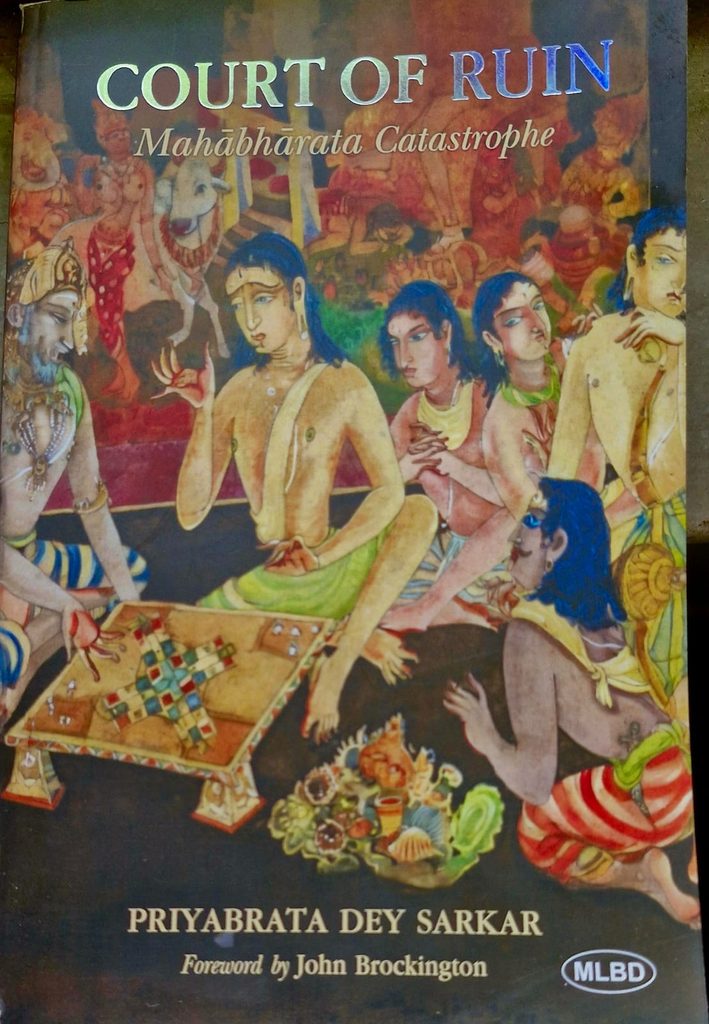
However, tautology mars the work. Several ideas and arguments are repeated under different chapter-headings. Some works mentioned in footnotes are missing from the bibliography. “Kali”, the evil spirit, is consistently misspelled as the goddess “Kaalii”. The book carries an appreciative foreword by J.L. Brockington, the famous Sanskritist, and encomia from the renowned Indologists Bruce Sullivan and Jeffery Long. It carries a striking painting as the cover. The painter should have been given credit by the publisher. The printing is excellent, easy on the eyes and not marred by errors. Here is a book that is a rewarding study.
[1] Priyabrata Dey Sarkar: Court of Ruin-Mahabharata Catastrophe. Motilal Banarsidass, 2026, pp.168. Rs. 295/-
[2] P. Lal: The Complete Sabhā Parva, Writers Workshop, Kolkata, 2005, p. 19.
[3] Ibid. 50.25-36, pp.160-161.
[4] Ibid. 46.26-28, p. 339.
[5] Shiva Purana, Rudra Samhita, Sati Khanda, 29.20 and Bhagavata Purana, 4.4.17.
[6] Shakespeare, All’s Well That Ends Well, IV.3.
[7] Bankimchandra Chatterjee, Krishna Charitra, M.P. Birla Foundation, Calcutta. 1991. The first English translation from Bengali by Pradip Bhattacharya. Also, Pradip Bhattacharya: “Was Draupadi ever disrobed?”, Annals of the Bhandarkar Oriental Research Institute, Vol. LXXXVI (2005), pp. 149–152.