• Skip to main content
  • Skip to footer

Pradip Bhattacharya

Indologist, Mahabharata scholar

  • BOOKS
    • MAHABHARATA
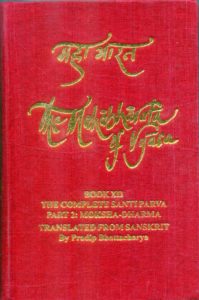
      • The Mahabharata of Vyasa – Moksha Dharma Parva
      • The Jaiminiya Mahabharata
      • The Jaiminiya Ashvamedhaparva
      • The Secret of the Mahabharata
      • Themes & Structure in the Mahabharata
      • The Mahabharata TV film Script: A Long Critique
      • YAJNASENI: The Story Of Draupadi
      • Pancha Kanya: the five virgins of India’s Epics
      • Revisiting the Panchakanyas
      • Narrative Art in the Mahabharata—the Adi Parva
      • Prachin Bharatey ebong Mahabharatey Netritva O Kshamatar Byabahar
    • LITERATURE
      • Ruskin’s Unto This Last: A Critical Edition
      • TS Eliot – The Sacred Wood, A Dissertation
      • Bankimchandra Chatterjee’s Krishna Charitra
      • Shivaji Sawant’s Mrityunjaya: A Long Critique
      • Subodh Ghosh’s Bharat Prem Katha
      • Parashuram’s Puranic Tales for Cynical People
    • PUBLIC ADMINISTRATION & MANAGEMENT
      • Leadership & Power: Ethical Explorations
      • Human Values: The Tagorean Panorama
      • Edited Administrative Training Institute Monographs 1-20. Kolkata. 2005-9
      • Edited Samsad Series on Public Administration. Kolkata, 2007-8
    • COMICS
      • KARTTIKEYA
      • The Monkey Prince
    • HOMEOPATHY
      • A New Approach to Homoeopathic Treatment
  • BOOK REVIEWS
    • Reviews in The Statesman
      • Review : Rajesh M. Iyer: Evading the Shadows
      • Review : Bibek DebRoy: The Mahabharata, volume 7
      • Review :The Harivansha – The Significance of a Neglected Text
      • Review : Battle, Bards and Brahmins ed. John Brockington
      • Review : Heroic Krishna. Friendship in epic Mahabharata
      • Review : I Was Born for Valour, I Was Born to Achieve Glory
      • Review : The Complete Virata and Udyoga Parvas of the Mahabharata
      • Review : Revolutionizing Ancient History: The Case of Israel and Christianity
    • Reviews in BIBLIO
    • Reviews in INDIAN REVIEW OF BOOKS And THE BOOK REVIEW New Delhi
    • Reviews in INDIAN BOOK CHRONICLE (MONTHLY JOURNAL ABOUT BOOKS AND COMMUNICATION ARTS)
  • JOURNALS
    • MANUSHI
    • MOTHER INDIA
    • JOURNAL OF HUMAN VALUES
    • WEST BENGAL
    • BHANDAAR
    • THE ADMINSTRATOR
    • INDIAN RAILWAYS MAGAZINE
    • WORLD HEALTH FORUM, WORLD HEALTH ORGANIZATION, GENEVA
    • INDIA INTERNATIONAL CENTRE QUARTERLY
    • ACTUALITIES EN ANALYSE TRANSACTIONNELLE
    • THE HERITAGE
    • TASI DARSHAN
  • STORIES, ESSAYS & POSTS
    • Chakravyuha by Manoranjan Bhattacharya
    • The Head Clerk. A short story.
    • BANGLADESH NEW-BORN: A MEMOIR
  • GALLERY
  • PROFILE
    • About the Author
    • IN THE NEWS
      • Epic discovery: City scholars find lost Mahabharata in Chennai library – The Times of India (Kolkata)

MAHABHARATA


Ashvamedha: Reconciliation, Reversals and Realization

December 5, 2019 By admin

The Complete Ashvamedhika Parva in the Mahabharata of Vyasa transcreated from Sanskrit by P. Lal, Writers Workshop, 2008, 440 pages including maps, genealogical tree. Rs.300 (special edition with original hand-painted patachitra Rs.800).

The Kurukshetra holocaust is over. After the Pyrrhic victory, what does Yudhishthira experience but a wasteland? ‘Son of man,’you know only’a heap of broken images’Only fear in a handful of dust.’

How does the morally sensitive man of Dharma achieve reconciliation after wading through a gory Serbonian bog, trampling over the corpses of kith and kin towards the throne of Hastinapura? Much to the shock of Draupadi and his brothers, instead of joyously quaffing the heady wine of victory, he would rather work out his salvation in a sylvan retreat. For, ever at his back he hears ‘The rattle of the bones and chuckle spread from ear to ear.’ After all, he is the only one to have played chess with death, answering the Mortal Lord’s riddles with his brothers as the stake. How can he recline at ease on the throne of blood? This model of rectitude, this man who is righteousness incarnate, has more than once done the wrong thing for the right reason. He has gambled away his brothers and their wife. He has not hesitated to ask patriarch Bhishma how he may be slain. He has quibbled so that guru Drona lays down arms. He has made uncle Shalya sabotage Karna’s valor and then speared that uncle to death. All the cataracts of wisdom rushing over him from Bhishma, Vyasa, Narada, Vidura and Krishna in the massive corpus of the Shanti and Anushasana parvas have failed to excise the profound mea culpa.

Section 12 has Krishna rebuking Yudhishthira sharply somewhat as he had done Arjuna: ‘Don’t you remember anything?’ Earlier he has reprimanded Dhritarashtra and Gandhari for evading their responsibilities. Krishna points out that Yudhishthira’s lack of ‘shraddha’ prevented his learning the meaning of ‘kama-corrupted karma’ though explained to him repeatedly. Krishna provides a simple solution to cut through all intellectual sophistry:

‘All crookedness leads to death,
simplicity leads to Brahman.
This is the essence of all wisdom.
The rest is idle babble.’ (11.4)

He explains the real meaning of the Indra-Vritra myth: Vritra is the enemy lurking within one’s self causing delusion. Krishna criticizes Yudhishthira for conveniently forgetting the public dragging of Draupadi and Kichaka kicking her, the exile, the sufferings at the hands of Jatasura, Chitrasena, Jayadratha. It is a new war that has to be fought now.

‘The battle with Drona and Bhishma
is over’the lonely battle now
is your battle with yourself.
Grasp the glory of your secret spirit
and perform your sva-karma!
No arrows will help you here,
no servants, no relatives.
You alone can help yourself.
You cannot escape the crisis’
You must fight, and you must win. (12.12-15)

There is no point lamenting time and again over the dead’they cannot be revived. ‘Mine’ is what leads to death; ‘not mine’ to eternity. ‘Kama-control is dharma’, rooted in self-discipline. Section 13 has a brilliant passage in which Kama explains how it deludes human beings by shackling them to desires. Therefore, it should be channeled into charity distributed in yajnas. Hence the need for the Horse Sacrifice.

Vyasa, too, criticizes Yudhishthira (‘your wisdom is weak’) and recommends that the Horse Sacrifice be conducted to earn merit, as Rama and Bharata had done in the past. The wealth needed for this huge ceremony is provided by Vyasa (how often does the author personally intervene in his plot!) who guides him to the gold left by Marutta, one of the very few human kings like Raji and Mandhata whom Indra failed to subdue. The gold Yudhishthira recovers is over 16 crore gold bharas, returning with it to Hastinapura when Parikshit is a month old.

Section 9 contains a rare dialogue between Indra, boasting of his omnipotence, and Agni sarcastically reminding him of his ignominious humbling by Vritra and Chyavana. This time it is Samvarta, Brihaspati’s brother, whose sacrifice for Marutta Indra is forced to sanctify. One of the messengers Indra dispatches to Marutta is the gandharva Dhritarashtra. The Kauravas have links with gandharvas and nagas. Satyavati’s son Chitrangada was killed by a gandharva with the same name; her grandson shares his name with a naga and a gandharva.

Yudhishthira, aware that the era of Kali is approaching, and that the raja’s character shapes the people’s future, rules wisely, inspired by dharma. An idyllic portrait of his reign is given in section 14.

As many as 42 sections are devoted to something quite different. Krishna has been enjoying the company of Arjuna: ‘To be with you/is to find joy/even in a desolate forest.’ Now he wishes to return home. A peripeteia occurs here as Arjuna makes a startling disclosure. Being of fickle concentration, he has forgotten what Krishna revealed on the eve of the battle. Krishna reprimands him:

‘I am maha-displeased by your silliness
in not understanding what I said’.
you seem to lack shraddha
and power of comprehension.’ (16.10)

The Gita is not a command performance. The divine afflatus cannot be repeated on demand: ‘Yoked-in-yoga then/I discoursed on Brahma-realisation’. As a substitute, Krishna offers Arjuna an ancient history that he must listen to with concentration and without questioning (in the Gita he had argued repeatedly). This takes the form of a series of conversations: between a Brahmin named Kashyapa and a perfected Siddha; a Brahmin and his wife (anticipating that between Vaishampayana’s rebellious disciple Yajnavalkya and Maitreyi); Narada and sage Devamata; Parashurama and his manes; finally, a guru and his disciple. This is the Anugita: a summation of the doctrine of liberation that, though profound in its intellection, presumably does not soar to spiritual heights beyond Arjuna’s ken. Krishna says that for a confused or unreceptive mind this wisdom is unattainable and that none but Arjuna has heard it till now (19.58).

The concepts of equanimity (sthitaprajna), Adhibhuta, Adhidaivata, Adhyatman are explained, as also the concept of Vibhutis. Vairagya (renunciation) is celebrated as the key to achieving nirvana that even the low-born and women can adopt. It takes but six months of dedication with faith and shraddha to attain this yoga (19.66). Gods do not value transcending bodily mortality by renouncing the fruits of action. Hence, their realm is for work-obsessed people. It is greed that is the single worst vice: ‘Slice greed with a sharp sword and happiness is won!’ Selflessness, impartiality, absence of desire constitute the supreme path of Dharma. The atman has to be purified by the atman, wiping out all rituals and social formalities to experience freedom.

Much of the symbolism of sacrifices is explained here. It is the ten hotri (priest)-senses who offer the ten sense-objects as libations in the ten fires that are the phenomenal world. The meaning of yajna is service and sacrifice to the divinity Narayana, the soul of all, by ego the hota, mind the adhvaryu, intellect the udgata using the shastra-weapon truth, the dakshina-offering being apavarga (emancipation). Animal sacrifice is explicitly condemned (with the rider that in the past this used to be offered to Narayana) and ahimsa extolled as the supreme dharma as we have first heard in the story of Ruru in the Adi Parva. Instead of the terrifying world-forest of Vidura’s parable in Stri Parva, here is Vidyaranya, the mighty forest of Brahma, where the tree of wisdom blooms with fruit of moksha and the soothing shade of peace.

The Gita’s eidetic symbol of the cosmic tree is repeated here twice (sections 35 and 47) with a different significance. Its seed is the un-manifest, its trunk the intellect, its branches self-conceit, the senses its sap, the five elements its ever-flowering tangled branches, leafy, fragrant, laden with bitter and sweet fruit. Two foolish birds sit on this tree: mind and intellect, neither very percipient. But there is another, the atman, the self-knower, the kshetrajna. He who slices this tree with the sharp sword of knowledge achieves freedom from birth and death. Krishna repeats the Gita’s figure of the nine-gated city fed by three streams of gunas along with a detailed exposition of Sattva, Rajas and Tamas, as also the advice to withdraw one’s senses like the tortoise pulling in its limbs. The Gita’s symbol of the body-chariot, the mind-charioteer, the intellect-reins, the senses-horses recurs. The guru narrating all this is Krishna and Arjuna’s mind is the disciple to whom this wisdom of Adhyatman is a gift of love, which none has heard previously.

We are taken by surprise to find that Shankaracharya’s sublime nirvana-shatakam has its source in section 28. Another serendipitous finding is that section 16 contains these lovely verses that are echoed by the Buddha:

‘Again and again I died,
again and again I was reborn’
I rejected the whirling world
and sought refuge
In the nirakara formless Divinity’
and so by the grace of my atman
I found the perfection I sought.
I shall not be born again’
No, never more!…
I shall be free,
and working for the welfare of others
I will find my fulfillment.’16.32-40

The Buddha says:

‘How many births have I known
Without knowing the builder of this body!…
But now I have seen you, O builder of this body!
All desire is extinct, Nirvana is attained!
The rafters have crumbled, the ridge pole is smashed!
You will not build them again.’ P.Lal: The Dhammapada, 153-154

Haridas Siddhantavagish, who edited and translated the Bengal recension of the epic, pointed out that the recital of the Gita to Arjuna on the battlefield is stated thrice in this parva (16.5 at the beginning, 19.55 in the middle and 51.49 at the end of the Anugita). Similar references occur in the Shantiparva too. Scholars claiming that the Gita is a later interpolation have overlooked this.

Krishna returns to Dvaraka and en route meets the sage Uttanka, whom we have met in the Paushya sub-parva of the first book and who motivated Janamejaya to hold the snake sacrifice. In the Ashvamedha account, his guru is not Veda but Gautama whose wife Ahalya demands, asdakshina, the earrings of the wife of the king-turned-cannibal, Saudasa-Kalmashapada who devoured Vashishtha’s progeny as plotted by Vishvamitra. The sage is furious that Krishna did not enforce peace and caused mass destruction. Krishna stops him from wasting his hard-won ascetic merit in a curse and instructs him about Adhyatman, repeating the concept of avatara and explaining that being born as a human he is forced to act in that fashion and not as the Omnipotent. Krishna blesses him not only with a vision of the Vishvarupa, but also persuades Indra to gift the sage Amrita. Indra approaches the parched Uttanka in the desert as a naked hunter, offering him the water streaming from his penis. Uttanka refuses, despite repeated urging. This parallels the Paushya parva incident where Indra asks him to eat a bull’s dung and drink his urine, both forms of Amrita, and Uttanka obeys because his guru Veda has done so previously. Here, he refuses and loses immortality. As recompense, Krishna assures him that to slake his thirst Uttanka-clouds will invariably appear in the desert to rain sweet water.

The account of the war Krishna gives his father is of interest because of the differences. In it, Shikhandi, not Dhrishtadyumna, leads the Pandava army against Bhishma and fells the patriarch, with no mention of Arjuna. Dhrishtadyumna slays weary Drona, with no mention of Yudhishthira’s quibbling. Karna is slain by Arjuna, with no reference to his chariot-wheel getting stuck. Shalya, leading three armies, is killed by Yudhishthira. Bhima tracks down Duryodhana and kills him. There is no mention of any blow below the belt. At Subhadra’s insistence, Krishna relates how Abhimanyu was deceitfully killed by Drona, Karna, Kripa and Duhshasana’s son. Significantly, the Yadava kinsman Kritavarma’s role is not mentioned.

The obtaining of Marutta’s gold begins, significantly, with the propitiation of Shiva whose presence has waxed, looming over the events more and more. Bhima now directly attributes Arjuna’s successes to Shiva’s grace. It takes them a month to return with the gold by when Uttara’s son has been born dead and revived by Krishna through an act of truth. Even at that climactic moment the very special place Arjuna holds in his consciousness is made clear once again. Krishna swears by the power of no rift having ever existed between him and Arjuna. Thus Parikshit, the remnant of the line, lives.

The remaining sections recount the roaming of the horse, the battles fought against the slender remnants of descendants of those slain at Kurukshetra and a brief account of the completion of the sacrifice. Only some of the encounters are narrated (Trigarta, Saindhava, Pragjyotisha, Rajagriha, Cedi, Dasharna, Nishada ruled by Ekalavya’s son, Dravida, Andhra, Raudra, Mahishaka, Kolla, Saurashtra, Gokarna, Prabhasa, Dvaraka, Panchanada in the west, Gandhara). The Sindhu queen Duhshala, Dhritarashtra’s daughter, approaches Arjuna for mercy, her son having died of fear on hearing of his approach. Anguished, Arjuna rails against the warrior code: ‘Shame on that which has made me/despatch all my relatives’. There are hints that Arjuna is not invincible without Krishna. Twice the Gandiva slips out of Arjuna’s grip (against the Trigartas and the Saindhavas). In Pragjyotisha, Bhagadatta’s son Vajradatta engages Arjuna for three full days.

Vyasa, master raconteur, grips our interest with unexpected reversals. The epic has several peripiteia. Just when we thought the Pandavas were finally victorious, their sons were murdered. In Manipura (Manalura in many manuscripts, located in southern India near Madurai) Ulupi suddenly appears to motivate Arjuna’s son Babhruvahana to fight and slay his father. Then she revives him, having engineered the event to cleanse her husband of the adharmik slaying of Bhishma, for which the Vasus had cursed him. At Arjuna’s request, Babhruvahana is specially honored in Hastinapura along with Ulupi and Chitrangada.

There is a piquant touch in section 87 where Yudhishthira asks Krishna why Arjuna should have to travel and suffer so much despite his body bearing all auspicious marks. Krishna replies that Arjuna’s over-developed ‘pindike’ are the cause. Draupadi casts an annoyed side-glance at Krishna, much to his delight at this sign of her love for Arjuna. ‘Pindike’ has been mis-translated as ‘cheek-bones’. ‘Pindikaa’ means a lump of flesh on shoulders, arms or legs, also ‘penis’. In view of Arjuna’s incessant roaming, it would connote his exaggerated calves.

The description of the Ashvamedha ritual is drastically abbreviated compared to what we find in the Ramayana and the Shatapatha Brahmana. The chief queen has a major role to play in the sacrifice and spends the night lying with the horse. Here Draupadi has no role other than sitting beside the sacrificed animal. In the Harivamsa Janamejaya prohibits performance of this yajna in future because of a scandalous incident involving his queen. In India today we see the peculiar phenomenon of this sacrifice being celebrated by businessmen without an animal sacrifice to purify the environment.

The audience presumes that the parva has now drawn to a close, but Vyasa astonishes them yet again. Suddenly a blue-eyed mongoose appears with a half-golden pelt and laughs to scorn the rich donations of which the Pandavas are so proud. It declares this horse-sacrifice a failure as it does not turn the rest of its pelt golden. Superior by far was the gift of a handful of parched grain by a fasting Brahmin to a guest who was Dharma himself. This story is yet another lesson imparted by Dharma to Yudhishthira on eschewing greed and anger. ‘No number of yajnas can make one virtuous’; ‘Dharma is not happy with maha-luxurious gifts, he prefers the littlest gifts if donated with shraddha and acquired by honest means.’ That is the anagnorisis, the recognition and realization of the core truth.

After this we find a fascinating record of the controversy over animal sacrifice. The ascetics and the gods disputed over whether it was better to sacrifice animals, grains or juices. Uparichara Vasu, asked to adjudicate, sought to wriggle out of the dilemma by ruling that whatever was available could be used. That evasion consigned him to hell. Agastya performs a twelve-year yajna only with seeds, overcoming Indra’s opposition. Thus ahimsa is extolled once again as the supreme virtue. Along with the mongoose episode, this provides a clue to when the epic might have acquired its written form. This would be in the time of Ashoka when non-violence to creatures acquired state sanction.

The Lal transcreation rightly omits the Vaishnava-dharma sub-parva of 1700 verses found after this in the Bengal and Southern recensions which is an obvious sectarian interpolation, having nothing to do with the theme of the Ashvamedhika Parva.

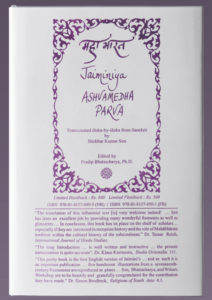
This parva is particularly significant for having inspired two very different but remarkable creative works. One is a novel, The Great Golden Sacrifice, the last part of Maggi Lidchi Grassi’s trilogy on Arjuna’s spiritual journey. The other is an ancient composition by Jaimini, one of Vyasa’s four disciples, whose Ashvamedha Parva is the only portion of his version of the Mahabharata that has survived. Jaimini’s work is larger than his preceptor’s and quite sensational, featuring the heroism of the sons of heroes slain in the Kurukshetra war. It was so popular that the medieval vernacular retellings of the epic and the Persian version Akbar commissioned used Jaimini instead of Vyasa’s composition for this parva.

Unknown to most, its first English translation by Major General Shekhar Sen has been published from Writers Workshop.


Filed Under: BOOK REVIEWS, IN THE NEWS, MAHABHARATA

HOW TO GOVERN

December 5, 2019 By admin

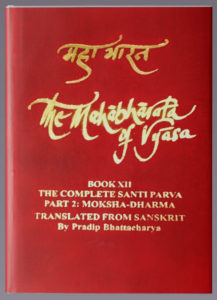
P.Lal: The Mahabharata of Vyasa, Book XII, the Shanti Parva Part 1 (Raja-Dharma), pp.1011, Rs.2000 (hardback), Rs. 1500 (flexiback), Writers Workshop, Calcutta.

The last part of the great epic of Bharata that Professor Lal, Padma Shri and Jawaharlal Nehru Fellow, succeeded in completing is now published. Devoted to the principles of governance (raja-dharma), it appears at a time most opportune when all principles have been cast to the winds and the polity of India is falling to pieces. Kiran Bedi’s tweet of 10th June 2012 on “Coalgate” shows how alive India’s great epic still is in our consciousness after millennia: “PMO clears Prime Minister. Did Dhritarashtra in Mahabharata not support Kauravas even after they attempted to disrobe Draupadi? Indian genes/culture? Or?” Soon after the Gujarat riots, Prime Minister Vajpayee’s only response to the public outrage had been to urge chief minister Modi to be mindful of “raja-dharma”. Unfortunately, today neither the legislature nor the executive is aware of what this phrase means. The availability of this transcreation should bridge that hiatus.

The holocaust of Kurukshetra is over; eighteen armies have been decimated. The cosmic design to rid over-burdened Prithivi of power-hungry warriors has been accomplished. Surely, for Yudhishthira, son of Dharma and the righteous king (Dharma-Raja), it is a time to celebrate the fulfillment of his mother Kunti’s dream to see her sons win back their inheritance. Instead, he is tormented by loss and guilt, confessing to the celestial sage Narada,

“motivated by greed
I committed this maha-murder
of my kith and kin…
what is it but defeat…?”

So the chink in his armour of righteousness is the passion that has doomed the lunar dynasty down the ages: greed. He is particularly anguished over the killing of Karna, who knew he was the eldest Kaunteya while fighting his brothers who did not. We learn that his anger against Karna would dissipate when he looked at his feet which strangely resembled Kunti’s. What an inimitable Vyasan vignette! Hence Yudhishthira’s curse that women will never be able to keep a secret. Narada informs him of a great secret: it was in order to engender the war that “a friction-fostering foetus/was placed in a virgin womb”. So Karna’s role from the very beginning was that of the resentful bastard, like Edmund in King Lear, backing up Duryodhana against the Pandavas. Narada narrates key incidents in Karna’s life bringing out the multiple handicaps he suffered: disowned at birth, cursed by Parashurama and a Brahmin, the boon he gave Kunti, his gift of the armour and earrings that made him invulnerable, being branded half-a-chariot-hero by Bhishma, constant belittling by Shalya, Krishna ensuring that Arjuna never faced a fresh Karna. Narada mentions Karna defeated Jarasandha who gifted him Champa town in Anga which begs a question: if he were truly king of Anga, as Duryodhana had crowned him, how could Champa be Jarasandha’s to gift? We always find Karna in Hastinapura, never ruling in Anga. Was the investiture merely symbolic?

We find here interesting revelations regarding the society of those times. For instance, what was the status of atheism? Charvaka (after whom the doctrine of atheism is named) takes advantage of Yudhishthira’s guilt to berate him publicly. The Brahmins kill him, branding him a demon and friend of Duryodhana disguised as a mendicant. Again, Narada informs that king Rantideva killed over 20,000 cows to feed guests. So the Vedic practise of slaughtering a cow for a special guest (who was therefore called “goghna”) continued into epic society. Vyasa tells that Uddalaka’s famous son Shvetaketu was actually begotten by a disciple on his wife on his guru’s orders. Uddalaka later renounced his son for having lied to Brahmins. Yajnas (sacrifices) are prescribed as essential for all four classes with the saving that the Shudra will not chant mantras. The three other classes are responsible for maintaining the Shudra. A Brahmin of ill character is equivalent to a Shudra and should be ostracized. It is one’s karma that makes dharma. The ruler must have a group of ministers taken from all sections of society: 4 Brahmins, 8 Kshatriyas, 21 Vaishyas, 3 Shudras, 1 bard expert in Puranas. Their qualifications are given in details, and of them the ruler has a cabinet of eight, whose decisions must be announced to the public. Section 108 contains the famous verses, extolling them as the highest teaching:

“One’s father excels ten teachers, one’s mother surpasses ten fathers, indeed surpasses the world itself. There is no guru anywhere to equal a mother…you will gain this world by serving your father, the next world by serving your mother properly, and the world of Brahma by serving your guru…When a legitimate adult son fails to support his father and mother, his crime equals that of killing a foetus—that which is no greater wickedness.”

There is an uncompromising condemnation of those who discarding the three Vedas, their professions and families, don saffron robes and go begging with a three-pronged staff:

“but they are tied to the world,
because to them
begging is a profession…
Pure selfishness.
These shaven dunderheads,
flaunting the flag of dharma,
are hypocrites.”

It is also admitted that “the shastras are full of contradictions”, and that “The Vedas do not cover everything” (Section 109). Ascesis, tapasya, is extolled above sacrifices and it is clarified that this does not mean mortifying the flesh but is non-violence, truthfulness, self-control, compassion. Incidentally, there is never any mention of the Vedas as numbering more than three, which shows that the Atharva Veda was a post-Mahabharata composition. We are also told that originally the three Vedas were one. It is Vyasa who arranged them under separate names, as he did with the original Purana.

As with the secret cause of Karna’s birth, another fascinating sidelight comes in the tale of demon Damsha that takes forward the rape of Bhrigu’s wife Puloman related in the Adi Parva. We learn that the rapist was cursed by Bhrigu to be reborn as a vicious insect, and in that form he bored through Karna’s thigh, resulting in Parashurama’s curse.

To dissuade Yudhishthira from becoming a sannyasi, by turn arguments are presented by the brothers and Draupadi extolling earning of wealth (artha), the householder’s life, desire (kama) and punishment and justice (danda) as the principle preserving a polity. In the process, they even call Yudhishthira a fool! To console Yudhishthira for the loss of his progeny, Krishna narrates the account of 16 past kings of far greater stature who all died. This account, occurring also in the Drona Parva, is similar to the Old English “Deor’s Lament” in intention.

Once Yudhishthira has reconciled to kingship, Krishna sends him to Bhishma, lying on his bed of arrows, for instruction on governance, for with his death “you will see the setting of all knowledge.” Bhishma begins with a paean to Krishna in which he mentions the ten avataras, interestingly saluting Balarama as “the soul of Bhoga, enjoyment” and Krishna as “the soul of sport”, and mentioning Buddha as disciplining the anti-gods. The crucial importance of the ruler is repeatedly stressed:

“First find a raja.
Then get a wife.
Then wealth…
Without a raja
Your wife and wealth,
What good are they?”

The ruler’s cardinal duty is to ensure his subjects’ welfare first and last. Unless he conquers his own senses he cannot conquer his foes. It is because he delights (ranjita) them that he is called “raja” and all dharmas depend on him. It is the ruler who shapes the nature of the age—Krita, Treta, Dvapara or Kali.

Much of what we know later as the Arthashastra is given here. Originally it was called “Danda-niti”, the principles of punishment. Composed of one lakh sections by Brahma, it was condensed by Shiva under the name “Vishalaksha” in ten thousand sections which Indra abridged in five thousand calling it “Bahudantaka”. Brihaspati reduced it to three thousand and that was further edited to one thousand sections by Shukra because of the decreasing life-span of humans.

Beginning with quotations from past savants and 8 stories on the origin and duties of the ruler, Bhishma narrates 19 tales on the core issues of ruling (repeatedly stressing impersonal administration of punishment, careful selection of advisers through fivefold tests and not trusting anyone completely), following up with 8 on what is to be done in extremity, and ending with 9 on expiating sins and the results of harming friends. The methodology adopted is Upanishadic question-and-answer between pupil and teacher. These make up the 173 sections of this tome in which sections 98 to 173 are in prose—the longest prose section in Vyasa’s narrative.

Vyasa narrates to Yudhishthira the “Ashma Gita” narrated to Janaka by the sage Ashma where the root causes of mental anguish are specified as either confused thinking or unexpected calamity, with attachment to material things as a related cause. We also find here the philosophy that is repeated in the Upanishads by Yajnavalkya:

“No one is anyone’s, no one
belongs to anyone but oneself.
Wife, and relative,
And friend—
All travelers, all passers-by
On the road of life…
Whoever you love, will leave you.”

Vyasa also repeats insights from the Gita regarding Time being the real slayer of the armies, and that

“Times are when dharma
starts looking like adharma,
and adharma like dharma.…
In special cases,
even stealing, lying and killing
can be dharma.”

As a telling example the story of Vishvamitra justifying stealing dog-meat from an untouchable is told: “What is important is to stay alive” because only then can dharma be practiced! If problems arise regarding dharma, a committee of ten experts in the scriptures is to resolve them, or three teachers of dharma.

Vyasa declares that since Yudhishthira got involved in fratricide because of the wicked deeds of others, he is not at fault. There is no sin in killing even gurus who flout their calling because of greed (as with Drona). He advises Yudhishthira to enthrone the surviving kin of the rulers, including daughters if there are no sons, showing compassion to establish peace in the land. This is where the famous verse on when it is permissible to lie occurs which is repeated at least thrice in this parva: to save one’s life or another’s; for one’s guru’s sake; to win over a woman; to arrange a marriage. “Women, diamond and rain-water—these three are always pure.” Even an unfaithful woman becomes pure after her period

From the standpoint of narrative art, a fresh frame has been introduced in this parva. The Mahabharata’s outermost frame is Sauti narrating it to Shaunaka and his sages in the forest of Naimisha. The next layer is the snake-sacrifice in Takshashila during which Vaishampayana narrates the epic to king Janamejaya in the presence of the author Vyasa, which is what Sauti heard. Now we have a series of concentric layers where several narrators tell Yudhishthira stories, of which the largest is Bhishma’s portion. Nested within Bhishma’s layer are so many tales, and tales-within-tales! The entire narrative structure reminds us of a Chinese Box or a Matroyshka.

Among these “akhyanas” (tales) are some that stand out. Such a one is Janaka’s queen quite unexpectedly berating him for wishing to abdicate, much as Draupadi does Yudhishthira. Others are animal fables that recur in Panchatantra.

Possibly the most fascinating of Bhishma’s many accounts is the conversation Krishna has with Narada. It is the only passage giving vent to the frustration Krishna experiences—something none of us would imagine, and which remains unknown to most of us who have not read the Shanti Parva fully. The mellifluous free verse transcreation communicates the emotions beautifully. Balarama, Gada, Pradyumna—all are engrossed with themselves, none helps Krishna. Among his quarrelling clansmen he is,

“like a mother of two gamblers:
I want one side to win
I do not want the other to lose.
And the result is that
I am at the receiving end of both.”

The bitter words of relatives “stir fire in my heart.” Narada, after pointing out that this is his own doing because they are all his own relatives, tells him of a weapon “not made of iron, a gentle but heart-piercing weapon” to wash clean their bitter tongues. Those of us who are interested can read section 81 to find out what it is.

The genocide of the warrior-class perpetrated by Parashurama is a significant story Bhishma tells to explain how the “kshatriya varna” had to be restored by Brahmins to protect the polity. The divine right of kings is not just a European and far-Eastern concept. Bhishma equates the ruler with the preserver Vishnu, explaining the sacred nature of his duties. The ruler is the god of fire when he scorches liars; the sun-god when he observes the people and ensures welfare; death when he kills criminals; Yama the judge when he punishes and rewards; the god of wealth Vaishravana when he collects taxes and remunerates. Bhishma also tells the tale of Vena to show that an unrighteous ruler is even killed or removed by the people. There is more than enough guidance available here for our own times—provided we are interested!

A bonus for the reader is the superlative introduction provided by the transcreator, packing into just two pages an amazing amount of profound insight, bringing home to 21st century society the lessons of the ancient past that never cease to be relevant. “Artha”, wealth, is indeed a basic goal of life, but it is not money but the meaning of money—trusteeship—that makes it worthwhile. Without benefiting others, how do I benefit myself? “Kama”, desire or pleasure is an essential ingredient of life, but what is important is to transform lust into love: “both are four-letter words; it’s our disciplined choice that changes one into the other.” Dharma is not just ritualistic religion but spiritual vision where differences of creed vanish. “Moksha” is not only escape from life, but transforming that into liberation for humanity at large. What a world of meaning has been concentrated into these few printed words!

At the end are detailed reviews of the Shalya Parva transcreation and the set of ten DVDs of readings by Prof. Lal from the Adi Parva telecast on Tara TV. Prof. Lal’s rebuttal of Dr. Amartya Sen’s misconception regarding what Krishna says in the Gita is also printed. This volume leaves the discourse on Moksha and the Anushasana Parva untranslated.

Thus ends the massive enterprise a single poet and transcreator of remarkable genius embarked upon in 1968, making transcreating Vyasa the major work of his life, having also covered, before his departure, the lovely ninth and tenth books of the Bhagavata Purana.


Filed Under: BOOK REVIEWS, IN THE NEWS, MAHABHARATA

Stri: The Book of Women from the Mahabharata

December 5, 2019 By admin

Dharmakshetre Kurukshetre
– On the field of righteousness, on the field of the Kurus –

What are the joyous fruits of victory?

 Ah! hapless wives of those mail-clad sons of Troy!
Ah! poor maidens, luckless brides, come weep,
for Ilium is now but a ruin; and I,
like some mother-bird that o’er her fledglings screams,
will begin the strain.

These words that fell from the lips of Hecuba, queen of Troy, on the Athenian stage when Euripides staged it in 416 BC (the Mahabharata took shape around the same time) could as well have been spoken by Vyasa’s Gandhari. Aeschylus’ The Trojan Women has been celebrated as the greatest piece of anti-war literature by those not familiar with Vyasa’s Stri Parva.

The Kurukshetra holocaust is over. Of the 18 armies only 10 warriors survive. The immense scale of slaughter is recounted by Yudhishthira to Dhritarashtra as numbering ten arbuda, sixty six crores and twenty thousand dead (1,660,020,000). A huge cremation rite is held for all of them. It is here that for the first time, in the Lal version, we come across the name of Abhimanyu’s slayer: Duhshasana’s son Sudarshana (the critical edition leaves him nameless).
Indian scholars have overlooked Vyasa’s repeated use of the image of war as a ritual sacrifice, which sets the Kurukshetra war well apart from the Trojan. It was Alf Hiltebeitel who highlighted this in The Ritual of Battle. James Fitzgerald has further elaborated it in his translation of the Stri Parva.

The Book of Women takes us back to the Book of Effort where Karna, imaging the ensuing war to Krishna as Duryodhana’s massive weapons-yajna, foretold:

When the wives of Dhritarashtra’s grandsons huddle together,
Keshava-Krishna, having lost their protectors, their sons, and their husbands,
And lament in the presence of Gandhari,
with dogs and vultures roaming the battlefield, that will be the yajna’s final bath,
Janardana-Krishna. – Udyoga 141.50-51, the Lal transcreation.

Sanjaya, consoling Dhritarashtra, makes this even more clear:

Into the sacred fire
Of the sacrificed bodies
Of the heroes, were poured
The ghee oblations
Of the arrows
Of their enemies – Stri 2.17

Ladies never seen outdoors now stream forth, clad in single white garments (as Draupadi had cursed after the dice-sabha), like screeching ospreys onto the corpse-strewn field, their complexion turned copper-brown by the sun as they frantically seek to match limbs to bodies and heads – often fruitlessly. Repeatedly Vyasa says that the scene resembled doomsday, yuganta. There is wailing and gnashing of teeth. David’s anguished lament rings in our ears:

Thy glory, O Israel, is slain upon thy high places!
How are the mighty fallen!
Tell it not in Gath,
Publish it not in the streets of Ashkelon;’
Ye daughters of Israel,
weep ‘

How are the mighty fallen in the midst of the battle!
And the weapons of war perished!

The previous translations of the Stri Parva are all in prose, the latest being James Fitzgerald’s in 2004. The anguish captured in the anushtubh shloka (from shoka came shloka said Valmiki) cannot, however, be conveyed thus. It is like couching David’s lament and Hecuba’s grieving in prose. The poetic Lal transcreation communicates it with great sensitivity, the mood set by the Preface itself. It is an extract from his remarkable long poem, The Man of Dharma and the Rasa of Silence recreating the stunning parable about the meaning of life that Vidura relates in response to Dhritarashtra’s frantic question: “But what is the way?…How does an un-winged bird like me fly? How does an unsonned sun like me shine?” The very unusual dedication that follows reinforces the tone:

“to the kanyas, devis, apsaras, dharma-patnis, kinnaris and other ladies in the Mahabharata whose shakti energises the kala-chakra of the Kshatriyan cosmos.”

Vyasa never proceeds along expected lines. He is the narrator par excellence who always has a surprise in store. The incidents of this parva are set in-between the murder of the sleepers and the capture of Ashvatthama in the preceding Sauptika Parva. Abruptly, with Duryodhana’s death, the heroic aura disappears and the survivors stand before us as ordinary men, terrified of the victors. Dhritarashtra and the widows, en route the battlefield, are met by Kripa, Ashvatthama and Kritavarma who give him the news and flee on horseback, splitting up lest the Pandavas catch them. Yudhishthira leads his brothers and sorrowing women to meet his blind uncle and aunt on the banks of the Ganga. The Kuru widows put to him a rhetorical question which he will echo later, wishing to abdicate:

You have killed father,
brothers, gurus,
sons and friends’
What good
is this kingdom to you
without fathers, brothers, without
valiant Abhimanyu,
And Draupadi’s sons?  (12.7, 9)

Dhritarashtra dissimulates, asking to embrace Bhima. Krishna’s brilliant prescience saves the Pandavas once again by substituting a metal image that the blind king crushes in rage, shedding crocodile tears. The two Krishnas, Vyasa and Vasudeva, bluntly point out to Dhritarashtra and Gandhari their responsibility for the war by not controlling Duryodhana and persuade them to cast aside vengeful thoughts. Dhritarashtra then calls for “Pandu’s second son, Bhima (not Arjuna as translated)” to caress him (13.15). Bhima, terrified, lies to Gandhari that he did not drink Duhshasana’s blood, justifying his other acts by citing the outrage committed on Draupadi. There is no mention of any attempt to strip her, only to her being dragged by the hair. But Gandhari’s fury has to have an outlet. As Yudhishthira, stooping to touch her feet, begs her to punish him, her glance from below the blindfold deforms his lovely fingernails. Section 15, shloka 30 is mistranslated as: “toe-nails of the king/instantly became black.”

Yudhishthira is stooping, or falling prone, at Gandhari’s feet; her glance would naturally fall on his finger-nails not his toes which are beyond her lowered glance. The original is angulyagrani, finger-tips, with no reference to pada (feet). Vyasa presents a lovely vignette here: seeing Yudhishthira’s plight, invincible Arjuna scurries to hide behind Krishna. Noticing this, Gandhari’s anger is quenched.

Besides Gandhari, we would have expected Draupadi to lament at length. Instead, it is limited to two verses addressed to Kunti who helps up the prone Draupadi and takes her to Gandhari who greets her coldly:

What good is grieving?
All dead. Grief is useless.
You and I are the same-
victims of grief’ (15.44)

There is none of the loathing that throbs in Hecuba’s reference to Helen: “A thing of loathing, of shame to husband, to brother, to home. She slew Priam, the king, father of fifty sons, she wrecked me upon the reef of destruction.” Shloka 44 of section 15 has Gandhari telling Draupadi that both are “rejected by all”, which ought to read “who will comfort us?” Gandhari ends with, “I am responsible for the slaughter of my family,” hinting that so is Draupadi because of her inveterate vengefulness.

Prior to all this, Vidura’s interaction with the grief-stricken king contains gems of philosophical insights: cosmic time is unavoidable, impartial, loving or hating none, merely cooking all creatures indiscriminately. The image of the body as chariot, the senses the horses, rational acts the reins recurs side by side with that of the world as the chariot of Yama. The sense-controller is free of the world-wheel, “He moves in the world./The world/does not move him. (7.16)” Grief can be cured only by not indulging in it. You are your own friend and your own enemy: do good, be happy; do bad, suffer, for “Always, everywhere,/ your deeds bring fruits-/ nothing else does.” The Gita’s image of discarding bodies like old clothes and that of the potter’s wheel are repeated as the sole eternal reality. In section 5 comes the wonderful image of the world as a wilderness in which man (named Samaraditya in Haribhadra’s Jain text) is lost that became so well known in medieval Europe – via Persian, Arabic and Greek – as the parable of the man in the well told by Saint Barlaam to prince Josaphat (Bodhisatva). Towards the end of section 7 Vidura stresses character as the pre-requisite for a sorrow-free mind, dependant on discipline (dama), detachment (tyaga), alertness (apramada). Interestingly enough, this same triad features on the Besnagar Garuda pillar of Heliodorus and forms a critical part of Buddhist teaching.

It is extremely rare that the author should himself appear within his own composition. Vyasa does so in section 8 specifically to bring the narrative full circle, taking us back to the Adi Parva to reveal to Dhritarashtra “the eternal secret of the gods”, providing an eye-witness account of the plan for this carnage drawn up by Vishnu at the over-burdened Earth’s request to the gods. He reminds us also that Duryodhana was a partial incarnation of Kali and that Shakuni (Dvapara) and Karna were born to assist in the carnage. This raises a puzzling issue over Surya fathering Karna who is ranged on the side of evil. Undoubtedly, to reconcile his affiliation with the anti-god Kauravas, some redactor added on the passage in the Vana Parva that Narakasura would possess Karna. Vyasa informs that during the Rajasuya ritual he had told Yudhishthira of this and Narada too had warned him of the impending destruction. The Sabha Parva, however, has no such warning by Narada, though after Shishupala has been beheaded Vyasa does foretell doom. This may well indicate a missing passage.

Vyasa now rings a marvellous change by replacing Sanjaya’s special gift of omniscience with that of Gandhari who paints for Krishna – appropriately called here “Janardana, crusher-of-people” – a heartbreaking picture of the battlefield spanning as many as ten sections (16 to 25). In it we find instances of erotic horror, as in Bhurishravas’ queen’s cradling his severed arm and recalling intimate caresses. Speaking of her brother Shakuni, Gandhari suddenly shifts to juxtaposing opposites: he won a kingdom by trick – and lost his own life; once soothed by the breeze of golden fans, today he is fanned by flapping birds; Shakuni has become the feast of shakunta-birds. Her mounting anguish is again transformed into rage directed at Krishna as Janardana, persecutor of people, for deliberately destroying the Kaurava dynasty. She curses him to become the doom of his own people after thirty six years and to die a shameful, disgusting death while his women weep like the Bharata ladies. Imperturbable Krishna acknowledges that this doom is inevitable. Thus, the Mausala Parva is anticipated.

When least expected, as Yudhishthira is offering water oblations to the dead in the Ganga, Kunti suddenly erupts with grief and stuns her sons with the truth about Karna’s birth. What a climactic scene Vyasa creates in the midst of the sea of tears! To Yudhishthira, this revelation is more agonising than the death of the Pandava children and the Panchalas. The agony of being responsible for his eldest brother’s death finds expression, as with Gandhari, in a curse pronounced by the dharma-king with which the Book of Women ends:

“Let no woman
from today keep a secret.”


Filed Under: BOOK REVIEWS, IN THE NEWS, MAHABHARATA

The Complete Shalya Parva

December 5, 2019 By admin

Pitamaha Bhishma suspended on a bed of arrows; guru Drona beheaded; son Lakshmana slain; favorite brother Duhshasana’s breast ripped open – none struck Duryodhana so much to the heart as did the death of Karna. Always keen that Karna lead the army, he had had to settle for ancient Bhishma and old Drona, biting his nails over their divided loyalties. With Karna in charge, victory seemed certain. But, multa cadunt inter calicem supremaque labra (“many things fall between the cup and the last lips”), pace Erasmus’ Adagia (1.5.1). It is with Duryodhana’s anguish over Karna’s death that the Shalya Parva begins.

For the first time we hear of fear in the context of Duryodhana who, Vaishampayana tells Janamejaya, “fled terrified” after Shalya’s death and hid himself in a lake. We are surprised to find Dhrishtadyumna too trembling with fear on seeing Shalva’s huge elephant charging him. The morning after the deaths of Shalya (after fighting for half a day), Duryodhana and the sleeping Panchalas (the Pandava sons are not mentioned in Vaishampayana’s summary) Sanjaya reports to Hastinapura that:

In this world caught
in the clutches of Kala,
only the women are left-
and seven from the side
of the Pandavas, and three
of your chariot-heroes
. (1.35)

There is a clear decline in the prowess of the successive Kaurava commanders-in-chief that is reflected in each leading the army for half his predecessor’s term. Shalya hardly qualifies to stand with them, devoid of superhuman qualities and prone to seduction by luxury. That is why S.L. Bhyrappa’s epic novel Parva, daringly beginning with Shalya, deserves acclaim all the more. After Karna’s death when Duryodhana turns to Ashvatthama, Vyasa paints him in such heroic colours that we are led to presume that he will be the next general. Instead, Ashvatthama advises that since Shalya left his nephews to join their enemies, he should command the army. Actually, like Bhishma and Drona, Shalya has been serving Pandava interests by discouraging Karna and directing his fury away from his nephews. From the very inception Duryodhana has continuously been betrayed. Even his most trusted general Karna did not kill a single Pandava, despite having four of them in his grasp, because of his promise to Kunti.

This last of the battle-books falls into 3 parts: the death of Shalya; the pilgrimage of Balarama; and the death of Duryodhana. Section 2 contains the deeply moving lament of the blind king:

O my son! Come to me! Come to me,
O maha-muscled Indra-among-rajas!
I am helpless!
What will happen to me without you?…
I am a wingless bird.

He recounts Duryodhana enumerating his allies as outnumbering the Pandavas and his supreme confidence that, should everything fail, Karna would be the final answer. That is why, Dhritarashtra says, he went along with his son’s decision. He attributes his plight to ill-luck in a lament of 17 verses which contains an interesting contradiction. First he wonders how a jackal like Shikhandi could lay leonine Bhishma low; 27 verses later he says Arjuna killed Bhishma. He wishes to retire to the forest rather than listen to Bhima’s bitter words (repeated in the Stri Parva) but ironically bears this humiliation for many years. Blindness and perception alternate in him. He will not take responsibility for his actions: “Fooled by fate I rejected his (Vidura’s) words.” Yet he also says, “There are fools in this world who have eyes but do not see. You see one such fool in front of you.”

There are fascinating variations following Shalya’s investiture in the 12th century Indonesian Kakawin, Bharatayuddha: Ashvatthama storms off the field, refusing to fight under Shalya’s command, holding him responsible for Karna’s death-surely a very logical development. On Krishna’s advice Nakula visits Shalya who tells him of Pashupati’s decree that he can only be slain by Yudhishthira. Shalya spends the night with his wife Satyavati, stealing off at dawn, cutting off with his sword the part of his cloth on which she lies asleep (inspired by Nala-Damayanti). She seeks out his body and stabs herself, as does her maid, turning epic into melodrama.
It is interesting that Bhima responds to an infantry attack by alighting from his chariot for hand-to-hand combat while Arjuna never fights except from his chariot. After Karna’s death and again after Shalya’s Duryodhana strains to rally his fleeing soldiers (sections 3 and 19) in identical words. In the first instance, Kripa advises him to make peace. Duryodhana refuses and the reasons he cites reveal he is no dreamer: he tricked Yudhishthira out of his kingdom and so will never be trusted; he tricked Krishna too during his visit, who will never forget the treatment of Draupadi and the killing of Abhimanyu; Arjuna burns over Abhimanyu’s murder; Bhima will not forget his terrible vow; the twins and Drupada’s sons hate him; the Pandavas cannot forget how menstruating Draupadi was abused and stripped in public. Finally, “How can I shuffle behind Yudhishthira like a cowering slave?” He then sums up his glorious achievements, which he will repeat after being struck down, and decides to fight to the death. For the night of Karna’s death they retreat to the banks of the Sarasvati, “the river of dawn-pink waters”, at the Himalayan foothills. This is where Shalya, son of Ritayana, is appointed commander.

Krishna now adopts a curious stance. He extols Shalya’s prowess above all and tells Yudhishthira that none but he can face him. But the truth is soon out. Till now, the eldest Pandava has no feat of battle to his credit. The conquering monarch needs to show the army his worth-at least one major kill is required. Therefore, Krishna urges him,

“You have survived the ocean
of Drona and Bhishma,
the sea of Karna.
Shalya is a water-hole
the size of a cow’s hoof print.
Don’t drown in it.”

He responds, “Only my share of valour remains”, recalling that Shalya was his allotted share in the Udyoga Parva (section 57). Finally, only handsome Nakula is left with no major kill, his “share” Uluka being dispatched by Sahadeva in addition to his own, Shakuni. There is a deliberate effort by the poet to build up Yudhishthira’s skills at arms, especially with the shakti (spear), by comparing him with Skanda.

Shalya adopts a new strategy: no warrior will face the Pandavas singly; all will fight collectively as one. Even after his death, there is no let-up and Shakuni decimates the Pandava cavalry. At this point Vyasa introduces a sudden lowering of pitch and change of tone. Arjuna addresses Krishna, puzzled at the unremitting bloodshed even after Bhishma’s fall:

“I do not know why,
but the war went on
and on and on.” (24.21).

It becomes the recurring refrain in this plangent passage of 30 verses on the meaninglessness of war. It is only now that Arjuna realizes the truth of Vidura’s warning that, come what may, Duryodhana will never share the kingdom and therefore war is the only solution.

Unable to remain a passive spectator as the Kaurava army is decimated, on this last day Sanjaya joins four warriors fighting alongside Kripa against the Panchala army (25.52). Routed by Dhrishtadyumna, he flees, is attacked by Satyaki, knocked unconscious and taken prisoner. Satyaki is about to behead him when Vyasa materializes and grants Sanjaya immunity. Laying aside his weapons, bleeding all over, that 18th evening Sanjaya leaves for Hastinapura. En route he is appalled to see Duryodhana grievously wounded,

“All alone.
No soldier.
No vehicle’
standing all alone
on five footsteps of land’
Such a Jagannatha reduced to such misfortune”.

Duryodhana’s eyes fill; he cannot speak, nor look straight at him. It is from Sanjaya that Kripa, Ashvatthama and Kritavarma get to know that Duryodhana is hiding in a lake. Yuyutsu comes into his own now, escorting the wives of the slain into Hastinapura, winning high praise from Vidura which brings him no peace, no delight in the palace:

“No joy here, no glory, no solace.
Desolate like a forsaken garden.”

Duryodhana’s reply to Yudhishthira’s challenge is in prophetic words:

“I give this empty earth to you.
She is all yours.
Which raja wants a kingdom
with no one in it?…
enjoy this husband-less earth
without wealth and warriors.
Be happy with this pathetic, life-less girl.”

Ironically, later the victor will repeat these very sentiments and wish to abdicate. At this moment, for once Yudhishthira refuses to compromise because

“If you live,
and I live,
the world will be confused:
Who won the war?…
Stand up!
And fight!”

Then once again he displays his complete lack of good sense, promising Duryodhana the kingdom should he kill any of the Pandavas. Krishna administers a sound tongue-lashing for his inveterate gambling instinct that, with just a single enemy left, stakes the kingdom in a perilous wager against one who cannot be defeated in a fair fight. Exasperated, Krishna exclaims,

“Pandu’s and Kunti’s children
don’t deserve the kingdom.
They were born to live
in forest-exile,
and go about as beggars.”

Duryodhana has been practicing with the mace for 13 years, while Bhima is out of practice. Krishna reminds Bhima to be true to his vow and smash his thighs. In the challenge Bhima roars out there is a very interesting detail in verse 49 where, while enumerating all those dead because of Duryodhana’s wickedness, he suddenly mentions that the sinful Pratikamin who made Draupadi suffer is also dead. This attendant merely carried Duryodhana’s insulting summons to her, so the reference is a puzzle-unless he is using it as an epithet for Duhshasana.

As the duel is about to begin, Vyasa deliberately lowers the tension by having Balarama stride in, back from the pilgrimage that he started 42 days ago just before the war began. If he has returned after 42 days, how has the battle lasted for only 18 days? This has led Vasudev Poddar to argue that the battle was not continuous but had intervals. Here and at two other places in Shalya Parva astronomical data appear that have been used to hazard dating the war. Janamejaya, in no hurry to have the story end, presses Vaishampayana to narrate the 43 pilgrim spots Balarama visited. By the time this ends, the audience’s frazzled nerves are relaxed, refreshed and prepared for the gory violence of the climactic battle.

Vyasa paints a lovely word-portrait of Narada in 54.18-20 as he comes to meet Balarama, ending with the wry comment: prakarta kalahana’ca nitya’ca kalahapriya, “He loved provoking people./He was a mischief maker.” Balarama’s pilgrimage is an adjunct to the elaborate itinerary of 350 holy fords that Lomasha guides the Pandavas through in the Vana Parva. Balarama’s includes two spots giving contradictory messages. Section 52 celebrates sage Kunigarga’s aged daughter who cannot attain heaven until she gets married. Section 54 immortalises Shandilya’s daughter who gains svarga by remaining celibate. The plurality of the Indian tradition that embraces opposites so felicitously is eminently in evidence.

By this time the river Sarasvati had already got lost at Vinasana because of tectonic upheavals hinted at in the myth of Dhundhumara. The river has seven names: Suprabha at Pushkara, Kanchanakshi at Naimisha, Vishala at Gaya, Manorama in north Kosala, Surenu and Oghavati at Kurukshetra and Gangadvara and Vimaloda in the Himalayas where the seven mingle at the Sarasvati-tirtha. In its waters spilled the semen of sage Mankanaka on seeing a naked girl bathing. Put in a pot, it produced 7 sages from whom sprang the forty-nine Marut wind-gods.

So here we not only have a myth paralleling the birth of Drona, but a variation on the origin of the Maruts who are otherwise Diti’s embryo that Indra cuts into 49 parts. We learn of a new cause of the destruction of Dhritarashtra’s kingdom: sage Baka’s destructive sacrifice when the king gave him animal carcasses instead of cattle. Two episodes in the Vashishtha-Vishvamitra conflict are described in connection with two tirthas. The story of the Aruna tirtha hints that a horrific war invariably follows a Rajasuya sacrifice (the first, Soma’s, was followed by the war against Taraka). This was the fate of Yudhishthira’s Rajasuya too. Vyasa tells Janamejaya as much in the Harivamsa. The birth and feats of Skanda form an important part of the account of pilgrimages. Among his attendants is the goblin Ghantakarna, an important figure Krishna meets during his tapasya for obtaining a son. Skanda’s investiture, the fearsome mother goddesses in his retinue and his killing the demon Mahisha are appropriated in the Shakta Puranas for Durga.

The reason for the special holiness of Kurukshetra-Samantapanchaka is revealed here. Eager to stop the inveterate tilling of the field by Kuru, Indra agreed that whoever died here by fasting or in battle would reach heaven. Hence the choice of the battlefield lying between Tarantuka, Arantuka, Ramahrda and Machakurka by the Dhartarashtras and Pandavas.

As the duel proceeds, Krishna tells Arjuna that Bhima will lose if he fights righteously, which calls to mind the parallel episode of Jarasandha’s killing. The predicament is all Yudhishthira’s fault. Krishna quotes from the lost treatise on governance by Ushana-Shukra that has been splendidly transcreated in gnomic verse:

“If an enemy routed
an enemy fled,
returns to fight you,
be filled with dread,
for his sole aim
is to see you dead” (58.15).

Like a seasoned bureaucrat, Krishna quotes precedents: Indra using deceit to destroy Virochana and Vritra (and Namuchi, Trishira). Moreover, Bhima is obliged to honour his oath. Once Duryodhana is down, Bhima proclaims the successful avenging of Draupadi’s molestation, attributing the Pandavas’ victory to “the strength of the tapasya of Yajnaseni” and shrugs off all criticism with “If this takes us to heaven, or takes us to hell’what do we care?” He then kicks prone Duryodhana’s head to the disapproval of all and is rebuked by Yudhishthira who tearfully attempts a closure by echoing Duryodhana’s own prophecy:

“It’s we who
should be mourning;
We must pass our days now
without all
who were near and dear to us’
You alone are the happy one,
heaven truly is yours.
we will suffer a fearful hell
on earth.”

As furious Balarama rushes with upraised plough to kill Bhima, Krishna grips him in his arms. The inimitable poet in Vyasa instantly paints a lovely portrait:

“The two Yadava brothers,
one dark, the other fair,
shone like sun and moon at day-end,
like white Kailasa
beside a black mountain.”

Krishna advances several justifications: imagine Kali Yuga has set in; Bhima had to fulfil his vow; Bhima has destroyed a disgrace to the family; Duryodhana was air-borne and not on the ground when Bhima hit his thighs. Vyasa does not scruple in recording that Balarama was “displeased with the crooked dharma of Keshava”. Through his lips Vyasa also heralds closure to the theme of war as a ritual sacrifice in which Duryodhana took initiation, offered up his life as oblation and attained glory completing the yajna.

Krishna reprimands Yudhishthira for not interfering when Bhima was stamping on Duryodhana’s head. Yudhishthira explains that knowing Bhima’s deep grudge he looked the other way, as did Arjuna though neither liked what was done. These verses conflict with what has gone before, where Bhima was promptly rebuked. One of the two sets is a later addition. Yudhishthira now tells Bhima that his debt to mother Kunti and to his own wrath stands discharged.

Duryodhana, roused to fury by the adulation offered to Bhima by all and their insults, now rears up

“like an angry venomous snake
with its tail sliced in half’
in excruciating pain”

to abuse Krishna, enumerating the many tricks he played to defeat the Kauravas. Later, he exclaims to Sanjaya,

“How does it profit
a good man
to win by wicked means?”

Krishna spares no words in hitting back with a list of Duryodhana’s crimes for which he is now paying. Duryodhana’s last words are majestic indeed, repeating much of what he said before the duel:

“I have studied, given gifts,
ruled the sea-girt earth,
Placed my foot on the heads
of my enemies’
I have achieved the peak of power.
Who is there more fortunate than me?
O Achyuta-Krishna,
I go to heaven
with my friends and followers,
And all of you stay back here
with grieving minds
and shattered hearts.”

Vyasa cannot be accused of pro-Pandava bias. In sections 33, 54 and 61 he records the applause greeting Duryodhana’s responses. Krishna and the Pandavas are dismayed, disconcerted and ashamed to find his speech greeted with a shower of celestial flowers and music. To raise their spirits, in a booming voice Krishna justifies his use of trickery for ensuring their victory. Duryodhana, in his speech to Sanjaya, wanders into make-believe, claiming that he never won by unfair means, never poisoned anyone or killed a sleeping enemy, drawing a convenient veil over Varanavata, Pramankoti and Abhimanyu’s murder. He hopes that the wandering mendicant Charvaka, expert orator, will avenge his death. That attempt is, indeed, made later. When the three surviving heroes of his army meet him, Duryodhana states that though he grants Krishna’s glory, it never blinded him. This is why Bankimchandra argued that Vyasa portrays Krishna not as God but as a human being of outstanding genius.

When the victors repair to the camp of the vanquished, a significant incident occurs.
Krishna directs Arjuna to descend first. The moment Krishna steps down, the great chariot is consumed in flames. Hit by many celestial weapons, it had held together so long as Krishna drove it. It is an ominous hint of the passing of superhuman prowess, which the subsequent books elaborate. Krishna advises them to spend the night outside this camp. Yudhishthira, terrified of Gandhari’s fury because of the unfair killing of Duryodhana, begs Krishna and Vyasa to go in advance to pacify her. This is stated cryptically in section 62. Section 63 is a typical elaboration by a later redacteur where Yudhishthira again addresses Krishna, praising him at length, urging him to the same task. Krishna’s tells Dhritarashtra that he has only his own karma to blame for his plight and not the Pandavas on whom he has now to depend. To Gandhari he says that what she had foretold has happened, so she should not curse the Pandavas. Krishna announces that he has intuited Ashvatthama’s plot to murder the Pandavas that night and therefore he must hurry back. Ashvatthama vows to Duryodhana to exterminate the Panchalas, not mentioning the Pandavas, which shows that what drives him is taking revenge on his father’s killers. With Duryodhana lustrating Ashvatthama as the last commander-in-chief, the Shalya Parva ends.

The unremitting carnage of this book is lit up by iridescent flashes of images that forcibly unite completely disparate ideas. It is Prof. Lal’s inimitable transcreation that brings home the realization that centuries before the much acclaimed English Metaphysical poets Vyasa’s poetry was replete with such images:

“Beautiful the field of battle,
struck by the hoof-beats of horses,
like a girl
scratched by the nails
of her lover.”
Or,
“The battlefield, O raja
covered over
with lifeless, mangled heads
with staring eyes
looked like a spread
of red pundarika-lotuses.”
Or,
“Under their onslaught,
your warriors teetered
and tottered,
like a young girl besotted with wine.”
Or, Bhima’s mace is,
“Indeed like a fragrant sandal-
paste-and-agaru-unguent
anointed sexually desirable girl,
it was smeared instead
with fat and marrow and blood.”
When Shalya falls,
“the earth
lovingly clasped
that bull-brave hero/to herself,
Like a lovelorn girl
embracing her lover
to her breasts. Long did he lie there,
passionately enjoying the earth,
covering her with all his limbs,
sleeping with her peacefully.”

Filed Under: BOOK REVIEWS, IN THE NEWS, MAHABHARATA

A Zero-Sum Game: Where Ignorant Armies Clash by Night

December 5, 2019 By admin

The Complete Bhishma & Drona Parvas transcreated from Sanskrit by Padma Sri P.Lal, Writers Workshop, Calcutta.  

The publication of the P. Lal transcreation of the first two of the five battle-books is an important event. After K.M. Ganguli’s prose translation in the late 1890s, followed by M.N. Dutt’s replication, the world has not had access to an English version of these in their entirety. J.A.B. van Buitenen passed away without touching them and his successors have, so far, published part of the Shanti Parva. The Clay Sanskrit Library’s diglot edition has brought out half of the Drona Parva. The Lal transcreation stands apart from all others particularly because of none of them dare to set the translations to poetic rhythm, something that comes so naturally to Prof. Lal, who brings to the work a unique Indian flavour by working into the transcreation many Sanskrit words. The great Ganguli had a P.C. Ray to take care of the manifold problems of publishing such a gargantuan work; van Buitenen had the University of Chicago Press; the Clay series has the New York University Press—all well established institutions with trained manpower. Here is another Abhimanyu taking on the awesome challenge of transcreating-and-publishing Vyasa’s hundred thousand verses, working through the epic-of-epics steadily, relentlessly.

Reading the first two battle-books together is rewarding because of the varied insights such an approach provides. In the first place, the second book, despite covering half of the duration of the first, is longer by half because the battle is far more sanguinary and varied. Both the Kaurava commanders-in-chief’appointed by Duryodhana reluctantly because of Karna’s refusal’are Vyasa’s expose of deeply flawed elders and their narrow dharma. We have here a patriarch who signally fails to provide protection to his foster brother’s wife and sons from murderous attacks in childhood and youth. Later, he and the two gurus of the grandnephews remain silent onlookers to the spectacle of a granddaughter-in-law being molested publicly by their employer, the heir-apparent. It is supremely ironic that the prince who earned the sobriquet of ‘Bhishma’ and came to be renowned as the greatest of renouncers should be so hopelessly bound to his father’s throne as not only to preside over the suicide of the dynasty, but to actually participate in it on the side he knows to be in the wrong! Indeed, Devavrata-Gangadatta-Bhishma is another Prometheus, bound in adamantine chains to the icy Caucasian peaks of the Hastinapura throne, wracked in immortal agony as the Dhartarashtra-Pandava fratricidal strife eats into his vitals endlessly. For, perversely, he cannot, or will not, die till liberation comes in the form of mortal arrows showered by a grandchild who loves him. And the person whom the Indian government holds up as the model of a guru is one who unhesitatingly indulges in sharp practice to ensure that his son gets exclusive tuition and his favourite pupil is not outdone by a talented tribal; who abandons his calling as a non-violent Brahmin to take up arms to acquire power and pelf for his son’no different from the blind king of Hastinapura in his paternal obsession.

It is in the first war book that both patriarch and guru acknowledge, ‘I am tied to the Kauravas by need.’ Bearing out Gandhari’s warning to her son in the Udyoga Parva, Bhishma and Drona fight for Duryodhana, but not with their hearts, announcing that they will not kill any of the five Pandavas. Duryodhana is caught in a zero-sum game: he has no option but to appoint them as the commanders-in-chief. His best bet, Karna, sulks Achilles-like in his tents, determined not fight so long as the patriarch is in command. Yet, this same Karna rushes to the fallen Bhishma begging his permission and blessings to fight against his brothers’what a marvellous vignette Vyasa presents us with! Even thereafter, aware that everyone is unlikely to accept his overlordship and for once letting his discrimination prevail over his egotism, he advises that Drona be made supreme commander. Fifteen days pass and every other day Duryodhana’s desperation mounts and he berates first Bhishma, then Drona for not killing the Pandavas’all to no avail. He directly indicts the guru (VII.94.14) in gravely insulting terms:

‘We ensure your livelihood
Yet you harm us.

I did not know
You are a honey coated razor.’

Drona’s flawed character is exposed as Sanjaya tells Dhritrashtra that in order to impress Duryodhana (VII.94.40) Drona encased him in golden armour made impervious mantrically. In the duel that follows, Arjuna, unable to pierce this armour, displays his unique bowcraft by wounding Duryodhana’s palms and underneath his finger-nails, forcing him to retreat (VII.103.31-32). However, this incident of encasing in magical armour seems to be an interpolation because in sections 116 and 120 Satyaki and in section 124 even Yudhishthira have no problem in wounding his chest so grievously that he is forced to flee the field.

Dhritarashtra’s perplexity over the failure of his army provides the reader with interesting information about how it was administered (VII.114): ‘We treat our soldiers well’Only after passing extensive tests’has their pay been determined, Not because of family connections, personal favour or nepotism. None is conscripted, none is unpaid’we spoke to them sweetly. Not one’has been unfairly treated. Each, according to his ability, gets paid and receives rations’we give presents, we honour them with the best of seats. Even these veteran warriors face defeat.’

In the duels with Dhrishtadyumna we are treated to martial acrobatics of a special type as he jumps on to the guru’s chariot and rapidly shifts position, foiling all Drona’s attacks (VII.97.26-28). Bhima’s duel with the guru is also memorable as he overturns Drona’s chariot repeatedly’as much as eight times! If he is defeated and spared by Karna (VII.139), he also succeeds in forcing the latter to retreat twice (VII.131, 145) and after Drona’s death Karna flees the battlefield out of fear (VII.193.10). The battle for Jayadratha reaches a high point with Arjuna single-handedly holding back the entire army while Krishna refreshes the horses in a hall-of-arrows. Sanjaya exclaims (VII.100.12, 21):

‘O Bharata! Krishna, smiling,
stood gracefully in the arrow-hall
created by Arjuna,
as if he was in the midst of women’
In a single chariot, clad in armour,
facing the Kshatriyas,
the two played with our warriors
like children with toys.’

As we wade through rivers of blood and gore these 15 days, we notice a gradual breaking down of codes of conduct as the stress mounts steeply. Chariot, cavalry and elephant divisions no longer refrain from attacking infantry and even unarmed charioteers and fleeing soldiers or from killing the charioteer to perplex the chariot-rider. After Bhishma’s fall, the battle even carries beyond midnight first by torchlight, then by moonlight, with warriors killing their comrades in the confusion:

‘And we are here as on a darkling plain
Swept with confused alarms of struggle and flight,
Where ignorant armies clash by night.’

As in Shakespeare’s Henry VI, fathers slay sons, maternal uncles kill nephews and vice-versa. Warriors intervene in duels, attack from behind, many encircle a lone fighter: ‘Dignity was lost/In that crazed clash’ (VII.169.50).

The Udyoga Parva had closed with Yudhishthira taking a measure of his strength after hearing from his spies that Bhishma and Drona had announced that each could wipe out the Pandava army in a month, Kripa in two months, Ashvatthama in ten days, Karna in five. He puts the question specifically to Arjuna who claims that using Shiva’s weapon he can annihilate all opposition in a flash, but adds that its use is improper against humans. He avoids declaring how many days of normal warfare he would take to defeat the opponents. It is Arjuna’s initial assurance that constitutes the backbone of Yudhishthira’s morale because he knows full well that Arjuna’s fulsome estimate of Virata and Drupada equaling Bhishma and Drona is nothing but bombast. The former was cowed down by Kichaka and routed by the Trigartas, as was the latter by the teenaged Pandavas. Sanjaya exclaims to Dhritarashtra:

O raja! Then erupted the battle
Between the Kauravas and Pandavas
Whose origin was the dice-game,
Whose end was all-embracing doom. ‘VI.103.44

Planning for a war is one thing; coming face-to-face with the imperative of killing a beloved patriarch and a revered guru is quite another. It is this existential angst that pierces through Arjuna’s moral armour, effectively unmanning him and becoming the occasion for the recital of Krishna’s Gita transcreated by Prof. Lal in 1947 in rhymed verse, in 1952 in prose, in free verse in 1965, revised in 1968. Intrigued by Arjuna’s uncharacteristic collapse and not finding answers in theGita, he embarked upon the epic journey of transcreating the entirety of Vyasa’s composition verse-by-verse. I will skirt this much-commented-upon text and deal with the rest of the parva. Both in VI.51.6 and in the Gita (1.10) there is a verse that remains intriguing. Duryodhana tells Drona that his forces led by Bhishma are ‘aparyapta’, inadequate, while the Pandava army led by Bhima is ‘paryapta’. This has been transcreated as ‘vast’ and ‘limited’, which is to twist the natural meaning of the word. If Duryodhana feels his army is innumerable, why should it be necessary for Bhishma to revive his spirit in the very next verse?

Prof. Lal’s Preface to the first war-book deals only with the Gita, seeing it as the core of the Bhishma Parva. Reading it is a gripping experience as the reader follows a sensitive and incisive modern mind grappling with Krishna’s recital to extract meaning, savours the delight of the memorably retold parable of the Kalpataru and is surprised by joy to come across gems of insight through a spectrum spanning Vyasa, Dante, T.S. Eliot and Ramprasad Sen. The Preface to the Drona Parva is another scintillating piece teasing out the many shades of the guru-chela relationship: neither will harm the other, yet ‘both must face each other, courtesy of Mahakala’. Against the ideal of the guru-shishya bond given in the Bhagavata Purana, here Vyasa shows us the ground reality of excruciating dilemmas: Drona trying to balance Arjuna-Ekalavya-Ashvatthama; Bhishma caught between Duryodhana-Karna-Pandavas-Krishna. And was Vyasa himself not the greatest victim of this, asks Prof. Lal, when his son almost drove him to suicide by not following his wishes?

Section 1, verse 7’describing the vast empty field of battle’is virtually identical to verse 25. The critical edition overlooks this duplication. Historically, Vyasa’s reference to icons of gods in 2.26 is of interest, as prior to the epic such references are almost absent.

For making sense of the divya drishti gifted by Vyasa to Sanjaya we need not conjure up theories of India having television cameras recording the war. The secret of the supranormal vision is revealed in Vyasa’s announcement at the very beginning that none will harm Sanjaya and his access to everything and everyone will be unfettered. In sections 4-12, Sanjaya gives the king a cosmography that the Vishnu Purana copies. There is a detailed description of 7 continents (dvipa, i.e. land with seas on two sides) with their mountains, the countries (varsha) in-between the mountains, 6 oceans. Man is associated with Bharatavarsha, which has 7 ranges, 161 rivers and 228 peoples among whom there is an intriguing reference in 9.56 to Romanah people in the northern region. In 6.14-15 we find a mini-myth of Garuda leaving Meru because all birds there are golden plumaged like him. 8.10 mentions Shandili living at Shringavat, winging us back to Garuda’s traumatic meeting with her in the Udyoga Parva. However, in 8.16 the reference to Hari’s golden chariot of eight wheels has no puranic correspondence. There is a moving reference in 9.5-8 introducing Bharata as a land loved by Indra and 16 famous kings, ‘all these kings and other powerful Kshatriyas/Have deeply loved the territory of Bharata.’ Astronomical data provided in these parvas are hopelessly garbled and have led to a wide variety of dates being fixed by scholars keen to pin down the date of the war, each claiming to have interpreted the dubious references correctly. Deliberate changes appear to have been made in the data around the time of Devabodha’s commentary (mid-18th century CE), each statement conflicting with the others.

Section 13 is virtually a new beginning of the Bhishma Parva as though the lesson on geography had not occurred at all. Reverting to the original narrative pattern of the epic, we find Vaishampayana stating that Sanjaya rushed back to the king to announce that Bhishma ‘lies dead, sprawled on a bed of arrows’. This is repeated in section 1 of the Drona Parva. In both cases, as well as in Dhritarashtra’s extended laments, the references are quite plainly to death and not to awaiting death. Therefore, it is in later times that the concept of Bhishma waiting for the auspicious stellar conjunctions for giving up life was added along with the elaborate Shanti and Anushasana Parvas. From Day 1 to Day 10, from the 11th day till the death Abhimanyu, then till the 15th evening and from Day 16 till the end of the 17th day, Dhritarashtra had no news till Sanjaya rushed back to report that Abhimanyu, Drona, Karna and Shalya had fallen. Sanjaya’s narration begins from VI.15 stating that ‘this long-distance hearing and vision, this insight into people’s mind and into past and future, this power of flaying in space, this immunity to war-weapons’ are his by Vyasa’s grace. His presence on the battlefield is testified to in VI.94.46 where he says, ‘though I and Devavrata kept shouting’ at the soldiers not to flee from Ghatotkacha’s illusions, they paid no heed. In section 30 of the Drona Parva he mentions hearing the twang of the Gandiva to his right and speaks of joining Drona’s division as the Kauravas are beaten back, of facing Chekitana in the field and in section 200 of witnessing Bhima’s incredible tackling of Ashvatthama’s attack. He is one of the five (the others being Arjuna, Kripa, Krishna and Yudhishthira) who alone saw the ascent of Drona’s soul to Brahma’s abode (VII.192.57-58). An intriguing bit of information contained in theDrona Parva is usually overlooked amid the welter of action: the blind king was not closeted in Hastinapura but was at least sometimes in Kurukshetra. After Abhimanyu’s death Dhritarashtra’s enquires of Sanjaya why he cannot hear any joyous sounds of dancers, bards and minstrels from the Kaurava camp as he used to while sitting in Somadatta’s camp.

Before the battle begins, we are given detailed descriptions of the Kaurava array led by Bhishma in a white helmet, white armour, under a white umbrella, in a silver chariot with his white palm-tree-symbolled flag fluttering. It is not Arjuna but Yudhishthira who is demoralised, vishadamagamad, at the sight of Duryodhana’s huge army and, as with Uttara, it is Arjuna who restores his morale, drawing upon on an ancient god-vs-demon battle narrative whose lesson is, ‘Victory is where Krishna is’ (VI.23). The next section is abruptly cut off at the seventh stanza with the exultant adversaries about to clash and the Gita begins, continuing till the fifth stanza of section 43. In the sixth shloka we find armies surging forward, as though the 20 sections in-between had not occurred, and are treated to a unique spectacle: Yudhishthira steps down armourless and weaponless from his chariot and proceeds on foot to the Kuru elders! Were Arjuna’s vishada and laying down the bow suggested by this? Each patriarch repeats a formulaic phrase: ‘a man is the slave of need’I am tied to the Kauravas by need’I say this like a eunuch.’ Later Drona and Bhishma recall the bread eaten in Duryodhana’s house (VI.77.71; 109.29). As with Krishna and Kunti’s master stroke of strategy that succeeded in weakening Karna’s animosity, this action of Yudhishthira’s wins him a signal moral advantage. By obtaining the blessings of the elders for victory, Yudhishthira fulfils Gandhari’s prophetic warning to her son in theUdyoga Parva that though the elders may fight for him with their bodies, their hearts and good wishes will ever be with the Pandavas. At this stage Krishna once again approaches Karna, trying to persuade him that since he will not fight so long as Bhishma is alive, he might as well fight on the Pandava side. Karna resolutely refuses to be part of such sophistry and undermine his friend in any way. Then, in a final master stroke aiming at demoralising the enemy, Yudhishthira openly invites defection and succeeds with Yuyutsu, born of a Vaishya handmaid to the blind king, of whom we have not heard anything till now. The reader would expect Vikarna, who spoke up so powerfully against his elders in the dicing match, to have responded instead, but his fraternal loyalty obviously holds, ending finally when Bhima reluctantly kills him. In the Drona Parva we suddenly find Dhritarashtra revealing a heroic feature about Yuyutsu that is never mentioned elsewhere: there was a bitter six-month-long battle in Varanavata where he remained undefeated and slew the Kashi king’s son, a notorious philanderer (VII.10.58-60). He is specifically mentioned by Krishna as severely rebuking the Kauravas for rejoicing after killing a boy (VII.72.63-67).

Sanjaya, in VI.9.74-75, uses an image that recurs at significant points of the epic, spoken by different protagonists: ‘Like dogs snarling over a chunk of meat,/These rajas are squabbling over this earth./And they cannot be satiated.’ The dice-game image is brought in towards the end (VI.115.45): ‘It was victory or defeat, with Bhishma as the stake,/It was a game of dice played by two armies.’ Drona shows Duryodhana the battle in terms of the dice-game (VII.130.20-21) with warriors as gamblers, arrows the dice, Jayadratha the pawn.

As with Abhimanyu later, Arjuna is unaware of his son Iravat’s death till informed by Bhima and then he tells Krishna that though he may be branded a weakling (VI.96.5, 11):

‘This has been a heinous war’
all for the sake of wealth’
we have killed for property!
Dhik! Shame on the wealth that comes
from killing kinsmen!…
But this killing of my kinsmen
is not to my liking.’

This could be referring to Krishna’s reprimand in the Gita. He curses the Kshatriya code and himself again in abject disillusionment after knocking Kripa unconscious:

‘Is there anyone
Like me
Hating a Brahmin and an acharya?…
My karma today deserves that hell’ (VII.147.16-27).

Following Drona’s death, he laments that the little of life left to them will be stained permanently because they killed their guru

‘to enjoy briefly a kingdom’
Because I too
Lusted for a kingdom
I failed to prevent
The murder of my guru.
Head lowered in shame,
I will go to hell’ (VII.196.46, 53).

This is hardly the Gita’s ‘sthitaprajna’ in practice! Arjuna will repeat this sentiment to Duhshala in the Ashvamedhika Parva blaming the warrior’s way of life in the same terms. In its 15th verse the Drona Parva states that the cousins re-examined Kshatriya dharma after Bhishma died, each condemning his sva-dharma. This introspection recurs after Abhimanyu’s death with Dhritarashtra exclaiming (VII.33.23), ‘How terrible is this war-code called Kshatriya dharma/that makes power-hungry men kill a small boy!’

In section 23, at Krishna’s instance, Arjuna invokes Durga for blessing him with victory, a passage occurring only in the Bengali and Devanagari manuscripts. The episode is repeated at greater length in the Mahabhagavata Purana where Krishna is an incarnation of Kali or Bhadrakali (the first appellatives by which Arjuna invokes Durga in the epic passage). Arjuna’s invocation resembles that in the Devi Mahatmya and markedly differs from Yudhishthira’s to Durga in the Virata Parva, where she is addressed as Krishna’s sister and of Nandagopa’s family.

Day 1 goes in favour of Duryodhana. We, who usually shrug the eldest Pandava away as a pacifist, are surprised to find Yudhishthira complaining to Krishna that Arjuna fights like uninvolved spectator (possibly following the letter, not the spirit of detached karma!), indifferently watching the destruction of own forces. That is when he announces that Dhrishtyadumna will command the Pandava forces and all ponder the meaning of the announcement till he explains that Dhrishtyadyumna is ordained by Shambhu to slay Drona. We now come to know that Drupada’s black-magic abhichara rite had invoked Shambhu, producing Dhrishtadyumna and Draupadi. Similarly, in the Drona Parva we are told that Shikhandi was the result of Shiva’s boon to Drupada for a Bhishma-killing son as was Bhurishrava to Somadatta to take revenge on Shini. The shadow of destructive Rudra looms over Kurukshetra. Bhima is specifically compared to Shankar, Rudra, and trident wielding Shiva during his grisly exploits, as is Arjuna repeatedly in his destructive fury. Significantly, Ashvatthama is identified with Rudra, looking forward to the horrific carnage he perpetrates in the Sauptika Parva. The climactic touch comes at the end of the Drona Parva where Arjuna tells Vyasa that though the opponents thought they were being routed by him, it was really a dazzling male form, trident in hand, who preceded him and created havoc whichever way he turned. Vyasa reveals that this was the primal lord, Ishana-Shankara, carried by Durga in her arms in the form of a babe with five tufts of hair. The myth of Barbarika rings a change on this when his bodiless head tells the Pandavas’who are disputing over who routed the enemies’that he saw the Sudarshana discuss whizzing through the battlefield, beheading thousands, and Draupadi in Kali form running behind, drinking up all the blood.

The first major casualty is Virata’s son Shveta who, due to some differences with his father, sought refuge with Pandavas (VI.49.4-5). Shveta must have had some connection with eastern India as the episode is not known beyond a few Bengali and Devanagari mss and the 11th century Old Javanese recension. On the second day there is an interesting elaboration on the charioteer’s role and on Bhima’s grisly swordsmanship. We learn that eastern India was renowned for its war elephants and had no liking for Krishna and his instruments the Pandavas. The Kalinga and Vanga kings and Bhagadatta of Pragjyotishpura (Assam) are important allies of Duryodhana. The Tamraliptas (today’s Tamluk in West Bengal) are clubbed along with mlecchas like Shakas, Kiratas, Daradas, Barbaras’all on the Kaurava side. Finding Satyaki unstoppable, Duryodhana finally turns loose the hill-tribes (Daradas, Tanganas, Khasas, Lampakas, Kulindas) expert in stone-warfare, of which both armies are ignorant (section 121), but Satyaki routs them. Indeed, this parva becomes a celebration of Yadava prowess, represented by Abhimanyu and Satyaki who equal Arjuna and Krishna in their battlecraft. Krishna, seeing Satyaki chariotless and about to face Karna, provides him his own chariot driven by Daruka.

On Day 2 Yudhishthira advises adopting the krauncha formation, a never before used vyuha, and the day goes to the Pandavas. This is the only occasion on which all the conches of the Pandavas are named (VI.51.26-27): Krishna’s Panchajanya, Arjuna’s Devadatta, Bhima’s Paundra, Yudhishthira’s Anantavijaya, Nakula’s Sughosha, Sahadeva’s Manipushpaka. Day 3 sees a breakdown of the codes of battle, which recurs on the 10th day, with confusion prevailing and no quarter given regardless of the status of the opponent. Arjuna uses a celestial missile for the first time: Mahendra, followed by Vayavya and then Aindra. The reason is that Krishna, losing patience with Arjuna’s half-hearted fighting, leaps off the chariot and rushes to kill Bhishma, the discuss miraculously appearing in his hand. Without turning a hair, the patriarch welcomes him, glorying in dying at the hands of the Lord of all:

ehyehi devesa jagannivasa namohastu te madhava cakrapa’e
prashya ma’ pataye lokanatha rathottama’ sarvasara’ya sa’khye

The incident is repeated on Day 9, where the description is less elaborate and more realistic with Krishna flourishing his charioteer’s whip. Bhishma’s welcome to Krishna is less exaggerated:

ehyehi pundarikak’a devadeva namohastu te
mamadya satvatasre’ha patayasva mahahave

This later incident must have been the inspiration for a later Vaishanavite composer to insert the episode, with miraculous embellishments, into the third day. Krishna breaks his vow again in the Drona Parva when, to save Arjuna, he receives Bhagadatta’s Vaishnava missile on his chest, where it turns into a celestial garland. To assuage Arjuna’s bruised ego, he recounts the vyuha doctrine of his four-fold existence’ a sure indication of interpolation. Following Drona’s murder, the infuriated Ashvatthama releases the invincible Narayana missile which is neutralised by Krishna. The name of the weapon and Krishna’s intervention bereft of any miraculous transformation indicates that this was the incident on which the Vaishnava missile incident was modelled subsequently to introduce a miraculous element and deify Krishna.  

On Day 4 Bhima makes his first kill of the Dhartarashtras: Senapati, followed by seven more. When Duryodhana asks Bhishma to explain the secret behind the Pandavas’ success, he is told about the Pancharatra cult. Bhishma’s account of the creation of the four varnas harks back to the hymn to Purusha in theRig Veda. An intriguing reference is made to Vishnu killing only Madhu, with no mention of Kaitava, and being called Janardana, the people-churner (it could be a reference to the wielding of the rod of punishment to control the wicked, which Arjuna later celebrates as the foundation of dharma). Duryodhana is uncharacteristically impressed and thinks highly of Krishna and the Pandavas’again a sure sign of interpolation..  The 3rd day incident, Bhishma’s discourse to Duryodhana, Dhritarashtra extolling Krishna’s divinity in VII.11 and, at the end of this book, Ashvatthama being similarly impressed by Vyasa’s explanation that Krishna is Narayana who is Rudra are obvious Vaishnavite interpolations.

Sanjaya minces no words in telling home truths to Dhritarashtra, reading him a lecture (VI.65.22-26) in the law of karma’ reaping as he has sown, suffering the fruits of his own misdeeds, tasting the fruit in this life and later. Often he repeats his admonition that the king is like a dying man refusing medicine and that he ought not to blame his son now for his own sins of commission and omission. He also explains that Krishna decided war was the only option on finding that despite his proposing peace the blind king was devious in dharma and, motivated by envy of the Pandavas, persisted in making crooked plans against them (VII.114.51-53).

In the battle descriptions certain formulaic metaphors occur frequently, such as of son and father, brothers, nephew and maternal uncle non-recognition and mutual slaughter, the horrific river of blood, wounded warriors looking like flames-of-the-forest etc. The reader is often taken aback by Vyasa’s use of conceits where two completely different objects are brought into violent conjunction: an arrow stuck in the forehead is like a lotus on a long stem; elephants drag chariots as if uprooting lotuses in a lake, the Kaurava army is vulnerable as a tipsy girl on a highway or standing senseless like a lovely limbed weak willed girl, the battlefield is as beautiful as the autumn sky flecked with red sunset clouds, or a haunting sight, glowing everywhere with softly flaming fires of blood stained armour and gold ornaments; littered with handsome faces with well-trimmed beards and ornamented, the earth looks like the sky scintillating with stars or like a lovely girl adorned with multiple jewels, strewn with golden girdles, glittering necklaces, gold-plated darts, golden breastplates. Arrows speed gracefully like flocks of birds settling on a tree with delicious fruit or slide into a body like swans gliding into the waters of a lake, or shoot up like birds from trees at early dawn. The princes slain by Abhimanyu are like five-year-old mango trees about to fruit shattered by a severe storm. Warriors pierced with golden-feathered arrows are like trees full of glow-worms. The transcreator lends a fine Shakespearean touch to the description of supine heroes who, ‘though dead, looked as if they were alive’ (VI.96.54). An unusual image surfaces on Day-9 of the Pandavas chasing Bhishma like the Asuras attacking Indra and, conversely, like the gods staring at Danava Vipracitti, facing Bhishma who is Death (VI.108.34, 39). The ineffable beauty of the description of exhausted warriors lying asleep and of the rising moon spreading its radiance over the battlefield (VII.184) is brought into violent clash with the blood-letting that follows. There is the unique passage of pathos embedded in the narrative when Duryodhana recalls the sweet childhood days Satyaki and he shared when he faces him in battle.

In VI.110.31 we come across a lost myth of Indra fighting the Asura Maya. The duel with Shrutayudha becomes the occasion for recounting the mini-myth of Varuna’s wondrous mace (Krishna’s Kaumodaki mace and Sudarshana chakra are also Varuna’s gifts). The brief battle with Shrutayu that follows has one of those extremely rare instances of Arjuna fainting (VII.93.12-19). VI.90 supplements the account of the Arjuna-Ulupi romance in the Sabha Parva. In recounting Iravat’s history, Sanjaya states that Garuda having killed Ulupi’s husband, she was in despair. Her father Airavata gave her to Arjuna, whom she desired. Iravat, abandoned by his wicked maternal uncle who hated Arjuna (possibly Takshaka), met his father in Indra’s realm and was requested to join the war. Curiously, Babhruvahana does not join his father in the battle. Iravat is the first Pandava scion to die, killed by the rakshasa Alambusha in the form of a garuda. Iravat is a very important figure in the south Indian cult of Draupadi, where, because his body carries all the auspicious signs, he becomes a willing sacrifice prior to the war to ensure the victory of the Pandavas. In the Drona Parva first Arjuna and then Bhima lose their sons, while Ghatotkacha loses his son Anjanaparva to Ashvatthama.

There is a misconception that Abhimanyu fighting six warriors alone is a unique situation. We find Bhurishravas taking on Satyaki’s ten sons simultaneously and beheading the lot. Bhishma is attacked by 6 or 7 warriors together frequently. In VI.86.16 there is a circular stranglehold of chariots around Bhishma, similar to what Abhimanyu faces. The difference is that where, in the Bhishma Parva, Abhimanyu pierces through the Kaurava ranks, leading Draupadi’s sons, the five Kekayas (sons of Kunti’s sister) and Dhrishtaketu in a needle-point formation to rescue Bhima, the latter is unable to replicate this in the Drona Parva where Jayadratha frustrates all attempts to aid Abhimanyu.

The special regard Krishna has for Arjuna is brought out more than once in these two books. In VI.107.36 Krishna tells Yudhishthira:

‘Arjuna is my sakha
my love-and-loving friend,
my relative and pupil.
I will cut off my flesh
for Phalguna.’

In VII.79 he tells Daruka that the world means nothing to him without Arjuna and whoever injures him, harms Krishna, for Arjuna is half of him. In VII.182.43-44 he tells Satyaki that his parents, brothers, his own life are less dear to him than Arjuna, and that he would not want to possess at the cost of losing Arjuna something more precious than all the three worlds. An interesting parallel to this duo (often called the two Krishnas on one chariot, as in VI.81.41) occurs when Dhrishtadyumna exclaims (VI.77.31-34) that life is meaningless without Bhima, ‘my sakha, my loved-and-loving friend, my devoted bhakta as I am his’. Like Arjuna in the Virata Parva, Dhristadyumna uses a special weapon to make the Kauravas fall senseless (VI.77.48).

At the end of Day 8, which goes very badly for Duryodhana, with many of his brothers slaughtered, he reproaches Karna for standing aside. Defying the much-touted virtue of undying loyalty to his friend, Karna’s pride takes precedence and he stands firm on not joining so long as Bhishma fights. It is this egotistical obduracy that erodes whatever chances Duryodhana has to win the war in the first ten days. Karna’s much-vaunted heroism stands exposed as he has to flee the field several times. Even Dhritarashtra exclaims that he has lost every battle fought against the Pandavas, ‘But my stupid son seems to be unaware of this’ (VII.133.9). Kripa mocks him for his empty bombast and when he insults Kripa, Ashvatthama pounces on him with drawn sword recounting how he has often been routed (VII.158).

Bhishma is truly a man at war with himself: he will neither kill any Pandava, nor will he stand aside from fighting for Duryodhana. He insults Karna grossly, ensuring that he opts out of battle. It is as if he were hoping to cause so much slaughter that, exhausted, both sides will agree to disengage. Otherwise why should he go on killing for the longest period among any of the Kaurava generals? Day 10 is a deeply moving narrative, with Bhishma repeatedly urging Yudhishthira to kill him as he has lost the desire to live (VI.115.15). The battle rages around him as if the patriarch were the stake in a dice-game. Turning away from Shikhandi, Bhishma smiles and tells Duhshasana that the arrows wounding him mortally must be Arjuna’s and cannot be Shikhandi’s for they strike his weakest spots deep, ‘Like baby-crabs emerging/after cannibalizing their mother/they are devouring me’ (VI.119.66). Ultimately, there is not even two-fingers-breadth of exposed skin left on his body!

Curiously, Dhritarashtra and Gandhari make no move to meet the fallen patriarch until the war gets over, which argues for his having been killed as indeed is often stated quite bluntly. At the end of the Bhishma Parva and again at the beginning of the Drona Parva Sanjaya describes Karna rushing to meet the fallen Bhishma to get his permission to fight. The patriarch unveils for him the secret of his parentage which Karna already knows from Krishna. Bhishma considers his birth adharmika,jatohasi dharmalopena. It may very well indicate that the story of the god Surya engendering him was not believed by the patriarch who frowned upon this instance of unwed motherhood. Bhishma tells Karna that such a birth warped his discrimination so that he chose to mix with the mean and was jealous of the noble (VI.122.12-13). Though Arjuna’s equal, these undermined him. This is substantiated in the Drona Parva when Arjuna berates Karna for his ignoble conduct in abusing Bhima although the latter had never spoken a harsh word to him despite uncharioting him repeatedly:

‘You must have a low mind
To speak as you do.
You say things
That should never be said.’ (VII.148.19-23)

Karna’s response to Bhishma is that of a tragic hero: fate is inevitable, struggle cannot overcome it, but he is obliged to pay with his life for the favours received. When Duryodhana complains about Drona’s failures, Karna’s reply sounds surprisingly like Krishna’s to Arjuna on performing kartavyam karma:

‘Do your duty,
And do it fearlessly.
Whether what you do
Succeeds or fails’
That’s in the hands of fate.’ (VII.152.31)

Envy of the much younger Arjuna is the driving force of his being and he remains obsessively true to his ‘sva-dharma’ of being the egotistical sublime till the bitter end. We recall that Duryodhana had declared him ruler of Anga, but here we come across Bhima killing the ruler of Anga who is called a ‘mleccha’ (VII.26.17).

Duryodhana’s soldiers can only imagine Karna as Bhishma’s replacement, not Drona. Karna discerns that he may not be universally acceptable as the commander and, for once swallowing his pride and listening to reason, advises the reluctant Duryodhana to install as Bhishma’s successor the guru: ‘Ear-long white hair,/shyama-dark the complexion, eighty-five years old,/Drona moved like a boy of sixteen’ (VII.125.73)’a description Sanjaya repeats when he is beheaded (VII.192.64-65). With this the horrors of war abruptly exacerbate. The first warning bell is rung with Satyaki beheading the armless, meditating Bhurishrava, presaging the manner of Drona’s death. That incident reveals that strong opposing views prevailed about the Vrishnis. When Arjuna suddenly intervenes in the duel and slices off his arm, Bhurishravas is astonished at his uncharacteristic conduct and attributes it to his keeping company with the Vrishnis and Adhakas who ‘are mean and vicious’ and making them his models (VII.143.16). Sanjaya counters this by extolling the nobility and virtue of the Vrishnis to explain their invincibility to Dhritarashtra (VII.144.26-32). Then there is the horrendous battle at night, fought by lamp-torch-and-moon-light. Next, six heroes combine to kill a sixteen year old. One cannot believe one’s ears when the revered guru advises Karna to cut Abhimanyu’s bow and armour from behind so that he can be killed. We recall how he played favourites, disabling Ekalavya and giving his own son special coaching, used his pupils to grab half of Drupada’s kingdom (if he was such a mighty hero, why did he not do this by himself?), uttered no protest when Draupadi was abused. Bhima brutally tells him to his face that, obsessed by love for his son, he forgot his dharma of ahimsa to chase after wealth and killed thousands (VII.192.38-40). Drona is no different from Dhritarashtra in this respect. This is the person after whom India has named the award for its best sports coach! His brother-in-law Kripa (a foundling reared by Shantanu) is no better. Despite being the first guru of the family, not only does he join in the killing of the youth, but assists Ashvatthama in the horrific carnage of sleeping combatants. Strangely, Vyasa has not a single word to say against Kripa!

After Jayadratha is killed, a gruesome picture of the battlefield is described to Arjuna by Krishna (VII.148) which is comparable to that in the Stri Parva. Ghatotkacha and Alambusha’s chariots are in a class apart, made of iron, of huge size, drawn by massive beasts and their duels are truly horripilating. Sauti may seem to be nodding when Alambusha, who has already been pummelled to death Bhima-style by Ghatotkacha (VII.109) is again beheaded by Satyaki (VII.140). However, in the latter instance, the rakshasa killed is ‘Alabala’ according to the Critical Edition.

There is no epic evidence for the popular tale of Abhimanyu learning the secret of penetrating the discus formation while in Subhadra’s womb. Arjuna’s behaviour is most curious. He knows that his primary responsibility is to prevent Yudhishthira from being captured by Drona, yet when the Trigarta suicide-squad challenges him, he suddenly announces his vow never to refuse a challenge and follows them far away, resulting in Abhimanyu’s death. Not only does Krishna remain silent, but later he praises Arjuna, as never elsewhere, for surpassing the gods in killing, single-handed, innumerable samshaptakas. Satyaki, Arjuna’s disciple, similarly suddenly recalls a vow to justify killing the meditating Bhurishrava. However, when Arjuna announces his vow to kill Jayadratha before sunset, Krishna does reprimand him for the rash decision taken without consulting him. In his dreams, Arjuna himself becomes apprehensive that he will fail and must commit suicide. This becomes the occasion for Krishna taking him to Shiva to obtain the Pashupata weapon. Once again at a critical juncture Shiva intervenes. However, it is a weapon never used except by Drona and is then ineffective! Similarly, when Ghatotkacha flings the spike-studded Rudra weapon at Karna, he throws it back at him incinerating the rakshasa’s chariot.

Then comes the gut-churning killing of Abhimanyu, grandfather of the yajamana of the snake-holocaust during which the epic is recited. The reader should note that there has been no lamentation earlier when Abhimanyu killed Duryodhana’s son Lakshmana. On Drona’s advice, Karna slices the youth’s bow from behind, Kritavarma kills his horses, Kripa slays his two escorts, Drona slices his sword, Karna shreds his shield, all jointly splinter the wheel he wields. Undeterred, Abhimanyu’Bhishma-like resembling a porcupine’attacks Ashvatthama who leaps away from his mace that pulverises his horses and both escorts. It is particularly puzzling that Duhshasana’s son, who smashes to pulp the recumbent Abhimanyu’s skull, should remain nameless and Vyasa never tells us what happened to him. One of the opponents Abhimanyu routs is of interest because of a possible historical reference: Paurava, whom van Buitenen links to Alexander’s Poros. Another instance is when Satyaki routs the Shurasenas referred to by Megasthenes (VII.141.9). In a rare instance of puranic irony, the Surya dynasty of Ayodhya is wiped out by Abhimanyu, incarnation of Chandra’s son, when he slays its last descendant Brihadbala. If we keep in mind theAmsavatarana, several conundrums surface where divinities clash, reminding us of the Iliad: Indra-Arjuna kills Vasu-Bhishma and Surya-Karna; Agni-Dhrishtadyumna kills Brihaspati-Drona and is killed by Shiva-Ashvatthama. Dhritarashtra’s lament over Abhimanyu’s death contains a cryptic statement in which lies the seed of a wonderful tale to be told later by Vidura to console the king that travelled over continents to be known in the Occident as the story of the man in the well told by Barlaam to Josephat: ‘In my eagerness to lick honey/I failed to foresee the fall from the tree.’ (VII.51.15)

The other major incident is Krishna getting Karna to expend his infallible missile on Ghatotkacha. Following this, Vyasa paints for us a picture that is literally horripilating. Krishna roars with joy, hugs Arjuna repeatedly, thumps his back and dances about ‘like a tree swaying in the wind.’ Arjuna is shocked and the explanation provided needs to be read carefully. With his skin-armour and earrings and then with Indra’s weapon, not even Krishna and Arjuna together could have defeated Karna. That is why Krishna did not allow Arjuna to face Karna so far (VII.147.34-35). In that context, section 148 is clearly inconsistent where, hearing Bhima’s complaint of being abused by Karna, Arjuna goes up to him and reads him a lecture on his meanness of mind.  Perceptively, the blind monarch exclaims,

‘When a dog and a boar fight
It’s the hunter who gains.
In the clash between Karna
And Hidimba’s son Ghatotkaca,
The winner was Vasudeva-Krishna.’ (VII.182.8)

To his question as to why Karna never used the infallible missile against Arjuna, Sanjaya responds that night after night he, Duryodhana, Shakuni and Duhshasana used to advise Karna to use it against Krishna, ‘the root of the Pandavas’. But, during battle Krishna invariably confused them by making others face Karna. Sanjaya goes on to narrate that Satyaki also asked Krishna the same question and was told ‘It was I who confused/The son of Radha’ (VII.182.40). Krishna now reveals (VII.181) that in order to lighten the balance of forces against Arjuna, he had systematically got rid of Jarasandha (who could be killed because Balarama destroyed his infallible mace), Shishupala and Ekalavya (this remains an untold tale) and would have killed Ghatotkacha one day since he was a dharma-destroyer:

‘I will destroy all
Who destroy dharma’
Brahma-sacred texts, truth, self-
Control, purity, dharma, humility,
Shri-prosperity, patience, constancy’
Where these are,
There I am.’ (VII.181.28-30)

Krishna’s clarity of focus becomes unnerving at times, as when he urges Arjuna to kill Kritavarma’a Yadava’without consideration of the relationship. At such times we need to recollect that his career began with killing his maternal uncle, then his cousin Shishupala and that Ekalavya who is another cousin of his. Moreover, Kritavarma was a rival of Krishna for the hand of Satyabhama in the Syamantaka gem affair and was one of Abhimanyu’s killers.

As we read the parva it becomes clear that stoking the flames of the Pandava-Dhartarashtra rivalry is the animosity between two classmates, Drona and Drupada, fed by the smouldering embers of the ancient Brahmin-Kshatriya conflict that Parashurama had drowned in lakes of kshatriya blood. When pressed to use his celestial weapons for victory, Drona agrees to do so, though aware that this is ignoble because the warriors are ignorant of these, to please Duryodhana. As he assures Duryodhana (VII.185.12), Parashurama’s disciple Drona gives no quarter to the Panchalas. He kills his arch-enemy Drupada, the three sons of Dhristadyumna and Virata. The major allies of the Pandavas, two of their sons and one grandson are, thus, slaughtered by their guru and his son who will finally exterminate the entire Panchala clan. Curiously enough, none of the Pandavas mention Duhshasana’s son as Abhimanyu’s killer, not even Yudhishthira in his extremely significant complaint to Krishna that instead of attacking Drona, the architect of his son’s death, Arjuna targeted Jayadratha who merely prevented help from reaching the youth. Yudhishthira is so infuriated that he sets out to kill Karna and has to be restrained by no less a person than Vyasa. Thereupon he commands Dhrishtadyumna to kill Drona whom Arjuna always bypasses. It is as though Krishna’s sermon had not happened (which, indeed, may very well be the case in the Ur-text).

Sanjaya has a very revealing comment about the Pandavas when they jointly attack Drona. Bhima and the twins were ‘crooked-minded’ and separated the Kauravas from the guru so that the Panchalas could kill him. Dhrishtadyumna cuts off the head of the meditating preceptor, just as Satyaki had beheaded Bhurishrava. Here it is important to dispel the popular misconception that following Yudhishthira’s lie (it is interesting that Arjuna refused to do so), Drona laid down his weapons. Bankimchandra Chatterjee analysed the text at length in Krishnacharitra (1892) to show that Drona did not stop fighting but began using the Brahmastra unethically. When Drona was rebuked by seers for the heinous act of using celestial weapons against those not conversant with them and directed to discard his weapons, he continued to destroy thirty thousand soldiers and even defeated Dhrishtadyumna who had to be rescued by Bhima. It is only after Bhima abused him for abandoning his dharma out of greed for the sake of his son that he discarded weapons. There was, therefore, no impact of the false news of Ashvatthama’s death. Neither theAnukramanika nor the Parvasamgraha refer to it. Krishna’s narrative to his father in the Ashvamedhika states that the guru was worn out by the strain of battle. On a very sound basis, therefore, Bankimchandra classified it as an interpolation. After his father’s death, Ashvatthama erupts in fury but, disorientated at Arjuna foiling his Agneya missile, he flees to Vyasa for an explanation. Hearing that Narayana, who is Krishna, is one with Rudra (whose devotee Ashvatthama is), he retreats with his army. The parva ends, ominously, with an elaborate paean to Rudra, the shatarudriya chant.

Bhishma’s fall had not led to any acrimony, but now Arjuna bitterly berates his brother-in-law for killing the guru and is soundly reprimanded in return. The Pandava camp now erupts in violence, bursting through the lid of compromise Krishna repeatedly weighs down over the seething cauldron of hidden agenda. Arjuna blames Yudhishthira and Dhristhadyumna who retorts and then Satyaki and the Panchala prince trade insults and come to blows, having to be restrained by Bhima and Sahadeva with great difficulty. Dhrishtadyumna bluntly states that both sides have used adharma as convenient for the sake of victory. Worse is to come in the Karna Parva where the smouldering resentment among the brothers, only a spark of which emerged during the game of dice, bursts out into the open.

Filed Under: BOOK REVIEWS, IN THE NEWS, MAHABHARATA

Interlude-in-Incognito and The Gathering Storm

December 5, 2019 By admin

The Complete Virata and Udyoga Parvas of the Mahabharata: transcreated from Sanskrit by Padma Shri Prof. P.Lal, Writers Workshop, Kolkata pp.407 and 962. Hardback Rs.400 and 1000, flexiback Rs.300 and 600 with 80 and 130 pages respectively of facsimile reproductions showing the extensive revisions and additions; special limited edition, numbered and signed, with original hand-painted pata-chitra Rs.800 and 1500.

Change of scenario, shifting of the spotlight from one protagonist to another, a sudden speeding up of pace— all these come to the fore in Vyasa’s narrative art in the Virata and Udyoga Parvas, the fourth and fifth books of the Mahabharata. In the Sambhava sub-parva of the first book, Arjuna took over centre stage from Bhima-the-rescuer till the focus shifted to Yudhishthira in the shattering climax of the gambling match. In the forest exile, the prime attention swayed between Bhima and Arjuna with the eldest brother and Draupadi anchoring the centre. When we come to the incognito phase, the spotlight stays on Bhima, turning only at the end to highlight the grotesque figure of Brihannala laying low Duryodhana’s forces.


It has become fashionable, since van buitenen’s translation and Peter Brook’s dramatisation, to label the fourth book of the Mahabharata as Vyasa’s udyoga at burlesque— all because the brothers and their wife assume low class disguises followed by a theatrical victory over enemy forces. On study, however, patterns emerge that continue and reiterate themes articulated in the earlier books. There is much anguish, considerable trauma and little of fun-and-games (Kichaka caressing Bhima disguised as a woman; Brihannala, skirts flapping and braid flying, chasing the fleeing Uttara— but in both cases the momentary hilarity is transformed into brutal blood-letting). In this fourth book, Vyasa looks before and after; there are interesting parallels and contrasts.

The attack by the forces of Hastinapura, with which the fourth book of the epic climaxes, is a reiteration of a see-saw conflict over succession between the cousins—one set whose parentage is unquestioned and the other who suffer from dubious fatherhood—that began with the mountain-dwelling Pandavas finding a royal home but having to escape the flaming house-of-lac and live disguised as wandering Brahmins, as they have to again years later. Their fortunes turned with Arjuna first obtaining a gift of wondrous horses from a Gandharva and then winning Draupadi. A skirmish followed with the frustrated princely suitors, prefiguring Kurukshetra, that was beaten back by Bhima (who threw Shalya down) and Arjuna (from whom the awed Karna withdrew) and was dissipated by Krishna who, in his very first appearance, commanded immediate compliance. The glory of Indraprastha and the royal Rajasuya sacrifice crowned the restoration through the removal of two major obstacles—Jarasandha and Shishupala—and the creation of the fateful Maya-sabha that fed Duryodhana’s envy afresh, leading directly to the gambling hall.


A second reversal of fortunes occurred in two stages: Arjuna enjoying a long self-imposed exile in which Krishna played a major role at the end; and the gambling away of Indraprastha twice over, with Krishna absent (in the Vana Parva he says that had he been present none of this would have occurred). These and the outraging of Draupadi’s modesty sowed the seeds of inevitable fratricide.

The next reversal occurred in the forest, with the advantage going to the Pandavas in rescuing Duryodhana from the Gandharvas while Karna fled the scene, as he does again in the Virata Parva. Krishna had no role. In this incident Vyasa replicates a Vedic motif absent in Valmiki—cattle as prime wealth—repeating it in the Virata Parva once again with Duryodhana who assumes the role of the Panis vis-a-vis the Indra-Pandavas.

There is a graded shift from encounters with demonic beings in the forest starting with Hidimb the cannibal, then the terrifying Kirmira, both strongly reminiscent of Valmiki’s Rakshasas, followed by Draupadi—the “Shri” (good fortune) of the Pandavas—being abducted first by Jatasura disguised Ravana-like as a Brahmin, and again by the human Jayadratha. The Pandavas win her back promptly, with even Yudhishthira fighting for the first time in the second event. In Kurukshetra, Jayadratha, released magnanimously by Yudhishthira, will defeat all of them and cause Abhimanyu’s death. Krishna continues to be off-scene. The mysterious mythic worlds of the forest—where lakes bloom with supernal blossoms guarded by demons; where an ape and a python can immobilise invincible Bhima—now give way to the rough-and-tumble of urban life in Virata’s city.

In Virata’s court they assume the disguises of a Brahmin gambler, a cook-cum-wrestler, a dance-and-music tutor with “a long reed”, a groom, a cowherd, and a chambermaid, which Dumezil tried hard to fit into his tri-functional Indo-European paradigm. Arjuna’s eunuch-hood and its verification by young women inversely parallels Shikhandi’s, while his sex-reversal parallels the Yaksha Sthunakarna’s. Draupadi’s modesty is outraged for the fourth time and she is even kicked in the court, with two of her husbands and the king remaining silent— a parallel of the Hastinapura scene. As this occurs during the Brahma festival, van Buitenen equates it with Saturnalia and Holi, which socially sanction the licentiousness that he finds inspiring the parva. Draupadi succeeds in getting Kichaka killed, but is abducted yet again to be burnt alive with his corpse. She calls out the secret names of the Pandavas, all of which are linked to the “Jaya” that is a synonym for Vyasa’s composition. Of these only “Vijaya” is a real name, being Arjuna’s, who does not respond. It is Bhima who, once more, saves Draupadi.

Now Duryodhana launches a full-scale attack featuring all the heroes who later figure in Kurukshetra. The entire lot is knocked unconscious, except Bhishma, by Brihannala (presaging Shikhandi in the Great War). Krishna is absent. Indeed, the disguised Arjuna is to the terrified and demoralised Bhuminjaya-Uttara what sakha Krishna becomes for him in dharmakshetre-kurukshetre, even to the extent of the significances of the many names/vibhutis of Arjuna/Krishna and the words in which Uttara begs pardon for having addressed Brihannala lightly. To believe that without Krishna the Pandavas are nothing is to reveal an extremely superficial reading of Vyasa’s complicated epic narrative.

A remarkable feature of this book, brought out in the transcreator’s insightful preface, is the breathtaking speed at which the narration proceeds. Prof. Lal’s effort to provide an English approximation of Sauti’s recitation is most satisfying. After the slow-moving, elaborate descriptions of forest life and holy pilgrimages in the preceding book, the complete change of scenario to the cut-and-thrust of court life is so well transcreated that the orality of the epic comes through forcefully. Vividly we listen to different voices speaking, the exchanges between apprehensive Sudeshna and pleading Sairandhri, the gossiping maids and humiliated Draupadi, lustful Kichaka and desperate Panchali, boastful Uttara and flustered Brihannala, sobbing Draupadi, unmoved Kanka, timid Virata and furious Ballava, the giggling girls and pig-tailed Brihannala.

In contrast, the Udyoga Parva presents a “heady mix of sincerity and duplicity”, with the spoken word holding us in thrall. “Nowhere”, writes Prof. Lal, “(is it) more charming and cunning, more straight and double-edged, more selfish and altruistic…A wonderful exercise in public relations and double-speak.” In this “Vyasan U.N. of sorts” each speaker is a mouthpiece, exploiting language to the maximum for pushing a case, irrespective of his personal beliefs, both sides bent on war. Such posturing can only result in the Ragnarok of Kurukshetra. As the fulminations die down, Vyasa introduces a wondrous vignette: Krishna-Karna-Kunti face-to-face, leaving it to us, Prof. Lal points out, to figure out where the moral rectitude lies. Is Karna right or Kunti; is Kunti the “real” mother or Radha; is Krishna right in tempting Karna with Draupadi? Buddhadeb Bose, in Pratham Partha, added another layer to the scenario by making Draupadi approach Karna in person.

Some issues need to be raised: why does the transcreator begin with an invocation saluting Vyasa that is not in the Mahabharata? The original runs: “Bowing to Narayana, and Nara, the best of men, and to the goddess Saraswati, utter Jaya.” A baffling incident in the Virata Parva is Brihannala assuring Uttara that he will not be defiled by climbing up the Sami tree to bring down the weapons because “There is no corpse on this tree” (41.4) although one specifically described as “foul smelling” was tied there by the Pandavas. Incidentally, this is the only place (section 43) where the bows, arrows and swords of the Pandavas are described lovingly in detail. Uttara’s description of a “bee-headed and bee-symbolled” sword (42.11 & 20) is a mistranslation of “shili prishtha shili mukha” which connotes “frog”. The translation of “Bibhatsu” as “the Loathsome One” (44.18) is also questionable, “horrific deed-doer” or “the Horrifier” being more appropriate. Curiously, Arjuna explains it as the opposite: “one who never commits any horror”, just as “Janardana” means “grinder of the people” but signifies the opposite for Krishna. The transcreation of 53.21 contradicts this by reversing Arjuna’s explanation in his announcement to the Kaurava host, “I am dreadful-deed-doer Bibhatsu” (53.21). It is difficult to make out the meaning he gives of being named “Krishna”. According to Lal and Ganguli, Pandu gave it out of affection, as he was “the dark boy of great purity”. Van Buitenen translates, “out of love for that little boy of the dazzling complexion” which provides an interesting link with his soul-mate, Krishna. In 66.13, victorious Arjuna can hardly ask Uttara, “Escape from the field!” The correct translation is “go out through the middle while they are unconscious”, collecting their upper garments, which avenges the Pandavas’ loss of their uttariyas in the gambling hall. When the Hastinapura army departs, Arjuna does not stand “still silently” (66.25). Rather, he follows them momentarily to pay his respects silently (the mode is described in the next two verses). In introducing Draupadi to his father, Uttara does not refer to her as “golden-skinned beauty” (71.18), but as kanakottamangi…nilotpalabha, “bedecked with gold ornaments…glowing like a blue-lotus”.

In the Udyoga Parva, on page 408, verse 19 of section 89 has not been translated. Instead, the last two lines repeat the preceding verse. This should run: “Then Dhritarashtra’s priests greeted Janardana as was proper with offerings of cow, honey-curds and water.” On page 724 verse 9 of section 171, the reference is not to Shishupala, who is long dead, but to Dhrishtaketu. The puzzle of why the sons of Draupadi are not considered for Uttara is answered in the Udyoga Parva where Draupadi speaks of her five sons led by Abhimanyu avenging her. This means they were all born later, which casts an interesting sidelight on what did not happen in Indraprastha during Arjuna’s exile. But Vidura’s prescription that cooked food, salt, honey, milk, curd, ghee, oil, meat, sesame seeds, roots, fruits, red cloth, molasses and perfumes should not be sold is puzzling and unglossed.

Before the incognito exile begins, the priest Dhaumya’s advice on how to behave with kings depicts the ruler as a self-willed tyrant— precisely the converse of the dharma-raja and giving us some idea about the Kshatriyas whom Parashurama destroyed and who are infesting the land once again. It is at the beginning of this book that, for the first time, we find a description of what the ominous dice looked like. Yudhishthira carries golden dice set with sapphires instead of the traditional vibhitaka nuts. Prof. Lal’s transcreation (red and black dice and ivory, blue, yellow, red and white pawns) is more correct than van Buitenen’s dice made of beryl, gold, ivory, phosphorescent nuts and black and red dice. The disguise he chooses is that of a royal sabhastarah, one who spreads the rug for dicing, for which Lal’s “courtier” is hardly adequate. Yudhishthira’s invocation to Durga for protecting them— hailing her first as Yashoda and Nandagopa’s daughter— is clearly a late interpolation coterminous with the Shakta puranas, as is the later prayer to her by Arjuna in the Bhishma Parva.

Curiously, Virata’s capital remains nameless (surmised to be Bairat near Jaipur) and the only place-name we have in his kingdom is Upaplavya where the action of the Udyoga Parva is located. Bhima undertakes to wrestle but not to kill any challenger, yet that is precisely what he does with Jimuta in the Brahma festival that becomes the occasion for Kichaka’s assault on Draupadi whose appearance is described more often in this book than anywhere else by Yudhishthira, Sudeshna and Kichaka. When the attack by the Trigartas is beaten back and Bhima drags Susharma to Yudhishthira addressing him as their slave—as he had done with Jayadratha—the eldest Pandava repeats the mistake by releasing him with foolish magnanimity. Jayadratha and Susharma become the causes of Abhimanyu’s death, one by preventing help from reaching him; the other by keeping Arjuna fully engaged elsewhere.

A hitherto unknown aspect of Draupadi comes to the fore in this book— her ability to use her sexual appeal to get her way. She approaches not Arjuna, knowing his total subservience to Yudhishthira, but the emotional Bhima who has not given a second thought to risking his life on several occasions in the forest to please her fancy. How succinctly yet memorably Vyasa paints the scene: “The room was ablaze with her beauty/and mahatma Bhima’s splendour.” Her seduction of Bhima is an elaborate affair spanning over 200 verses spread over five sections beginning with twining herself around him as he sleeps. The images Vyasa uses are all from the wild, evocative of primal passion: mating forest-born heifer and bull, female and male cranes, lioness and lion, she-elephant and tusker. Beginning with a plangent lament that plays skilfully on his psychology, she administers the coup-de-grace by holding out to him her hands chapped by grinding ointments for the queen. Simple Bhima’s reaction is all that she had hoped for: he covers his face with her hands and weeps in anguish.

Bhima’s attempt at consoling her by quoting examples of five renowned satis of the past includes a reference to Indrasena-Narayani that is of great interest because it looks back to the account Vyasa gives Drupada of Draupadi’s previous birth. Incidentally, Indrasena is also the name of Nala and Damayanti’s daughter who married Mudgala the eldest of five sons of Brhamyashva who founded the Panchalas. A number of manuscripts contain the account of Indrasena-Narayani’s remarkable devotion to her husband, the irascible and leprous sage Maudgalya, which led to her being cursed to have five husbands in the next birth. In the Rig-Veda (10.102) she is valiant Mudgalani, driving her husband Mudgala’s chariot, acting like “Indra’s dart” to win back stolen cattle. A passage in one of the manuscripts refers to yet another previous birth of Draupadi that links her to the Matsyas too. As Shaibya, daughter of Bhumashva, she wedded in a svyamvara the five sons of king Nitantu named Salveya, Shurasena, Shrutasena, Tindusara and Atisara who founded five branches of the Matsyas paralleling the five of the Panchalas.

What finally forces Bhima’s hand, however, is her threat of committing suicide, saying,

“Where will your maha-dharma be then
O my dharma-seeking husbands?
You will keep your word,
but you will lose your wife.”

It is a tactic she repeats with him at the end of the war for avenging the murder of her brothers and sons by Ashvatthama. We are given an extremely rare glimpse into Arjuna’s heart, most sensitively transcreated, when he tells Sairandhri, who reproaches him with enjoying himself in the women’s quarters while she suffers:

“Brihannala has griefs too, terrible ones,
She is fallen into the womb
of an animal.
You will not understand anything of this,
my good girl…
No one can look into the deepest places
of another’s heart.
You don’t know me,
you don’t know what I feel.”

But nowhere does Draupadi ever recall an attempt at stripping her. Even when Ashvatthama berates Duryodhana he mentions her being dragged in her period in a single cloth into the gaming hall, but nothing more. When Arjuna rebukes Karna, it is only for letting a “wicked rascal” drag Panchali into the sabha. In his peace embassy, Krishna accuses the Kauravas of this same dragging by the hair only. Was the attempt to strip added later?

Despite all her fulminations against her eldest husband, the complexity of Draupadi’s relationship is instructive indeed. When Virata gives Yudhisthira a nose-bleed—the first ever physical wound he has suffered—he has only to glance at Sairandhri for her to understand immediately and catch the blood in a vessel so that it does not drop on the ground to cause famine and to hide it from Arjuna’s eyes.

This parva provides a rare chronological clue when Brihannala tells Uttara that Arjuna carried the Gandiva for 65 years (43.7), which could be stated only by someone who knew the end of the epic and has to be an interpolation. In the Udyoga Parva (52.10) Dhritarashtra says that 33 years ago Arjuna burnt the Khandava forest, which provides another indicator.

An information of interest is that a special area was set apart to be ruled by Suta chiefs like Kekaya whose children were Kichaka and Sudeshna. The Suta Karna’s conduct vis-à-vis Draupadi is paralleled here by Suta Kichaka, whose unrestrained passion conflates Duryodhana and Duhshasana, his brothers being like the Dhartarashtras. The Udyoga Parva presents another parallel in Nahusha’s lust for Indrani, recounted by Shalya to the eldest Pandava. Similarly, the laying low of the Kaurava heroes by Brihannala, including the knocking down of Bhishma without his losing consciousness, anticipates Shikhandi’s role in the fall of Bhishma. Arjuna defeating a joint attack by six heroes anticipates the similar attack by them on his son. Arjuna’s double sex change (man-eunuch-man) parallels the conflation of Shikhandi (woman-man) and Sthunakarna (man-woman). Virata’s bewilderment when Arjuna refuses to wed his daughter parallels Drupada’s when faced with the opposite demand regarding Draupadi. Arjuna’s reaction reveals not just his sensitivity to social mores but also Virata’s insensitivity—the exact reverse of the Pandavas’ attitude to Panchali’s polyandric marriage.

Krishna pours Yadava wealth into Pandava coffers thrice over: when they marry Draupadi; when Arjuna marries Subhadra; and at Abhimanyu’s marriage. There might be a patron-bard issue involved in shaping the narration since Janamejaya, to whom the epic is being recited, is Abhimanyu’s grandson.

Shiva plays a crucial role in these critical events: he grants Drupada the boon of getting a Bhishma-killing son and gives Amba the boon of killing Bhishma as a man. It is the leader of his hosts, Kubera, whose attendant bestows his manhood upon Shikhandi. Draupadi’s five husbands are Shiva’s boon, and it is he who curses five Indras to be born as the Pandavas. It is by Shiva’s boon that Jayadratha is able to defeat the Pandavas and get Abhimanyu killed.Shiva blesses Chitravahan’s ancestor with one son per generation because of which Chitrangada is brought up like a son (paralleling Shikhandi), whom Arjuna weds and is killed by his son from her. The gem by virtue of which Ulupi resurrects Arjuna is Shiva’s gift to Shesha-naga. By Shiva’s grace Krishna obtains his son Shamba who becomes the nemesis of the Yadavas.

The peculiar conduct of Bhishma anticipates what he will do in Kurukshetra. He provides Duryodhana with clues to track down the Pandavas and marshals his forces to oppose Arjuna, with no scruples in aiding Duryodhana in rustling cattle! The picture he paints of the kingdom where Yudhishthira resides is a virtual Rama–rajya. The battle with the Trigartas continues into the night as will happen in the Drona Parva. Kripa advises that six of them should jointly attack Arjuna, as Drona will do with Abhimanyu. Uttara’s vainglorious boasting contains an apocryphal reference to his defeating “Surya’s son Karna” (36.6) which is a mistranslation of “Karnam vaikartanam”, the reference being to his slicing off his skin-armour which is shown when Arjuna’s arrow rips through his coat of mail into his flesh (60.26). The same mistake in translation occurred in the passage describing the skirmish between Karna and Arjuna after Draupadi was won in the Adi Parva (192.10) where “Vaikartana” was translated as “Vikartana’s son”.

In the dice-game, Yudhishthira’s response to the assault on Draupadi had been silence. Her independent thinking was never to his liking. Here the gambler Kanka’s response to Kichaka’s kick contains the notorious verse:

“A woman is never free.
As a girl, she is protected by her father;
as wife, by husband;
in old age, by her son.”

He adds a sly dig at Sairandhri, stating that a devoted wife, whatever her sufferings, “never criticises her husband”. What this reveals of his attitude helps us to make sense of his callous explanation at the end of the epic about why Draupadi cannot make it to heaven.

After the Brahma festivities comes the gathering storm. Post-wedding, the Pandavas marshal their allies: Satvata-Vrishnis (Kritavarma and the Bhoja-Andhakas are with Duryodhana), Matsyas, Ushinaras, Chedi, Panchalas, Magadha, Kashi, Kekaya princes (whose forces are with Duryodhana). The southern Pandya king is an intriguing addition till we find that in southern recensions Chitrangada is the Pandya princess, a detail that van Buitenen misses out and hence finds this inexplicable. The split among the Yadavas is now open as Balarama’s sympathies lie with the Dhartarashtras whom he praises and blames Yudhishthira for walking into disaster with open eyes. It becomes quite clear that the Panchalas are the real force behind the anti-Hastinapura alliance, which is why Dhrishtadyumna is designated commander-in-chief. Bhishma’s long account of Amba mentions that much before Drupada organised the ritual for obtaining a Drona-killing son, he had propitiated Shiva demanding a son who would kill Bhishma. Duryodhana does not ask Bhishma why and van Buitenen annotates “there is no reason for Drupada to hate Bhishma.” The reason is given in the Harivansha, appropriately styled the appendix to the epic. After Shantanu’s death, the Panchala usurper Ugrayudha had demanded that Satyavati be handed over to him in exchange for a handsome bride-price. Bhishma slew him; hence the enmity.

Van Buitenen presciently notes that the Pandava alliance stretches from Mathura in the north to Magadha in the east, all along the right banks of the Yamuna and the Ganga. The five villages asked for are also located here. The Kauravas range from the northwest to the southeast along the left bank of the Ganga (Gandhara, Kamboja, Sindhu-Sauvira, Shalva, Madra, Trigarta, Pragjyotisha, and Avanti and Mahishmati near the Vindhyas, southwest of the Pandava coalition). They clash at Kurukshetra on the right bank of the Yamuna. Interestingly, the last scion of Rama’s dynasty, Brihadbala of Koshala, fights against the Pandavas and dies at the hands of Krishna’s nephew.

Besides the geographical conglomeration there is a deeper political impetus that ranges these kingdoms on either side. Sri Aurobindo has pointed out that with the Kauravas are those who refuse to accept Krishna’s new concept of a samrat, an overlord who will bring disparate chiefs under a single umbrella of righteous rule. In Indian history it is these areas which always remained recalcitrant to any type of unification, efforts for which were invariably articulated from the lower reaches of the Ganga.

This parva gives us a unique scene of Krishna and Arjuna with their wives in the inner apartments (section 59.7) when Sanjaya visits them, where even Abhimanyu and the twins do not enter. A preliminary glimpse of this was given before the burning of the forest in the first book when they retired with the women for a riverside picnic. Sanjaya finds them reclining, drinking,

“Keshava’s feet rested in Arjuna’s lap
and mahatma’s Arjuna’s feet
reposed in the laps of Krishnaa
and Satyabhama.”

Krishna makes a significant comment: he is yet to repay the debt owed to Draupadi for not aiding her in distress. There was, therefore, no miraculous supply of garments in the gaming hall and the attempt to disrobe Draupadi is most likely a subsequent addition.

The gathering storm reveals the Kautilyan side of Yudhishthira once he knows that Duryodhana has beaten him to obtaining the alliance of Shalya (a parallel to Arjuna and Duryodhana vying for Krishna as ally). The dharma-raja asks him to betray Karna. He repeats this, after listening to his lengthy account of how Indra regained his throne by perfidy, till he obtains the promise. The story of Nahusha’s fall as a python that Shalya recounts links up with Bhima’s encounter in the Vana Parva and with Yayati’s fall because of overweening pride in the first book. Quite uncharacteristically we find Yudhishthira telling Krishna that artha, wealth, is the basic dharma (72.29), anticipating Arjuna’s celebration of this in the Shanti Parva.

The message Drupada’s priest conveys contains the intriguing assertion that the Pandavas are stronger despite having a smaller army, an unexplained statement that Duryodhana repeats to Bhishma at the beginning of the Gita. Dhritarashtra’s discourse to Sanjaya tells us that Shishupala had a chariot-duel with Krishna and it was no miraculous decapitation inside the Rajasuya sabha. Several manuscripts contain lengthy passages describing this duel at the end of which Krishna uses the chakra.

Sanjaya’s embassy to the Pandavas contains a bitter truth, “neither winning nor losing/will bring any good…what joy will you get/after you have killed (elders and cousins)”. This strikes home at the end of the war when Yudhishthira repeats this realisation and wishes to abdicate. Yudhishthira himself echoes this while urging Krishna’s peace-embassy. This speech includes ominous forecasts about many jointly killing one (Abhimanyu), of survivors grouping to wipe out victors (Ashvatthama). He even uses the image of dogs fighting which Arjuna repeats in the Ashvamedha Parva when lamenting before Duhshala over the loss of kin. It is supremely ironic that Yudhishthira’s reply to Sanjaya repeats his ancestor Yayati’s warning, “kama-and-artha/feed upon desires/like fire upon ghee,” but directs it at the Kauravas, oblivious of his own admission in the Vana Parva that he had gambled hoping to win Hastinapura.

Sanjaya’s reply and Krishna’s—both here and in response to Yudhishthira’s plea to undertake the peace-embassy and in reply to Bhima—state doctrines regarding dharma and karma that anticipate the Gita. Krishna also uses the Anukramanika Parva’s image of two massive trees for the two sides. Sanjaya’s report to Dhritarashtra contains several passages regarding the atman that anticipate the Gita as does Vidura’s advice and the oft-repeated verse,

“Where dharma, truth, simplicity
and humility are,
Govinda-Krishna is.
And where Krishna is, victory is.”

Vidura speaks the famous verse that Krishna repeats in the Hastinapura court:

“For the family, sacrifice a man;
for the village, a family;
for the country, a village;
for the atman,
the world.”

He warns to curb craving, repeating Yayati’s advice from the Adi Parva. Sanata-Sujata, like Krishna, declares that the Vedas and sacrifices cannot liberate men, but knowledge, ascesis and renunciation of attachment can. He also celebrates the thumb-sized, heart-dwelling eternal Purusha.

The Udyoga contains fascinating myths that hark back to the Rig Veda (Indra treacherously murdering Trishira and Vritra), and the Adi (a different version of Vishvamitra’s attainment of Brahminhood; Yayati’s fall from heaven and his daughter Madhavi’s polyandry, the subject of plays by Bhisham Sahni and Girish Karnad and novels by V.S.Khandekar and Chitra Chaturvedi). It creates new myths like that of omnipotent Garuda being foiled in his prey (the theme of Subodh Ghose’s brilliant creation, “Sumukha and Gunakeshi”) and humbled by the female ascetic Shandili; Amba’s sex change (the theme of Chitra Chaturvedi’s recent novel); folk-tales like the mice (Kauravas) and the hermit-cat (Yudhishthira). We also come across lost myths, like the reference to Divodasa making love to Madhavi as Narada did to Satyavati, Shukra to Shataparva and Pulastya to Pratichya.

Duryodhana is the only Kaurava clear-sighted enough to realise that it is Krishna who seeks to destroy them and make Yudhishthira the samrat. Krishna, like Rama, has no pretensions to divinity and tells Arjuna plainly that he does all that is humanly possible but cannot alter what destiny (daiva) dictates (79.5-6). It is quite a surprise to discover that the only husband of Panchali to urge war is not Bhima, as one would expect, but Sahadeva, the youngest. No wonder Draupadi, feeling let down, says that her old father, brothers and adolescent sons will avenge her. That is when Krishna declares his vow in implacable terms recalling Devavrata’s:

“The Himavant hills may move,
the earth shatter
in a hundred pieces, heaven collapse;
my promise stands.”

Yet he undertakes the embassy so that none may say that he never tried to stop the world-destroying war. Unfortunately, despite this, that is precisely what Gandhari accuses him of and curses him.

The two Krishna-Kunti meetings expose the anguish behind Pritha’s iron façade. She blames her father most of all for her misfortunes, beginning with giving her away in childhood “like money squandered by a rich man”, and also holds her father-in-law responsible for her griefs of which the greatest is the insult to Draupadi. The message she conveys through her nephew to her sons is an elaborately structured rhetorical exercise that moves deeply while trumpeting a resounding call to arms. Its highlight is the exhortation of Vidula to her defeated son Sanjaya that Sri Aurobindo translated into English for rousing the martial spirit in Indian youth against foreign domination.

Duryodhana’s response to the embassy via Uluka has interesting convoluted logic: he refused to compromise so that the Pandavas would be motivated to wipe their mother’s tears with a victory and to prove that they were true Kshatriyas, not mere loud-mouths! He is not in the least impressed with Krishna’s cosmic manifestation (for which we have been prepared in the Vana Parva by Lomasha’s description of Parashurama seeing the cosmos in Rama and Bhima seeing it in Hanuman, as Dr.Vasudev Poddar has pointed out), which he dismisses as magic that he himself can replicate. His words even echo the message Kunti sent her sons (“the reason for which a kshatriya lady gives birth to a son is here”). But, in the allies he enumerates he makes a slip by including the Matsyas who are on the other side (160.103). His words fly straight to the mark as he points out that the Pandavas were saved from slavery not by Bhima’s mace and Arjuna’s Gandiva but by Parshati-Panchali.

Krishna’s embassy contains quite a few surprises. He announces that the Pandavas are willing to have Duryodhana as the crown-prince and his father as the ruler if they get back Indraprastha (124.60). There has been no mention of this in the consultations in Upaplavya. Similarly, he offers Karna overlordship with the added attraction of bedding Draupadi. Her reaction, had she got to know of this, offers rich scope for a creative writer.

Most unexpected is Karna’s foreknowledge about his own death and the annihilation of the Kauravas. He paints a vivid picture of the war in terms of a ritual sacrifice and narrates a dream that is an exact parallel of Avindhya’s portentous dream in the Rama-katha (Vana Parva) of Lakshmana seated on a heap of bones, gulping boiled milk-and-honey rice. Buddhadeb Bose’s play, The First Partha is a gripping recreation of the Karna-Krishna-Draupadi and Karna-Kunti encounters with fascinating innovations offering new insights going well beyond Tagore and Vyasa.

As the book ends, the Kaurava ranks split wide open. Bhishma succeeds in exploiting Karna’s hubris so that his pride overcomes his concern for Duryodhana and, Achilles-like he sulks in his tents, opting out of the war, warning that the army’s morale is being sapped by Bhishma who ought to be dismissed.

This fifth book is unique because of two possible historical references. Vidura’s warning about an angry Brahmin destroying a kingdom could be a reference to Chanakya and the Nandas and dates the final text of the epic as post-Mauryan, tallying with Hiltebeitel’s thesis in Rethinking the Mahabharata. There is also a great chariot-hero Paurava named by Drupada with the kings of northwestern India recommending him as an ally, whom Arjuna defeated along with the Kashmir chieftains in the Sabha Parva. Paurava becomes Duryodhana’s ally and there is no record of his death in Kurukshetra. Van Buitenen argues that this is a reference to the Poros of Arrian’s Indica whom Alexander honoured. Gilles Schaufelberger has noted that Guy Vincent in his lecture on the 21st May 2005 at the University de Provence identified Kalayavana and Alexander. We have, therefore, at least three identifiable historical figures, both denoting the same historical period.

Filed Under: BOOK REVIEWS, IN THE NEWS, MAHABHARATA

  • « Go to Previous Page
  • Page 1
  • Interim pages omitted …
  • Page 4
  • Page 5
  • Page 6
  • Page 7
  • Page 8
  • Interim pages omitted …
  • Page 12
  • Go to Next Page »

Footer

Recent Posts

  • Test
  • Revising the Critical Edition of the Mahabharata: An Approach through the attempt to strip Draupadī
  • EYELESS IN HASTINAPURA[1]

Tags

Bangladesh Bankimchandra Bengali Bhishma Book Reviews Bulcke Critical Edition Desire Dharma Draupadi Draupadi Dream Trust Drona Essays glb Grantha script Harivansha Hiltebeitel Homer Indraprastha Jaimini Jaiminiya Mahabharata. Journal Kalpataru Karna Kauravas Kavi Sanjay krishna Mahabharata McGrath memoir Mokshadharma News novel P. Lal Panchakanya Pandavas Ramayana refugee Satya Chaitanya shakuni Sri Aurobindo Vande Mataram video Vyasa Yudhishthira

Follow Me

  • Facebook
  • Linked In
  • Twitter

CONTACT ME

Search

Archives

  • September 2026 (3)
  • June 2026 (1)
  • April 2026 (1)
  • February 2026 (2)
  • December 2025 (1)
  • November 2025 (1)
  • October 2025 (1)
  • July 2025 (1)
  • June 2025 (1)
  • May 2025 (1)
  • September 2024 (3)
  • May 2024 (3)
  • February 2024 (1)
  • October 2023 (2)
  • September 2023 (1)
  • March 2023 (4)
  • February 2023 (1)
  • January 2023 (1)
  • September 2022 (1)
  • August 2022 (2)
  • July 2022 (1)
  • June 2022 (2)
  • February 2022 (1)
  • January 2022 (2)
  • November 2021 (1)
  • September 2021 (5)
  • January 2021 (2)
  • December 2020 (1)
  • September 2020 (1)
  • July 2020 (3)
  • June 2020 (1)
  • March 2020 (1)
  • January 2020 (2)
  • December 2019 (12)
  • October 2019 (1)
  • September 2019 (1)
  • August 2019 (2)
  • April 2019 (2)
  • March 2019 (4)
  • February 2019 (1)
  • January 2019 (2)
  • December 2018 (1)
  • November 2018 (4)
  • October 2018 (2)
  • September 2018 (2)
  • August 2018 (4)
  • July 2018 (4)
  • June 2018 (5)
  • April 2018 (3)
  • March 2018 (2)
  • February 2018 (1)
  • January 2018 (1)
  • November 2017 (2)
  • October 2017 (7)
  • August 2017 (1)
  • July 2017 (2)
  • June 2017 (11)
  • May 2017 (19)

Copyright © 2026 Dr. Pradip Bhattacharya