• Skip to main content
  • Skip to footer

Pradip Bhattacharya

Indologist, Mahabharata scholar

  • BOOKS
    • MAHABHARATA
      • The Mahabharata of Vyasa – Moksha Dharma Parva
      • The Jaiminiya Mahabharata
      • The Jaiminiya Ashvamedhaparva
      • The Secret of the Mahabharata
      • Themes & Structure in the Mahabharata
      • The Mahabharata TV film Script: A Long Critique
      • YAJNASENI: The Story Of Draupadi
      • Pancha Kanya: the five virgins of India’s Epics
      • Revisiting the Panchakanyas
      • Narrative Art in the Mahabharata—the Adi Parva
      • Prachin Bharatey ebong Mahabharatey Netritva O Kshamatar Byabahar
    • LITERATURE
      • Ruskin’s Unto This Last: A Critical Edition
      • TS Eliot – The Sacred Wood, A Dissertation
      • Bankimchandra Chatterjee’s Krishna Charitra
      • Shivaji Sawant’s Mrityunjaya: A Long Critique
      • Subodh Ghosh’s Bharat Prem Katha
      • Parashuram’s Puranic Tales for Cynical People
    • PUBLIC ADMINISTRATION & MANAGEMENT
      • Leadership & Power: Ethical Explorations
      • Human Values: The Tagorean Panorama
      • Edited Administrative Training Institute Monographs 1-20. Kolkata. 2005-9
      • Edited Samsad Series on Public Administration. Kolkata, 2007-8
    • COMICS
      • KARTTIKEYA
      • The Monkey Prince
    • HOMEOPATHY
      • A New Approach to Homoeopathic Treatment
  • BOOK REVIEWS
    • Reviews in The Statesman
      • Review : Rajesh M. Iyer: Evading the Shadows
      • Review : Bibek DebRoy: The Mahabharata, volume 7
      • Review :The Harivansha – The Significance of a Neglected Text
      • Review : Battle, Bards and Brahmins ed. John Brockington
      • Review : Heroic Krishna. Friendship in epic Mahabharata
      • Review : I Was Born for Valour, I Was Born to Achieve Glory
      • Review : The Complete Virata and Udyoga Parvas of the Mahabharata
      • Review : Revolutionizing Ancient History: The Case of Israel and Christianity
    • Reviews in BIBLIO
    • Reviews in INDIAN REVIEW OF BOOKS And THE BOOK REVIEW New Delhi
    • Reviews in INDIAN BOOK CHRONICLE (MONTHLY JOURNAL ABOUT BOOKS AND COMMUNICATION ARTS)
  • JOURNALS
    • MANUSHI
    • MOTHER INDIA
    • JOURNAL OF HUMAN VALUES
    • WEST BENGAL
    • BHANDAAR
    • THE ADMINSTRATOR
    • INDIAN RAILWAYS MAGAZINE
    • WORLD HEALTH FORUM, WORLD HEALTH ORGANIZATION, GENEVA
    • INDIA INTERNATIONAL CENTRE QUARTERLY
    • ACTUALITIES EN ANALYSE TRANSACTIONNELLE
    • THE HERITAGE
    • TASI DARSHAN
  • STORIES, ESSAYS & POSTS
    • Chakravyuha by Manoranjan Bhattacharya
    • The Head Clerk. A short story.
    • BANGLADESH NEW-BORN: A MEMOIR
  • GALLERY
  • PROFILE
    • About the Author
    • IN THE NEWS
      • Epic discovery: City scholars find lost Mahabharata in Chennai library – The Times of India (Kolkata)

IN THE NEWS

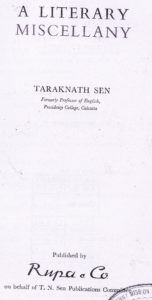
Remembering Professor Tarak Nath Sen

September 5, 2019 By admin

The birth centenary of the legendary professor of English in Presidency College, Calcutta, T.N.Sen was observed by the alumni on 9th July 2009. Some of us wrote reminiscences that were published in a souvenir. Here are my memories of this remarkable teacher of English literature.

When to the sessions of sweet silent thought…
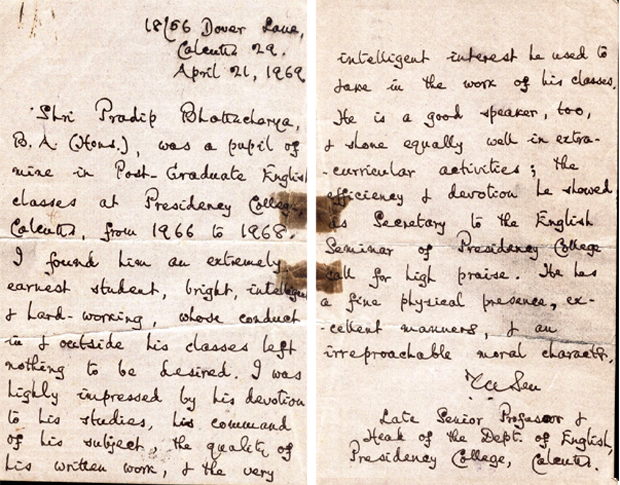
I am looking at a rare document: a small piece of blue notepaper covered with writing impeccably spaced, each letter perfectly formed. This is the character certificate-cum-recommendation Professor T.N. Sen wrote out for me at his residence at 18/56, Dover Lane when, with much trepidation I approached him as I wished to apply for the post of lecturer in English in St. Xavier’s College in 1969. I have not heard of him providing such a certificate to other students of his—perhaps they dared not ask! I guess my Xaverian brashness led me on to enter where betters dared not tread.
After graduating with Honours in English from St. Xavier’s College, when I wanted to join the Calcutta University’s M.A. course in 1966, I found that it was possible to be enrolled through Presidency College. As a Xaverian, I had been brought up on a staple diet of the impossibility of anyone but a Presidencian attaining the dizzy heights of a first class in English. The cold, hard truth of it had been brought home when that summit eluded me by two marks in Part-I and a single mark in Part-II. I was, therefore, intensely curious to find out what made the English Department of this college so very special.

I found myself the solitary “outsider” in a class consisting of four ladies [Chitrita Banerjee, later a well-known author, Indrani Chaudhuri, Anjushree Ghosh, both became lecturers subsequently, and Sunipa Basu, who joined the Indian Customs & Excise Service] and two men [Arya Gupta and Gautam Basu], all native Presidencians. I grit my teeth and was determined to stick on despite the fulminations of Dr. Amalendu Bose, the Sir Gooroodas Banerjee Professor and Head of the English Department of the Calcutta University, who demanded to know what was so wonderful in “that college” that I enrolled in it. The answer was obvious. What a galaxy of luminaries taught us: Dr. Sailen Sen, Prof. Amal Bhattacharjee, Dr. Kajal Sengupta, AKDG (Prof. Arun Kumar Das Gupta— Tarak Babu’s “onlie true begetter”) and Prof. Ashoke Mukherjee. Above them all was Prof. T.N. Sen himself: lanky, tall, appearing almost spectre-like as the shades fell when his classes began, going on well into the dark, teasing out every little nuance of Shakespeare and Yeats. Amal Babu’s remarkably clear explication of T.S. Eliot’s complicated The Sacred Wood inspired my first book. AKDG took up Timon of Athens, turning a minor play into a major experience. S.K. Sen took us through Shakespearean criticism with classically structured deliberation. Kajal-di handled Chaucer with scintillating brilliance, communicating her delight in “The Nonnes Priestes Tale” unforgettably. Prof. Ashoke Mukherjee taught Browning’s “Dramatic Monologues” in his inimitable “Do you follow?” fashion.

Much to my surprise I found Prof. Sen usually referred to as “Tarak Babu” (in St. Xavier’s College we weren’t used to anything but “Mr.” or “professor” for our teachers). He began our classes with a devastating statement delivered in his characteristic sibilant whisper: “If you have come to get the M.A. degree of Calcutta University, it is of no use as it is not worth the paper it is printed on.” Over the next eight weeks he dictated to us an elaborate bibliography paper by paper, dividing it into three categories marked “M” for ‘must read’, “D” for ‘desirable’ and “O” for ‘optional’. A more comprehensive reading list spanning the entire gamut of English Literature I have yet to come across. I used it later when teaching literature in St. Xavier’s College, distributing it to my students as an invaluable resource to be passed on.

As Tarak Babu took up Yeats’ poems on Byzantium I came to realise the vast gulf separating the University teaching from his. The charismatic Prof. P. Lal completed the Byzantium poems in two lectures, one for each; Tarak Babu took eight. The richness of that experience cannot be communicated in words. During this time I noticed a first year fresher poring over a tome in the library where Tarak Babu’s classes were held in a cubicle. It was Indrani’s younger brother, Sukanta Chaudhuri, subsequently a Shakespearean scholar of international renown. He was looking at Leonardo da Vinci’s “Madonna of the rocks” that Tarak Babu had asked him to examine, possibly in the context of Rossetti’s “The Blessed Damosel” (or was it Renaissance poetry?). That is how literature was taught by him, interlinking it with art, leading the student to explore and develop his own insights.

And then he started on “King Lear”. What a wealth of insight he held out to the eight of us (Kasturi Gupta, our senior, joined these classes too and insists it was “Othello”)! The approach was intensely textual, concentrating on extracting the last drop of meaning from every single verse. Indrani Shome, who had graduated from Presidency, used to regale me with accounts of how Tarak Babu’s teaching of “Macbeth” sent shivers up her spine in the witches’ scenes, with his long lanky arms snaking about and how the ladies were taken home in police vans for their safety when classes went on into the dark hours in those Naxalite terror times. Gautam Basu—ardent left extremist who switched loyalties to join the IAS—was a treasure trove of anecdotes, sending us into peals of helpless hilarity with his account of Tarak Babu’s ghost springing out from behind a Presidency pillar as AKDG performed the funeral obsequies, hissing, “Short line! Short line! Action needed! Ghee dao, ghee!” (Tarak Babu’s paper on “Shakespeare’s Short Lines” is a major contribution to understanding Shakespeare’s art and craft).

I remember his setting me a tutorial assignment on Pope’s “The Rape of the Lock”. True to Xaverian tradition, I put into my essay all the critical insights available from various “eminent critics”, only to be told in a sibilant undertone that I was expected not to reproduce others’ views but my own. I grit my teeth, slogged away and resubmitted my tutorial. My exercise book was returned with just one remark that left me crestfallen and considerably puzzled: “This will do”. When I asked my class-mates, they enlightened me that this meant I had achieved the expected standard. That was truly a crowning success for an outsider! This was followed by a bonus: he appointed me Secretary to the English Seminar, putting me in charge of its excellent library.

At the end of two years I found to my complete surprise that I had been placed first in the first class, with Anjushree following. And, in the paper on Romantic and Victorian poetry I had won a medal. The tradition of only Presidencians topping the Calcutta University had been broken—thanks to the unforgettable tutelage of Professor Tarak Nath Sen and his team of colleagues, the likes of whom we will not see again.
Filed Under: IN THE NEWS, STORIES, ESSAYS & POSTS Tagged With: T.N.Sen

VIEWS AND REVIEWS

August 29, 2019 By admin

PUBLICATIONS

    1. Ruskin’s Unto this Last: A Critical Edition. Alpha Publishing, Calcutta. 1969.
    2. S. Eliot’s The Sacred Wood: A Dissertation. Calcutta. 1969; 2nd ed. Bharati Bhawan, Patna. 1995.
    3. Government of West Bengal’s Manual of Protocol & Ceremonials. Calcutta. 1976.
    4. Kartikeya, Amar Chitra Katha comics. English, Hindi, Bengali. Bombay. 1981.
    5. The Monkey Prince. Adarsh Chitra Katha English, Hindi. New Delhi. 1983.
    6. Secret of the Mahabharata. Parimal Prakashan, 1984.
    7. I.R.D.P. Guide Book. Bengali. Murshidabad. 1984. 2 edns.
    8. Ed. Proceedings of Workshop-cum-Conference on Co-operative Functioning. West Bengal State Cooperative Union, Calcutta. 1985.
    9. The Unknown Ashoka. The Heritage magazine, Madras, 1987.
    10. Themes & Structure in the Mahabharata. Dasgupta & Co., Calcutta. 1989.
    11. Bankimchandra Chatterjee’s Krishna Charitra. M.P. Birla Foundation, Calcutta. 1991. The first English translation from Bengali.
    12. Shivaji Sawant’s Mrityunjaya: A Long Critique. Writers Workshop, Calcutta, 1991.
    13. The Mahabharata TV film Script: A Long Critique. Writers Workshop, 1991.
    14. Ed. Lt. Col. G.L. Bhattacharya’s Krishna of the Gita. Writers Workshop, Calcutta. 1993.
    15. Ed. Handbook of Valuation, Central Valuation Board, West Bengal, 1994.
    16. Pratibha Ray’s Yajnaseni: the story of Draupadi. RUPA, New Delhi, 1995. The first English translation.
    17. Human Values: The Tagorean Panorama (with Dr. S.K. Chakraborty). New Age International, New Delhi. 1996. The first English translation of “Shantiniketan” from Bengali.
    18. Sri Aurobindo & The Mother: Right Attitude to Work & The Right Spirit. Govt. of W.B., Calcutta. 1997; 2nd ed. 2005; 3rd ed. 2012.
    19. Ed. Manual of Refugee Relief & Rehabilitation, 2 vols. Govt. of W.B., Calcutta. 1998.
    20. Annual Administration Report, 1997-98, Refugee Relief & Rehabilitation Dept. Govt. of West Bengal. Calcutta. 1998.
    21. Subodh Ghosh’s Bharat Prem Katha. Rupa, 1998. The first English translation from Bengali.
    22. Annual Administration Report, 1998-2000, Sunderban Affairs Dept., Govt. of West Bengal. Calcutta. 2000.
    23. Ed. Leadership & Power: Ethical Insights (with Dr. S.K. Chakraborty). OUP, New Delhi. 2001.
    24. Prachin Bharatey ebong Mahabharatey Netritva O Kshamatar Byabahar (with S.K. Sen) Bengali. Dasgupta & Co., Calcutta. 2002. Translation from English.
    25. Annual Administration Reports 2000-2002, 2002-03, Consumer Affairs Dept., Govt. of West Bengal. Calcutta. 2003.
    26. Ed. Manual of Legal Metrology, Govt. of West Bengal. Calcutta. 2005.
    27. Ed. Consumer Handbook. Consumer Affairs Dept., Govt. of W.B., Calcutta. 2005.
    28. Parashuram’s Puranic Tales for Cynical People (with S.K. Sen). Indialog, New Delhi. 2005. Translated from Bengali.
    29. Love Stories from the Mahabharata. Indialog, New Delhi. 2005. Translation from Subodh Ghosh’s Bengali Bharat Prem Katha.
    30. Pancha Kanya: the five virgins of India’s Epics—a Quest in search of Meaning. Writers Workshop, Calcutta. 2005. 2nd edition, Sri Vishnu Mohan Foundation, Chennai, 2017.
    31. Administrative Training Institute Monographs 1-20. Kolkata. 2005-9.
    32. Ed. Revisiting the Panchakanyas—proceedings of a national seminar. Eastern Zonal Cultural Centre, Kolkata. 2007.

    31-36. Ed. Samsad Series on Public Administration. Kolkata, 2007-8.

    -The Appu Papers by P.S. Appu

    -WB Services and Financial Rules and Office Procedure

    -Dimensions of Law and Order Administration

    -Inspections and Tours

    -District Administration: Changes and Challenges

    -Crisis of Governance by P.S. Appu

    1. Ed. Manual on Training of Trainers for Human Development by Dr. A. Ghosh. ATI, Kolkata. 2008.
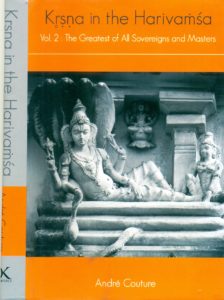
    2. Ed. The Jaiminiya Ashvamedhaparva by Maj. Gen. S.K. Sen VSM. Writers Workshop, Kolkata. 2009. The first verse-by-verse English translation from Sanskrit.
    3. Narrative Art in the Mahabharata—the Adi Parva. Dev Publishers & Distributors, 2012.
    4. The Mahabharata of Vyasa: The Complete Mokshadharma Parva, translated from the Sanskrit, Writers Workshop, Kolkata, 2016. This is the first sloka-by-sloka translation in verse and prose.
    5. The Jaiminiya Mahabharata: Mairavanacaritam and Sahasramukharavanacaritam, A Critical Edition, with sloka-by-sloka verse translation (with S.K.Sen), National Mission for Manuscripts & New Bharatiya Book Agency, New Delhi, 2017.
    6. Kabi Sanjay’s Mahabharata, the first Bengali Mahabharata translated verse-by-verse into English verse, Das Gupta & Co. Kolkata 2019.
    7. Camille Bulcke: The Rama Story: Origin and Growth (translated from Hindi to English) The Sahitya Akademi, New Delhi, 2022.
    8. The Mahabharata of Vyasa: The Complete Anuśāsana Parva, translated from the Sanskrit, Writers Workshop, Kolkata 2023. This is the first sloka-by-sloka translation in verse and prose.

OTHERS

  1. Edited “X“, the first Eng-Beng minimag, 1968-71.
  2. “Wordsworth the Kavi,” a bicentennial tribute, Journal of the Department of English, Calcutta University. Reprinted in Mother India.
  3. Associate Editor, 20 Points: Nadia (1976).
  4. The Administrator, quarterly journal of the L. B. S. National Academy of Administration, Govt. of India, 1980-83.
  5. Associate Editor, The Service, journal of the I.A.S. Association, West Bengal, (1986-88).
  6. Case Studies on relief work in Bangladesh and various facets of district administration in The Administrator and The Statesman.
  7. “Indus Valley Civilization” in Dravidian Encyclopaedia vol.1 (International School of Dravidian Linguistics, Thiruvananthapuram, 1990). Articles on Harappan Civilization in Puratattva, journal of the Indian Archaeological Society, The Book Review, The Administrator and on new light on ancient Indian history in the K. D. Sethna Festschrift (Sri Aurobindo Ashram, Pondicherry1994.)
  8. Articles on Transactional Analysis in TASI Darshan (journal of the T. A. Society of India), The Administrator, Actualiatesen Analyse Transactionelle (journal of the European T.A. Association) and in TAJ (journal of the International T. A. Association, USA).
  9. Articles on civil service training in Bhandar (journal of the West Bengal Co-operative Union), HRD: International Perspectives on Development & Learning (ed. M. Jones & P. Mann, Kumarian Press, USA); Indian Journal of Public Administration.
  10. Articles on comparative mythology in Indian Railways, Indian Literature, The Heritage, India International Centre Quarterly, Mother India, Xaverian Literary Treasury, Shatapatra, Vyasa’s Mahabharata: Creative Insights (ed. Padma Sri Prof. P. Lal, 2 volumes), The Statesman, Indian Review of Books, Indian Book Chronicle, The Book Review, BIBLIO, PURANA, Journal of the Asiatic Society, Journal of South Asian Literature (Michigan State University), International Journal of Hindu Studies, PARABOLA, South Asia, International Journal of Cultural Studies and Social Sciences.
  11. “The Unprotected Terracotta Splendour of Murshidabad” in Indian Studies in memory of Prof. Niharranjan Ray Amita Ray, H.Sanyal, S.C.Ray and in the Bengali District Gazetteer for Murshidabad.
  12. Articles on Values in Management in Human Values for Managers (ed. Dr. S.K. Chakraborty. Wheeler, New Delhi, 1995), Liberalised Economy & Quality of Life (ed. Dr. Subir Chowdhury & Prof. Nikhil Barat. Association of Indian Management Schools, 1995), Sri Aurobindo Mandir Annual 1995, Journal of Human Values, Mother India, Advent.
  13. “A spiritual viewpoint” in WHO’s Round Table on the “Renewal of the Health-for-All Strategy”, World Health Forum, 17, 1996 (the only Indian selected for contributing to this discussion).

THE AUTHOR

Parents: Lt. Col. Gunindra Lal Bhattacharya, B.Sc., MA, LL.B and Suprobhat Bhattacharya nee Chatterjee, MA, B.T. Lt. Col. Bhattacharya, Corps of Signals (1942), served in the XIV Army in World War II and suffered solitary imprisonment in East Pakistan 1961-64 after being shot and abducted. He fought his own cases against the Pakistan Government in their Supreme Court which created sensation.

Education: Schooling in St. Lawrence High School, Calcutta, 1955–63.

  • Graduated with Honours in English from St. Xavier’s College, first in the college and first in the 2nd class in Calcutta University (1966).
  • M.A. (English) from Presidency College, 1968, first class first, Calcutta University; awarded gold and silver medals and cash prizes.
  • B. (Prely.) University College of Law, Calcutta University, first class. Completed the degree course.
  • German Language Certificate, Max Muller Bhawan, Calcutta, first in the first division.
  • The only candidate awarded the Post-Graduate Diploma in Public Service Training with Distinction, Manchester University, 1983.
  • Certified Scholar (Homeopathy), Grace Medical Mission Kerala; M.D. (Homeopathy), Premier Homeopathic College, Chandigarh.
  • Ph.D. in Comparative Literature on “Narrative Art in the Mahabharata” from the Netaji Subhash Open University, West Bengal.

Honours:

  • The sole Indian awardee of the International Human Resource Development Fellowship by Manchester University and the Institute for Training & Development, U.K. in 1989, the year it was instituted, and invited to address the World Training Conference in London. The citation states: “Mr Bhattacharya’s designation as an International HRD Fellow is indeed an honour to him and the IAS, for it recognises the outstanding contribution that he is making to the achievement of professional excellence in human resource development.”
  • The only Indian selected to contribute a paper to WHO’s Round Table on the “Renewal of the health-for-all strategy” published in World Health Forum, vol. 17, 1996.
  • The sole third world representative to address the 1983 National Conference of the Institute of Transactional Analysis, U.K. in London.
  • Founding Vice President of THE OSKARS a new-wave theatre group in Calcutta.
  • Revived the British Council Play-Reading Group, Calcutta.
  • Founding editor, “X”, the first English-Bengali mini-magazine.
  • The only officer selected twice to lead, from inception, World Bank Projects (viz. upgrading of Industrial Training Institutes and the Bank’s largest intervention in the health sector—the State Health Systems Development Project-II).
  • Twice elected Member of the Board of trustees, Transactional Analysis Society of India (TASI); accredited Basic T.A. Trainer by TASI; Founding Chairperson, TASI Calcutta Chapter.
  • Elected Executive Committee Member of the I.A.S. Association, West Bengal several times and served as its Honorary Secretary,
  • Government of West Bengal’s longest serving nominee on the Board of Governors, I.I.M. Calcutta 1993-2002; 2005-contd.
  • The Provincial’s nominee on the Managing Committee, St. Xavier’s Collegiate School, Calcutta, for several years till 1996.
  • Guest faculty in the L.B.S. National Academy of Administration for courses on Ethics in Administration and in the Management Centre for Human Values of I.I.M. Calcutta.
  • Selected by the Sahitya Akademi as a judge to choose the best English translation for the year.
  • Served on the Editorial Board of IIMC’s Journal of Human Values (SAGE) and of MANUSHI.
  • Regional Editor (East) for the Mahabharata Encyclopaedia Project of the Mahabharata Samshodhana Pratishthanam, Bangalore, funded by the Ministry of HRD, Govt. of India.
  • Member of the governing board of the Rabindranath Tagore Centre for Human Values set up by Ambuja Realty in May 2011 to commemorate the 150th birth anniversary of Tagore. Taught a 30 hour credit course on India’s Epics and Puranas for the M.A. in Human Values course of the Netaji Subhas Open University, West Bengal.
  • Initiated a Regional Mahabharatas Documentation Project by the Indira Gandhi National Centre of Arts, New Delhi, under the Ministry of Culture, Government of India.
  • Chaired sessions and presented papers in several international and national seminars on the Mahabharata organised by the Sahitya Akademi, IGNCA, MANUSHI and the Department of Sanskrit, Bombay University.

Career:

  • Lectured in English at St. Xavier’s College, Calcutta, 1969-71, organising the first inter-collegiate seminars on English Literature.
  • Joined the Indian Administrative Service in 1971. Relief work in Rajshahi District, Bangladesh, 1972, resettling several thousand evacuees.
  • Radically remodelled the training of IAS probationers, posting them as BDOs for the first time in 1974-75.
  • Drafted Agriculture Department’s orders vesting supervisory and coordinating powers over all extension officials in BDOs.
  • Established the Directorate of Homeopathy in Govt. of West Bengal, 1975.
  • Wrote Government of West Bengal’s first Manual of Protocol and Ceremonials, a standard reference work since then.
  • Twice acted as “One-man Enquiry Committee” into problems of Government of West Bengal’s premier hospital, SSKM Hospital.
  • Carried out cadre review of the armed forces and Defence Lands & Cantonment Service, Government of India, 1979.
  • Deputy Director, National Academy of Administration, Govt. of India, 1979-83, training the All-India and Allied services.
  • District Magistrate & Collector of Murshidabad 1982-83; commended by Govt. of India for the outstanding work done under IRDP for poverty alleviation.
  • As Registrar of Co-operative Societies, West Bengal, organised a workshop-cum conference on the functioning of co-operatives that was acclaimed “a unique learning experiment” by the International Co-operative Alliance and the Govt. of West Bengal.
  • As Managing Director of the W.B. Tourism Development Corporation made unprecedented earnings for the languishing organization.
  • As Chairman, Central Valuation Board, computerised the calculation of taxes for urban holdings, tripling the tax base of municipalities.
  • As Secretary, Municipal Affairs, drafted legislation in West Bengal in the context of the 73rd and 74th Constitutional Amendments, setting up the State Election Commission, the District Planning Committees, the Metropolitan Planning Committee, several Municipal Corporations and finalised the West Bengal Municipal Act, 1993.
  • As Director, Administrative Training Institute, West Bengal, radically remodelled the training content and style and published a Handbook of Service and Financial Rules and several training monographs and case-study volumes.
  • The only officer selected for leading from inception two World Bank projects [for modernising Industrial Training Institutes in West Bengal (1989-91) and the Bank’s largest intervention in the health sector, a Rs. 710 crore project for West Bengal (1996-97)].
  • Edited & published the first comprehensive Manual of Refugee Relief and Rehabilitation in 2 vols.
  • Drafted Government of West Bengal’s orders setting up public grievance and assistance offices in all districts and constituting a Working Group on increasing efficiency in government functioning and introducing E-governance.
  • As Commissioner of Presidency and Burdwan Divisions held inspections for the first time since 1974, computerised processing of land acquisition cases resulting in considerable savings, got all Collectorates cleaned up, persuaded Government to revise the ACR format of WBCS officers incorporating objective-setting and evaluation.
  • In Consumer Affairs introduced on-line grievance handling, bringing all three wings under one roof in all districts, both for the first time anywhere in India, which was acclaimed by the Govt. of India.
  • Revised the B. Secretariat Manual and the Rules of Business. Drafted the state government rules under the Central Right to Information Act.
  • Served in Land Reforms, Home, Finance (Jt. Secy. Audit and Banking, and as Director Staff Inspection Unit), Health, Tourism, Labour, Technical Education & Training, Municipal Affairs, Refugee Relief & Rehabilitation, Food Processing Industries & Horticulture, Sunderban Affairs, Consumer Affairs, Development & Planning.
  • Retired as Additional Chief Secretary to the Government of West Bengal in charge of Development & Planning and Director of the Administrative Training Institute (2 tenures).

 REVIEWS

T.S. Eliot: The Sacred Wood–A Dissertation

  • “I have read your work on The Sacred Wood carefully and enjoyed reading it…I myself think that this is an excellent commentary.” Amalendu Bose, D. Phil. (Oxon.), F.I.A.L., Sir Gooroodas Banerjee Professor & Head, Department of English, Calcutta University.
  • “I have gone through your work with much interest and have been much impressed by your methodical exposition and your very clear analysis of Eliot’s thought. This is what critical appraisal and analysis should rest on; otherwise criticism, however good, so easily passes into myth for the next generations which their successor have in turn to pull down. Thank you very much for giving the opportunity to see your worth.” T.G.P. Spear, Fellow, Selwyn College, Cambridge University.
  • An extraordinarily well-informed, sympathetic and useful dissertation…In fact, for the general reader this is probably the best organised book on Eliot’s criticism, the appendices being products of much thought and sensitivity. Mr. Bhattacharya has five topics that will be specially useful to university students…It is encouraging to see an alert mind not unafraid to tell off grey eminences like Sean Lucy, Eliseo Vivas and Kristian Smidt where they seem to go wrong in their understanding of Eliot’s meanings. Mr. Bhattacharya’s work is not, as most books of this nature are, a re-hash of available material on the subject. There is much original thinking in it–and many new viewpoints on clichéd areas. For instance, Watson apart, no one has so far explained the title of the book. Mr. Bhattacharya suggests that this is sacred grove at Nemi near Rome…Eliot’s murderer in ‘the bloody wood’ has not yet appeared on the scene; and acolytes of Mr. Pradip Bhattacharya’s devotion will not doubt prevent the guru’s stiff shroud from being dishonoured.” Padma Shri P. Lal in The Hindusthan Standard.
  • A valuable little book…very useful, totally unpretentious and well written. Your power of concentration on the subject is admirable. With your writing ability you will, I feel, turn in due course to other subjects and authors as well, both old and new.” A. N. Kaul, Head, Department of English, Delhi University.
  • “I have read (it) with interest and profit. Sri Bhattacharya’s writing shows a good deal of critical penetration and intelligent understanding of complex and difficult ideas of a book which still remains a basic work on modern criticism. I am particularly impressed with Sri Bhattacharya’s wide reading in Eliot’s prose and poetry and in the large Eliot literature. The dissertation gives a careful and minute analysis of the major chapters of the book and follows up with a series of appendices of a more general nature, all bearing on Eliot’s fundamental ideas. These show a critical maturity which is rare indeed. In spite of its modest compass the book will be of great help not only to students but to those also who are interested in Mr. Eliot’s work as poet and critic.” Amal Bhattacharji, Head, Department of English, Presidency College, Calcutta.
  • “It is thoughtful and well written and I have read it with pleasure and profit. Indeed, I am happy to congratulate the young author. He deserves everyone’s congratulations.” S.K. Sen, Professor & Head, Department of English, Presidency College, Calcutta.
  • “I have read it with interest and delight. I feel this is a notable contribution to the study of T.S. Eliot’s most important literary essays…Mr. Bhattacharya’s book will not only be of great assistance to students new to Eliot’s criticism; it is sure to prove a refreshing and stimulating work even for old readers of Eliot. I hope to see more work of the same order from our young author.” Sujata Chaudhuri, Principal & Head, Department of English, Lady Brabourne College, Calcutta.

Ruskin’s Unto This Last: A Critical Edition

  • “Pride of Bookmarks’ place to a finely annotated edition of Ruskin’s Unto This Last…the book, which has long introduction and careful notes, is excellent value.” Padma Sri P. Lal, The Hindusthan Standard.

The Secret of the Mahabharata

  • Churning of the Ocean: “Pradip Bhattacharya is not only an able administrator…but an erudite scholar. In the present work, he has delved into some of the most revolting (apparently) episodes of the Mahabharata, and tried to explain their deep moral/spiritual significance…No doubt, all this is interesting and thought-provoking and probably hints at the true import of the myth in the “ Dr. H. D. Sankalia, The Times of India.
  • Message in the Myth: “Pradip Bhattacharya’s work is an erudite and important study of Vedic spiritual messages and symbols as transmitted and popularised through the Mahabharata myths & stories…The analysis is essentially dialectical in mode and principle…The logic involved is not formal-rational but dialectical-esoteric. An excellent work.” Subir Das Gupta, The Telegraph.
  • Vyasa & the Vedic Secret: “A brilliant analysis of Vyasa’s myths in terms of Vedic truths comes as a fresh corroboration of the validity of the integral approach… It is delightful to see the author reads correctly the message of Vyasa…with a marvellous sweep from Veda to Savitri…Shri Bhattacharya’s scholarship has an eye and ear for the mystic, which is the essential pre-requisite for a researcher in Indology… After going through the 155 pages of his book, one is convinced that the Mahabharata is a unique time-capsule invented by Vyasa the Veda–the Grand Synthesis–is preserved for posterity.” Gauri Dharmapal, The Statesman, Mother India and Srinvantu.
  • The technique the author adopts to discover the secret meaning is indeed a Herculean task. Since the Mantras reveal their innermost secret only to an intuitive mind, Bhattacharya with little difficulty attains success…the fruit of a decade of intensive study of the epic…(his) arguments are very convincing and his discoveries open up new vistas in the Hindu epic lore. Certainly the seeker after spiritual truth cannot afford to ignore this book which is a consummate scholarly piece of work written with verve and style.” P. Raja, Mother India.
  • The Impact Eternal–Lights from the Great Epic: “An equally noteworthy addition to the Mahabharata lore by a senior member of the Indian Administrative Service who is basically a serious scholar…The author chooses some of the episodes in the epic and discovers the truths underlying the story elements. He performs his complex task ably, mostly with the help of Sri Aurobindo’s Vedic Glossary compiled by A. B. Purani.” Manoj Das, The Heritage.
  • “I read your book on the Mahabharata and enjoyed it greatly. More than anything, it showed a deep and moving comprehension of the symbols, something experienced rather than simply quoted…after reading your book I feel like doing a story of the ‘Earings’…Thank you for the experience your book afforded me.” Maggi Lidchi Grassi, internationally renowned novelist.
  • “I am impressed by your perceptive scholarship and find your analysis of the subject interesting. I agree with many of your conclusions.” P. Pandit, Sri Aurobindo Ashram, Pondicherry.

Themes & Structure in the Mahabharata: the Adi Parva

  • Journey to the Centre of an Epic: “A quality of the treatise that stands out is the manner in which the scholar dishes out information, knitting them together with both relevance and order…If (certain) elements sometimes intrigue an average reader of the epic, Bhattacharya views them in a wider perspective and establishes their justification… While commenting on certain issues Bhattacharya recreates the stories behind them and does so with beauty and restraint, making cogent references to sources to sources outside the Mahabharata whenever appropriate. He shows, through arguments, cross-references to characters and events and drawing our attention to the totality of the Mahabharata are more meaningful than meets the eye. He has followed a method which he expects would let the epic ‘as it were, to grow on the reader’. No doubt he succeeds in this.” Manoj Das, The Statesman.
  • Far Beyond the Idiot Box: “Pradip Bhattacharya’s illuminating book is a welcome addition to modern work on our national epic…It has obviously been a labour of love—Bhattacharya’s commitment and devotion are apparent in each page of his analysis… (he) deserves all congratulations for providing answers…he has pegged the Mahabharata squarely within an international framework of comparative literature and universal appeal. (His) method is painstaking… He searches for meaning, layer within layer. Thus we find him meticulously splitting hairs with a very definite purpose—the drawing out of nuances and variations of emphasis… Particularly impressive is (his) capacity for underlining the tongue-in-cheek humour in the Mahabharata, which most commentators are too solemn to note…Another service the commentator performs is to highlight those verses which once heard ring for ever in our ears…The book is not for cursory reading. It represents hours of solid study and requires to be approached in a similar spirit. The author deserves all praise for his application in the midst of the pressures of his working life far removed from academic cloisters.” Ketaki Datta, Business Standard.
  • Vyasa Nodding & Critic Napping: “this enthralling book…One does not very often come across a work of such elegance and depth. Bhattacharya’s prose is effortless and beautiful… He has established his firm control over the language even in the poetic form while transcreating some slokas…extremely well-informed commentary…has continuously endeavoured to establish some kind of continuity, remove irrelevance, apparent or otherwise, establish the logicality of seemingly meaningless words and episodes with tremendous research… He presents very interesting social and cultural concepts prevalent within that frame of reference… (he) has made it a point to mention and pinpoint all the Vedic concepts in the epic whenever they occur in the course of narrative…The basic characteristic of the book is the brilliant of incidents which is very clearly the results of extensive research…He has introduced touches of humour too, which, in combination with his erudition and skill with language, has made the book eminently readable…He has also done the stupendous task of connecting far-related incidents…consequently the reader obtains a clear, logical, intelligible and sane picture of the very involved and confused panorama of the ..(he) has provided for fun time too…There are so many pieces of interesting information that one is amazed…a genealogical chart and a map…are two of the best points of the book. Thematic analysis and highlighting have made (the book) an experience of a special kind…The book leaves one with a feeling of joy and satisfaction…(he) has analysed the characters and incidents with consummate skill and dedication and provided an unforgettable insight into the greatest story of the tragedy of man. He has done this service only for the first parva. There are seventeen more. Here is hoping that we shall hear from him again, soon, on these.” Maj. Gl. S.K. Sen, VSM, Vyasa’s Mahabharata: Creative Insights, Vol. 1. ed.  Padma Shri Prof. P. Lal (Writers Workshop, Calcutta).
  • Vyasan Alap: “A commendable effort to analysis the alap–the baffling nebulous mass of material with which the epic begins…bringing out (the) central theme of each of the subparvas…poetic breath is retained in translation. He also injects a bit of Comparative Mythology…His sub-titling…shows more vividly the connecting links…(they) become a condensed commentary, or rather sutras, to comprehend the Adi Parva…the author (is) a successful explorer of symbolism…He analyses each section and gives his comments. Dhritarashtra’s psychoanalysis from his famous lament is excellent…(His) observations are insights what really help us to get glimpse of the Vyasan Vision and Master’s mastery of his epic art in all its nuances. He helps the reader to to comprehend the web of inter-connections…He also points out similarities with the other epic ..He gives parallels from European literature of characters, themes, expressions etc. which add a taste of comparative literature and thus widen our field of vision…The study is lit up with humour at places…Vyasa’s humour is also noted. He delightfully follows the Indian habit of chanting out a couplet by way of comment even in a serious critical work. Thanks are due to Bhattacharya for displaying to us some intricate fabrics of the gigantic pattern that is the Mahabharata and giving us another opportunity to breath-in the refreshing air of great poetry, blowing away the monotony of life and opening up a Cosmic Panorama before which all pettiness vanishes.” Dr. Gauri Dharampal, Mother India, The Statesman, Srinvantu.
  • “Most striking…is the effortless way in which he moves back and forth from ancillary material to the Bharata story…it yields gems of insight about thematic congruence that seem to echo throughout the epic narrative.” Dr Barbara Gombach, doctoral dissertation, Columbia University.

Bankimchandra Chatterjee’s Krishna Charitra

  • “Pradip Bhattacharya and M. P. Birla Foundation deserve the gratitude of all the serious students of the Mahabharata. The translation is almost word-perfect…He has been able to capture the flow and the difficult and complicated syntax used by Bankim…very successfully captured that distinguishing atmosphere that is essentially Bankim…The introduction contains some interesting information hitherto little-known…The Bibliography…is very exhaustive…This work of translation is a production of very high order. The printing, the binding, the get-up etc. are excellent.” Maj. Gen. S.K. Sen, Vyasa’s Mahabharata: Creative Insights, Vol. 2, ed. Padma Shri Prof. P. Lal (Writers Workshop), The Statesman.
  • “Truly meritorious translation…It is no routine exercise, but a labour of love and dedication.” K. R. Srinivasa Iyengar.
  • “I am very glad to have this important translation in my library…what I have checked seems excellent.” Julius Lipner, Faculty of Divinity, University of Cambridge.
  • “Bhattacharya, a noted scholar on the Mahabharata with several works on the subject to his credit, certainly accomplishes a fine translation of a difficult work… But what is more, he enriches the work in the light of research subsequent to Bankimchandra’s… He also provides in the Appendix notes on references to works and persons left unannotated by Bankimchandra as well as English rendering of Sanskrit verses the author quoted only in their original.” Manoj Das, The Hindu.
  • “The style is racy and invigorating, facilitating understanding of the original essay…The abstruse Indian ontology propounded by Bankim has been lucidly and elegantly conveyed.” Debal Kr. Chakravarti, Vyasa’s Mahabharata: Creative Insights,Vol. 2, ed. Padma Shri Prof. P. Lal (Writers Workshop, Calcutta).
  • “A monumental work…I do not think that anybody working on Mahabharata or Lord Krishna can afford to neglect this work…Publication and printing is flawless and matches to the standards of the contents of the book. The M. P. Birla Foundation deserves congratulations.” Jodh Singh, Head, Department of Religious Studies, Punjabi University, The Journal of Religious Studies.
  • “excellent translation”. Hans Harder, Universität Halle, Germany.

A Long Critique on “MRITYUNJAYA”

(Shivaji Sawant’s novel was awarded the Moorti Devi Puraskar by Bharatiya Jnanpith. This Critique was published in Marathi as well.)

  • Karna is the hero: “The discussion on Shivaji Sawant’s Mrityunjaya will remain incomplete if in this context another work is not referred to. The critique written on Mrityunjaya by a Calcutta civilian Pradip Bhattacharya IAS has behind it not only his own research on the Mahabharata but also the two Hindi and English translations of Mrityunjaya. He has examined Shivaji’s Karna differs from Sawant’s Karna, where Shivaji has departed from facts to establish the greatness and sublimity of his creation, Karna, nothing has escaped Bhattacharya’s eye. Still, he remains an admirer of Sawant’s genius…Bhattacharya’s scholarly critique has brought the hapless Karna even closer to us.” Neeta Sen Samarth,
  • “Pradip Bhattacharya brings to the difficult if fascinating task the resources indicated in his The Secret of the Mahabharata and Themes & Structure in the Mahabharata: Adi Parva…it leaves one with a feeling of joy and satisfaction.” K. R. Srinivasa Iyengar, The Hindu.
  • “This is the real microscopic literary valuation of Mrityunjaya. My heartiest congratulations with thanks to him. Here he has taken a deep dive like the author into the character of Karna. He has suggested some very essential corrections… done full justice to the magnum opus literary creation.” Shivaji Sawant, author of
  • Echoes of the Epic: “a welcome venture…an estimate at once objective and highly readable, Bhattacharya’s scholarship on the Mahabharata being commendable and his study of Sawant’s work being sincere…The critic has done well by pointing out a couple of errors made by the translators.” Manoj Das, The Hindu.
  • “Highly incisive, critical yet objective critique.” Subramanian, Pratibha India.

The Mahabharata TV Film Script–A Long Critique

  • “A brilliant critique. His assessment of the ten volumes is certainly most enlightening and puts the entire work in proper perspective.” Satish Bhatnagar, translator of the Hindi script into English.
  • “I feel particularly obliged for your very enlightening critique (and) in-depth study of Mahabharata…all praise for the highly intellectual display of critical excellence…Your critique on the serial was really a masterpiece of writing… heartfelt thanks for the contribution you have made to books on Mahabharata.” B. R. Chopra, noted film-maker & producer of the tele-epic.
  • Mythology—A Contemporary Appropriation: “Bhattacharya goes to great pains to chronicle these departures (from the epic) bringing to bear his considerable scholarship in this area… Both Reza and Bhattacharya are believers in the feminine cause…With Reza and Bhattacharya the Kunti-Draupadi-Gandhari triumvirate emerges from the no less resplendent than the Arjuna-Karna-Bhima trio, an yang-yin balance which enhances the impact of the epic… Bhattacharya here goes the entire distance in secularising the epic…If Bhattacharya after Bankim Chandra is more concerned with Krishna as Purushottama, Reza is occupied with showing Krishna as Magi not Magic. The end result in both cases is a character more suited for secular absorption.” Champak Chatterjee IAS, The Indian Book Chronicle & in Vyasa’s Mahabharata: Creative Insights, Vol. 2, Padma Shri Prof. P. Lal.
  • Is anybody listening? “Pradip Bhattacharya’s review, in many ways, is much more than a review. It is an independent work that throws a lot of intimate insights into the mysteries of the epic. He has given his own interpretation, besides, pointing out the strengths and weaknesses of Reza’s presentation and those of the English translation. Consequently, what we have in the 10th volume is a work of art that not only has incisive criticism, but also creative insights that give us much more than what we have in the script. Reza has thrown up many ideas on values and PB has dexterously fielded them, enriching his observations with his characteristic expertise. Those important aspects of the Mahabharata which Reza should have included but did not and those aspects that Reza has included but has blundered are pinpointed with ruthless precision and exposed in razor-sharp clarity… The nicest thing about it is that there is no exhibitionism, no pomposity of the pseudo-intellectual, but the simplicity of a mind rich in incisive wisdom that is born out of a comprehensive assimilation of available literature… PB has an excellent discussion on the similarity of the principal female characters and the concept of eternal virginity…we get information not commonly known…His discussion of lust being the nemesis of the Paurava Dynasty is one important contribution…he startlingly reveals that it was Dharma who protected Draupadi, not Krishna. He gives us a hint that the entire episode of vastraharana is an interpolation. PB effectively brings out Krishna’s political acumen… PB’s discussion of the Sishupala incident is significant in dispelling the myth of Bhishma’s unquestioned supremacy (and) for the demystification of Krishna’s superhuman Halo… PB introduces the Kalpataru concept but unfortunately does not elaborate… But his discussion on the Karna-Kunti relationship provides perhaps the most interesting analysis of a much-talked about incident of the Mahabharata…PB has very sensitively brought out an expose on Dharma as spoken by various characters…he has been able to, very effectively, garnish his review with quotations and discussions from authors…He has also quoted parallel situations from European mythology and literature…We also find evidence of his expertise in this field (of Transactional Analysis) in his work…PB has also brought in modern day parallels…these, too, have added a freshness to the work and brought in a touch of contemporaneity…a superb work of penmanship.” Gen. S.K. Sen VSM, Vyasa’s Mahabharata: Creative Insights Vol. 2 (ed. Padma Shri Prof. P. Lal).
  • “I like rehandling of old texts with changes in accents and nuances. Some of these may not be quite sound and for creative changes tributes are due. Reza deserves such a homage and your long critique pays it unreservedly. It must have taken through study and is most comprehensive.” Krishna Chaitanya.
  • Epic which came to the drawing room: “Volume X has also a Critique running to about 280 pages of high class English prose which is at once a fine addition to modern Indo-Anglian English literature and an extremely fair, critical review of Rahi Masoom Reza’s monumental work in Hindi for the T.V. Serial of the …Bhattacharya’s Critique is a masterpiece of Literature by itself and it can be safely recommended for special study for students of modern mass communication schools in the English speaking world.” K. Vedamurty, The Hindu.
  • A trip down the memory lane: “Pradip Bhattacharya has a brilliant epic simile to ram it (the public stripping of Draupadi) down our intelligence…truly a meaningful gift to the coming generations. In his masterly analysis of the script, (he) whirls us through the inner countries of the mind to get at the core significance of Vyasa’s epic as well as Reza’s version. In the course of a painstaking, fair and boldly critical study of Reza’s script, he brings in scores of other versions of Vyasa’s epic characters… There is a blow-by-blow comparison of Vyasa and Reza…According to PB, the very fact that an Indian Muslim has brilliantly recast the epic is a sterling validation of the universality of appeal of Rishi Vyasa’s epic…Backed by wide reading in Indian and Western literatures, Pradip ‘load every rift with ore’ in his critique. The way Reza and he have amply fulfilled Sri Aurobindo’s dream for a ‘weighty, careful and unbiased study of the work, canto by canto, passage by passage, line by line, which can alone bring us to any valuable conclusions.” Prema Nandakumar, The Hindu.

Ed.  Lt. Col. G. L. Bhattacharya: Krishna of the Gita

  • Living scripture & personal testament: “ P. Lal, a Gita enthusiast himself, confesses to have met his waterloo in GLB’s book out of the ordinary…we owe the present posthumous publication to the filial devotion and editorial expertise of Gunindra Lal’s son Pradip Bhattacharya, himself a writer of distinction doubled with a responsible civil servant in West Bengal. It is legitimately claimed that Krishna of the Gita is the only exegesis written by an army officer. No wonder GLB is in a sense both the subject and the commentary… GLB was to be guided by Sri Aurobindo’s exposition of the Gita itself, come to terms with it, live its Yoga and play the role of Arjuna in despondency, and listen to Bhagvan, and find solace and strength in the Lord’s words… (he) braved the worst privations…(it) invites careful study…his presence was something of a benediction to the fellow prisoners as well… For Gunindra Lal the two aims of his writing are to come to the core of the Gita’s message and to suggest a regrouping of the text of the Gita…it is a personal testament and his wide-ranging understanding has room also for the profound insights of Christianity and Islam… Once rises after reading Gunindra Lal’s book feeling more than ever certain that the Gita is truly living scripture.” Dr. K. R. Srinivasa Iyengar, The Hindu.
  • Guidebook on the Gita: “a symmetrical and complementary instance of the Gita’s truth playing a redemptive role in the life of another soldier…its message proved a great source of strength…the most important concepts seem to be conserved. The author stresses the radicalism of the Gita in the bold rejection of Vedic orthodoxy…a guidebook-like text…The author’s son, Pradeep Bhattacharya, who writes the preface, has studied the epic and its inset with exceptional thoroughness.” Krishna Chaitanya, Indian Review of Books.
  • Sweetness and Light: “Lt. Col. G.L. Bhattacharya who has undergone a lot of trouble, suffered anguish and imprisonment, forgets his misery by applying himself to The Gita. Krishna of the Gita is born of his intense suffering and the Col. seems to have read a lot in religious literature and his learning is sprinkled with quotations from various religious texts such as the Holy Qur’an and the Bible… Colonel’s comments on Yoga are informative as he has learnt the techniques from his study of Sri Aurobindo… Col. has dwelt extensively on this aspect of The Gita and has discussed minute details necessary for a through understanding of the text…a dependable commentary born of the author’s sadhana. It reveals the author’s erudite scholarship and catholicity of outlook.” The literary Half-Yearly (Mysore).
  • Another viewpoint: “The speciality of this commentary by Lt. Col. Bhattacharya is that he has analysed Gita’s Krishna and Arjuna from a new point of view.” Moni Gangopadhyay, Ananda Bazar Patrika.
  • “An intensely personal account…Here indeed one is witness to the rising of the Human Spirit over constricting and confining religious boundaries to truly catholic heights. Bhattacharya’s journey through the Gita in the company of Krishna to discern the path of Samarpan is an exercise with contrasts built into its structure. It begins with delicate precision and ends in a wanton faquir! …The appendices form a fascinating collage…The text does indeed flow like an internal dialogue, a personal missive…A superb piece of delicate artistry!…the get-up is refreshingly original.” Shashi Mishra IAS, Director General, YASHADA, Mother India.
  • “Another attempt at understanding the Gita but with a difference…the book also records the profound inner transformation of the author…the metamorphosis takes place in the seclusion of an East Pakistan prison where he, a victim of an evil confinement… What sets the book apart from other commentaries is its unconventionality…he considers it is an essentially military document…brings out the relevance of the Gita in an actual battle-field situation forcefully and logically…the only commentary on the Gita written by a serving soldier…it describes the new order of Krishna very vividly… (he) provides an insight into Krishna’s three yogas which generates further insight into Krishna’s value system…(what) makes the book unique is the unconventional approach…he challenges the orthodox understanding of the Gita…interesting observation that demolishes some popular beliefs…Bhattacharya also finds a need for regrouping the verses of the Gita as the present arrangement has no true authority… There is a lovely little article in Appendix H on Prophet Mohammad…reinforces the catholicity of Bhattacharya… All in all the book provides a refreshing change from the intellectual fare that one usually comes across.” Gl. S.K. Sen VSM, Journal of Human Values.

YAJNASENI: the story of Draupadi

(Pratibha Ray’s novel won the Orissa Sahitya Akademi Award and Bharatiya Jnanpith’s Moorti Devi Puraskar 1993. The original Odiya 100th edition came out in December 2018. )

  • Draupadi’s Saga: “In a language richly poetic and sensitive, which seems to have lost no beauty in translation by Pradeep Bhattacharya, Draupadi’s soul in its poetry, charm and music cries out for love.” Janaky, Indian Express.
  • Of Eternal Appeal: “What we are looking into is the English translation of the famous novel by a distinguished bureaucrat belonging to the Indian Administrative Service and author of 14 published books including one on ancient Indian History and author on the ..The novel reads well in its English translation.” M. L. Varadpande, Hindustan Times.
  • Celebrating womanhood: “The celebrated Oriya novel at times admirable translated by Pradip Bhattacharya.” Suresh Kohli, The Hindu.
  • New Myths: “Pradip Bhattacharya’s English translation appears to be smooth.” M. Badola, The Pioneer.
  • “Pradip Bhattacharya’s translation shows that Pratibha’s original Oriya must have strong and suggestive whorls of significance. Here is no doubt a welcome addition to the growing shelf of Indian literature in translation…a mesmerising picture of Draupadi who is ‘burdened with the sorrow and struggle’, the image of woman in all her yesterdays…She hits at the quintessence of womanhood…proclaims this message of integrality…” Prema Nandakumar in Mother India.
  • “Nicely written and translated, it has interesting twists on the marriage.” Alf Hiltebeitel, Professor of Religion, The George Washington University, in Rethinking the Mahabharata (University of Chicago Press), p. 268.
  • Amazing interpretation: “This book is beautifully written, and gets inside Draupadi’s head in a way that really endears her to you, while staying utterly true to the source material. I read another book that tried to do this, and it didn’t handle it nearly as well as Pratibha Ray has. I burned through this book in days, and now that I’m finished, I want to go back through and read it again. There are things in Draupadi’s character that are brought into better light by Ray’s writing, and it’s as if endearing an already dear friend to you. Highly recommended reading for anyone who is a fan or even casual studier of the Mahabharata.” Budgie Feather on https://www.amazon.com/Yajnaseni-Story-Draupadi-Pratibha-Ray/dp/8171673236
  • “It is a story about a women’s strength, her devotion, her intelligence, her passion and above all her sacrifice in every role she played. Very beautifully written (I am sure original version must be even better).” Pratikhya Das in goodreads.com
  • “One of the first and the finest books ever written from the perspective of Draupadi…One of the quotes that I shall always remember from the book: ‘Life is sacrifice from the minute you step into this world and God is your only shelter from it.’”
  • “I have read 2-3 books on Draupadi and have found this the best book written on Draupadi or Yajnaseni. Have recommended this book to many of my friends.” Ashima Roy Chowdhury on amazon.com
  • “Life of draupadi is beautifully portrayed… I forgot my sleep hunger everything and continued reading it… many things are there which I didn’t knew before about draupadi and pandavas… just loved it.” Lipsa on www.amazon.com
  • “Fantabulous story. Very nice translation. Excellent flow. Recommended for avid readers. A collector’s choice.” Ranjith on amazon.com
  • “Enjoyed the scholarship but the writing style is easy and highly readable. Recommend it highly to serious readers.” Nagasundari on www.amazon.com

Vyasa’s Mahabharata:  Creative Insights (2 vols)

  • “Your essays are wonderful, simply brilliant. Your review is full of lovely insights giving me insights into my insights!!” Maggi Lidchi Grassi, (internationally acclaimed novelist).
  • “I feel you have been more than generous. The criticisms you have made but lend credibility to the praise…your critiques of Sawant’s and Maggi Lidchi-Grassi’s novels are very perceptive indeed.” K. R. Srinivasa Iyengar.
  • “I fully agree with your critique of my colleague, John Smith’s review of the Brook Mahabharata…Sometimes western scholars study this great epic with preconceived notions.” Julius Lipner, Faculty of Divinity, University of Cambridge.
  • “The essays by Pradip Bhattacharya and B. K. Matilal are serious, deep.” Arnab Guha, Amrita Bazar Patrika.
  • “Other interesting critical work is by Pradip Bhattacharya.” Arshia Sattar, Indian Review of Books.
  • “Paradoxically, it is the seemingly heavy essays of Pradip Bhattacharya that keep us glued to the book with their dramatic inputs… ‘Desire under the Kalpataru’ shows what an astute observer of the epic Pradip is, a fact seen in several other pages of the volume containing his reviews or where his views get discussed…Even a school-boy effusion in ‘What Happened to the Golden Mongoose’ Aurpon tells his tale with a neat moral.” Prema Nandakumar, The Hindu.

Human Values: The Tagorean Panorama

  • Managing Values: “a welcome addition to the growing literature of the ethico-moral art of management… practical yet profound values for daily life…The authors, indeed, deserve praise for making this treasure-trove available to the English-speaking audience…these inspired talks will be an excellent handbook for experienced and senior managers who have lived through stress and strains, trials and tribulations. In the days of ruthless hedonism which caters for cakes and ale, the intensely spiritual yet immensely practical instructions of Tagore will, no doubt, bring about attitudinal change from Individualism to Universalism, from suspicion to trust, from hatred to love, from chaos to cosmos… Such insights which combine spirituality with materialism are a rarity and these will, certainly, turn our mind from the daily monotonous rut of thinking to something new, something fresh for revising our old established ideas procedures, providing an aid to holistic management.” Pankaj Kumar Mandal, The Statesman.
  • Small is beautiful: “they are excellent specimens of creative treatments in which philosophy, poetry and pragmatism have a memorable rendezvous.” Manoj Das, The Hindu.
  • “No, this is not just a book: verily it is an invitation for kindling consciousness itself… One feels beholden to Chakraborty and Bhattacharya for the cumulus of wisdom they have painstakingly arranged and offered with care and sensitivity in this collection of essays on human reality by one of the greatest sages of our times… Do we really need a Jonathan Livingstone Seagull to bring this home to us from across the Atlantic? … the oarsmen, Chakraborty and Bhattacharya, steer the boat over a smooth course into eternity. Nowhere is there an undue splash of oars to register a presence, not even in their brief introduction where one gets the impression that the effort is not to say much themselves but to induce the reader to step into the main text… Nor do the translators’ personalities intrude upon the reader, consistently revealing the subtle mastery, the unstated competence of the nature percussionist, constantly drawing one’s attention to the singer with well rounded echoes, enough to uphold but never to obtrude. This book is indeed a work of love, untainted by the gravitational pulls of small individual egos; hence the sense of unity and harmony.” Shashi Mishra IAS, Director General YASHADA, Journal of Human Values.
  • “Chakraborty and Bhattacharya have rendered yeomen’s service to the English readership by providing English translations of discourses and essays from Tagore’s Santiniketan…What strikes one at the outset is the simple elegance of honest translation… The translation touches you as does the original…very sensitively captured and conveyed in these translations. They have like expert oarsmen steered our understanding through Tagore’s wisdom. The qualities of honesty, sensitivity and the easy graceful flow of language place this book in the must-read class. Going through the essays has been an educative and cherished experience…it will indeed be a very important weapon in the quiver of managers and administrators.” Gen. S.K. Sen, VSM in The Statesman.

Leadership and Power: Ethical Insights

  • “An assorted yet well marshalled collection of papers makes an intellectually stimulating reading.” Prasanna Bhat in Business Line
  • “This compilation (comes) at a time when materialism, commercialisation of education and research have devoured almost the whole of traditional wisdom. Theirs is an attempt to examine the problem, make a list of the diseases and suggest remedies in the light of earlier experiences. The contributors were given wide freedom, and since they come from a variety of work-areas, Leadership and Power has shaped itself into a double-jointed inter-disciplinary tool. There is a charming variety of subjects and style…When seen in balance, the twenty-nine papers in the collection usually zero in on either political power or corporate power and discuss the tremendous pressure upon a leader in either of these areas. So many authors leading us on Himalayan treks helping us look at the blossoms and thorny bushes on the pathway, the gurgling stream flowing close by, the strips of waterfalls that make you blink, the dangerous gorges on the sides and the beckoning peaks of achievement beyond. This elevating and practical adventure has been given a visual kick-start by Pradeep Nayak who has placed the leaders and their instruments of power in a capsule and whirled it into the space on the cover. Indeed Leadership and Power sets awhirl significant ideas and makes us think that transformation is possible. Transformation of a misused present into a worthy future. Yad bhaavam tad bhavati.“— Prema Nandakumar in BIBLIO.
  • “In their book, Chakraborty and Bhattacharya have compiled a wide selection of perspectives on power. Twenty-nine diverse pieces…enriching material…from different parts of the world and from different fields and professions. The articles are thought-provoking and deal with real issues we are faced with on a day to day basis. On several levels the material in the articles is rich…have a high degree of authenticity about them…There is also a high degree of scholarship in many of the articles with myriad references from many renowned sources and personalities…the articles are a rich source with which to glimpse many aspects of power…in reading these pieces many questions arise which, when worked through, facilitate the emergence of a framework for power.” Pravir Malik in Mother India.

Panchakanya: The Five Virgins of Indian Epics—A Quest in Search of Meaning

  • Pradip Bhattacharya is one of those intrepid scholars who also happen to be bureaucrats… Pradip has been exploring the Mahabharata tradition with enviable tenacity…. (it) is a mine of information… Pradip has taken up a cosmic canvas for his portraiture. His erudition lies in the ability to pick up a few intelligible details, send questions flying at himself, and seek answers from the reader…..  Pradip’s approach is a feminist’s delight…Pradip’s account is sublime because the subject is sublime…In this wonderful chapter bringing together Vyasa with a good deal of latter-day recreations of Draupadi’s personality… Though Pancha-Kanya seems to be a slim monograph, it expands to Trivikraman proportions as we ruminate on the past sorrows, trials, triumphs of these five heroines…As Pradip says in conclusion:  “The past does indeed hold the future in its womb.” It has been a great adventure … discovering new leads It is a wonderful package…prepared, and I will be coming to it again now and then, I am sure.— Dr. Prema Nandakumar, The Hindu
  • (It) is anything but a simple analysis. It is unique as the first elaborate study of the two epics seen through the lens of a popular exhortation, whose source is elusive. It also posits a feminist perspective in the male dominated literary world of South Asia. Bhattacharya incorporates unorthodox scholarship in conjunction with orthodox scholarship, with the text poised at the cutting edge of Internet research…. It is this feminist “eye” that sets Bhattacharya’s analysis apart from most academic scholarship…. The analysis of the characters of non-Aryan Tars and Mandodari as strategists, politicians, visionaries, and no simple helpmates to their male consorts is brilliant and convincing….he displays his ability to “twist the plot” and throw the reader off-center while making him or her a partner in this “quest for meaning.”… The analyses again center around the duo as powerful females, as creators of their own destinies, independent of any male partners…. This slim volume is packed with information, references, and data, stemming from the ancient texts to modern revisitations in literature and performance studies. It is invaluable in its tested appeal for both undergraduate students and scholars. It is concise yet exhaustive. It is diverse as opposed to monolithic in its imaging of South Asian womanhood. And, finally, it engages a dialogue between past literature and present scholarship.— Ratna Roy, International Journal of Hindu Studies, 10 (3), 2006.
  • The book is a beauty: it is hand-produced, with calligraphed trimmings, and the hardback is bound in patterned sarī cloth…. Many female epic characters are discussed in addition to the five, and mention is made of similar characters in other world mythology and literature. Overall the interested reader will feel that many fascinating issues have been raised… By the end, the book has become a dissertation on the kanyā concept rather than an inquiry into the śloka…Distributed throughout the book are thirty small black-and-white illustrations, including representations of Indian sculpture and painting from various regions and periods up to the present day. These pictures serve to emphasise one of Bhattacharya’s most central and well-made points, the cultural importance of the kanyā— Dr. Simon Brodbeck, SOAS, South Asia Research, volume 26 issue 1 (February 2006).
  • “…a deeply engrossing and scholarly study…impeccable analysis… He brings about an effective fusion of the past and the present in his dextrous analysis of feminine psychology… He displays great fluidity of style, as he moves back and forth in time… the author encourages in the reader a spirit of inquiry, and leaves much of his observations to the interpretation of the reader, thus making the latter an active and creative participant in the development of his analysis… Panchakanya imparts a new dimension to post-colonial intellectual literature in English, in which the author relates historical and mythological facts to contemporary literature, theatre and modern feminist and psychoanalytic theories, thereby bringing out the richness of Indian feminism and cultural heritage.”— Ralla Guha Niyogi in Jadavpur University Essays and Studies, Kolkata, Vol. XIX–XX, 2005- 06.
  • “Not only is it encyclopaedic in scholarship, it is written with exceptional sensitivity, asks all the questions that anyone can think up on the Pancha-Kanyas, provides answers that are at once thoughtful, provocative and commonsensical and what’s very important is that it eschews jargon to take you on a gripping ride across world-cultures regarding parallels and analogues to the Pancha-Kanyas. It’s a terrific, exciting read. It’s a book on comparative mythology like no other that I’ve read. Everyone should read it. It takes you deep into questions about women across time and across civilizations that will provide you both education and entertainment….spell-binding research work…a monument of scholarship that is of great relevance to our lives…a Renaissance man…he seems to have critically read through everything ever written on the Pancha-Kanyas across the globe…classical scholars, mythologists, translators, theatre directors and actors, film makers, dancers, musicians et al.”— Prof. Amitava Roy, former Shakespeare Professor, Rabindra Bharati University, in International Journal of Cultural Studies & Social Sciences, Vol. VIII, No. XI, 2017.

Revisiting the Panchakanyas

  • “Five brilliant women speaking of the five traditional ‘Five Ladies’… The result is an arresting document that has also an afterword by Saroj Thakur and some paintings on the subject, executed during the seminar. … detail essentially a personal voyage within, anxious and defiant by turns. Which, of course, makes them eminently readable…. each a flame of courage and tapasya. Pradip, thank you!”— Prema Nandakumar, Mother India.
  • “The volume’s inclusion of voices from outside academia as examples of contemporary interpretation complemented the goal of exploring the relevance of the pañca-kanyā in modern times and as a living tradition. This volume will be of greatest interest to scholars of contemporary Indian discourse on gender and gender models.”— Kendall Busse, University of California, Santa Barbara, in International Journal of Hindu Studies 13, 2, 2009.
  • “This is an altogether an impressive and intellectually satisfying publication. Well-documented, and enriched with art drawings and dance photographs, the editor deserves praise.”— N. Vedanta Desikan, The Hindu, 10 July 2007.
  • “Dr Pradip Bhattacharya weaves the seams together effortlessly… In celebrating the kanyas, we celebrate survivors.”—Amreeta Sen in The Sunday Statesman 6th May 2007.

Puranic Tales for Cynical People

  • “The translators have done a wonderful job, despite the fact that they were faced with a daunting task, that of translating humor into English, from a language that is far removed in kinship terms. Indialog Publications deserves all praise for doing their bit for cynical people!” Lekshmy Rajeev on www.boloji.com

Ed. The Jaiminiya Ashvamedhaparva by S.K. Sen

  • “The translation of this influential text, which renders it more accessible to English speaking scholars and other interested individuals, is therefore very welcome indeed! On the whole, the translation is easy to follow and flows nicely… Sen has done an excellent job by providing many wonderful footnotes as well as two glossaries… I find the introduction to be extremely interesting and instructive. In conclusion, this book has its place on the shelf of scholars interested in the Mahābhārata, especially if they are interested in its reception history and the role of Mahābhārata tradition within the cultural history of the subcontinent.” Dr. Tamar Reich in International Journal of Hindu Studies.
  • “The long Introduction…is well written and instructive…the present transcreation is quite accurate”. Klaus Karttunen in Studia Orientalia vol. 111.
  • “Their pretty book is the first English version of Jaimini’s …and as such it is an important publication which can bring the text to an enormously enlarged audience…it reads nicely enough… five handsome illustrations from a seventeenth-century Razmnama are reproduced as plates…The book includes a seven-page contents list with summaries of each chapter. This is a valuable reference tool, and readers will consult it often…The book has four useful glossaries…Sen, Bhattacharya, and the Writers Workshop are to be heartily and gratefully congratulated for the contribution they have made. This book will undoubtably reinvigorate scholarly and public interest in Jaimini’s Asvamedhikaparvan.” Dr. Simon Brodbeck, Religions of South Asia 4.1 (2010).

Narrative Art in the Mahabharata

“This is a solid, original work of scholarship. It is also unusually well written, with flare and elegance, and carefully edited; I found almost no typos or infelicities of style. I actually enjoyed reading it, and learned much from it. The insights come not in any overarching argument or thesis, but rather in a series of separate apercus that come in each chapter, shedding light on each of a series of human problem, even beginning with the structure of the table of contents! These insights often come from, or reflect, works outside of Indian literature, classics of Greek and English literature, in particular, but the work also incorporates a knowledge of Chinese and Irish history, inter alia. I also enjoyed the quiet citations of English literature peppered throughout the writing. And I welcomed the continuous concern to present the agency of women throughout the Epic, a focus on the strong women in the story—not just Draupadi and Kunti, but Shakuntala, Devayani, Urvashi, and many others. The historical background is brought into the argument from time to time, to ground it.”—Dr. Wendy Doniger, Mircea Eliade Distinguished Service Professor of the History of Religions, Chair of the Department of South Asian Languages and Civilizations, University of Chicago.

“…reveals (his) command over the entire epic story and the creative literature that has been inspired by it…his study of the epic has transcended the perimeters of a doctoral dissertation to stream forth into the epic’s parameters…A very satisfactory introduction to indicate how out of all the jumble of man-woman relationships (in and out of wedlock), a certain perfected aim at conserving the very best in the nation had been achieved by the time the Kurukshetra war took place and how the very human passions that billow throughout the epic get their early push from the Book of the Beginnings…there are also flashes of insight…Despite the tangled nature of the criss-crossing myths and legends, Sri Bhattacharya has maintained clarity in outlining the themes, indicating the structure and conveying his views in a commendable manner.”—Dr. Prema Nandakumar, noted scholar.

“This is a most valuable and original contribution to the field of Hindu Studies in general and in particular to the study of the Mahabharata. It contributes to new understanding. It makes important corrections to well-established views and gives an interesting and original account of a topic that remains important. It will add a new approach and addition to the study of the Mahabharata. The work is based on Hindu categories, epistemology, and historical experience. The work effectively restores complexity to a subject that indeed is often badly over-simplified. It offers a fascinating, insightful but critical account to the study of the Mahabharata. It is a well-researched reflection on the topic, and the author gives evidence of a deep familiarity with the material. It is engaging and well written and should capture the attention of readers. I learned a lot from this work. It made me think of my own work in a new way. An outstanding contribution.”—Dr. Sushil Mittal, Associate Professor of Hinduism, James Madison University, USA.

“…succeeds in directing the reader’s attention to the key patterns in the Ādiparvan time and again…insights are enriched by parallels and cross-references to other epic and purāṇic material, and are strengthened by an intimate familiarity with the MBh as a whole…rightly identifies the Ādiparvan as an object worthy of exclusive and lengthy investigation… succeeds, in an easy and readable style, in drawing attention to the merits of Lal’s poetic rendering, and in presenting several intriguing insights into the Ādiparvan‘s dominant themes.” Dr. Christopher Austin, Dalhousie University, International Journal of Hindu Studies.

The Mokshadharma Parva

  • “It is indeed very brave of Bhattacharya as this is the toughest section of the epic, containing the essence of Vyasan philosophy…The depth of research that has gone into this translation is amazing. The additional stories and verses he found have been included…providing the reader with the ‘full ragbag version.’ This has lent the book a unique comprehensiveness. A difficult and colossal job, well done! …he has succeeded in communicating the meaning of the concepts difficult to comprehend. One moves easily with the easy flow of his language. His poetry is excellent. It is rich yet simple. One never stumbles while going along. It has the easy flow of a river and the cadence of raindrops, and that makes the translation so attractive.” Shekhar Sen, The Sunday Statesman, 25.12.2016.
  • “Bhattacharya is the foremost Sanskrit scholar in India today in the field of Mahabharata Studies… (his) method of approach makes for a definitive translation…sustains the profound subtlety of the original and extremely compressed words…likewise captures well the extremely complex dramatic quality of so much of Bhīṣma’s vast monologue…this great event of mimēsis is fully conveyed by the translation…The great Naranārāyaṇīya…is beautifully translated and finely captures the tone and flavour of that long anthem…the author frequently leaves within his translation certain words in the Sanskrit which brings to the text a much larger authenticity and authority…This is a crucial aspect of the book’s effectiveness as a medium not simply of specific communication but also of cultural significance…This wonderful, thoroughly well-composed, and masterful book is faultlessly printed and handsomely bound…surely to become a matchless title on the shelves of any library of theology. This mighty work will long remain as one of Bhattacharya’s most renowned and paramount contributions to current Indology, both in Asia and in the West.” Kevin McGrath, Harvard University, Journal of Vaishnava Studies, Vol. 26, No.1, 2017.
  • “Bhattacharya’s work is culturally important in bringing to the English speaking world this very important parvan…Bhattacharya deserves kudos for bringing into light the stupendous work and name of Siddhāntavāgiśa…translation is crisp, compact and lucid. As an experimentation in translation, Bhattacharya’s methodology is here to last…The annexures are useful and enlightening….In final analysis, Bhattacharya’s rendering is a must in library for serious scholars and readers alike. Indrajit Bandyopadhyay, Indologica Taurinensia, 43 (2017).
  • “…brilliantly translated into English…a monumental piece of work as well as a superb literary achievement. Bhattacharya’s mastery of the English language is astounding. With amazing fluidity, the mighty torrent of the translation flows on for 1077 pages, carrying us with it…a superb example for what encyclopedic knowledge, hard work, superb literary talent and total commitment can achieve. The work is a masterpiece of Sanskrit translation. As a translator Bhattacharya eminently succeeds in achieving all the aims he sets for himself.” Satya Chaitanya in Religions of South Asia 11.2-3 (2017).

The Jaimini Mahabharata

“The texts are unique in many ways…takes the readers to another unexplored domain of Ramayana tradition…(The) Introduction provides valuable information, research and insight on parallels and regional variations of Ramayana in general and these episodes in particular in different languages and tradition, both within India and beyond…through comparative analysis in lucid style…Bhattacharya’s style, other than giving a perspective of what is translated, infuses the rendered work with an archaic charm with authentic flavour…Such style pioneers a new direction in the much misdirected translation-game…act as guidelines to future enterprisers…The charm of the translation is enhanced by the image-plates…a gigantic task…No one else could possibly have handled this difficult task in a better way.” Prof. Indrajit Bandopadhyay, Indologica Taurinensia, vol. 45, 2019.

“The translation is consistently outstanding, which is not always the case when it comes to translating Sanskrit verse into English verse. The great mastery of the editor- translators over English language and literature is certainly one reason behind it. Keeping the translation as close in syntax to the original text has its own charm. The translators need to be congratulated for achieving this difficult task.…immense significance of the splendid work done by the editor-translators. What they have done is to make a superb contribution to the study of ancient Sanskrit literature, and the fact that they discovered the text and saved it from oblivion makes their work all the more praiseworthy. This is a truly masterly work for which all lovers of Ramakatha studies, Sanskrit literature and Indian culture will remain deeply indebted to the scholarly editor-translators.” Prof. Satya Chaitanya in www.boloji.com

The Mahabharata of Kavi Sanjay

“A creditable performance indeed!…by presenting this classic in English he has brought it to the attention of a larger readership. This will go a long way to help in the field of research on the history of Bengali literature…This is the first ever English translation of Sanjay’s Mahabharat.…The book is worthy of being in one’s collection, not only for the literary value of its content but also for the aesthetic quality of its presentation.” Maj. Gen. S.K. Sen, The Sunday Statesman.

The Rama Story: Origins and Growth “…ambitious translation…critically examining the errors and omissions…supplementing Bulcke’s original list…an organised exhaustive bibliography…sheds light on…intriguing episode…that Bulcke skipped…the book is worth all the attention at present and for times to come…a comprehensive wellspring of information.” Oshin Vipra Sagar, Avinash Kumar, Kalakalpa, IGNCA Journal of Arts, VII.2.2023.

The Complete Anushasana Parva

“…The verbatim quoting of verses, even while providing translations, makes Bhattacharya’s book useful for researchers, looking for cross-references… Bhattacharya’s translation is in verse form, and therein lies its appeal… Reading Bhattacharya’s translation is like listening to Vyasa speak to you through English verses, with Sanskrit verses interwoven into his narrative… Bhattacharya often gives a Sanskrit name or epithet and then gives its meaning in English alongside. But the flow of the translation is never impeded because of this bilingual presentation. This kind of presentation, in fact, gives us an idea of the richness of Sanskrit…Bhattacharya’s is a monumental work, splendid and impressive, and would be a great addition to any library.”- Suganthy Krishnamachari in The Book Review, Feb. 2024.

“Bhattacharya’s translation experimentation pioneers that cultural consciousness (of Indianizing English)…coins Sanskrit-English compounds or retains the Sanskrit word as it is…departs from customary translations in providing the original Sanskrit sloka in cases of key messages of the Mahabharata…The retention of the original sloka gives the reader better opportunity to see the similarity with Gautama Buddha’s teachings…translation is definitely uttamam.” – Indrajit Bandyopadhyay in Indian Literature, Jan-Feb 2025.

ARTICLES

Panchakanya: Women of Substance

(Translated into French, Hindi, Kannada, Tamil, Malayalam)

“What a fantastic piece of writing is Panchakanya! The research is extraordinary, but so is the in-depth analysis…It’s the kind of writing that should reach the wider reading public …champions of women’s rights, feminists included, would be greatly interested.”  Dr.Sarala Barnabas, scholar and novelist, Ahmednagar College, Maharashtra

  • “I have read it with great interest I am baffled that such a highly specialised topic could arouse such an interest.” Gilles Schaufelberger, on the Panchakanya Seminar report on indianest.com .
  • “It is a piece that should be read slowly…find your article packed with information.” Ahana Lakshmi about “Panchakanya: Women of Substance.”
  • “We found the article of great interest, and it shows considerable scholarship.” Nanny de Vries, co-editor Thamyris
  • “Panchakanya indeed made a very interesting reading. I am yet to come across such exhaustive yet comprehensive piece of work. It appears as through the writer has actually delved deep into the minds of all the five characters (this I say inspite of the references used) and somewhere deep down I feel there is one in most of us. The write-up is very much unputdownable.” nisiasn@yahoo.com
  • “Many thanks for the complex and fascinating notes on the dharma of niyoga, which strike me as absolutely right.” Wendy Doniger, University of Chicago.

OTHERS

  • “I just read your wonderful review in BIBLIO (of Splitting the Difference), for which I am VERY grateful. It raises big issues and is very generous, all at the same time. I am so happy to have it; there have been very few truly perceptive reviews of that book and they are precious to me…What would I do without you! I do appreciate your appreciation of my work.” Wendy Doniger.
  • “It remains the very best review of ANY of my books, ever, and I remain very grateful to you.” Wendy Doniger on the review of her The Bedtrick.
  • “As I read the review of Doniger’s book (Splitting the Difference), I began to realize the reviewer had done such an excellent, comprehensive job, it was almost as good as reading the book.” Sarla Barnabas, Ahmednagar College, Maharashtra.
  • “Thank you SO MUCH for such a generous and appreciative review (of The Hindus—an alternative history); it says all that I hoped critics would say, and some did, in part. It’s a great gift.” Wendy Doniger.
  • “Thank you very much for reading it so carefully. I don’t think I have ever received an extensive and careful review before.” Dr Paula Richman on the review of her Questioning Ramayanas.
  • “I am grateful to you for such a long and detailed review of Epic Threads…thank you once again for the care with which you have prepared your review.” J.L. Brockington, School of Asian Studies, Edinburgh University.
  • “Your long and thoughtful review does justice to Brockington’s work, and I’m glad to have seen it. The review of Richman’s book is—like your review of Brockington—very thoughtful and balanced and well-informed. The Panchakanya article introduced me to a topic I had never come across before.” J. D. Smith, Faculty of Oriental Studies, Cambridge University, on the reviews of Epic Threads and Questioning Ramayanas.
  • “That is quite a review. Good to see you getting tough…the extensions on Doniger’s piece and the proposals on a Narmada research are most well taken. Can we hope for some such study from you?” Alf Hiltebeitel, Professor of Religion & Human sciences, The George Washington University, on the review of Hawley & Wulff’s Devi: the Divine Consort.
  • “I have been very interested in your text, it breathes life into old friends of mine, Bhishma, Karna, Krishna, Satyavati, Kunti and Draupadi, and it has deeply changed the opinion I could have on them. Thus, I have the impression to understand them better, which gives me also a better understanding of the epic itself. Be thanked for that.” Gilles Schaufelberger on “Leadership Insights from Mahabharata” (translator of “Panchakanya: Women of Substance,” “Desire under the Kalpataru” and “Leadership Insights from the Mahabharata” into French http://www.neurom.ch/mbh/5.htm#liens).
  • “Your most recent piece on Mausala backfills the sparse Critical Edition account of the end of the Yadavas with so many informative narratives, from the Harivamsa on. A truly edifying and inspiring piece.” Alf Hiltebeitel
  • “I took time out to read and re-read your review on Debroy and Smith. As the popular saying goes: What is there in the Mahabharata may be found elsewhere but what is not there cannot be found anywhere else. Truly, the same could be said about you too with reference to literature reviews on our Epics. What you don’t know about the various translations and scholarship on the Mahabharata would not be known by anyone else indeed.”—Avin D.
  • Text and Variations of the Mahabharata: “two articles by Pradip Bhattacharya are arresting. In one he strikes at the very root of the most talked-about episode of the epic, the disrobing of Draupadi.…In another remarkable essay on Mahabharata as performed on the small and the large screen, Bhattacharya discusses in depth B.R. Chopra’s notable television production of the Mahabharata bringing out the salient features of Rahi Masoom Reza’s sensitive and ingeniously conceived script, …to lambast, quite rightly, Peter Brook’s inadequate eight-hour production of the epic…highlighting Brook’s shallow and insensitive handling of the epic.”— Gen. S.K. Sen, VSM.
  • “Dr. Bhattacharya currently is the greatest and most reliable authority on Mythology and the Indian epics…(his) knowledge of Sanskrit epical literature (not to speak of Western epics!) and the parallels and analogues of both Western and Eastern mythology offered here shine out from his “Limerence and Lust as Ananke in the Mahabharata”…it has global literatures and mythology as its province which only the rarest of scholars can map out and navigate through. The paper is encylopaedic in scope and perspective. Bhattacharya’s prose and his own transcreations are limpid, luminous and models of clarity…(its) distilled wisdom leaves us better human beings than when we started reading. Truly a transnational and transformative paper on a very complex and compelling theme.”—Prof. Bryan Reynolds, Claire Trevor School of the Arts, University of California. International Journal of Cultural Studies and Social Sciences, Vol.IX, No.XII, 2018.

Filed Under: BOOK REVIEWS, IN THE NEWS, PROFILE

A Landmark in Indological Studies–Companions to Indian Epics

August 26, 2019 By admin

Madhusraba Dasgupta: Samsad Companions to The Mahabharata and The Ramayana, Shishu Sahitya Samsad, Kolkata, Rs. 1200 and Rs.800; pp. (large size) 608 & 400
The sheer magnitude of India’s epics has proved a great challenge as much to the scholar as to the aficionado, besides putting off the common reader—but no longer. Thanks to the astonishing labour of Smt. Madhusraba Dasgupta, who has put together single-handedly everything there is to know about both epics, even the quizmaster will now have an easy time finding material to draw upon. For the Mahabharata, she has used the Pune Bhandarkar edition, the Bengal Asiatic Society edition, and its translation by K.M. Ganguli, which she unaccountably refers to as “P.C. Ray” although he was only the publisher. Every entry is referenced with respect to both editions—an extremely useful feature. The publisher, Debajyoti Dutta, deserves our gratitude for publishing these volumes with such excellent production values.
Long ago, Sorensen had compiled an index to the Mahabharata arranged in dictionary form. A Hindi version by Ramkumar Rai was published in several volumes in the Chowkhamba Sanskrit Series, with a parallel “kosha” for the Ramayana in the early 1980s. If, however, one wishes to find out what weapons were used, what the terms mean and what the army formations were, that information was not found there. Dasgupta groups the data under eight headings “to kindle enthusiasm and ease the exertion of the reader who wants to see beyond a mere account of facts.” These are: the parvas and sections; identities; the ancient world (then and now); races, tribes, castes; troop formations, weapons, accessories; specific terms; other names of characters; an appendix providing select genealogies, the last without providing any reference to the text. She has formulated her own pronunciation guide, departing from the internationally accepted diacriticals, finding that inadequate.
The introduction to the Mahabharata volume is rather slender. She makes the interesting point that no detailed physical description of any character is found—what we have is quite vague. Besides listing characters and places, she also provides the inhabitants of different regions, the social orders. She points out the lack of mention of any temple or idol. However, in Ganguli’s translation of the Sabha Parva section 79, we find Vidura telling Dhritarashtra, “And jackals and vultures and ravens and other carnivorous beasts and birds began to shriek and cry aloud from the temples of the gods and the tops of sacred trees and walls and house-tops.” In section 32, there is reference to temples of gods, and to a temple of Shiva in section 15 in which Jarasandha imprisoned princes. Dasgupta claims that there is archaeological evidence of the Kurukshetra battle. Actually, no such evidence has been found. Only pottery was dug up in the early 1950s, but nothing that connects to what we find in the Mahabharata. Strangely enough, there has been no excavation here since then, despite all the breast-beating about unearthing and preserving ancient Indian heritage. The astronomical evidence she refers to as fixing 1500 BC, as the time of the war is as dubious as the Yudhishthira Era of 3102 BC is. She refers to the epic having had 8,800 verses initially, an erroneous notion propagated by Weber. This is the number of verses that Sauti refers to as “knotted slokas,” very difficult to understand. Nor does the Mahabharata consist of one lakh slokas, but extends to over 90,000 verses.
Anyone wanting a list of all the pilgrimage spots mentioned will find it readily in this volume. The spots Balarama visits could have been mentioned in a cluster as has been done for the Pandavas. All forests, lakes, rivers, mountains, kingdoms, cities, villages and even steeds and standards are listed! Besides vyuhas (troop formations), parts of the chariot, the various modes of fighting, celestial weapons and normal ones are catalogued. She has tried to identify, as far as possible, the current names of the places mentioned, so that the geography comes alive to us today. Unfortunately, there is no map in both volumes, which would have enhanced their usefulness.
The entry on Shiva seems to contain a few errors. It was Agni, not Shiva, who gifted the Gandiva bow to Arjuna. Shiva’s pinaka is not a small drum but a pike or trident. What he holds is a dambaru which is an hour-glass shaped small drum. His going before Arjuna killing those whom his arrows later slay has been omitted.
Some of the entries could have been a little more informative. Where can we find the names of the eight sons of Kavi? Surya was named Martanda (dead-egg) because he was stillborn (like Parikshit). Also, as Martanda is also the name of Yama, it hints at why he was called lord of death. Again, Ekalavya is not the son of Nishada king Hiranyadhanu, but his adopted son, born to Krishna’s paternal uncle Devashrava who gave him away. He is, thus, Krishna’s agnate cousin whom he kills, as he does his aunt’s son Shishupala. Again, Jara, Krishna’s killer was his stepbrother, being Vasudeva’s son from a Shudra wife who became a Nishada chief (cf. Harivansha, Vishnu Parva, 103.27). In the genealogy provided in the Appendix, these relationships are not indicated, nor the fact that Pritha-Kunti was of Yadu’s lineage and the sister of Vasudeva, and names of the mothers of Balarama, Krishna and Subhadra. Balarama and Krishna’s wives are also missing. One would have thought that the very critical role women play in the Mahabharata would have motivated Smt. Dasgupta to include all the names of women in the genealogies. She overlooks references in the Ashramavasika Parva to two more wives: another wife of Bhima is the sister of Krishna’s inveterate foe (Shishupala/ Jarasandha/Dantavakra?) and a wife of Sahadeva is a daughter of Jarasandha. Their names and progeny are not mentioned. How many of us realise that when Abhimanyu killed Brihadbala, ruler of Kosala, it was in effect the Lunar Dynasty wiping out Ayodhya’s Solar Dynasty! In the genealogy, no link is shown between Pratipa (Paryashravas in a parallel version) and Shantanu, despite their being father and son. The fact that Bharata adopted Bhumanyu from Bharadvaja, disinheriting his nine sons, has not been indicated.
One misses a list of the partial descents (amshavatarana) of gods, demi-gods and anti-gods that is an important part of the framework of the epic, which is to relieve the earth of its burden of demonic rulers. Surya’s two wives, their progeny and how Surya was partly shorn of his blaze are missing. Though the names of Yayati’s disinherited sons are given, what happened to their lineages is missing. However, bhaktas will readily find here the 1008 names of Shiva and Vishnu conveniently grouped at one place.
The introduction to the Ramayana Companion is satisfyingly long, providing features of the three cities that are in conflict: Ayodhya, Kishkindha and Lanka, along with the living patterns, culture, and an overview of the characters and the pantheon. Unlike the other volume, this draws not upon the Baroda critical edition, but only on the vulgate, i.e. the Gita Press and the Calcutta edition of 1907. Besides the sectional headings of the preceding book, added here are creatures, heavenly bodies, flora-fauna, gems, musical instruments, food and drink, transport, units of measures and weights. These additional sections indicate that the society of the Ramayana is more developed than that of the ostensibly later Mahabharata which is quite Hobbesian in being nasty and brutish. Interestingly enough, there is no paean listing multiple names of any deity in Valmiki’s composition, which does suggest an earlier culture. The geographical section omits the name of Shravasti, the capital of Northern Kosala ruled by Lava. The unfortunate omission of an index in the Mahabharata volume has been remedied here so that one can easily locate the relevant entry.
No praise is adequate for the extraordinary work Smt. Dasgupta has done. Hers is a signal contribution to Indological studies. The publisher, too, richly deserves accolades from all readers.

Filed Under: BOOK REVIEWS, IN THE NEWS, MAHABHARATA, Ramayana

Review of Mokshadharma Parva, Mahabharata in Indologica Taurinensia

April 20, 2019 By admin

Indologica Taurinensia 43 (2017)

PRADIP BHATTACHARYA, trans. from Sanskrit, The Mahabharata of Vyasa: The Complete Shantiparva Part 2: Mokshadharma, Writers Workshop, Kolkata, 2016, pp. 1107, Rs. 2000/-

The book reviewed here is Pradip Bhattacharya’s translation of Mokṣadharmaparvan in the Śānti-Parvan of Mahābhārata, which starts from Section 174 of the Śānti-Parvan in Kisari Mohan Ganguli’s (KMG) prose translation, and corresponds to Section 168 of the Bhandarkar Oriental Research Institute (BORI) or Pune Critical Edition (C.E).

Padma Shri Professor Purushottam Lal, D. Litt. began the first ever attempt to a verse “transcreation” of the Mahabharata in 1968; unfortunately, his timeless ongoing work lost to time in 2010 with his untimely demise, so that “transcreation” of sixteen and a half of the epic’s eighteen books could be published. Bhattacharya takes up the unfinished job of his Guru, and offers this verse-prose Guru–Dakṣiṇā to his “much-admired guru and beloved acharya”, Prof. Lal. He however, is on his own in that he does “translate rather than transcreate”.

Bhattacharya proposes to “keeping to the original syntax as far as possible without making the reading too awkward” and sets out on his translation venture “in free verse (alternate lines of ten and four-to-six feet) and in prose (as in original) faithful to Prof. Lal’s objective of providing the full ‘ragbag’ version.”

Mokṣadharmaparvan being the philosophic and soteriological culmination of Mahābhārata and Ancient India’s message and wisdom, Bhattacharya’s work is culturally important in bringing to the English speaking world this very important parvan.

The idea of Mokṣa that Kṛṣṇa teaches Arjuna in the Gītā (Udyoga Parvan) and found elsewhere (though mostly in the sense of liberty from any Tyrannous Power) is elaborated in Mokṣadharmaparvan through Itihāsa-Puraṇa, narratives, recollections and fables. Mokṣa is the final of the Four Puruṣārthas – following Dharma, Artha and Kāma; yet it would not arrive automatically or inevitably by law of chronology unless Puruṣakāra blends with Daiva, and Daiva may favour only when Balance of Puruṣārthas – Dharma-Artha-Kāma – is attained through Buddhi, Upāya (Strategy/Policy), Will and Karma.

The parvan stands out as unique in its advocacy of Liberal Varṇa System (portraying non-Brāhmiṇ characters like Sulabhā, prostitute Piṅgalā and Śūdras as qualified for higher merit and social status through wisdom), and carries the important and interesting message that understanding Gender Relation or Evolutionary Nature of Gender is essential for Prajñā leading to Mokṣa. Yudhiṣṭhira learns all these theoretically from grandfather Bhīṣma, who is then on his Bed of Arrows. This is not without significance. Bhīṣma’s physical life-in-death or death-in-life is apt parallel and metaphor for Yudhiṣṭhira’s mental state. Yudhiṣṭhira and his brothers and Draupadī qualify to gain knowledge on Mokṣa–Dharma only after their growing realization through dialogues, debates, experiences and feelings that victory in war has been futile, and Kurukṣetra War is as much external as internal. Yet, at the end of Śānti-Parvan, theoretical knowledge does not suffice, and the Pāṇḍavas and Draupadī emerge Dynamic in their quest for more quests – that sets the stage for further of Bhīṣma’s advice in Anuśāsana Parvan. The message that emerges from Mokṣadharmaparvan is that, one has to actually attain Mokṣa; mere theorizing is only furthering Bandhana.

Bhattacharya has long been a critic of the C.E considered almost sacrosanct by perhaps most of the Videśi and Svadeśī scholars alike, while, ironically, even V.S. Sukhtankhar (1887-1943), the first general editor of the project, was tentative in calling it an approximation of the earliest recoverable form of the Mahākāvya. Bhattacharya’s taking up the massive project of translation is, in a way, his critical commentary on C.E through action; he boldly declares about his project “whatever the C.E. has left out has been sought to be included” – ringing like Mahābhārata’s famous self-proclamation – yad ihāsti tad anyatra yan nehāsti na tat kva cit (1.56.33).

Bhattacharya’s project is thus, what James Hegarty calls “(recovery of) embarrassment of riches” and perhaps more, because it is “a conflation of the editions published by the Gita Press (Gorakhpur, 9th edition, 1980), Āryaśāstra (Calcutta, 1937) and that translated and edited by Haridās Siddhāntavāgiś Bhattacharya in Bengali with the Bhāratakaumudī and Nīlakaṅṭha’s Bhāratabhāvadīpa annotations (Bishwabani Prakashani, Calcutta, 1939).”

Bhattacharya has done an invaluable job to English readership by providing four episodes found in Haridās Siddhāntavāgiś (Nibandhana-Bhogavatī, Nārada, Garuḍa and Kapilā Āsurī narratives) and many verses not found in the Gorakhpur edition. Of these, the Kapilā Āsurī Saṃvāda at Section 321-A (p-815) is only found in Siddhāntavāgiś edition (vol. 37, pp. 3345-3359). Just as in archaeology, every piece of human-treated rock delved from earth is beyond value, I would say that every unique variation or every narrative in Mahābhārata recensions is of similar value particularly in marking a curious interaction point between Classical and Folk Mahābhārata – that no serious Mahābhārata scholar can ignore.

Bhattacharya deserves kudos for bringing into light the stupendous work and name of Siddhāntavāgiś, an almost forgotten name even to most Bengalis, and an unknown scholar to most Mahābhārata scholars or readers, almost eclipsed by the other popular Bengali translator Kālī Prasanna Siṃha.

Translation is a difficult and complex ball-game, particularly when it comes to Sanskrit. India and the Mahābhārata-World have witnessed much Translation Game all in the name of scholarship. The Translation Game as a part of Colonizer’s Agenda as well as the Game-calling is already cliché – having been pointed out and criticized by stalwarts from Rsi Bankim Chandra Chattopadhyay to Edward W. Saïd. Sometimes Agenda sometimes peculiar whims have done injustice to Sanskrit. While Alf Hiltebeitel’s constant rendering of Itihāsa as “History”, or Mahākāvya as “Epic”, or translation of Dharma as “religion” or “law” or “foundation” (the latter also in Patrick Olivelle) is the most common example of the former, Van Buitenan’s rendering of Kṣatriya as “Baron” is a signal case of the latter.

The whole Vedic (later, Hindu) tradition is contained in culturally sensitive lexicons that should not be subjected to Free Play in the name of translation. Needless to say, Dharma holds the Key to Bhāratiya Itihāsa as also understanding Mahābhārata. Given the inclusion of Dharma in Oxford dictionary, and given definition of Itihāsa in Kauṭilya’s Arthaśāstra (anywhere between c.a 300 BCE – 300 CE) and Kalhana’s (c. 12th century) Rājātaraṅgini, I wonder why Dharma has to be translated at all, or why Itihāsa has to be translated as “History”, a signifier that falls shorter to the signified of Itihāsa. Bhattacharya arrives at a compromise by rendering “Itihāsa-history” (e.g. Section 343, p- 998).

Bhattacharya’s translation venture has to be understood at the backdrop of above-mentioned translation-scenario. He declares he has been cautious on the matter of translation in having cross-checked with Kaliprasanna Sinha’s Bengali translation (1886), KMG’s first English translation (1883-96) and the shorter BORI edition. Such crosschecking with available translations in different languages of a time-tested Sanskrit work is no doubt the safest and most appropriate translation-methodology that every aspiring translator of already rendered works should follow. Mahābhārata can neither be reduced into simplistic narratives, nor it can be thought in terms of Grand Narrative; more so because Sanskrit denies singular and straightjacket interpretation of signifiers. Varied translations are actually explorations of various narrative possibilities in the Sanskrit lexicon and Ślokas. The wise way therefore, is to keep open to different narrative possibilities.

As one reads Bhattacharya’s translation, one finds that his work is as much experimentation with translating Sanskrit into English, as much with English language itself. If Sanskrit is not a translatable language, then English must transform into a worthy receptacle language – this, it seems, is Bhattacharya’s underlying purpose and belief. He retains Sanskrit words that are in the Oxford English Dictionary, and following Prof. Lal’s style of rendering some Sanskrit words and giving their common or contextual English synonym with a hyphen, also coins Sanskrit-English compounds or retain Sanskrit word as it is. In latter cases, initially, the unused eye and ear may miss the rhythm; however, the Sanskrit-English compound has a rhythm of its own, adds to poetic flavor, enables Bhattacharya to maintain syllable counts in feet, and also enables him to be the simultaneous translator and reader.

Bhattacharya’s Sanskrit-English compounding is utilitarian and perhaps Political too, and surely comes under the purview of Skopostheorie. The reader has the option either to make sense of the Sanskrit on his/her own, or take the English suggested by Bhattacharya. In ‘pure’ translation, this option is unavailable and the reader has to be at the receiving end.

At times, however, over-use of Sanskrit-English compounds makes the reading strenuous and breaks the rhythm. For example, “Likewise by force do I Pṛthivī-earth verily for the welfare of all creatures” (Section 339, verse 71, p- 936) is not a sonorous rendering. Similarly, in “Niṣāda-tribals” (Section 328, verse 14, p- 863), compounding ‘tribal’ is neither politically correct, nor historically or Mahābhāratically correct, because Niṣāda is Varṇasaṃkara (12.285.8-9), and sometimes considered Kṣatriya – though “fallen”, and overall a very complex entity.

In some cases, where the Śloka itself offers the explanation to an epithet or name, Bhattacharya’s retaining the Sanskrit word for what is already explained in the Śloka is a laudable strategy to introduce the Sanskrit word into English vocabulary. For example, “śitikaṇṭha” (verse 98) and “Khaṇḍaparaśu” (verse 100) at Section 342 (p- 990). However, the “ś” in former is small, but “K” in later is in capital; consistency should have been maintained, as also in the case of “maha”. For example, mahāprājña (12.200.1a) rendered as “Maha-wise” is with capital “M” (verse 1, 12, p- 157, 159), whereas it is not in other 6 cases like “maha-rishis” (p- 1026, 1027). ‘P’ in Puruṣottama is not capitalized at Section 235 verse 39 (p- 908), but capitalized at page- 910 (verse 53). Guṇa is not transcripted (Sec- 205, verse 10-12, p- 142); it is with small “g” in most cases, even at page-143, verse 17 where once it is small and once with a capital “G”. Kāla is transcripted but in same verse-line saṃsāra is not (Sec- 213, verse 13, p- 217). Similarly, “atman” (Ātmā) is sometimes with small “a” sometimes capital “A” (e.g. p-386-7).

Bhattacharya may address these minor issues in his next edition; minor, because his laudable retention of culturally exclusive words like “arghya” (e.g. Section 343, p- 1000) and “āñjali” [“palms joined in āñjali” (e.g. Section 325, verse 30 & 32, p- 846)], as also Praṇāma in “pranam-ed” (verse 19, p- 176) and “pranam-ing” (Sec- 209A, verse 25, 28, 29, 33; p- 177), outweighs occasional capitalization-italicization inconsistency or misses.

Even if it is not “inconsistency” but deliberate, Bhattacharya’s dual strategy of transcripting Sanskrit words in IAST, and non-transcripting Oxford accepted Sanskrit words, may appear confusing to readers. For example, he does not transcript the prefix ‘maha’ or italicize it. Similar is “rishis”. In my opinion, the recurrence of the prefix ‘maha’ could have been avoided in some cases. For example, “maha-humans” (Section 343, p- 999) and ‘mahāyaśāḥ’ (12.200.33a) translated as “maha-renowned” (Sec- 207, vn. 33, p- 161) sounds odd and breaks the rhythm.

The translation experimentation is Bhattacharya’s commentary too – which Sanskrit words English should accept in vocabulary instead of futile indulging in Translation Game. Take for example the word Puruṣa, which is a Key word in the Mokṣadharmaparvan and in the doctrine of Puruṣārthas. Puruṣa has been translated in various ways. Renowned scholars like Julius Eggeling, Max Muller, Arthur Berriedale Keith and Hanns Oertel have mostly translated Puruṣa as “man” or “person” in their renderings of ancient Vedic texts. Needless to say, these renderings are misleading because originally, it is a non-gendered concept. Bhattacharya has it both ways; he retains Puruṣa and offers different compounding in different contexts – Puruṣa-Spirit (e.g. Sec- 348, p- 1026), “Puruṣa-being” (e.g. Sec- 321, verse 37, p- 817; Sec- 343, p- 1000), and “Puruṣa the Supreme Person” (Sec- 334, verse 29, p- 900). While the contextual compounding offers the reader the choice to make his own sense of Puruṣa, in my opinion, Bhattacharya could have retained Puruṣa as it is, because the compounded English translation is at times etymologically problematic. For example, Bhattacharya translates ekāntinas tu puruṣā gacchanti paramaṃ padam (12.336.3c) as “those exclusive devotees, reaching Puruṣa-spirit the supreme station” (Sec- 348, p- 1026). But, ‘Spirit’ from PIE *(s)peis– “to blow” does not go well with Puruṣa (though “ru” connotes “sound”), and though the Latin spiritus connotes “soul” (other than “courage, vigor, breath”), the modern English connotation (since c.1250) “animating or vital principle in man and animals,” and Puruṣa is indeed identified with Prāṇa in Brāhmaṇas and Āraṇyakas, yet Puruṣa is much more than all those combined connotations and significances. Perhaps, Bhattacharya could have left Puruṣa as Puruṣa, and Pada as Pada given the immense significations of Pada. “Supreme station” does not seem to be an adequate translation of paramaṃ padam. ‘Station’ from PIE base *sta– “to stand” is rather Static, whereas, Puruṣa is a Dynamic principle in Vedas with “thousand feet” (RV- 10.90). Bhattacharya seems to have followed Griffith’s translation of Paramaṃ Padaṃ as “supreme station” (e.g. Griffith’s trans. in RV- 1.22.21 – “Vishnu’s station most sublime” for viṣṇoḥ yat paramam padam). Further, the punctuation ‘comma’ is missing after Puruṣa-spirit.

Bhattacharya has sometimes quoted the whole Sanskrit Śloka and then given its translation. Mostly these are well-known and oft-quoted famous Ślokas; at times, it seems these are his personal favourites. This strategy is a severe jolt to conventional translation. Bhattacharya makes the point that despite reading translation, the reader must have the reminder of the original. In some renderings, he has used popular English idioms in addition to the translation, which carry the sense of the Śloka though not literally implied. Such experimentation makes the communication forceful. For example, he translates karoti yādṛśaṃ karma tādṛśaṃ pratipadyate (12.279.21c) as “as is the karma done, similar is the result obtained”; and then further adds, “as you sow, so shall you reap” (verse 22, p- 639). This being a popular idiom, succeeds in better communication with the reader, which is no doubt the translator’s achievement.

Bhattacharya’s translation is crisp, compact and lucid. For example, KMG renders – manoratharathaṃ prāpya indriyārthahayaṃ naraḥ / raśmibhir jñānasaṃbhūtair yo gacchati sa buddhimān (12.280.1) as “That man who, having obtained this car, viz., his body endued with mind, goes on, curbing with the reins of-knowledge the steeds represented by the objects of the senses, should certainly be regarded as possessed of intelligence.” The result is loosening and dispersing of the original sense; besides, “curbing” adds negative dimension. Bhattacharya translates this as “obtaining this chariot of the mind drawn by the horses of the sense-objects, the man who guides it by the reins of knowledge…” – which is a more practical and easy-flowing rendering, retaining the poetic flavour; besides, “guiding” instead of KMG’s “curbing” is positive and does justice to the optimistic philosophy implied here.

Bhattacharya’s task is indeed a “Himalayan task” (preface, p-6) as he is aware of the “challenge”. With all humbleness that befits an Indian scholar’s Śraddhā to Indian tradition, Bhattacharya is open-minded to revise towards perfection and admits “all errors are mine and I shall be grateful if these are pointed out” (Preface, p- 6).

As an experimentation in translation, Bhattacharya’s methodology is here to last; future translators of Sanskrit may improve the system, but surely cannot indulge in whimsical translations without mentioning the original Sanskrit words that hold the key to the overall meaning of a Śloka or a section or even the whole Text.

The annexures provided at the end of the translation work is useful and enlightening. Annexure-1 gives the internationally accepted system of Roman transliteration of the Devanāgari. Annexure-2 is Prof. P. Lal’s sketch of the Mahābhāratan North India (based on the Historical Atlas of South Asia) showing important places and rivers; however, one feels, the sketch could have been magnified a bit for better legibility. This document and Annexure-3, another sketch of the whole of India, is historically valuable as reminiscence of Prof. P. Lal. Annexure-4 provides a comprehensive list of all the episodes of Mokṣa–Dharma parvan courtesy Madhusraba Dasgupta. This document is an instant information provider of what is contained in Mokṣa–Dharma parvan. One wishes, Bhattacharya could have provided the corresponding page numbers to the episodes of his translation.

In final analysis, Bhattacharya’s rendering is a must in library for serious scholars and readers alike.

Indrajit Bandyopadhyay

Associate Professor, Department of English

Kalyani Mahavidyalaya, West Bengal, India

Filed Under: BOOK REVIEWS, IN THE NEWS, MAHABHARATA Tagged With: Mokshadharma

Insights into the Harivansha

March 23, 2019 By admin

Couture HV-2

Andre Couture: Krishna in the Harivamsha, vol. 2—the greatest of all sovereigns and masters, DK Printworld, New Delhi.

In 1858 at the age of 18 when Kaliprasanna Singha embarked upon his massive project of translating the Mahabharata (MB) into Bengali, he omitted the Harivansha (HV) finding it patently later in language and style. MB refers to it as khila, appendix. Andre Couture, professor of Indology at the Universite Laval, Quebec, is the only scholar to have studied this neglected text in great detail showing that in order to appreciate the dimensions of Krishna’s character one has to read the HV. Like the sub-tales in the MB, the HV serves to complement the mahakavya.

Western Indologists have argued that the figure of Krishna conflates two separate persons: the child-god, a pastoral deity, and the warrior-hero. In Couture’s first volume he had shown how the childhood tales elaborate the nature of Krishna’s divinity. He is protector of the gopas, creator of a new world and destroyer of demons. Restoring stolen earrings to Aditi, mother of the devas, he also harries Swarga to snatch its Parijata tree. The present work takes this further to argue that instead of being a haphazard anthology of ancient tales of diverse origins the HV is a dextrous weaving of material to portray the universal sovereignty of Krishna. Looking at him merely as a hero fails to explain major elements in his life.

What is most satisfying is that Couture does not restrict himself to the Critical Edition—which leaves out huge swathes of material—but studies the vulgate’s rich repository. Comparing the later accounts of Krishna’s childhood in the Puranas he makes the very important point that the shortest version does not necessarily connote the oldest. Further, thematic content and literary structure remain the only means for studying the received text as its authorship cannot be pinned down. The HV is not an ancient relic. It was a living composition responding to questions from new listeners familiar with ritual practices. The episode about the destruction of the kapittha tree (rejected by the CE), for instance, explains the link between Krishna and Shiva. For Couture, “the various HV versions hide lingering questions…the traditional text adjusts to ever-changing environments while still speaking the same, unchanging mythic language.” These changes reveal what is underlying. Another good example is the fight with Bana. Instead of exemplifying how bards corrupted the text (as the CE editors hold), it shows how pauranikas reworked it to keep the audience interested and explain it to them. He finds that a passage (*1259 after HV 108.98) about Narada meeting Aniruddha and Usha has not been included in the CE although it occurs in all the key recensions. Another such passage (*435 after HV 28.12) is about the origin of the Syamantaka gem His research leads to the conclusion that “the logic underlying the reconstruction of the HV is not always evident. (p.145)”

Beginning with Krishna and Balarama’s initiation at Sandipani’s ashram, Couture shows that it marks stepping into adulthood leading to Krishna’s victory in Dvaraka. In the process he acts as a son in many ways: rescues his parents; resurrects Devaki’s six sons; restores the throne to Ugrasena; restores to his guru his lost son; restores to a Brahmin his four dead sons. Arjuna undergoes similar initiatory rites of passage vis-à-vis Drona and Shiva in the MB. MB and HV follow the same plan.

The paper on Dvaraka shows how it is built following procedures for constructing a temple. That indicates the later date of the HV because the MB does not know temples. Couture holds that HV took shape between 200 and 1200 or 1300 AD. Dvaravati is built as objectifying Vasudeva’s divine self. As Krishna-Balarama are the complementary sheshin and shesha, so is Dvaraka complemented by the sea which retreats to house it. Further, between the two brothers in the city stands their sister Ekanamsha, Krishna’s maya. Their combination in the court that replicates heavenly Sudharma shows that this is a city embodying dharma. Its destruction is wrought by ascetics representing nivritti, withdrawal from creation.

Couture draws a fascinating parallel between Madhuvana and Kushasthali. Shatrughna destroys the former and builds Mathura there. Yakshas and rakshasas destroy the latter and Krishna builds Dvaraka there. Before that, Krishna has abandoned Vraja, causing wolves to appear so that the gopas flee to Vrindavana, which is also abandoned after the brothers shift to Mathura. The Yadavas abandon these settlements as the avatara takes birth and dies. Couture proposes that the HV has moved beyond the earlier contrasting of the town with the forest to a new philosophy conscious of the ambiguities inherent in building a city. While it must be built following prescribed rituals, it must be destroyed like any ritual construction.

Couture is the only scholar to study in depth Krishna’s enthronement by kings in Kundinapura (rejected in the CE) to show how it replicates his childhood installation as Upendra/Govinda in the Govardhana episode. This new tale stresses Krishna’s status as universal sovereign. Unlike Shiva he is no renunciant but deals with riches all the time. All the foes he destroys are hoarders. Whatever wealth he recovers he does not hoard but redistributes among devotees. His use of wealth follows the tradition of yagyas in which the monarch distributed the tribute he received among the public. In Dvaraka he says, “I do not wish to see any more hungry, thin, dirty, poor people asking for alms in this city” (86. 60). His speech in the Govardhana episode is similar to that in the Gita in urging all to perform their svadhrma and surrender to the Supreme Purusha in self-sacrifice. The HV’s originality lies in modelling Krishna along the lines of Narayana the Yagya-Purusha to whom worldly goods must be surrendered so that he may redistribute them.

A very important contribution is the development of the theme of goddess Yoganidra-Ekanamsa (“one and indivisible”). She is Ekanamsa because by herself she protects Krishna after birth. Five papers explore the critical role she plays in ensuring the success of Krishna-Balarama’s exploits. Most interestingly, Couture shows that in HV (96) she stands between the two exactly as they are depicted in iconography today. They are avatars of Narayana, Nidra the cosmic night and Shesha-naga. She is sister to both Krishna and Indra, “mahendra-vishnu-bhagini”. She is given the name Kaushiki as Indra takes her as his sister (he is of the Kushika gotra). She is also called Katyayani, consort of Narayana who is worshipped in the Vindhyas and elsewhere with offerings of meat. Thus, when the HV was composed there were many places where the goddess was worshipped (c. 1st to 3rd centuries AD?). Couture equates her with Devi Kotavi who suddenly appears nude during Krishna’s attack on Bana to ensure his “svadharma” in honouring Shiva’s boon to the asura. The HV posits that Krishna as the Purushottama is one with Rudra. She is also related to “jrimbha” (yawn) which appears when demonic forces have to be destroyed, closely linked to fever (“jvara”). Pradyumna and his father Krishna exhibit similarities in childhood, with the devi playing a role in both. As Maya, she helps Pradyumna kill Shambara and as Kotavi she saves Aniruddha’s father-in-law Bana. In a valuable contribution Couture shows that the Pancharatra tetrad is foreshadowed in the HV. Aniruddha alone is not an avatar. He stands for the ego (“ahankara”) sunk in worldly life from which Krishna (kshetrajna, the knower-of-the-self), Balarama (the atman) and Pradyumna-Sanatkumara (“manas”) liberate him.

There is a peculiar cross-cousin marital custom prevalent among the Yadavas that Couture overlooks. Pradyumna marries his maternal uncle Rukmin’s daughter Subhangi. Their son Aniruddha marries Rukin’s granddaughter Rukmavati. In the MB Arjuna marries Subhadra, daughter of his maternal uncle Vasudeva. In Telegu folklore their son Abhimanyu marries his maternal uncle Balarama’s daughter Shashirekha or Vatsala.

Couture provides us with a detailed analysis of Sankarshana’s relations with Krishna—how they come together and move apart. Balarama is not a name given in the MB and the HV, which call him “halin/langalin” (plough-wielder), Sankarshana and Baladeva. Balarama’s plough is linked both to sacrificial rites and to the destruction of cleaving the earth. It is in Jain texts that he is called “Rama”. The MB refers to Sankarshana as the first born of all beings who at dissolution withdraws all into himself. Krishna is the spiritual principle “purusha” while he is the material principle, “pradhana”. The adult relationship of Balarama and Krishna is a vexed one although they complement each other. The episode of the Syamantak gem marks a break in trust, with Balarama moving away to Mithila presuming that Krishna is concealing his appropriation of the gem. Such separation always heralds some violence analogous to cosmic dissolution (pralaya). Couture makes a puzzling reference to Sankarshana being an avatar of the snake who consumes the earth during pralaya, as no such phenomenon is described. Their relationship is seen to evolve from the HV through the Vishnu and Bhagavata Puranas to the Brahmavaivarta Purana where Sankarshana fades out and Radha predominates.

Couture misses an important point the HV makes. Krishna’s conflict with his own clan is not limited to the Mausala Parva of the MB. He refers to having killed Ekalavya, who is a son of his paternal uncle Devashrava. He also kills his paternal aunt’s son Shishupala. Jara, who kills Krishna, is also a cousin of his. Thus, the fratricide that is the Kurukshetra holocaust is paralleled in Krishna’s life. The Syamantaka gem is at the centre of this conflict.

Challenging the editor of the Critical Edition who sets little store by the peculiar story of the Syamantaka gem, Couture shows that every element of it constitutes a carefully constructed narrative depicting the supreme sovereignty of Krishna. Indeed, he is the Yagya-Purusha, the lord of sacrifice (Agni and Soma), of the sun and the moon and through them of the two major royal lineages. It is as the Yagya-Purusha that he overcomes the three Vedic fires who confront him in the battle with Bana, an incident that makes no sense otherwise. Besides the MB, Yaska’s Nirukta refers to Syamantaka, showing its antiquity. Its appearance coincides with the founding of Dvaraka and it has a solar as well as an oceanic (i.e. lunar) origin. Krishna’s possession of it indicates his mastery of both these yagyic principles. Indeed, Janamejaya states that Vishnu contains both. Couture has not noticed that the Krishna-Jambavan duel inside a cave with Balarama posted outside is a clear parallel of the Vali-Mayavi duel with Sugriva standing guard in the Ramayana.

The concept of bhakti in the MB and the HV receives detailed attention. It denotes a two-way traffic. It is not just that the devotee depends upon the deity, but there is a reciprocity involved, an interdependence. The deity, too, has a duty towards his bhakta.

The concluding paper analyses the concept of avatar, finding that the devas’ descent upon earth is analogous to appearing on stage (ranga-avatarana), like the Greek deus-ex-machina. Earth is the arena (ranga) for Vishnu’s performance (lila, krida), in which he assumes many disguises (pradurbhava, kritrima rupa). Significantly, Krishna kills Kansa in an arena and both brothers are said to appear on the stage like the Ashvins descending from Swarga. Couture in an inspired observation links this to Krishna being named “Ranganatha,” lord of the stage.

There are a few misprints, a major one occurs on page 243 where instead of Jarasandha the text has “Janardana”. On page 393 Ugrashravas Sauti is called a Brahmin whereas he is a suta. While putting the papers together, Couture could have edited out the repetitions relating to Yoganidra-Ekanamsa. There is a very useful bibliography and an index. The front cover has a lovely Vishnu sculpture and the back has a bas relief of Krishna teaching Arjuna both from Tamil Nadu. Other than the minor lapses, this well-bound volume is essential reading for any Indologist interested in the HV, providing many new and valuable insights.

Pradip Bhattacharya

This was first published in The Sunday Statesman’s 8th Day Literary Supplement of 15th April 2018.

Filed Under: BOOK REVIEWS, IN THE NEWS Tagged With: Harivansha, krishna, Yogamaya

The “Lost” Mahabharata of Jaimini

March 21, 2019 By admin

This paper features on pp. 33-67 of IGNCA’s journal of arts, KALAKALPA, Basant Panchami 2019, vol.III, No.2. The Editor-in-Chief, Dr. Sachchidanand Joshi, Member Secretary of the IGNCA, writes in his editorial, “Professor Pradip Bhattacharya is an acclaimed scholar on Mahabharata…Professor Bhattacharya’s contribution is stupendous.” The paper has been published with 3 colour plates of photographs I took of frescos on the walls of the Silver Pagoda in Phnom Penh, 3.65 metres high, illustrating the episodes contained in these 2 manuscripts of Jaimini which retell unknown episodes from the Ramayana in the Ashramavasika Parva of the Mahabharata.

This was also delivered as the K.K. Handique Memorial Lecture in The Asiatic Society, Kolkata on 4th August 2017 and published the monograph, “Mananena Hi Livati–K.K. Handique Memorial Lectures” edited by Nabanarayan Bandyopadhyay in 2019.

THE “LOST” JAIMINĪYA BHĀRATA

Pradip Bhattacharya[*]

An anonymous narrator tells us that the wandering bard Ugraśravas Sauti told the rishi Śaunaka and his group of sages in the forest of Naimiṣa that Vyāsa composed the Mahabharata after mastering the Veda and what its original compass was (Bhārata of 24,000 slokas without the peripheral tales), the length of its other versions (Mahabharata) and who recite them to different audiences:[1]

“Ṛṣi Vyasa presented this storehouse of knowledge in detailed as well as condensed forms, because the learned of the world are eager to know it at length and in abridgment….

Originally the Bhārata, without the fringe episodes, consisted of twenty four thousand slokas: this, to the learned, is the real Bhārata.

Later he added a list of contents, summarising the epic in a hundred and fifty slokas.

He taught this summary first to his son Śuka, and then to such of his pupils as possessed the same qualifications.

After which, he added another collection of sixty lakh slokas. Of these thirty lakhs are known in the world of the gods.

Fifteen lakhs are known in the world of pitṛs, fourteen lakhs in the world of the gandharvas, and one hundred thousand – one lakh – in the world of men.

Narada recited them to the gods, Asita and Devala to the pitṛs, and Śuka to the gandharvas, yakṣas, and rakṣasas.

Vaisampayana, a pupil of Vyasa, a sage of firm principles and deeply learned in the Vedas, recited them to the world of human beings. I might add that I, Sauti, have also recited one hundred thousand slokas.”—I.1.52, 101-107.

The human world, therefore, has heard a Mahabharata of one lakh slokas recited. In response to Raja Janamejaya’s request, Sauti has heard Vaiśampāyana recite it at Takṣaśilā at Vyāsa’s bidding during the intervals of the king’s snake-holocaust-rite:[2]

“Repeat, exactly as you have heard from me,

The story of the discord between the Kauravas

and Pandavas.”—I.1.60.22

Vaiśampāyana offers a very significant insight into how different recensions of Vyāsa’s composition came to be. He states that Vyāsa had five disciples: Sumantu, Jaimini, Paila, his own son Śuka and Vaiśampāyana himself: [3]

“He compiled the Vedas.

And was called Vyāsa, the Compiler.

Next he taught the four Vedas

And the fifth Veda, the Mahabharata,

To Sumantu, Jaimini, Paila,

His own son Śuka, and to me,

His disciple Vaiśampāyana.

And the Bhārata Saṃhitā

He published through them

Each separately….” –I.63.93-95

Thus Vyāsa had bidden his five pupils to propagate their individual versions based upon what he had taught them. Only the one recited in his presence by Vaiśampāyana at Janamejaya’s sarpa-sattra is extant in full in18 books as recited by the wandering rhapsode Ugraśravā Sauti to the rishi Śaunaka and his group of sages in the Naimiśa forest during intervals of their 12-year-long yajna. Of Jaimini’s version, only his Aśvamedha Parva exists in full where he, not Vaiśampāyana, recites it to Janamejaya. That other parvas by him did exist is sure because at the end (section 68.14-15) Jaimini states that he has narrated 14 parvas to the raja and will now recite the Āśramavāsa Parva. Further, in Section 36, slokas 84-85.5, Sūta (not “Sauti” who transmits Vaiśampāyana’s recital) addresses an audience of ascetics, presumably identical to Śaunaka and his community of sages in Naimiśāraṇya, stating that he has described all that Jaimini had told the son of Parīkṣit. The spelling of the name of Janamejaya’s father (Parīkṣit instead of Parikṣit) provides a clue to Jaimini’s period, as this spelling occurs first in the Bhāgavata Purāṇa. It means, “to look around,” while the Mahabharata spelling means, “remnant (of a ruined family).”[4]

The legend goes that Vyāsa rejected all the other compositions. According to Śrīdhara’s Pāṇḍavapratāpa (Marathi, 17th century), Vyāsa condemned Jaimini for introducing his own material critical of the Pandavas.[5] This Aśvamedha Parva is of great significance because when Akbar commissioned a Persian translation of the Mahabharata naming it Razmnama (The Book of War, 1584), for the Book of the Horse Sacrifice he chose Jaimini’s version instead of his guru Vyāsa’s, as is evident from the illustrations. We do not know if he made similar choices for the other parvas because his personal copy lies inaccessible in the Jaipur Palace museum.

The Government Oriental Manuscripts Library and Research Centre of the Tamil Nadu State Department of Archaeology has palm-leaf manuscripts in Grantha script ascribed to the “lost” Jaimini Bhārata. Of 15 manuscripts, two that were complete, viz. Sahasramukharāvaṇacaritram (The Deeds of the Thousand-Faced-Rāvaṇa), and Mairāvaṇacaritam (The Deeds of the Dark Rāvaṇa) were critically edited with a sloka-by-sloka English translation in free verse for the first time by Major General S.K. Sen VSM and myself.[6] The Lava-Kuśa manuscript was not included, though complete, as the episode is part of S.K. Sen’s translation of Jaimini’s Aśvamedha Parva.[7] The Setumāhātmyam manuscript from the Āraṇyaka Parva is incomplete, having only four chapters.

The Enigma of Jaimini

Jaimini is the celebrated author of the Pūrva Mimāṃsā and the Jaimini Bhārata. Mairāvaṇacaritam appears to be an independent work included in the Jaimini Bhārata, not claiming to be part of any parva. On the other hand, Sahasramukharāvaṇacaritram, also called Sītāvijaya, claims to be a part of the Āśramavāsa Parva of the Jaiminīya Mahabharata. The way in which Jaimini’s Sahasramukharāvaṇacaritram begins, with Janamejaya’s queries following the return of Sita and her sons to Rama, indicates that it is a sequel to Jaimini’s Aśvamedha Parva account of Lava-Kuśa’s battle with Rama. Unfortunately, those other parvas are yet to be found.

The link with Vyāsa is apparent as in both manuscripts Sita and Hanuman use mantra-infused grass to consume the demons. In Vyāsa’s Udyoga Parva (94. 27-30) Nara demolishes the army of Dambhodbhava by launching iṣīkābhir (blades of grass). Again, in the Śānti Parva (330. 48) Nārāyaṇa takes an iṣīkā, transforms it into an axe with a mantra and flings it at Rudra. Jaimini seems to have taken this concept from his guru.

Further, the invocation to Jaimini’s Aśvamedha Parva repeats Vyāsa’s with a significant difference: he adds his guru’s name in the introductory namaskar:

nārāyaṇaṁ namaskr̥tya naraṁ caiva narottamam /

devīṁ sarasvatīṁ vyāsaṁ tato jayamudīrayet //

Vyāsa is said to have assigned Jaimini the Sāma Veda. In the Mārkaṇḍeya Purāṇa (c. 250- 550 CE), Jaimini is the interlocutor. According to Monier-Williams, Kautsa is his other name.[8] However, in the Mahabharata, Sauti tells Śaunaka that in Janamejaya’s snake-sacrifice, “The learned old Brahmin Kautsa became the udgātṛ; Jaimini the brāhmaṇa.”[9] In Yaska’s Nirukta, Kautsa is a commentator questioning the meaning of Vedic mantras and his arguments are presented in Jaimini’s Mimāṁsā Sūtra (4th to 2nd century BC).[10]

Bulcke[11] assigns Jaimini’s Aśvamedha Parva to the period after the composition of the Bhāgavata Purāṇa (8th-10th century CE). It was translated into Kannada[12] in the 13th century. Its Kuśa-Lava episode is very similar to that in the Padma Purāṇa’s Pātālakhaṇḍa[13] (c. 10th century CE). Surely, different Jaiminis existed writing under the same name, as with Vyāsa, creating different texts across the centuries following the time-honoured tradition of the guru-śiṣya paramparā.[14] The author of Mairāvaṇacaritam and Sītāvijaya (if they are the same person) would be one such “Jaimini.”

The concluding chapter of Mairāvaṇa provides a clue towards the probable time of its composition. There is a reference to the “six syllable mantra” in sloka 6 of chapter 20. This is rāṁrāmāyanamaḥ that is found in the Rāmarahasya Upaniṣad, which is possibly of the 17th century. In it, Hanuman instructs Sanaka and other sages how to worship Rama. Again, the paean to Hanuman (sloka 24 of chapter 18) as adept in the Vedas and its limbs and the shastras is paralleled by Tulsidas (1532-1623) in his Vinayapatrikā, where he calls Hanuman vedavedāntavid.[15] His Ramacharitmanas contains the Ahirāvaṇa tale. There is also a Sītopaniṣad celebrating Sita as Shakti but, unfortunately, its period cannot be determined.[16]

Language and Style

The language of Mairāvaṇa and Sītāvijaya is quite pedestrian, strangely devoid of alaṃkāras and rasas.[17] The flamboyant poetry characterizing the Aśvamedha is entirely missing. Though one does come across the usual similes e.g., “burnt like trees in a forest fire,” or bathed in blood “looking like an Ashoka tree in full bloom,” or “arrows raining like rain from clouds,” the Aśvamedha’s striking use of metaphors and rhetoric is absent. The unexpected juxtaposition of opposites, the conceits, which the Jaimini of the Aśvamedha merrily uses, appears to be unknown to the Jaimini of Mairāvaṇa and Sītāvijaya. Consider this from the Aśvamedha Parva:

Nandi could not seize Garuda as an angry elephant cannot seize cotton-wool in a courtyard (21.32); or,

…armour destroyed, Sita’s son stood on the battle-field like the newly-sloughed king of serpents (34.6); or,

Rama’s glowing iron arrows were as useless as a poor man’s desires in a miser’s home (36.58).

Mairāvaṇacarita and Sītāvijaya are bereft of such interesting conceits. The only common feature is the use of hyperbole, especially in battle. The Jaimini of the Aśvamedha exaggerates outrageously. However, in Mairāvaṇa and Sītāvijaya people do not grow on trees, horses do not turn into mares and tigresses, and no rakshasi uses her eight-mile-long breasts as weapons in battle!

The Aśvamedha effectively uses all the nine rasas. In Sītāvijaya and Mairāvaṇa, only vīra (heroic) and bhayānaka (terrible) with a sprinkling of raudra (fury) are seen, with adbhuta (wondrous) prevailing. In Mairāvaṇa, Hanuman increases and decreases his body at will, creates an impregnable fort with his tail, Brahma constructs an amazing defence for Mairāvaṇa’s palace, Mairāvaṇa shape-shifts continually in battle like Mahiṣāsura fighting Durga. In Sītāvijaya, Rāvaṇa has a thousand heads and two thousand arms, his brothers have hundreds of heads, eyes, bellies and hands, the diseases fight a terrific battle, Hanuman is given five heads, grass columns turn into blazing missiles, and so on.

A major difference between the Aśvamedha and these two manuscripts concerns variety. The Aśvamedha has many peripheral stories, tales within tales, e.g. Agni and Svāhā, Uddālaka and Caṇḍī, Mālinī and Yama, Candrahāsa, Bakadālbhya, the golden mongoose, the quarrelling Brahmins, Babhruvāhana’s exploits, etc. Almost all its chapters contain different narratives. The battle sequences, the mainstay of all three texts, are singularly dissimilar. Those in Sītāvijaya are monotonous. The characters change, but the sequence of events is more or less the same in all, except for the last battle in which Sita kills Sahasramukharāvaṇa with a grass-missile. Hanuman also uses mantra-infused blazing grass against Mairāvaṇa, but ineffectually. Here the battle-descriptions read more like the reports of a war correspondent than literature. The exuberance and creativity of the Jaimini of the Aśvamedha’s is missing.

Besides the heroic, the other ruling sentiment of the Aśvamedha Parva is Vaishnava bhakti. All the protagonists worship Krishna even as they fight him, their bhakti masked by the animus they display outwardly as they wish to receive death as his grace. The battlefield is their temple where they worship their deity with weapons. Krishna is worsted by them because the essence of the concept of bhakti is that the deity must be overcome by the intensity of the bhakta’s bhakti.

On the other hand, in Mairāvaṇa and Sītāvijaya there is little bhakti. While the former is dedicated to the glory of Rama and the latter incongruously to Krishna, there is but a single paean to Rama at the beginning and at the end of the former. The latter has paeans to Hanuman and to Sita’s wondrous form towards the end. How can an author, so immersed in Vaishnava bhakti in one work, be almost completely bereft of it and extol Hanuman and Shakti in the two others?

An underlying current of Shaivism runs through the Sahasramukharāvaṇacaritram. The crisis it deals with is precipitated by two insults: the first is by the Trinity to Anasuyā; the second is to Shiva’s avatar Durvāsā at Māndhāta’s yajna. The latter parallels the insult to Shiva at Dakṣa’s sacrifice, which Vīrabhadra and Kālī destroyed, routing all the sages and devas. The names of Durvāsā’s sons who rout the devas are among the thousand names of Shiva in Section 284 of the Mokshadharma Parva[18] of the Mahabharata. The presence of Shiva in Vyāsa’s Mahabharata is quite significant, though understated. Therefore, Jaimini is not blazing an altogether new trail here. The dreadful destructiveness of Durvāsā’s sons is of a piece with other demons originating from Shiva such as Andhaka, Bhasmāsura and Jalandhara. Here Hanuman is a product of Shiva’s seed and is five-faced like him. However, the heads of lion, horse, boar and eagle represent avatars of Vishnu and his mount Garuḍa. This is, therefore, a Hari-Hara image, a fusion of Vishnu and Shiva. Parallel to the pair of Vīrabhadra and Kālī, we have here the pair of Hanuman and the shadow-Sita.

There is a feature that indicates the somewhat casual attitude of the author of these two works. The names of the characters take different forms at different places. Mātaṅgī becomes Sītā, Uṣṭramukha becomes Oṣṭhamukha, Vakranāsa becomesVakranetra and so on. This is a defect noticed in both the texts. The sincerity with which the Aśvamedha was created is missing in these. However, these could very well be copyists’ errors.

The Aśvamedha Parva is characterised by flamboyance of description, be it of a road, a palace, or nature. Consider the rhetoric of the passage in which Vriṣaketu describes a lake to Bhīma (4.11-14):

“…the enjoyment the elephants are getting from these waters is like the pleasure the lustful men get from making love to women. The life-giving water is tinted deep red with the vermilion falling from the temples of these elephants. Since the temples of the elephants are now bereft of charity, the bees have now forsaken them and entered the clump of lotus plants. There is no loyalty among the mean. Picking up the lotus-stalks, the swans are generously offering them to the bees, like those who know the principle of equity among beings. The fish are leaping in the lake as poor people do on getting riches.”[19]

There are many such instances throughout the text.

In Mairāvaṇa, there are only two descriptions: one of Ayodhyā (section 1) and the other of a forest in Laṅkā (section 10, verses 2-6), of which the latter is superior:-

“Having gone up to thirty yojanas,

a maha-forest was afar,

filled with bears, lions, tigers and

other animals and birds,

Nārikela, panasa, āmra,

          pāṭala, tinduka,

kapittha, jambū,nipa, jambīra,

also nimbaka.

Filled with different trees it was like

Nandana.

Entering the forest, they saw a lake

of two yojanas,

Adorned with red and white lilies, crimson

and blue lotuses,

thousand-petalled lotuses and hundred-

petalled water-lilies,

All filled with cackling, teeming with

intoxicated bees,

the lake appeared like a sea adorned with

leaves all around.”[20]

In Sītāvijaya there is only one description, that of the palace that Viśvakarmā built for Rāvaṇa (section 8.33-41):

“In width a lakh yojanas, double that

in length, a fifty-

yojana high excellent wall adorning it,

With four ornamented towers, four gates,

maha-roads, adorned with

ten million palaces each with a

hundred horned doors.

On four sides four lakh maha-markets stood

adorning. The maha-

royal road was provided with countless

large seats.

Five thousand yojanas long was the king’s

palace, furnished

with an unfathomable moat impassable

for enemies,

Many śataghnīs and equipped with

all weaponry.

On four sides, placing Sudharmā and the

other halls with care,

In the centre an immaculate

assembly hall

endued with wondrous attributes, with

a hundred gardens

filled with flags and garlands of pennants,

With qualities superior to the world

of devas, abounding

in markets and shops, mixed herds of maha-

elephants like

the Meru and Mandara mountains,

Inhabited by divine horses swift

as thought, adorned

with lotus lakes full of swans and cranes,

Better than the Trinity’s abodes,

radiant as

newly arisen Bhānu…”[21]

The qualitative difference between the excerpts is obvious. How can a poet capable of describing so beautifully in the first instance hardly display his talent in two of his own works? So is it with the dialogues, of which there is profusion and variety in the Aśvamedha. Dialogue is used to establish characters and situations effectively. In Mairāvaṇa and Sītāvijaya there is only martial talk and the occasional paean. These two texts cannot stand beside the poetic elegance and expanse of the Aśvamedha Parva. It is unlikely, therefore, that their author is the same, although they might belong to the same “Jaimini” school.

Is it the Same Author?

Were Mairāvaṇa and Sītāvijaya composed by the same author? The language and the style seem similar. As in Mairāvaṇa Rama and Lakṣmaṇa are abducted when asleep, so, too, in Sītāvijaya are Bharata and Śatrughna. In both, mantra-infused grass is used as a missile and the supernatural prowess of Hanuman is celebrated.

However, an interesting difference in the colophons of these two works raises a doubt. The colophons in Mairāvaṇa mention Śrī Jaiminibhārata without stating the parva concerned. The colophons of Sītāvijaya ascribe it to the Āśramavāsa Parva of the Jaiminīya Mahabharata. Would the same author composing two stories use different names in the colophons denoting the principal work of which these are parts?

It is pertinent to recall that Vyāsa first composed the Bhārata of 24,000 slokas, without the fringe episodes:-

“Originally the Bhārata, without the fringe episodes, consisted of twenty four thousand slokas: this, to the learned, is the real Bhārata.”[22]

caturviṁśatisāhasrīṁ cakre bhārata saṁhitām /

upākhyānair vinātāvad bhārataṁ procyate budhaiḥ //[23]

Is Mairāvaṇacarita part of Jaimini’s version of the Bhārata? But, then, is it not a fringe episode?

Parallels and Variations

Indian tribes have analogous versions of both the stories Jaimini relates.[24] About the Mundas of Chhotanagpur, K.S. Singh notes that they believe the vānaras were forest dwelling tribes who wore part of their dhoti trailing loose as a tail, as the Mundas and Savaras still do on their dancing ground.[25] The episodes also occur in Ramayana retellings and plays in South East Asian countries. However, there is no mention of these two stories in the Rama tales of Sri Lanka, Tibet, Khotan, Mongolia, China, Japan and Vietnam (Champā).

Sahasramukharāvaṇacaritam or Sītāvijaya

The Agarias, an ironsmith tribe of Madhya Pradesh, tell a tale in which Sita tells Rama about a thousand headed Rāvaṇa in Pātāla. He pulls out from his foot the arrow Rama shoots at him and despatches it to kill the sender. Rama falls. Sita, frightened, goes to Lohripur and asks Logundi Raja to send Āgyāsur and Lohāsur with half an earthen pot of charcoal. By its smoke, she turns black. Carrying the pot in one hand and a sword in the other, she cuts off Rāvaṇa’s heads. Āgyāsur and Lohāsur lick up the blood.[26] Thereafter, according to a tale in Braja literature, Sita becomes Kālī-māī (Mother Kali) in Calcutta.[27]

The Marathi Śatamukharāvaṇa Vadha (19th century) by Amritrao Oak also narrates the killing of this demon.[28] There are two Tamil tales relating to the hundred-headed and thousand-headed Rāvaṇas, Sadamuka Ravanan Kathai, Sahasramuka Ravanan Kathai, that do not not occur in Kamban.[29] In Telegu, there is a similar Śatakaṇṭha tale, which occurs in Assamese, Oriya and Bengali Ramayanas too.[30]

Both Sāralā Das and Bārānidhi Das wrote a Bilaṅkā Ramayana. In the former, Sita challenges Rama to kill the thousand-headed Ravana whom she ultimate kills. In the latter, Vibhīṣaṇa begs Rama to kill the thousand-headed Ravana.[31] Sarala Das in his Mahabharata’s Vanaparva has Agastya recount how in different aeons Rama slew Ravanas with one lakh, one thousand, one hundred and ten heads. According to the 17th century Oriya Bilaṅkā Rāmāyaṇa (pūrva khaṇḍa) by Siddheśvara, Bilaṅkā lies 120 yojanas south of Laṅkā. Its ruler, Sahasraskandha, defeats Rama, Lakṣmaṇa and Hanuman. Then Sita obtains a flower-bow and five arrows from Maṅgalā Devi, assumes an enchanting form and shoots the five arrows at the rakshasa, who gets besotted with her. Thereupon, Rama and Lakṣmaṇa cut off his thousand heads with five arrows. In the Uttara Khaṇḍa, assuming the form of Kālī, Sita kills the Rāvaṇa with one lakh heads. In the Bilaṅkā Khaṇḍa by Bārānidhi Das (or Balarāma Das), first Aṅgada and then Hanuman are sent with a truce proposal to Sahasraskandha, who rejects it and flings them far away. Jāmbavān encourages the depressed Rama to fight. Sahasraskandha knocks Rama and Lakṣmaṇa unconscious with his śakti and tries to abduct Sita. However, a gandharva army emerges from her body and slays him.[32]

In Assamese, there is the play Śataskandharāvaṇa Vadha, the killing by Sita of the hundred-headed demon, which re-casts the Adbhuta Ramayaṇa account as a drama. Here Sita mocks Rama who has been boasting of his prowess in killing ten-headed Rāvaṇa and challenges him to kill the hundred-headed ruler of Siṃhala. Twice the demon picks up Rama with his chariot and places it back in Ayodhyā. The third time he sends his son Ardhaśata (half-hundred) who knocks Sugrīva and Vibhīṣaṇa unconscious, seeing which Rama faints. Hanuman is also struck down and returns to bring Sita. Becoming the fierce Devi, she beheads both demons. To calm her, at Vishnu’s behest, the devas revive Rama and Lakṣmaṇa. Hanuman asks Rama to appease the Devi who will destroy creation otherwise. Terrified at Sita’s form, Rama hides among the devas. The gods ask Hanuman to pacify her. He paeans her; she becomes ashamed and all return to Ayodhyā.[33]

In Bengali, Jagatrāmarāya wrote an Adbhut Rāmāyaṇa (c. 18th century) with eight instead of seven cantos as in the Sanskrit original. Its Puṣkarakāṇḍa, placed before the Uttarakāṇḍa, describes the killing of the thousand-headed Rāvaṇa by Sita.[34] Further, in the Uttarakāṇḍa of Rāmamohan Bandopādhyāya’s Ramayana (1838), the tale is retold along the lines of Caṇḍī’s killing of the demons Śumbha-Niśumbha.[35]

Narrated to Bharadvāja by Vālmīki, the Adbhut Rāmāyaṇa[36] (c. 15th century) in Sargas 17-27 narrates the killing of the thousand-faced Rāvaṇa, living in Puṣkara, north of Mānasa, by Sita. This Sahasravadana Rāvaṇa, with two thousand arms and eyes, is a son of Viśravā and Kaikasī. Once Viśvāmitra and other rishis visit Ayodhyā and praise Rama for killing Rāvaṇa. Thereupon, Sita smiles and tells them about his elder brother Sahasravadana who has imprisoned Indra and the other gods in Puṣkara, as she had heard from a Brahmin guest in her father’s court. Hearing this, Rama proceeds with his brothers, the apes and rakshasas, an army and Sita to Puṣkara.

Sahasraskandha blows away the entire army to Ayodhyā (the men), Kiṣkindhā (the apes) and Laṅkā (the rakshasas) with the vāyavya (wind) missile. When Rama shoots the Brahmāstra at him, he catches it with his left hand, snaps it in two and with his own arrows knocks Rama unconscious. Incensed, Sita laughs loudly and assumes the terrifying form of Devi with sunken eyes, ravenous, lolling tongue, garlanded with heads, girdled with bones, terribly swift, with a piercing voice, horrifying in appearance, long-nosed, four-armed, bearing bell, noose, sword and skull, matted-haired, with blazing ornaments on her head. She slices off Rāvaṇa’s thousand heads and, tearing off the heads and ripping open the bodies of his warriors with her nails, she dances frenziedly, throwing all creation into turmoil. From her pores emerge terrifying mother-goddesses who accompany her, playing with skulls as balls.

To prevent the earth from sinking into pātāla, the devas pray to Shiva who, assuming the form of a corpse, lies under her feet, bearing her weight. Brahma and all the devas, rishis, the manes and lords of the quarters beg her to stop. She refuses to think of the world’s welfare since Rama lies unconscious. Then Brahma resuscitates Rama, who shuts his eyes at the terrifying sight of Kālī. Brahma tells him this is Sita. Rama, trembling, pranams her. She informs him that she is Maheśvara’s Shakti Śivā and grants Rama divine vision to see her true form. He paeans Sita with 1008 names as the Supreme Shakti and begs her to abandon her terrible form. Sita then resumes her ordinary form. The parallel with Arjuna’s viśvarūpadarśana is clear. Sita remains in the terrible form north of Mānasa and returns in blue-and-red form with Rama to Ayodhyā on the Puṣpaka aerial vehicle. There Rama relates to all how the thousand-faced demon was killed. Saudāmini Devi composed a Bengali version of this in rhyme in the late 19th century,[37] and Chandranath Basu in prose in 1902.[38]

Rāmadāsa’s Ānanda Rāmāyaṇa[39] (c.15th century) in the Rājya Kāṇḍa, pūrvārdha, sarga 4, verses 80-85, has the hundred-headed Rāvaṇa with two hundred hands living in Māyāpurī on the bank of Śroṇa river. Kumbhakarṇa’s grandson Pauṇḍraka, born to Nikumbha, asked for his help and the two threw Vibhīṣaṇa out of Laṅkā. Approached by Vibhīṣaṇa, Rama, with Sita, went there and killed both, re-establishing Vibhīṣaṇa in Laṅkā.

Later (sarga 4 verses 85-143, sargas 5 and 6), Vibhīṣaṇa again approached Rama and informed him that Kumbhakarṇa’s son Mūlakāsura, leading rakshasas from pātāla, had driven him out of Laṅkā after besieging it for six months and had pledged to take revenge by killing Rama. This asura was so named having been born under the Mūla asterism and was reared at the roots of trees by bees on drops of honey. Vibhīṣaṇa had to flee at midnight with his entire family through a tunnel. Ordered by Rama, Lakṣmaṇa assembled Sugrīva and all kings save those aggrieved with Rama.

With his brothers and seven sons, Rama flew on the Puṣpaka aircraft to Laṅkā. The battle raged for seven days. Hanuman revived dead monkeys with medicine from Droṇācala mountain. The entire army of the asura was destroyed. Then Mūlakāsura knocked unconscious all the kings with their armies. Kuśa’s arrows flung the asura back into Laṅkā. He sheltered in a cave and began an abhicāra (black magic) rite to obtain weapons and a chariot. Noticing the smoke, Vibhīṣaṇa advised Rama to send monkeys to impede it. At this point Brahma appeared with many devas and informed him that by virtue of his boon the asura could not be slain by any man. However, in an assembly of Brahmins he had abused Sītācaṇḍī as the cause of his clan’s destruction. A rishi had cursed him to be slain by that same Caṇḍī. Hence, only after Sita had arrived should the monkeys disturb the rite. Then Rama directed Garuḍa to bring Sita there, escorted by Hanuman.

Sita, miserable at being separated from her husband for so long, was greeted by Rama who embraced her, kissing her lips and caressing her breasts. Then he instructed her in the art of aiming and releasing all weapons and Lakṣmaṇa prepared a fully equipped chariot driven by Dārūka (Krishna’s charioteer—an anachronism). Rama asked her to ride that chariot and kill the asura.

Thereupon, she despatched her tāmasī (dark) shadow, which got into the chariot. The apes created chaos in performance of the rite now. Furious, the asura rushed to the battlefield. On the way, his crown fell off and he, too, fell down, but went on to face the shadow-Sita. She had large teeth, terrifying eyes, hair like yellow lightning, thighs like palm trees, feet like winnowing baskets, mouth cloud-black and cavernous, lolling tongue, and a huge head. The asura was terrified. She declared her identity as Caṇḍāsītā, the cause of his clan’s destruction. A tremendous battle was waged between the two for seven days, watched from the Puṣpaka aircraft by Rama, Sita and many kings. Finally, using a maha-missile, Caṇḍikā beheaded the asura. Pranam-ing Rama and Sita, she merged into the latter. Brahma, with all the devas, apsaras and bards, paeaned Sita at length.

Rama Brahmānanda’s Tattvasaṃgraha Rāmāyaṇa (17th century) states in canto 7 that sages complained to Rama about a hundred headed Rāvaṇa living with an asura named Raktabindu beyond the seven seas. Sita wished to kill him, so Rama sent her off with Hanuman and a huge army on the Puṣpaka aerial vehicle. In the battle, Hanuman assumed the terrifying forms of Narasiṃha, Garuḍa, Hayagrīva, and was a manifestation of Shiva. He was paeaned as Pañcamukha Hanuman. Sita assumed a terrible form with 18 arms and slew the hundred-headed demon. The devas chanted a paean to her thousand names.[40]

Jaimini’s version, running to fifty chapters, is very different.[41] The interlocutor is Janamejaya and the narrator is Jaimini. However, in slokas 10-11 of the first chapter, the last verse of the second chapter and slokas 30-31 of chapter 50 at the very end, there is someone who is narrating what Jamini told Janamejaya. This would be a sūta, a wandering rhapsode who remains nameless.

Jaimini alone provides the cause for the birth of the thousand-headed demon along with his brothers, with hundred heads, hundred bellies, hundred tongues and hundred eyes, viz. the insult to Anasūyā by the Trinity and to Durvāsā in Māndhātā’s sacrifice. Bharata and Śatrughna are abducted and married off (without any demur) to the demon’s daughters. In the battle the devas, monkeys, rakshasas, kshatriya kings with their armies, Rama and even the Trinity fall. That is when Sita takes the field, bestowing five heads on Hanuman with which he devours the demonic army. With fiery grass columns she despatches the thousand-headed demon. Rama is not terrified of her, as her form is not horrifying, though wondrous. In Mairāvaṇacaritam Hanuman too uses mantric sacred grass to consume the demon.After being paeaned at length, Sita joins Rama and all return to their abodes. The demon’s city is divided between Citradhvaja and Citraratha, the sons of Bharata and Śatrughna, who are not mentioned in any Ramayana. There is no mention of Bharata and Śatrughna being accompanied by their new wives when the four brothers meet their mothers back home.

What is of great interest is that here Sita does not abandon Rama and her sons to disappear into the bowels of the earth. All kings condemn the washerman (there is only this cryptic mention) and praise Sita, whom Rama embraces. He is given a span of eleven thousand years to rule by Brahma, as in Vālmīki.

Janamejaya is eager to know what further deeds Rama did after the return to Ayodhyā.Jaimini responds by telling Janamejaya that what he has been narrating so far is (part of) the story renowned as Āśramavāsa Parva beginning from the victory of Sita till the death of King Dhṛtarāṣṭra. The closing benediction anachronistically dedicates the work to Krishna, again displaying the Vaishnava bhakti tradition.

Mairāvaṇacaritam

The tale is completed in twenty chapters. Jaimini’s creation is quite distinct from other versions. It is an episode composed not by Vālmīki, but by Jaimini and is narrated by Agastya to Rama to celebrate a wondrous nocturnal deed of Hanuman. He rescued Rama and Lakṣmaṇa who were overcome by enchanted sleep and abducted by Mairāvaṇa to the nether world. According to Jaimini, it is not Lakṣmaṇa but Rama who, enraged with Śūrpanakhī’s amorous advances, cuts off her nose, as Rāvaṇa informs Mairāvaṇa. Indeed, in the entire story, neither brother has any role to play, being asleep throughout.

The story of Mahī (earth) or Mai (collyrium, or black in Tamil) Rāvaṇa is a celebration of Hanuman’s prowess and intelligence. It was far more popular than tales about multiple-headed demons other than Rāvaṇa. Besides Sanskrit, it exists in Gujarati, Marathi, Malayalam, Kannada, Tamil, Nepali, Bengali, Oriya, Assamese, Hindi, Thai, Lao, Khmer, Malay and Burmese and has many tribal variations. It is not surprising that some manuscripts are entitled Hanumadvijaya, the victory of Hanuman.[42]

Acccording to the Birhors of Chhotanagpur, Lakṣmaṇa is able to kill Rāvaṇa as he had taken no food for twelve years, which was the boon Rāvaṇa had obtained. Then Kumbhakarṇa appears, seizes the brothers and takes them to a sacrificial pit before the goddess Kālī-māī. He asks them to eat grains from the ground as animals do before being sacrificed. The brothers ask him to show them how to do this. When he prostrates himself, Lakṣmaṇa beheads him. Kālī-māī laments and asks who will sacrifice to her. Rama asks her to wander all over earth. Thus her cult spreads.[43]

The Ālu Kurumba tribe in the Nilgiri hills of South India have a prose version of the Ramayaṇa in which, when Lange (Laṅkā) is burnt by Alumaru (Hanuman), Cīde (Sita) is burnt to ashes which someone puts into a box and throws into the sea.[44] The box lands up with a Pāṇḍya prince who finds Cīde miraculously alive within it. He sends her to Ayi and Mayi Rāvaṇa, two elder brothers of Rāvaṇa, who live underneath Lange. Rāvaṇa had turned Emme Daruma Raja (Dharmaraja-Yama) and his followers into beetles and forced him to grant immortality to his elder brothers. Gumbagaruna (Kumbhakarṇa) was his younger brother. Rāmaru and Laccumaṇa were told about Cīde’s whereabouts by Gumbagaruṇa who submitted to them after Rāvaṇa’s death.

Seeking her, Alumaru faced a demoness Mangea-Karaci who had a crocodile’s head and hands bound by the curse of Ayi and Mayi. She could become free by devouring Alumaru. He tricked her by expanding his body, then suddenly contracting it, entering her jaws and jumping out. Freed, she obtained him as her husband, told him that Cīde was hidden in Ayi and Mayi’s fort and showed him the path to it. She became pregnant by a drop of his sweat that had fallen upon her. She had a son called Maccavala (strong man-fish). Alumaru succeeded in bringing Cīde back to Rāmaru.

Rāmuru and Laccumaṇa reached a forest seeking to fight Ayi and Mayi, who were waiting for them. Disguised as beggars, they had tracked Cīde to Ayodi. At night, Alumaru made a cone of his tail and hid them within it. Ayi and Mayi, as priests, requested him to show Rāmaru as they wished to offer puja to him. He allowed them entry. Instantly they overpowered the brothers and took them to the underworld through a tunnel, imprisoning them in their Kālī temple.

Next morning, discovering this, Alumaru went down the tunnel but was stopped from entering the fort by Maccavalla. They fought a lengthy duel, neither winning. The demoness Mangea-Karaci appeared and called out, whereupon Maccavalla stopped and Alumaru felled him. The demoness used to gather flowers daily to garland the icon of the goddess. She hid Alumaru, who had taken a miniscule form, in the flowers. Within the temple, he took the form of a priest and located the brothers who were to be sacrificed on Friday. That day Alumru hid behind the idol and ordered everyone to provide food. Huge amounts were poured on the idol from a hole in the roof of the temple. Alumaru ate everything and declared that the next Friday the brothers should be sacrificed. On that day, Alumaru freed the brothers and gave them weapons he had procured in the meantime.

For 22 days the brothers fought Ayi and Mayi, who revived every time they were killed, and doubled on each occasion. Mangea-Karaci told Alumaru that a woman named Āravali could tell him their secret. Alumaru flew to her. She agreed to reveal the secret provided Rāmuru married her. Alumaru agreed provided the litter on which they would sit for the ceremony did not break in two. Āravali agreed and told Alumaru about a lake visited by seven beetles who sprinkled its water on a dead person, whereby he revived and doubled. Alumaru killed six of them and caught the seventh who took human form. He was Emme Daruma Raja who with his followers had been turned into beetles by Rāvaṇa to ensure immortality to Ayi and Mayi. Alumaru asked him to break the litter of the wedding rite. Thus, Ayi and Mayi could be killed. Alumaaru brought Rāmaru and Laccumaṇa to Āravali. The litter broke during the marital rite, whereupon Rāmaru refused to wed her. He installed her as princess of Lange and left for Ayodi. After his return, he was crowned king and Alumaru left for his own land.

In Tamil there is a Mayilirāvanan Kathai. Mayil kidnaps the brothers in a box; Vibhīṣaṇa guides Hanuman to Pātāla Laṅkā where he meets his son Maccagaraban (Matsyagarbhan). After his birth, Vayu Deva had named him and told him of his father.[45]

According to a Tamil tradition,[46] Rāvaṇa approached the demon, Māyil (peacock) or Mai (collyrium, darkness)[47] and sought his help to win the war. The demon, using black magic, took away Rama and Lakṣmaṇa and planned to kill them after conducting rituals in a secret place. Hanuman learnt from Vibhīṣaṇa that the demon’s life in the form of five wasps was kept inside a box in a cave, far away from the seven seas. He went there and brought the casket to the place where the demon was conducting puja. As all the five wasps had to be killed simultaneously to annihilate the demon, he assumed the form of Viśvarūpa Pañcamukha Āñjaneya, with divine powers of all the gods. His form radiated the brilliance of one crore suns and he killed all the five wasps, thereby killing Māyilirāvaṇa. Further, according to “Sudarsana Samhitai,” Mayilrāvaṇa took away the Sudarśaṇacakra and Āñjaneya was asked to retrieve it. He fought a fierce battle with the demon who resorted to maya. The Lord told Hanuman that to kill the demon, who might take the form of an animal or bird or snake, he should possess the powers of all his earlier incarnations like boar, man-lion and horse-headed, as also of his mount Garuḍa. It was then that Hanuman assumed the five-faced form with three eyes in each face. Pārvatī bestowed upon him the lotus, Rama the divine bow and arrow, Garuḍa the pot of amṛta and his wings, and Yama, the noose. Other gods bestowed their entire powers and blessed him. Hanuman killed Mayilrāvaṇa and returned the Sudarśaṇacakra to the Lord.

Mahirāvaṇacaritra in Telegu was written by Madayya Kavi in the 16th century.[48] In Malayalam there is a Pātālarāmāyaṇam epic in which Pātālarāvaṇa abducts the brothers. Hanuman kills him and rescues them. A killippattu (c.18th century) also exists on this theme.[49] In Marathi Mukteshvar wrote Ahi-Mahirāvaṇa-Vadha in the 17th century.[50]

In Assamese there is the poem Mahirāvaṇa Caritraaru Betālacaṇḍīra Upakhyāna by Chandra Bhārati based on book 1 of the Sāra kāṇḍa of Ānanda Rāmāyaṇa, or on Krittibasa’s Bengali Ramayana, or on the Mahānāṭaka. Mahirāvaṇa (sometimes called Mairāvaṇa), son of Rāvaṇa, in conference with his father is spied upon by Hanuman—who has been sent by Jāmbavān who fears the arrival of Mairāvaṇa—in the form of a crow. Despite the advance information, the demon succeeds in putting everyone to sleep, binds the brothers with his snake-noose and abducts them for sacrificing in pātāla to Betāla Caṇḍī.

Hanuman, becoming a kingfisher, questions birds who tell him of the abduction. They carry him to pātāla as a gadfly on the back of a fish-hunting bird machroka (matsyaranka). Staying as an old Brahmin in a flower girl’s house, he gets information that the sacrifice is on the next day. He turns into a crow, is discovered by other crows whom he kills. He reaches Dolani Nagara, the demon’s city. Becoming a fly he lands on the distraught Rama’s thigh within the prison. He finds that the goddess is his mother’s sister. When she refuses to save Rama and Lakṣmaṇa, he spins her about seven times with his tail and flings her a hundred yojanas, splitting open her head. He assumes her form and summons Mahī to bring the brothers for the sacrifice. As a flea, he advises the brothers to tell Mahī to show them how to prostrate. When he does so, Hanuman beheads him with his own sword.

The demon’s queen attacks him and Hanuman kicks her in the belly. She dies, aborting a slippery foetus (named Garbhāsura), shaped like a pumpkin, who fights and Hanuman cannot grip it. His tail flares up with brahma-agni, reducing Dolani Nagara to ashes. The storm of dust and ashes enables him to catch hold of the foetus with his tail and fling him at Rama’s feet. By Shiva’s boon he does not die. Rama curses him to go to earth as a dirt-eating bird, never touched by Brahmins, wandering in Laṅkā uttering his cry. Hanuman returns with the brothers riding the same bird, which unsuccessfully tries to drown them in the sea.[51]

Birendranath Datta refers to the Assamese Rama-Kathā in the Kamrup region about Mahit Rāban and his son Ahit Rāban who is also called Tolka or Telka (slippery) Rāban, a slimy foetus fighting Hanuman who is unable to grapple with it. So he calls upon his father Vāyu who blows dust on foetus so that Hanuman can catch hold of it. However, he cannot be killed, so Hanuman bangs him on ground cursing him to become a cock. Hence cocks always itch to fight.[52]

Anant Kandali (c. 16th century) has a poem in Assamese, “Mahirāvaṇa Vadha” describing how Rāvaṇa’s son Mahī abducts the sleeping brothers to Pātāla and is about to sacrifice them to Kālī when Hanuman kills him and saves them.[53]

Sabin (Sita) Alun or Rama-Lakhan Alun (song) is the Karbi Ramayana of Assam. It has the same tale of Mahirāvaṇa disguised as Vibhīṣaṇa abducting the brothers to pātāla through a hole in the ground, which Hanuman enters. Finding a sea, he weeps in distress. The sea god’s daughter, as a crocodile, catches the tears. With her help, Hanuman reaches pātāla where, as a crow, he searches and finds the brothers. He tells them to ask Mahirāvaṇa to show how to prostrate. Hanuman asks the deity Singdi if it wants Mahirāvaṇa’s head or those of the brothers. Singdi wants the brothers’ heads, so Hanuman crushes Singdi’s head and throws it into the Khasi hills. Pretending to be the deity, he calls for much food. Finally, when Mahirāvaṇa prostrates, Hanuman crushes his head and carries the brothers on his shoulders to Laṅkā.

Similar is the Bajong-Phura version of Rama-Lakhan Alun sung by the fishermen of Bey in Karbi-Anglong, except that a bird tells Hanuman about the plan to sacrifice the brothers to Singdi. In disguise, Hanuman meets Mahirāvaṇa who tells him about Singdi puja. Advised by the god, Hanuman kills Mahirāvaṇa with a sword and carries the brothers back on his shoulders.[54]

In Assamese there are several works dealing with Hanuman’s adventures in the netherworld with serpents, e.g. Dhananjaya’s Gaṇakacaritra, Vidyāpancānana’s Pātāli Kāṇḍa, Raghunāth Mahanta’s Adbhuta Rāmāyaṇa and Satruñjaya.[55]

In Oriya, in Bikram Narendra’s version,[56] the devas command Nidrā, the goddess of sleep, to overcome everyone in Rama’s camp because they want Mahīrāvaṇa dead. Rama is abducted. The first place that Hanuman searches—we are not told why—is where Sita is imprisoned. Taking the form of a bee, he sees that when Trijaṭā tells her of the abduction, two tears fall from Sita’s eyes from which two devis with four arms and three eyes named Tārā and Tāreṇī appear whom she commands to guard the brothers.

In Mahīrāvaṇa’s prison, Rama is singularly distraught and Lakṣmaṇa has to boost his morale. Getting inside the temple as a bee hidden in a flower garland, when it is placed on the icon of the deity, Hanuman assumes a thousand-armed viśvarūpa and crushes the devi’s head under his left foot. When the demon raises his sword to behead the brothers, the two devis deflect it so that he kills his attendants instead. Hanuman then protects the brothers with his tail and kills the demon’s attendants. However, every time he beheads the demon, the head re-grows. Vāyu deva advises him to tear Mahī in two, and that is how he kills the demon. This portion is anachronistic and has been influenced by the way in which Bhīma—the Wind-god’s other son—killed Jarāsandha in the Mahabharata.

In Balarāma Das’ Oriya Jagamohana/Dakṣiṇī/Dāṇḍi Rāmāyaṇa, Mahīrāvaṇa is Indrajit’s son, killed on the eleventh day of the siege of Laṅkā.[57] Here it is Lakṣmaṇa who kills the demon in Sulaṅkā after being imprisoned there with Hanuman and Suṣeṇa. The story also occurs in Bishvanātha Khuntiā’s Bicitra Rāmāyaṇa almost in the same form, in Bikram Narendra’s Oriya Śrīrāmalīlā and Shishu Ishvara Das’ Nala Carita. In the Bicitra Rāmāyaṇa, when the devi refuses to aid Hanuman, he assumes his terrible form and crushes her, placing his left foot on her head. It is the Wind God who advises the brothers to ask to be shown how to prostrate, and when the demon demonstrates this, Hanuman beheads him. Tārā and Tāreṇī play no role.[58]

According to the Rama Kathā of the Bhils of Northern Gujarat, while crossing the sea, Hanuman rested on an arrow Rama had shot. On that occasion, he ejaculated and his semen was drunk by a fish which gave birth to a boy called Matsyarāja, an aquatic warrior.[59]

The Giradhara Ramayana in Gujarati (19th century) narrates the birth of Ahi and Mahī Rāvaṇa according to the Agni Purana, Makaradhvaja’s birth from Hanuman’s sweat drunk by a makarī, how Hanuman tricks Candrasenā, Mahī’s wife, who wishes intimacy with Rama, after terrorising the wasps who revive Mahī and Ahi whenever they are killed. He also narrates Hanuman’s hesitation in accepting, as Bhadrakālī, puja from Rama in the nether world and how he rescues the brothers.[60]

The Mewat community’s “Ram-Katha” mentions the killing of Rāvaṇa’s brother Ahirāvaṇa.[61]

The Mizos have “Khena Leh Ramate Unau Thawnthu,” the story of Khena and Rama. Mahirāvaṇa is called Luphirabon, a priest of Lusariha (Rāvaṇa with seven heads).[62] Luphirabon takes the brothers away to a distant land beyond the sea, but Hawlawman crosses the sea and rescues them.[63]

Tulsidas’ Rāmacaritmānas (late 16th c.) in Awadhi contains the “Ahirāvaṇa Kathā.”[64] After the death of Indrajit, Rāvaṇa summoned his son Ahi. He was so named being born with snakes, because of which he was buried underground. Reared by Rāhū’s mother, he was named in Pātāla by Śukrācārya. He performed ascesis in Nāgaloka worshipping Kāmad Devi for 14 years. He received the boon of being unslayable, except by monkeys whom he regarded as his food. He ruled in Pātāla.

Ahi, put off by Hanuman’s tail-rampart, got in by becoming Vibhīṣaṇa. Putting all to sleep by a mantra, he leapt off with the brothers. Vibhīṣaṇa identified the abductor, as none but Ahi could assume his form. Hanuman, en route, overheard vultures saying that human flesh would be available after the brothers were sacrificed that day.

He proceeded to Ahi’s city where Makaradhvaja as guard refused to give him way. He told Hanuman of his birth from him and where the brothers were. They fought and Hanuman bound him with his own tail.

In tiny form, Hanuman entered the temple, hiding in the flowers being offered to the devi. At the touch of his feet, the devi sank into the earth. Hanuman assumed a terrible form. All felt that the devi had manifested. He devoured all offerings. Ahi, glad, brought the brothers to be sacrificed. Roaring, Hanuman placed them upon his shoulders and seizing a sword sliced off the arms and heads of the demons, binding them all with his tail. Ahi struck him with a sword. Snatching it, Hanuman beheaded him and threw his head into the fire as oblation. While leaving, he made his son Makaradhvaja the ruler.

Krittibās’ Bengali Ramayaṇa (early 15th century) contains a section named, “Mohīrāboner Pālā” (Mahīrāvaṇa’s Turn or Tale).[65] After Indrajit had been slain, Rāvaṇa was miserable. His mother Nikaṣā reminded him of his pātāla-dwelling son Mahī who was blessed by the goddess Kālikā with the power of invincible maya. Summoned, appearing through a tunnel, he assured his father that he would sacrifice the brothers in pātāla.

Vibhīṣaṇa entered Laṅkā as a bird and overheard the talk. He warned about Mahī’s invincible maya and advised keeping watch all night. Hanuman made a fort with his tail and asked Rama to cover the top with Vishnu’s discus. Sugrīva took Rama on his lap, Aṅgada took Lakṣmaṇa on his. Vibhīṣaṇa told Hanuman not to let through even his own father. Mahī assumed in turn the forms of Daśaratha, Bharata, Kauśalyā and Janaka, but Hanuman refused entry. Finally, as Vibhīṣaṇa, Mahī got entry. He cast magical dust on Sugrīva, Aṅgada and the brothers who fell unconscious along with all monkeys. Through a tunnel, he took them home. Vibhīṣaṇa arrived, was threatened by Hanuman, reassured him about his identity and discovered the tunnel. Sugrīva pointed out to Hanuman that to restore his reputation, he must bring back the brothers.

He entered the tunnel, investigated Pātāla and saw the palaces of Bali, Bhogavati city of the Nāgas, Kapila rishi and, finally, Mahī’s city. He perched atop a tree as a small monkey on the bank of a lake. An old man noticing him told others that the devi did not grant immortality to Mahī but a boon that he would not be slain by any except his food, viz. humans and monkeys. Now both had arrived here. An old palace maid came to fill water and told other women that two young humans who lay imprisoned in the king’s palace would be sacrificed to Mahāmāyā that day.

Hanuman went there in the form of a fly and reassured the brothers. As a fly, he went to Yogādyā Devi and told her that if she had ordered Mahī to make this sacrifice, he would sink her with the temple in water. The devi smiled and said that when Mahī asked Rama to do pranam to her, Rama should say he did not know how to do so and ask Mahī to show him. When Mahī performed pranam, Hanuman should take the devi’s khaḍga and behead him. Hanuman informed the brothers of the plan.

At this stage Krittibās narrates that Brahma informed Indra and the devas that a gandharva Śakradhanu, who used to dance and sing before Vishnu, once laughed at Aṣṭāvakra rishi’s twisted limbs and was cursed by him to be born a terrible rakshasa and be liberated by Hanuman.

All happened as planned: the attendants fled, Hanuman freed the brothers, killing Mahī. Hearing this, Mahī’s queen was furious, declared that she was discarding the devi and with an army showered arrows on the brothers. Hanuman kicked her in the belly, killing her. Her ten month old embryo Ahirāvaṇa was born with 8 arms and 4 heads. He attacked Hanuman with his hands and feet. Hanuman could not grip him and called upon his father Pavana, who raised a dust storm. Hanuman could then grab the infant by his legs and smash him on the ground. He killed all others who attacked. The devi asked who would serve her in pātāla. Hanuman then took her out of pātāla. Through the tunnel, they returned to the camp.

Balarāma Bandyopādhyāy’s introductory hymn to his Bengali Ramayaṇa states that after Mahīrāvaṇa had been killed, Devi Yugādyā, whom he worshipped, was taken by Hanuman to Kṣīragrām in Bengal where she is offered puja.[66] The episode also occurs in the poems on Rama by Shankara Kabichandra, Jagadrāma and Dāsharathi Rāya. In Jagadrāma’s Bengali Ramayana, Mahīrāvaṇa is a secret devotee of Rama. Hanuman enters the temple as a bee and, knocking down the goddess, assumes her place. After Mahīrāvaṇa and Ahirāvaṇa have been killed, Makaradhvaja is made ruler of the kingdom.[67]

Eknath’s (late 16th century) Marathi Bhāvārtha Rāmāyaṇa (canto 6, verses 51-54), the Kannada Mairāvaṇa Kālaga and the Gujarati Narmakathā Kosha also contain the tale of Mairāvaṇa.[68]

Greater India

Curiously enough, the stories of Sita killing Rāvaṇas with more than ten heads do not occur in the Ramayanas of South East Asian countries, which celebrate Rama and Hanuman (as his son) most of all, nor is the episode depicted in any sculptures.

Jayata of Pāṭan, Nepal, in 1337 wrote a Sanskrit play, Mahīrāvaṇavadha Nāṭaka. According to W.L. Smith, it ispossibly “the oldest datable version of the story in any language.”[69] In it, before Laṅkā is attacked, Vibhīṣaṇa receives warning from the rakshasa Nīla that Mahīrāvaṇa has been summoned by Rāvaṇa. Hanuman, thereupon, encircles the camp with his tail-rampart. Vibhīṣaṇa goes to bathe in the sea. The demon, assuming his form, gains access to the brothers and, binding them in his nāgapāśa, abducts them for sacrificing to devi Kālikā. Hanuman, in tiny form, hides in flowers taken to the temple. When asked to prostrate, Rama answers he does not know how to do so. The brothers then argue over who should be sacrificed first. Hanuman manifests and kills the demon. Garuḍa is summoned to free the brothers from the snake noose. Then the three return to their camp.

The abduction of Rama and Lakṣmaṇa by Mairāvaṇa is found in numerous Lao, Thai and Malaysian versions.[70]

In the Thai Rāmakien Rāvaṇa sends his mermaid daughter Suvannamacchā (Golden Fish, called PuteriIkan in the Wayang Kulit Siam) to destroy the causeway. Hanuman catches and weds her.[71] Their son Hanuman Ikan or Matchanu is adopted by the demon Maiyarap, the grandson of Sahamālivan (Mālyavāna?) whom Rāvaṇa asks for help. He abducts Rama, putting the monkeys to sleep with his magical powder. Hanuman meets his sister Virakvan who has been ordered to fill a jar with water in which her son will be boiled alive. She hides Hanuman in her upper garment in the form of a lotus fibre, reaches him to Rama and tells him how to kill the demon whose life has been kept on Citrakūṭa mountain in the form of a fly by his guru Sumegha. Hanuman beheads Maiyarap and brings Rama back, installing Virakvan’s son Vaiavika as king and Matchanu as crown-prince of the underworld. This is the Tamil story of Mayilirāvaṇa.[72] The Thai Khon (masked play) invariably features Maiyarab the magician and the Floating Lady (Vibhīṣaṇa’s daughter who is forced to assume Sita’s form and float as a corpse in a river near Rama’s camp).[73] There is mention of Hanuman’s son Asurāphad too in chapter 25 of the Rāmakien.[74]

In the Malaysian Hikayat Seri Rama,[75] during the journey to Laṅkā, Hanuman’s sperm falls into the sea and is swallowed by a fish, producing his son Hanuman Tuganggah who is raised by Rāvaṇa’s son Gangga Mahasura, ruler of the sea. He becomes the guard of the pātāla fortress ruled by Rāvaṇa’s son Pātāla Mahārāyan (the Tamil form of “maharaja”) who assumes Hanuman’s form to enter the monkey army, puts Rama to sleep with a magical ointment and abducts him. Following him, Hanuman meets a princess who has come to collect water for her son’s bath. It has been foretold that her son will succeed Pātāla Mahārāyan (this is clearly taken from Jaimini’s tale). Hence, the demon has decided to kill him along with Rama. Hanuman promises to make her son king and she hides him in the form of a lizard in her vessel, taking him within the fort. At the entrance, Hanuman duels with his son Tuganggah, defeats Pātāla Mahārāyan and rescues Rama who awakens only when Vibhīṣaṇa washes off the magical ointment. The next day, Rama kills Pātāla Mahārāyan.

According to the Shelāber recension of the Seri Rama, the demon first despatches two chiefs (as in Jaimini). Later, as a worm he gains entry, takes Rama away by way of a lotus-stalk to the netherworld (as in Jaimini). The princess here is the sister of Ameer Arab (perhaps the Islamicization of Ahirāvaṇa) who is Rāvaṇa’s maternal uncle and has imprisoned his sister’s son. Hanuman hides as a bird in the princess’pot,then kills Ameer Arab and makes his nephew the king.[76] These incidents occur in Jaimini’s composition.

The Indonesian Hikayatcheritera Maharaja Rāvaṇa[77] has Hanuman Turagangga (or Tugangga) as the son of Hanuman Panchasona (long-lived) born of his sperm that dropped when he jumped to Langkāpura. Sent by his mother, he tears to bits with his nails a water demon (Gangga Serayan) and his wife who are destroying the bridge being built from Ligur to Langkāpura. He also kills with his nails Rāvaṇa’s son Gangga Mahaya Sura who lives in the sea, along with his four ministers Sura Gangga, Indera Gangga, Wira Gangga and Singa Gangga. Rāvaṇa sends forth his son Petala Maharayan from the underworld, who appears by the power of God (dengankudrat Allah tala—showing the Islamicization without changing the character). The battle continues for three months. First Sura Petala and Wira Petala are killed and finally Hanuman Turagangga kills Petala Maharayan. He magically abolishes the fire and rain of tin that Indrajit creates and then creates an iron fort to protect Rama’s army from Kumbhakarṇa’s fiery arrows. After the battle, he returns to his land, presumably under the sea.

The Javanese wayangs (puppet plays) have Kuntala Mariyam as the son of Rawana, and his brother Trigannga, a white monkey. He abducts Rama and Lesmana and battles Anoman till discovering that he is Anoman’s own son. His mother was Rawana’s wife.[78]

In the Malaysian Wayang Siam ranting (branch story), Hajal Sri Betara Nala captures Seri Rama and Lakshmana, then abducts Sita Dewi. Pak Dogol, taking the form of Dewa Sang Yang Tunggal, fights Hajal who is created from a drop of his sweat, and reverts to that form. Seri Rama, Lakshmana and Sita Dewi are rescued.[79]

In another ranting story, Hanuman Bongsu is Hanuman Kera Putih’s son by Puteri Bongso, daughter of Perbuana, younger brother of Rawana. He kicks his way out of her womb on hearing her weep over her father who has been pierced in the chest by Raja Sibigadong, ally of Rawana, who takes over Langkapuri. Hanuman Bongsu seeks out Seri Rama, who realizes this is his grandson (Hanuman KeraPutih is Seri Rama’s son) and with his help re-establishes Perbuana in Langkapuri.[80]

In the Laotian Ramayana, Hualaman (Hanuman) expands his palm to protect the camp. The king of Pattalum from the underworld abducts and imprisons Rama in an iron cage. Hualaman rescues him.[81] The Rāma Jātaka (c. 15th-16th century) of Laos also has the episode of Miarab (Mairāvana).[82]

In the Burmese Mahā Rama (late 18th-early 19th c.), Gombadina (Mahirāvaṇa) carries Rama away to the underworld by magic.[83] In the drama Thiri Rama (late 18th-early 19th c.) by Nemyo Nāṭaka Kyaw Gaung, Mahirāvaṇa is the son of Rāvaṇa by his second queen Appathari.[84]

Among Balinese Wayang plays there is the Hanoman Watuganggain which Hanoman meets his son Watugangga.[85]

In Cambodia, on the walls of the Silver Pagoda in Phnom Penh, extending for 642 metres, reaching a height of 3.65 metres, frescoes of scenes from the Ramayana were painted during 1903-04 by a team of 49 artists led by Oknha Tep Nimith Theak.[86] Among these is a huge fresco depicting Waiyreab’s (Mairavana’s) abduction of Rama and his rescue by Hanuman. Hanuman, becoming huge, placed Rama within his mouth. Guards were outside awaiting the morning star. Waiyreab shot a lighted glass sphere into the sky at midnight to make it seem that the morning star had risen. So the guards slept. Waiyreab’s sleeping potion drugged Hanuman who fell asleep and from his open mouth Waiyreab stole the sleeping Rama putting him in a cage. Mairavana flies off with the sleeping Rama. There is no sign of Lakṣmaṇa. Waiyreab also captured the Yeak (Yaksha) Waiywaet who tried to stop him from engaging Rama. Hanuman is shown entering the temple by breaking its spire and killing the demon with a sword. At the extreme right are two Rama and Waiywaet asleep. The foreground is badly damaged, but people can be seen milling about and two cages, one with the sleeping Rama and another with a small monkey (Hanuman?). He enters the prison by becoming a tiny insect and hanging from the skirt of an old woman, Dara Khuorn. The guards weigh her and the balance breaks, whereupon Hanuman becomes huge and flies away with Rama’s cage leaving him on Mount So Kan Chan in the care of goddesses. Rama is shown fast asleep, within a cage on a mountain (as in the Ānanda Ramayana) while Hanuman sits with joined palms and four gods or goddesses keep watch. Returning, he killed Waiyreab by locating his soul, whose location was revealed by Dara Khuorn, and gave the kingdom to Waiywaet and his own son Machanub to rule. Returning, he broke open the cage and carried the sleeping Rama to his abode. On waking, Hanuman reported all that had happened, but Rama did not believe him.[87] In the Thai, Laotian, Burmese, and Malaysian Ramayanas too it is only Rama who is abducted.

Many films have been made about the story since 1922[88] in Marathi, Tamil, Hindi and Telegu: Ahiravan-Mahiravan Vadh (Marathi, silent, 1922), Mahiravana (silent, Tamil, 1923), Chandrasena (Mahirāvaṇa’s wife who helps Hanuman) by V. Shantaram (Marathi 1931, remade by him in Marathi, Tamil and Hindi in 1935), Mahiravana (Telegu, 1940 and 1957), Hanuman Patal Vijay (Hindi, 1951 and 1960) by Homi Wadia who also made Chandrasena (Hindi, 1959), Hanuman Vijay (Hindi, 1974). Not a single film, however, has been made about Sita and the Thousand-Headed Rāvaṇa. In the recent television serial on Star Plus channel, Siya-ke-Ram (2016), however, this incident features as episode 256.[89]

In Sanskrit, Canto 8 of Advaita’s Rāmaliṅgāmṛta (1608) recounts how Ahirāvaṇa and Mahīrāvaṇa take Rama-Lakṣmaṇa to the netherworld and how Hanuman kills them with the help of his son Makaradhvaja and a Nāga’s daughter in love with Rama. According to Rāmadāsa’s Ānanda Rāmāyaṇa (c.15th century), Rājyakāṇḍa, sarga 14, slokas 23-24, the two Aśvinīkumāras on being cursed by Vishnu’s doorkeepers Jaya and Vijaya were born as Airāvaṇa and Mairāvaṇa, friends of Rāvaṇa.[90] The Sārakāṇḍa, sarga 11, slokas 72-129 narrate their story. After Hanuman had revived Lakṣmaṇa and the monkeys by bringing Droṇācala from the sea of milk—in the process meeting Bharata who decided to go to Rama’s assistance with all the rajas—Rāvaṇa sent emissaries to Pātāla to summon his friends, the mighty, great and savage Airāvaṇa and Mairāvaṇa. Hearing the state of affairs, they rushed to Laṅkā and proceeded to Rama’s camp to abduct the brothers, only to find that an unassailable rampart had been made by Hanuman with his tail. By the skyey path, the two entered the monkey army. Finding the brothers asleep on a slab of stone, they lifted them with the stone and took them to Pātāla.

Hanuman, discovering them gone, proceeded on foot to Pātāla. On the way, in the south of Laṅkā in Nikumbhila cave, a pregnant pigeon told her spouse of her desire to eat human flesh. He told her that Rama and Lakṣmaṇa would be sacrificed by the daityas before the Devi and then their flesh would be available. Hearing their words, Hanuman went ahead and at the entrance found Makaradhvaja who seized him and asked him who he was. Hanuman stated he was Rama’s emissary and had come to find them as they had been abducted to Pātāla by two demons. He sought information about them. Makaradhvaja then asked him after the welfare of his father, Añjani’s son. Astonished, Hanuman asked him who was Hanuman’s wife and how he was born. He answered that after burning Laṅkā, when Hanuman was cooling his tail in the sea, he spat out the phlegm congealed in his throat, which a makarī swallowed, whose son he is. Hanuman revealed his identity. Makaradhvaja pranam-ed him and informed that before leaving for Laṅkā, the asuras had resolved to sacrifice the brothers to Kāmākṣī Devi. Accordingly, this would be done the next day. He advised Hanuman to go to the temple and rescue them.

Hanuman shrank to the size of a mote of dust in a sunbeam and quietly entered the temple. From there, in a devi-like voice he commanded that puja be offered through the window that day and, thereafter, by any means, the brothers be sent in with their bows and quivers, adorned with forest flowers. He threatened that anyone who had a glimpse of the devi would be struck blind. Hearing this they were assured that the devi was pleased and contented that day and through the window offered puja and poured in piles of food and sweets, crores of jars of pañcāmṛta and fruits. Devouring them, Mārutī roared again that this was too little food and she was still very hungry. Astonished, the daityas sent messengers to collect all foodstuffs from shops and citizens’ homes and poured all that mountainous heap into the temple. No food was left even in the palace. Children had nothing to eat. Tremendous tumult broke out in all households.

Then, with bow and quiver, adorned with forest flowers, the brothers were sent in. Seeing them, Mārutī embraced them. Opening the doors, he challenged the demons and, coming out, the brothers in a moment slew the daityas raining arrows. But they rose repeatedly, every time they were slain, even a hundred times.

Surprised, Mārutī wandered through the city seeking for a way to kill them. In a solitary place, he found a woman who was a nāga’s daughter and the mistress of Airāvaṇa, having been raped by him. She said that Mairāvaṇa also looked upon her with wicked intentions. She did not have the strength to please them both sexually. One was a friend, the other an enemy. The death of both would content her. If Rama made her his wife, she could tell Mārutī how they could be slain. Hearing that, Mārutī said that provided her bed did not break under Rama’s weight, he would become her husband. Satisfied, she said in the past some children were piercing bees with thorns. The two daityas freed the bees. Pleased, the bees said they would protect the daityas from death. The bees remained in the demons’ bedroom and brought excellent amṛta, sprinkling its drops on them at the moment of death. They were crores in numbers and would have to be killed. Mārutī did so and directed one bee, who took shelter with him, to hollow out the bed of Airāvaṇa’s mistress. The two daityas being thus slain by the brothers’ arrows, Makaradhvaja was anointed king in their place.

As they were about to leave, Mārutī requested Rama to proceed to the nāga maiden’s apartments to see its wondrous beauty, smilingly take the lovely, beautifully dressed and ornamented lady by the hand, sit on her bed and break it by his weight. After this happened, in response to her anguished prayer Rama said that having discarded this body she would become a Brahmin maiden and conduct lengthy ascesis. As Kanyākumāri, a Brahmin’s daughter, she would be born on earth. In her third birth in the Dvāpara Yuga she would become his wife Jamavantī.[91]

Rama climbed on Mārutī’s shoulder happily. Assigning the kingdom to ministers, Makaradhvaja carried Lakṣmaṇa, avatar of Śeṣa who carries the universe, on his shoulder. Thus, the brothers reached Lankā and were greeted by Sugrīva and the monkeys.[92]

The matter of Jaimini’s Mairāvaṇacaritam[93] is virtually the same, except that:-

  • There is no Airāvaṇa.
  • Mairāvaṇa gains access to Rama and Lakṣmaṇa by assuming the form of Vibhīṣaṇa and carries them off in a magical box.
  • Entry to the underworld is via a lotus-stalk known to Vibhīṣaṇa.
  • Hanuman’s son by a makarī is named Matsyaraja.
  • The entry to the palace is through a magical bridge Brahma made that collapses if an enemy steps upon it.
  • The demon is killed a hundred times but keeps resurrecting. His life lies in the seven horns of a seven-headed bee, which Hanuman destroys and then pulverises him.
  • Rama and Lakṣmaṇa remain asleep.
  • Mairāvaṇa’s sister Durdaṇḍī is the helper here, not a serpent princess.
  • Her son Nīlamegha is crowned king of the netherworld and marries Mairāvaṇa’s daughter.
  • Matsyaraja becomes Nīlamegha’s general.

The bard states that this narrative was not related by rishi Vālmīki, who considered that the bringing of the medicinal herbs by Hanuman was heroic enough, but was narrated by Jaimini.

The final benedictory verses state that the Ramayana or the Mahabharata must be in every village, otherwise an expiatory vow must be observed. Hanuman’s twelve names are given as the mantra for success.

One would have expected the Hanumannātakam[94] or Mahānātakam to narrate these wondrous exploits of Hanuman alongside Sita and his rescue of Rama and Lakṣmaṇa. Strangely enough, they do not feature in this Sanskrit play whose author is supposed to be none other than Hanuman himself.

[*]An Indian Administrative Service officer, he retired as Additional Chief Secretary to the Govt. of West Bengal. The only Indian selected as International HRD Fellow by Manchester University and the Institute of Training and Development, UK, he has over 40 published books on various subjects and specialises in Comparative Mythology, Public Administration and Transactional Analysis. His PhD is on the Mahabharata.

[1] P. Lal: The Mahabharata of Vyasa: The Complete Ādi Parva, Writers Workshop, Calcutta, 2005, p. 19.  I have amended verse 101 to conform to the original Sanskrit.

[2] Ibid. p. 256.

[3] Ibid. p. 282. I have amended the last two lines to make it a faithful translation.

[4] S.K. Sen, (ed. Pradip Bhattacharya), The Jaiminīya Aśvamedha Parva, Writers Workshop, Calcutta, 2008, p.303, fn.435.

[5] Ibid. pp. 17-18.

[6] Pradip Bhattacharya & Shekhar Kumar Sen, The Jaiminiya Mahabharata, A Critical Edition with English translation, 2 vols, National Mission for Manuscripts, New Delhi, 2017.

[7] S.K. Sen op. cit.

[8] M. Monier-Williams: English-Sanskrit Dictionary, Clarendon Press, Oxford, 1960, p. 316.

[9] P. Lal op.cit. p. 233. BORI edition Adi Parva, 48.6.

[10] David B. Zilberman:The Birth of Meaning in Hindu Thought, Springer, 1988, p.101

[11] C. Bulcke: Rama Kathā: Utpatti aurVikas, Hindi ParishadPrakashan, Allahabad, 2009 reprint p. 140.

[12] D. Sanderson: Jaimini Bharata in Canarese with translation and notes, 1852.

[13] Bulcke, op.cit. p. 569.

[14] Sen, op.cit. pp. 19-24 has an excellent discussion of this.

[15] Bulcke, op.cit. p. 540-541.

[16] Bulcke, op.cit. p. 119.

[17] This section draws upon the insights of Shekhar Kumar Sen.

[18] Pradip Bhattacharya, The Mahabharata of Vyasa, Book Twelve, Part Two: Moksha-Dharma, Writers Workshop, Kolkata, 2016, p.592 ff.

[19] S.K. Sen, op.cit. pp. 98-99.

[20] Bhattacharya & Sen, op.cit. vol. 1, pp. 115-116.

[21] Bhattacharya & Sen op.cit. vol.2, pp. 442-443.

[22] Lal, op.cit. p. 19.

[23] Mahabharata, Adi Parva, 1.106, BORI edition.

[24] K.S. Singh & B.N. Datta (ed): Rama-Katha in tribal and folk traditions of India, Anthropological Survey of India & Seagull Books, Calcutta, 1993.

[25] K.S. Singh ibid., p. 50.

[26] T.B. Naik, in K.S.Singh ibid. p.35.

[27] Bulcke, op.cit.p.500 fn. 1.

[28] Bulcke, op.cit. pp. 204, 501.

[29] Saraswathi Venugopal, p. 103 ibid., quoting T.P. Meenakshisundaran, TamilumPiraPanpadum, 1974, p. 118.

[30] W.L. Smith, Rāmāyaṇa Traditions in Eastern India, Munshiram Manoharlal, New Delhi, 2nd edition, 1995, p. 137.

[31] Nilmoni Mishra, “Ramayana in Oriya literature & Oral Tradition,” in V. Raghavan (ed.) The Ramayana Tradition in Asia, Sahitya Akademi, New Delhi, 1980, pp. 624, 626.

[32] Bulcke, op.cit. pp. 193, 500, 501; W.L. Smith, op.cit. p. 145.

[33] W.L. Smith, op.cit. p. 141.

[34] Ibid. p.192. D.C. Sen, The Bengali Ramayanas, p. 251

[35] D.C. Sen ibid. p.228.

[36]Adbhut Rāmāyaṇa, with Hindi translation by Ram Kumar Rai, PrachyaPrakashan, Varanasi, 2010; with English translation by Ajai Kumar Chhawchharia, Ayodhya, 2009.

[37]http://poetry.sangamhouse.org/2014/10/the-adbhuta-ramayana-by-saudamini-devi-translated-by-arjun-chaudhuri/

[38] Chandranath Basu, Adbhut Rāmāyaṇa.

[39] https://archive.org/details/HindiBookAnandRamayan, pp. 412-422; W.L. Smith, op.cit. pp. 136-137.

[40] Bulcke op.cit. pp. 136, 501; Raghavan, Studies onRāmāyaṇa, p. 161.

[41] For synopsis cf. Introduction to the Critical Edition by Bhattacharya and Sen, op.cit., pp.xlviii-li.

[42] Mss nos. D 12215 and 12216 in the Government Oriental Manuscripts Library, Madras, vide D.B. Kapp, “The Ālu Kurumba Rāmāyaṇa,” p. 124.

[43] T.B. Naik in K.S. Singh ibid., p.47

[44] D.B. Kappop.cit. pp. 125, 129, 132-137.

[45] Saraswathi Venugopal, in K.S. Singh, p.101 ibid.

[46] T.A. Srinivasan, “Hanuman’s special avatar as Annihilator,” The Hindu, 7 March 2003.

[47] W.L. Smith, op.cit., p. 146.

[48] Mukherjee, Sujit, A Dictionary of Indian Literature, p. 219

[49] N.V. Krishna Warrior, “Rāmāyaṇa in Malayalam literature & folklore,” in Raghavan ibid. p.213. K. Satchidanandan, “Ezhuthaccan’s Adhyātma Rāmāyaṇa and the Rāmāyaṇa Tradition,” in A.K. Singh (ed): Rāmāyaṇa through the Ages, p. 186.

[50] Bulcke op.cit. p. 204.

[51] S.N.Sarma in K.S. Singh ibid. p.114-115. W.L. Smith, op.cit. pp. 149-151

[52] K.S. Singh ibid. p. 125.

[53] Biswanarayan Shastri, “Rāmāyaṇa in Assamese Literature,” in V. Raghavan ibid., p.591.

[54] Rong Bong Terang, Prem Kanta Mohonta, B.K. Gohain, Swami Bangovinda Parampathi, p.198, 208 ibid.

[55] W.L. Smith, “Mahiravana and the Womb Demon,” IndologicaTaurinesia 10, 1982, p. 223.

[56] W.L. Smith, Rāmāyaṇa Traditions in Eastern India, pp. 148-149, 180.

[57] W.L. Smith op.cit. p. 148.

[58] W.L. Smith, “Mahiravana and the Womb Demon,”op.cit. p. 223.

[59] Bhagvandas Patel, “Rom-Sitmani Varta, the Rāmāyaṇa of the Bhils”, in A.K. Singh ibid., p. 255.

[60] U.N. Dave, “The Girdhara Ramayana,” in A.K. Singh ibid. p.293.

[61] Umar Farookh Mewati & Satyendra Singh, “Mewat Jogiyon ki Ramkatha”, in M. Kaushal, A. Bhalla & R. Pant: Ramkatha in Narrative Performance and Pictorial Traditions, IGNCA, New Delhi, 2015, p.296.

[62] K.S. Singh ibid., p. 179.

[63] Lalruanga & B. Datta, p. 222 ibid.

[64] Tulsidas’ Rāmacharitmānas pp.727-741

[65] D.C. Sen, op.cit. pp. 180, 252-283 provides a translation. Bulcke provides a summary, op.cit. p. 479.

[66] Ibid. p. 118

[67] W.L. Smith, op.cit. p. 152

[68] Bulcke, op.cit., pp. 479, 154

[69] W.L. Smith, op.cit. pp. 147-148.

[70] K.R. Srinivasa  Iyengar (ed.): Asian Variations in Rāmāyaṇa, p.269; V. Raghavan, ibid. p.8

[71] Bulcke, op.cit. p. 440.

[72] M.C. Subhadra Diskul, “Valmiki’s Rāmāyaṇa and the Thai Rāmāyaṇa of King Rama-I” in L.P. Vyas (ed): The Rāmāyaṇa: Global View, pp.146, 149, 150. Ghulam-Sarwar Yousof, “Ramayana in Southeast Asian Traditional Theatre Performances,” in Kaushal op.ciṭ. p. 92. Bulcke, op.cit. p. 480.

[73] Chamlang Saraspadnuke, “Rāmāyaṇa in Thai Theatre,” in Raghavan ibid., p.255 and Raghavan, Studies on Rāmāyaṇa, p. 412.

[74] Bulcke, op.cit., p.481.

[75] S. Singaravelu, “The Literary Version of the Rama Story in Malay,” in Iyengarop.cit. p.283.

[76] Bulcke op.cit. p. 480

[77] R.K. Ramakrishnan, “Hikayat Maharaja Rāvaṇa in the Indonesian Version of the Indian Rāmāyaṛa,” in his Rāvaṇa and Laṅkā, pp. 145-149.

[78] M. Saran and V.C. Khanna, The Ramayana in Indonesia, p. 162.

[79] Ghulam-Sarwar Yousof, “Rāmāyaṇa branch stories in the Wayang Siam shadow play in Malaysia”, in Iyengar, ibid., p.307.

[80] Yousof, p. 318 ibid.

[81] S.Sahai, “The KhvayThuarophi”, in Iyengarop.cit., p.294.

[82] V. Raghavan, Studies in Ramayana, Dr. V. Raghavan Centre for Performing Arts, Chennai, 2009, p. 406

[83] U Thein Han & U KhinZaw, “Rāmāyaṇa in Burmese Lit. and Arts,” in Iyengarop.cit., p.305.

[84] Ibid. p.307.

[85] I. Nyoman Sedana, “Rāmāyaṇa in Balinese Performance,” in Kaushalop.cit. p.139

[86] Personal communication from Ms. Chan Monirasmey, Tourist Guide of Phnom Penh, who has provided an excerpt from Chatomuk Mongkul’s The Royal Palace, Phnom-Penh that mentions the frescoes.

[87] Preap Chanmara, Chan Vitharin, San Phalla, The Reamker painted by Chet Chan, Reyum institute of Art and Culture, Phnom Penh, 2002, pp. 19-20.

[88] http://www.imdb.com

[89] http://www.siyakeramsp.com/2016/08/siya-ke-ram-30th-august-episode-256-hd-images.html The episode can be seen at  http://www.hotstar.com/tv/siya-ke-ram/sita-kills-sahastra-ravan/1000151036, https://www.youtube.com/watch?v=X93FgkwqmhA and https://www.youtube.com/watch?v=iMfUrc7enh8

[90]Ānanda Rāmāyaṇa, p. 475; Bulcke op.cit. p.478 summarises.

[91] Bulcke, op.cit. p. 479 fn. 1 notes that the Tattvasaṃgraha Rāmāyaṇa (6.6) also indicates this.

[92] Bulcke, op.cit. p. 154.

[93] For a detailed synopsis cf. the Introduction (pp. xlvi-xlviii) in Bhattacharya & Sen, Critical Edition, op.cit.

[94] Mannalal Abhimanyu ed.: Hanumannāṭakam, ChowkhambaVidyaBhavan, Varanasi, 1992 2ndedn.

Filed Under: IN THE NEWS, Ramayana, STORIES, ESSAYS & POSTS Tagged With: Hanuman, Jaimini, Mahabharata, Mairavana, Ramayana, Sahasramukharavana, Sita

  • « Go to Previous Page
  • Page 1
  • Interim pages omitted …
  • Page 8
  • Page 9
  • Page 10
  • Page 11
  • Page 12
  • Page 13
  • Go to Next Page »

Footer

Recent Posts

  • MAHABHARATA’S SECRETS
  • Test
  • Revising the Critical Edition of the Mahabharata: An Approach through the attempt to strip Draupadī

Tags

Bangladesh Bankimchandra Bengali Bhishma Book Reviews Bulcke Critical Edition Desire Dharma Draupadi Draupadi Dream Trust Drona Essays glb Grantha script Harivansha Hiltebeitel Homer Indraprastha Jaimini Jaiminiya Mahabharata. Journal Kalpataru Karna Kauravas Kavi Sanjay krishna Mahabharata McGrath memoir Mokshadharma News novel P. Lal Panchakanya Pandavas Ramayana refugee Satya Chaitanya shakuni Sri Aurobindo Vande Mataram video Vyasa Yudhishthira

Follow Me

  • Facebook
  • Linked In
  • Twitter

CONTACT ME

Search

Archives

  • October 2026 (1)
  • September 2026 (3)
  • June 2026 (1)
  • April 2026 (1)
  • February 2026 (2)
  • December 2025 (1)
  • November 2025 (1)
  • October 2025 (1)
  • July 2025 (1)
  • June 2025 (1)
  • May 2025 (1)
  • September 2024 (3)
  • May 2024 (3)
  • February 2024 (1)
  • October 2023 (2)
  • September 2023 (1)
  • March 2023 (4)
  • February 2023 (1)
  • January 2023 (1)
  • September 2022 (1)
  • August 2022 (2)
  • July 2022 (1)
  • June 2022 (2)
  • February 2022 (1)
  • January 2022 (2)
  • November 2021 (1)
  • September 2021 (5)
  • January 2021 (2)
  • December 2020 (1)
  • September 2020 (1)
  • July 2020 (3)
  • June 2020 (1)
  • March 2020 (1)
  • January 2020 (2)
  • December 2019 (12)
  • October 2019 (1)
  • September 2019 (1)
  • August 2019 (2)
  • April 2019 (2)
  • March 2019 (4)
  • February 2019 (1)
  • January 2019 (2)
  • December 2018 (1)
  • November 2018 (4)
  • October 2018 (2)
  • September 2018 (2)
  • August 2018 (4)
  • July 2018 (4)
  • June 2018 (5)
  • April 2018 (3)
  • March 2018 (2)
  • February 2018 (1)
  • January 2018 (1)
  • November 2017 (2)
  • October 2017 (7)
  • August 2017 (1)
  • July 2017 (2)
  • June 2017 (11)
  • May 2017 (19)

Copyright © 2026 Dr. Pradip Bhattacharya