• Skip to main content
  • Skip to footer

Pradip Bhattacharya

Indologist, Mahabharata scholar

  • BOOKS
    • MAHABHARATA
      • The Mahabharata of Vyasa – Moksha Dharma Parva
      • The Jaiminiya Mahabharata
      • The Jaiminiya Ashvamedhaparva
      • The Secret of the Mahabharata
      • Themes & Structure in the Mahabharata
      • The Mahabharata TV film Script: A Long Critique
      • YAJNASENI: The Story Of Draupadi
      • Pancha Kanya: the five virgins of India’s Epics
      • Revisiting the Panchakanyas
      • Narrative Art in the Mahabharata—the Adi Parva
      • Prachin Bharatey ebong Mahabharatey Netritva O Kshamatar Byabahar
    • LITERATURE
      • Ruskin’s Unto This Last: A Critical Edition
      • TS Eliot – The Sacred Wood, A Dissertation
      • Bankimchandra Chatterjee’s Krishna Charitra
      • Shivaji Sawant’s Mrityunjaya: A Long Critique
      • Subodh Ghosh’s Bharat Prem Katha
      • Parashuram’s Puranic Tales for Cynical People
    • PUBLIC ADMINISTRATION & MANAGEMENT
      • Leadership & Power: Ethical Explorations
      • Human Values: The Tagorean Panorama
      • Edited Administrative Training Institute Monographs 1-20. Kolkata. 2005-9
      • Edited Samsad Series on Public Administration. Kolkata, 2007-8
    • COMICS
      • KARTTIKEYA
      • The Monkey Prince
    • HOMEOPATHY
      • A New Approach to Homoeopathic Treatment
  • BOOK REVIEWS
    • Reviews in The Statesman
      • Review : Rajesh M. Iyer: Evading the Shadows
      • Review : Bibek DebRoy: The Mahabharata, volume 7
      • Review :The Harivansha – The Significance of a Neglected Text
      • Review : Battle, Bards and Brahmins ed. John Brockington
      • Review : Heroic Krishna. Friendship in epic Mahabharata
      • Review : I Was Born for Valour, I Was Born to Achieve Glory
      • Review : The Complete Virata and Udyoga Parvas of the Mahabharata
      • Review : Revolutionizing Ancient History: The Case of Israel and Christianity
    • Reviews in BIBLIO
    • Reviews in INDIAN REVIEW OF BOOKS And THE BOOK REVIEW New Delhi
    • Reviews in INDIAN BOOK CHRONICLE (MONTHLY JOURNAL ABOUT BOOKS AND COMMUNICATION ARTS)
  • JOURNALS
    • MANUSHI
    • MOTHER INDIA
    • JOURNAL OF HUMAN VALUES
    • WEST BENGAL
    • BHANDAAR
    • THE ADMINSTRATOR
    • INDIAN RAILWAYS MAGAZINE
    • WORLD HEALTH FORUM, WORLD HEALTH ORGANIZATION, GENEVA
    • INDIA INTERNATIONAL CENTRE QUARTERLY
    • ACTUALITIES EN ANALYSE TRANSACTIONNELLE
    • THE HERITAGE
    • TASI DARSHAN
  • STORIES, ESSAYS & POSTS
    • Chakravyuha by Manoranjan Bhattacharya
    • The Head Clerk. A short story.
    • BANGLADESH NEW-BORN: A MEMOIR
  • GALLERY
  • PROFILE
    • About the Author
    • IN THE NEWS
      • Epic discovery: City scholars find lost Mahabharata in Chennai library – The Times of India (Kolkata)

Mahabharata

MAHABHARATA: AN EXISTENTIALIST TEXT

July 20, 2018 By admin

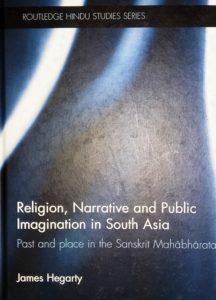
James Hegarty: Religion, Narrative and Public Imagination in South Asia—Past and Present in the Sanskrit Mahabharata. Routledge Hindu Studies Series, Oxford, 2012, 234 pages.
“The MBH presents a narrative solution to the ideological and social situation in which the Brahminical establishment found itself around the beginning of the Common Era.”

Here is a fascinating exploration of how the Mahabharata (MBH), the story-to-end-all-stories, re-constructed the significant past for the listeners and readers of its present and for its world which, James Hegarty of Cardiff University proposes, was South Asia. He explores what the MBH tried to do, how and with what success. He argues that it had a specific socio-religious and exegetical agenda, categorically placing itself above the Vedas and Upanishads as the sine qua non of learning. It constructs stories from Vedic rites (e.g. the churning of the ocean from soma pressing). In doing so it transforms ritual into itihasa (the Brihaddevata, composed by the epic’s immediate interlocutor Shaunaka, has similar features) and executes a narrative coup d’état. Just as Brahma’s Smriti, says the MBH, was abridged successively by Shiva, Indra, Brihaspati, Kavi and the seven rishis, so was the MBH from six million to successively briefer editions, the final being of one hundred thousand slokas. It also plucks Vedic figures like Indra, Atri, Surabhi, out of their context to expound new philosophical doctrines. In battle-descriptions it invariably likens the combatants to past heroes, creating an elaborate network of connections.

An obvious example of using the past to make sense of the present is the Book of the Forest, where moping Yudhishthira hears the tales of Rama and Nala. His coming to terms with his existential predicament is portrayed at the end of this book where—over the corpses of his brothers—he solves the riddles posed by Dharma-Yama disguised as a crane. It is this relevance for practical living draws the audience and readers to the MBH.

Another attraction is the repetitive debunking it indulges in. Thus, having extolled the emperor-making rajasuya sacrifice sky-high, it demolishes its empowering effect by the catastrophic dice-game that follows. Again, the potency of the much-vaunted ashvamedha is wholly undermined by the scoffing of a mongoose with a half-golden pelt (yet again Dharma). Even the merit of the much celebrated dharma-yuddha, righteous war, is questioned. The mongoose extols the poverty-stricken life of a Brahmin living by gleaning as the ideal and quotes Dharma on kings achieving salvation by selfless giving, while those holding showy sacrifices fall.

However, for this Hegarty need not have gone to the 14th book. The very first book prefaces Janamejaya’s holocaust of snakes with a harmless lizard telling the vengeful Ruru that ahimsa is the supreme dharma. The mongoose-Dharma being freed from his curse by denigrating the sacrifice does not imply restoration of the value of the ashvamedha, as Hegarty asserts. For, this book concludes with Vaishampayana telling Janamejaya that equal to sacrificial ritual are gleaning, ahimsa, contentment, good conduct, sincerity, self-restraint, truthfulness and charity. He further states that gleaning and charity are salvific for all four classes (even the Shudra who was prohibited the Vedas). The MBH was meant for all four classes as well as women to whom the Vedas were not available. Let us not overlook the significant fact that Yama-Dharma had to take birth as a Shudra maidservant’s son Vidura because of another curse, and that he is Vyasa’s mouthpiece of morality, never subject to the dilemmas plaguing Dharma’s son Yudhishthira, but whose advice is like straws in the wind (except for his alter-ego Yudhishthira). The importance of the mongoose story in social and religious contexts is seen in its recurrence in Kshemendra’s epitome of the MBH, Bharatamanjari (11th century) and Vyasa’s disciple Jaimini’s Ashvamedhaparva (c. 12th century).

Repeatedly, in the two massive tomes of Bhishma’s counsel, Vedic sacrifices of the past are critiqued. Even austerities and sannyasis are denigrated, while chaste domesticity, taking care of parents, honesty and non-attachment are held up as the paths to moksha. The MBH’s very setting is Shaunaka’s 12-year-long sacrifice against the background of Janamejaya’s snake-holocaust. Then, Yama’s 12-year-long sacrifice is the setting for the mortal birth of five Indras and Shri. Narada warns Yudhishthira that the rajasuya sacrifice heralds destructive war. In the Ramayana, Bharata prevents Rama from performing it because of this. At the end of the Udyoga Parva, Karna pictures the impending war in terms of a bloody sacrificial ritual. Then there is the over-arching image of Rudra presiding over it all, right from causing the descent of the five Indras and Shri to empowering Ashvatthama for the holocaust-at-night.

Hegarty argues that studying narrative against the background of early South Asian public imagination provides insight into the intellectual and social conditions underlying it. Modifying Marx’s description of the 18th Brumaire of Louis Bonaparte, he proposes that here every matter of concern is “transformed into narrative and debated as narrative” about both modes of governance and ways of moral living and reflect the processes of change in South Asia in late BC and early AD periods. The MBH was a deliberate intervention relating to issues of cultural power linked to current and past doctrines of belief and to processes of state formation against the Ashokan background of dharma-propagation (272-185 BC) and the Sunga campaign against it. Patanjali (of Pushyamitra Sunga’s time 185 BC?), has several references to the MBH, as does his predecessor Panini (possibly early Mauryan).

Prior to the 7th century BC (the Upanishads) and Buddhists and Jains (c. 500 BC) there is no mention of ahimsa or retiring to forest-life. In extolling these, the MBH is deliberately anachronistic, validating current ideologies by inserting them into the past, “Vedicizing” them. Other early texts and inscriptions testify to its success in this attempt. While legitimizing Brahmins, it also integrates new practices as “traditional.” For instance, instead of sacrifices, performing puja with lamps and incense, visiting tirthas, and, supremely, studying the MBH!

Hegarty makes a dubious suggestion that the tale of the Chedi king Vasu falling into a hole for having recommended animal sacrifice reveals a “regionalist agenda of denigrating the Cedis.” After all, it is with this Chedi king that Vaishampayana begins his narrative, who is favoured by Indra with a sky-roaming chariot, an unfading garland and a bamboo pole to protect the good. Further, the Queen Mother of the Kauravas, Satyavati, is said to be his daughter.

The book contains nuggets of information such as Sanskrit first appearing in inscriptions, replacing Prakrit, at the time of the Kanvas (c.73 BC); and the earliest MBH manuscript in Brahmi script being found in Kizil (Xinjiang, c.230 AD) listing the books Adi, Aranyaka, Udyoga (partly), Bhishma, Shanti, Ashvamedhika and the supplement (Harivansha), proving its circulation in Central Asia that early. The next evidence is from Kashmir in Kshemendra’s epitome in Sanskrit verse, Bharatamanjari c.11th century AD. Both lack the Anushasana Parva but include the Shanti Parva, showing that right from the 3rd century AD the epic was disseminated with considerable doctrinal material. This is evidence of deliberate composition, not compilation of disparate bardic narratives. The extensive spread of the MBH is seen in 6th century AD Cambodian inscriptions, the sculptures of Baphuon (11th century) and Angkor Wat (12th century). Eight parvas are found in Old Javanese (c. 10th century) and currently in shadow wayang puppetry. Stories from both epics and tales of Vikramaditya, Bhoja and Krishna are part of Mongolian folklore. A late 17th century Mongolian commentary, revising a Tibetan original, contains a summary of the MBH. The Japanese Kabuki play Narukami is the Rishyashringa tale. A 14th century Tibetan genealogy traces royal descent from Rupati a brother of Pandu who, after the war, went to Tibet where the people made him king. No evidence is cited, however, from Sri Lanka and Myanmar possibly because of the very strong Theravada influence. Thailand is heavily influenced by the Ramayana, not the MBH. Therefore, it seems South-East Asia, and Central Asia (Mongolia) instead of South Asia, which Hegarty proposes, was the world of the MBH.

In the Middle East, beyond Hegarty’s focus, the first Arabic summary of the MBH was by Abu Saleh (1026 AD), which was translated into Persian in 1125 AD by Abul-Hasan-Ali, keeper of the city library of Jurjan located near the Caspian seashore, for a chieftain of the Dilemites. Then there is Vidura’s parable of the man in the well that St. John of Damascus retold in the eighth century. It was Latinised in 1048-49 AD as Barlaam and Josephat, and became part of the Gesta Romanorum by the thirteenth century as Chapter 168, “On Eternal Damnation.”

Through his treatise on Sanskrit grammar, states Hegarty, Patanjali sought to codify the language and thereby restore social traditions. The same ideological agenda underlies the Manava Dharmashastra, Arthashastra, Ramayana and MBH, of which the last highlights the turbulent clashes of forces in contemporary times, i.e. the centuries following Ashoka’s passing (pace Witzel and Hiltebeitel). Bronkhorst has suggested the existence of a strong non-Brahminical culture in and around Magadha. In that context, the MBH could be “an attempt to impose, at least imaginatively, a pan-Indian Brahmanism,” writes Hegarty. He adopts Stientencron’s suggestion that the epic might have been composed in Vidisha, the last Sunga stronghold. Its nearness to Sanchi would explain the strong perception of Buddhist threat. Vidisha continued as a locus of political strife even during the Guptas. It could also have been the site for production of the dynastic histories incorporated in the Purana (vide Hans Bakker).

MBH’s open-ended narrative structure enables it to interweave commentaries and to focus on existential dilemmas for drawing audience attention and mould their thinking. Realising this helps us to comprehend its use of the past to resolve present confusion—as the Buddhist Dighnikaya does—and to appreciate its locale. The selection of Shaunaka, the Rig Vedic commentator, as the immediate audience shows that the MBH is interested in aggrandizing the Vedic past and applying it to daily knowledge. Frequently it engages Vedic figures like Indra in ideological discussions quite distant from the Vedic. Its three themes are: Brahminical triumphalism; integrating new ideologies and practices; and the existential problems of living.

Regarding “place,” Hegarty argues that the Sabhaparva accounts of the halls of gods and men reveals political and social concerns not of mythical antiquity but rather the scattered power-centres of the present. As a counterpoint, Sanjaya in the Bhishma Parva presents a detailed picture of the known world with legitimate rulers as the central authority.

Hegarty’s main argument is that the MBH transforms Vedic ritual structures into textual form, setting it deliberately in two sattras (Shaunaka’s and Janamejaya’s) and also in Yama’s sacrifice. These are rites that are repetitive and endlessly extendable. Each rite is embedded within one or many others—just like the Russian doll-like structure of the upakhyanas, complementary tales, of the MBH. The first narrative frame is provided by Sauti repeating Vaishampayana’s recital, which is the frame for subsequent tales-within-tales, of which the major ones are those of Markandeya, Lomasha and Balarama on tirthas and Sanjaya’s narration of the battle-books. Hegarty takes up the Drona Parva as a case-study of this technique of permutation-and-combination, representing it diagrammatically—a telling instance of the application of mathematical models to literature without making it unintelligible. Vidura’s recounting of the trial of Prahlada during the gambling match is analysed to demonstrate how a commentary is woven into the text.

The MBH repeatedly asserts that by reading and listening to it the audience is transformed—much as Greek Tragedy sought to do through catharsis. Indeed, that is why Anandavardhana stated that the overwhelming rasa of the MBH was shanta, quietude. This role of the MBH parallels that of Vedic rituals that sought to impose order and stability on the chaos of the first creation, manipulating the microcosm to re-form the macrocosm: “The MBH presents a parallel narrative tool for the ongoing creation and re-creation of a functional cosmos… (presenting) a narrative solution to the ideological and social situation in which the Brahminical establishment found itself around the beginning of the Common Era.” In the context of major social upheaval, it offers new options for a good life and escaping rebirth. The MBH sees itself as a rescue mission, an intervention by the gods to restore society that has become nasty, brutish and short, overrun by demonic overlords. While the MBH explicitly equates itself with the Vedas, as the fifth Veda, at the end it emphasizes the benefits it confers in daily life. Here Hegarty’s translation of the exhortation why dharma should not be abandoned, “nor on account of…ignorance” is an error as the original is “lobhad,” “on account of greed.”

Part of the narrative technique is the repetitive interjection of vocatives (“O Brahmin,” “O Raja”) which refer to the audience, not to anyone in the tale, thus indicating the context of the narration. In particular, the repetition of “O best of Bharatas” helps to stress the “overarching dynastic and narrative continuity.” These vocatives act as signals to the audience within and without the text to interpret the material being presented in the context of their own lives. Thus, each narration is a performance too and the speeches within each often pose ironic questions. For instance, Kanva forecasts perpetual imperial hegemony for Bharata’s dynasty, yet his speech is reported in Janamejaya’s sacrifice, long after that dynasty was almost wiped out. Both Janamejaya and Sauti’s audience would be wondering what went wrong. Moreover, the current Kali Yuga began soon after the Pandavas died. So, the same question becomes relevant for all audiences since Shaunaka and his companions. The picture Markandeya paints of Kali Yuga for Yudhishthira is that of post-Mauryan South Asia, current for the audience of the MBH: “much of the Mahabharata is intended to provide a space within which to articulate a new series of understandings of what it means to be human…The war is one way to clear the ground of this.” In contrast, the Ramayana never seeks to address the problematic present, and keeps to its recital of things past.

What is of great interest is the manner in which the MBH questions its greatest revelations. Thus, despite the Gita and the many upanishadic exhortations of Vidura, Krishna is cursed and dies an inglorious death, as does Vidura. It is not only the glory of dynastic history that is questioned, but even philosophical solace and the power of the Purushottama himself. The last four books of the MBH relentlessly focus on loss and grief, discounting the salvific messages of the Shanti and Anushasana Parvas. The cultivation of equanimity is urged, but how feasible is it in the context of all the suffering? The final book cites moral failings as the cause of the death of Draupadi and four Pandavas. The final reconciliation comes only after Yudhishthira reaches heaven, and there too with some difficulty.

The MBH narration proceeds both horizontally (developing in linear fashion) and vertically (emboxing stories within one another), thus offering the audience a variety of ways of interpreting the material in terms of the varying contexts of the narrations. For instance, while the story of Nala is aimed at consoling Yudhishthira, for Janamejaya and Shaunaka its happily-ever-after ending rings hollow, as they know what happened to the Pandavas. It is because of this ambiguity and irony in its narration that the MBH is very much “a modernist text”, very existential indeed.

Dharma, originally ritual activity, is portrayed in the context of social norms in the MBH, taken to a crisis in the gambling match. The MBH repeatedly situates ritual activity in social contexts to tease out the implications of human conduct vis-à-vis dharma. Rites were no longer meaningful only for preserving cosmic order, but had to be meaningful in terms of social conduct: “if the Dharmashastras are …a commentary on life as a special of ritual, then the MBH is the revelatory account of a past and a place conceived of in these terms.” Hobbes’ insight is so applicable to what happens in the MBH: “For the laws of nature (as justice, equity, modesty, mercy, and, in sum, doing to others as we would be done to) of themselves, without the terror of some power to cause them to be observed, are contrary to our natural passions, that carry us to partiality, pride, revenge and the like.”

Tales such as those of the Sadhyas and the swan stress self-restraint, serenity and, above all, the intention behind an act as salvific, which resonates with Buddhist doctrine. Hegarty provides several examples of such Buddhistic parallels from the Dighnikaya which sought to incorporate and supersede Vedic knowledge, as does the MBH. The emphasis on avoiding violence is a message for the ruler from an audience aware of the human cost of the imperial Mauryan impulse. There is emphasis on domestic puja and humble gifts in the post-war book of instructions, turning daily worship into a type of sacrificial rite. These are still practised in all Hindu communities. While innovating, the MBH carefully embeds these in a Vedic context, thus offering a Brahminical synthesis of new ideologies in the late BC and early AD period.

Hegarty analyses the Sabhaparva to show that here not only does Maya, instructed by Krishna, construct the hall to reflect the abhipraya, intention, of gods, demons and men, but the parva has a plan of its own. Yudhishthira’s very entrance “is a model of Brahmin-centred conservatism.” Further, there are references to yavana-Greeks and their kings pointing to political contexts relevant to audiences outside the text. Heterodox beliefs are condemned as a vice, and a mini-Arthashastra is presented on norms of governance. The description of divine halls contains the seed of the rajasuya rite, which is the imperial vision of conquest of the four quarters aimed at by this parva. The paradigm of Brahma’s hall being at the centre surrounded by those of the lords of the quarters (lokapalas) is mirrored by Yudhishthira in the Indraprastha hall at the centre of the conquest of the four directions (by his four brothers), whose peoples are enumerated at length, including Rome and Antioch! Interestingly, while rishis are found in all divine and human halls, only one king, Harishchandra, has a place in Brahma’s hall. Atheists and Greeks are absent from the divine halls, which contain only Vedic and post-Vedic figures. The conservative agenda becomes quite clear.

However, the destruction the rajasuya brings in its wake seems to wipe out the triumphant galactic picture of the Sabhaparva. We find that at the beginning of the war, in the Bhishmaparva, Sanjaya presents a geography of the earth concentrating on hare-shaped Jambudvipa, mentioning Romans, Greeks, Chinese and Huns, i.e., the world as known at the time of composition of the MBH, not when the Kurukshetra war had occurred. No foreigners exist in the other regions. The four yugas are said to pertain only to Bharatavarsha. Through the lists and descriptions, the war is focussed upon “as the cusp of the problematic present,” which is Janamejaya’s time. The region at the northern extremity ruled solely by Prajapati has only one dharma, contrasted with the many in Bharatavarsha, along with many disputing kings and foreigners. The assurance that listening to this account makes a ruler healthy, wealthy and wise is demolished by the war that follows.

Moreover, there is the intense personal tragedy of Vyasa himself. Not only does he witness the destruction of most of his grandchildren (Pandaveyas and Dhartarashtras), but also of all his four sons (Pandu, Dhritarashtra, Vidura, Shuka). The culminating irony is in Vidura, Dharma-incarnate, starving to death, wandering madly, filth-covered, in a forest. No wonder that Vyasa’s final outcry is the anguished query:

“With arms uplifted I shout, but no one listens!

From dharma flow profit and pleasure.

Why is dharma not practised?”


Consistently, the MBH appears to subvert the visions it creates. As T.S. Eliot wrote,


“Between the idea

And the reality…

Falls the shadow.”


Hegarty is the first to bring out what makes Kurukshetra such a significant place. It is Prajapati’s main altar; the dwelling of Takshaka, assassin of Janamejaya’s father; where Shantanu’s son Chitrangad was slain; the residence of the asuras Sunda and Upasunda; where Bhishma fought Parashurama; where Skanda was anointed general of the gods; where Sudarshana and Oghavati conquered death.

Similarly, of critical importance is the forest of Naimisha, featuring as a major tirtha created by the turning back of the river Sarasvati at the end of a twelve-year rite performed by ascetics. Here Yama held a rite during which the five Indras were cursed; here Yayati’s grandsons sacrificed; and here the MBH is narrated. Tirthas mark great past events, are sites of major rites and where Puranas are composed, many of which are narrated in Naimisha, Kurukshetra and other tirthas. Descendants of MBH characters become interlocutors in these. Both Kurukshetra and Naimisha are linked to the Sarasvati, which is one with Vedic knowledge and ritual. To this, the MBH adds the statement that gods visit tirthas while asuras do not. Visiting tirthas, even listening to their origin tales, earns merit manifold to that from sacrifices. The pilgrimage spots are also located in the four quarters, paralleling the rajasuya conquests. Superior to both tirthas and sacrifices, it is asserted emphatically, is studying the MBH, which contains tales of visiting tirthas. In this manne,r the MBH integrates religious ideas and activities preceding it, and establishes new paradigms in the current socio-cultural and political scenario.

For establishing the influence of the MBH on South Asia (actually, South-East Asia) over the first twelve centuries AD, Hegarty selects epigraphs of the Guptas and thereafter. These monarchs compared themselves to the epic heroes and the descriptions of their conquests use terms reflecting the world-conquest goal of the MBH. Land grants refer to Vyasa’s pronouncements and the samhita of one lakh verses. So, in the 5th century AD the size of the MBH was almost what it is today. They emulate the reciprocal relationship between king and Brahmins depicted in Yudhishthira’s gifts to them. Both epics are looked up to as models for kingly conduct. Some, like the Chalukyas, trace their descent to epic figures like Drona and Kartavirya Arjuna.

This influence is, of course, is more widespread in literature. Hegarty finds the richest engagement with the MBH in Kashmir. Retellings of the MBH begin with Kshemendra’s in the 11th century AD. Then come numerous adaptations of episodes, more from the MBH than the Ramayana. Elsewhere, Bhasa’s plays bring out not the triumphant imperialism of the epigraphs but the human tragedy of war, thus focussing on what makes the MBH “modern” in its appeal. Hegarty studies Kashmir’s Nilamata Purana (c. 6th to 8th century AD) to show how, beginning with a question from Janamejaya, it follows the MBH’s imperial agenda as also its integrative approach towards new ideologies by making Buddha an avatar of Vishnu in the 28th Kaliyuga. However, in doing this is it not following the centuries earlier Vishnu Purana?  Like the MBH, the Nilamata sacralizes new tirthas and makes an innovation by stressing the holiness of images of deities. The Nilamata is to Kashmir what the MBH is to Bharatavarsha. Imagining Kashmir’s past in ways similar to the MBH, the Rajatarangini (12th century AD) also projects an existential sense of transience and instability and explicitly states its aim to be the cultivation of serenity (shanta rasa). Kalhana makes explicit much that is implicit in the MBH with respect to present situations: “For Kalhana, the MBH captured something essential about the predicament of being human, be this in the exalted past or in the more mundane present.”

One wishes that sculptural representations from the MBH had also been touched upon to bring out what aspects were considered significant. The epilogue deals with fresh re-construction of the past in the MBH tele-serial—introducing ideas of democracy and nationhood—but loses out by being aware only of the Chopra version, not the different approaches seen in versions by Sanjay Khan (2001) and Siddharth Tewary (2013). Nor is he aware that the script for the Chopra serial was by a Muslim, Rahi Masoom Reza (available in English translation), which lends it a unique dimension, and that in the repeat telecast the government, for political reasons, excised the initial episode in which Bharata disinherits his unfit sons, thus proving the modernity of the MBH. One expected a comparison with Peter Brook’s interpretation. Hegarty surprisingly refers to Vajpayee as “Bihari Vajpayee.” His immersion in Sanskrit ought to have provided an awareness of Indian names.

All in all, the book is an extremely stimulating read, laying out a rich repast of new insights into the relevance the MBH had for the time of its composition and continues to have even today as an existential, modernist text.

Pradip Bhattacharya
Filed Under: BOOK REVIEWS, MAHABHARATA Tagged With: Dharma, Mahabharata

DRAUPADI AND HER PANCHALA

July 8, 2018 By admin

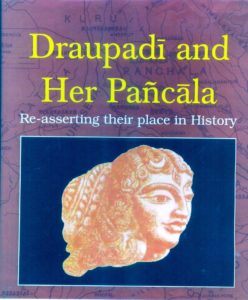
Neera Misra & Rajesh Lal (eds): Draupadi and her Panchala, B.R. Publishing Corporation, pp. 187, Rs.2250/-

The Draupadi Dream Trust held an international seminar to highlight the character of Draupadi and research about her land, Panchala. This book, edited by the trust’s chairperson Neera Misra, who is from Draupadi’s birthplace Kampilya, and Air Vice-Marshal Rajesh Lal collects 11 papers on Draupadi and 12 on various facets of Panchala in Hindi and English. What is of importance is material drawn from the rare “Kampilya Mahatmya” where Draupadi is an avatar of Parvati. There are a large number of colour plates and illustrations that make this a valuable repository of data.

Hiltebeitel’s paper on Draupadi is a valuable contribution resolving the controversy over whether her laughter spurred Duryodhana’s vengeance. Examining the recensions of the Mahabharata, he shows that the initial account only has Bhima, Arjuna and the twins laughing at Duryodhana’s discomfiture in the palace of illusions. It is Duryodhana who, while complaining to Dhritarashtra, adds Draupadi and Krishna as also taunting him to get him to join in the conspiracy of the dice game. It is Villi’s Tamil Mahabharata that has Panchali clapping her hands and laughing. The crowning insult of “Andhey ka betaa andhaa” (the blind man’s son is blind) was invented by Dharmavir Bharati in his play, “Andhaa Yug” and popularised by the Chopra TV serial.

Possibly the most rewarding research in this book is by Indrajit Bandyopadhyay who plumbs the depths of what is meant when the term “Shyaamaa” is applied to Draupadi. He ranges far and wide across the epics and the Vedas, including Anandavardhana’s concept of dhvani. He brings out its multiple meanings and resonances to show how Krishnaa-Draupadi stands at the centre of the Krishnas who mould the epic narrative: Krishna-Dvaipayana-Vyasa, Vasudeva-Krishna, Arjuna-Krishna. However, while doing so his enthusiasm leads to convoluted interpretations of wheels-within-wheels not all of which are easy to follow.

The organisers are to be complimented for bringing together eminent novelists to speak on Draupadi. Pratibha Ray, author of Yajnaseni, the autobiographical testament of Draupadi, for which she became the only woman to be awarded the Moorti Devi Puraskar by Bharatiya Jnanpith, provides sensitive insights into her interpretation. Sujata Chaturvedi summarises the insights of Chitra Chaturvedi in her Hindi novel Mahabharati depicting Draupadi as a fiery upholder of women’s rights and a profound bhakta of Krishna. Unfortunately, this excellent novel has not been translated into English. Narendra Kohli, renowned for his recreation of the epic in Maha Samar (Hindi, 8 volumes), stresses the need to go back to the original text for the proper perspective. He, too, notes that Duryodhana lied to his father about Draupadi taunting him and points out that she never demanded Duhshasana’s blood to wash her hair (as Neera Misra claims in her paper), nor desired Karna. P. K. Balakrishnan’s And Now Let Me Sleep (summarised in Kavita Sharma’s paper), on the other hand, has her die realising that Karna protected her and her children. Kohli interprets the emergence of Draupadi and Dhrishtadyumna from the sacrificial fire as starting a new life—that of vengeance for their father’s humiliation. He is the only participant to mention the critical role Kunti plays in the Pandavas’ fight for their rights.

Haripriya Rangarajan wrongly asserts that Draupadi was known as Parsati after her mother. Drupada’s father was called Prishat, after whom Draupadi was called Parshati. Nor has Hiltebeitel written three volumes on the cult of Draupadi, but only two. Shri is not the epitome of sattvik quality but of rajasic and Draupadi is never depicted in sattvic form in the epic. Why Narhari Achar’s paper on the date of Draupadi’s svayamvara has been included is unclear. He states that astronomical information is non-existent and whatever dates he proposes “are at best guesses.” He bases his calculations on one “Raghavan”, providing no references. The editors have not rectified this omission. Ramola Kumar’s “Draupadi Communicates” that ends the section on Draupadi, rehashes what is very well-known. She does not even attempt a critique of how the TV Mahabharatas and Peter Brook’s film portray Draupadi. It would have been rewarding to read what Mallika Sarabhai and Shaoli Mitra have to say about their experiences of portraying Draupadi on stage.

Neera Misra draws twelve lessons from the Kampilya Mahatmya and the epic about what Draupadi signifies. She has the soul-force of Parvati; she is pure, radiant, constant; she converts challenge into opportunity; the stripping shames the men not her; she was the victim of the war, not its cause; she was a dedicated ardhangini; she upheld dignity of labour (serving Virata’s queen); her friendship with Krishna empowers her (the folklore of her binding up his bleeding finger is cited); progressive men believe in gender equality (but how does Krishna saving the Pandavas from being cursed by Durvasa show this?); she balanced her husbands equally; she was compassionate, as in sparing Ashvatthama; finally, she is a role model to women today in overcoming challenges to stand tall.

The section on Panchala is by a host of archaeologists, historians and numismatic experts led by Dr B.B. Lal who excavated Hastinapura in 1951-52 finding a Painted Grey Ware settlement of around 800 BCE that had been destroyed by flood in the Ganga, as the Puranas state. King Nichakshu relocated to Kaushambi, where degenerated PGW has been found. On an ad hoc estimate, Lal puts the Kurukshetra War at 900 BCE. However, he makes the usual mistake of stating that the epic originally consisted of 8,800 verses, whereas that is the number of riddling slokas mentioned by Sauti. Ahichchhatra, Kampilya, Kanauj, Atranjikhera and Sankisha have been excavated turning up ochre coloured pottery, black-and-red ware, black slipped ware and painted grey ware with as many as 46 combinations of line and dotted decorations. Dr B.R. Mani suggests that the Rig Veda’s Battle of Ten Kings between five Panchala clans and Sudasa occurring on the Ravi led to a movement eastwards to Panchala by the Krivis who came to be known as Panchals. Bhuvan Vikram presents a detailed analysis of artefacts found in Ahichchhatra along with two large ziggurats which might be temples. It is regrettable that since they were excavated in the 1940s no further investigation has been done. O.P.L. Srivastava studies a coin of Damagupta carrying three Panchala symbols which are unidentified.

Panchala was famous for its pure Vedic pronunciation, its resident Galava having developed different styles of recitation. A.K.Sinha’s paper shows it was the seat of materialistic as well as spiritual Upanishadic philosophy expounded by great intellects like Yajnavalkya, Pravahana Jaivali, Pratardan, Gargyayana and Uddalaka (c.1000-700 BCE). The original Kamasutra was written by Babhravya of Panchala.

Panchala, one of the 16 maha-janapadas, was swallowed up by Magadha’s Nandas and Mauryas. In the pre-Kushana (150 BCE-150 CE) and post-Kushana phases till 350 CE, 22 kings ruled Panchala as copper coins reveal. Thereafter, it came under Gupta rule, followed by Harsha and Gurjar Pratiharas till the end of the 10th century. Ahichchatra is where Parshvanath attained kaivalya. Sankisha has Ashoka’s elephant capital where Buddha descended to earth from heaven.

Recently T.P. Mahadevan has shown that in the 5th century CE a group of Purvashikha Brahmins moved from Panchala to South India carrying the northern recension of the Mahabharata and moved to Kerala whence the recension in Malayali script emerged. Another group, the Aparashikhas, followed them during the Chola period, creating the recension in Grantha and Telegu scripts.

Neera Misra presents a detailed account of Kampilya including the excavations by an Italian team (1997, 1999) that revealed that the plans for the Drupada Kila and Dholavira coincide remarkably. The Kila was dated as post-Mauryan with Kushana restoration. It was deserted around 1st century CE as the Ganga shifted. Further excavation is needed to explore the PGW and NBW settlements that have been found. The justification for this has been established by IIT Kanpur’s GPS survey.

The state of Uttar Pradesh has adopted as its emblem the revolving fish pierced with an arrow which was the test for winning Panchali. The assertion that the Panchala area comprised all of this state does not account for the rival kingdom of Hastinapura and the Yadava oligarchy of Mathura. Nor did Ashvatthama ever rule in Ahichchhattra as Abhay Singh asserts.

This is undoubtedly a stimulating volume compiling important research and insights which is somewhat marred by erratic use of diacriticals and printing errors. The editors would do well to take greater care in future enterprises.

http://epaper.thestatesman.com/1722756/8th-Day/8th-July-2018#page/2/2

Filed Under: BOOK REVIEWS, MAHABHARATA Tagged With: Draupadi, Draupadi Dream Trust, Mahabharata, Panchala

Why is the Ramayana more popular than the Mahabharata?

June 24, 2018 By admin

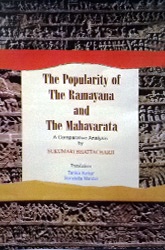
Sukumari Bhattacharji: The Popularity of the Ramayana and the Mahabharata—A Comparative Analysis. Translated by Tanika Sarkar and Somdatta Mandal. Anustup, 2018, pp. 109, Rs.300/-
The late Sukumari Bhattacharji was one of the rare Sanskrit scholars from India who was equally at home in English. Her The Indian Theogony has been a major reference work for decades and Legends of Devi is a delightful retelling. Possibly her most fascinating Bengali book is a study of why the Ramayana is more popular than the Mahabharata (1996). She asserts, “What we claim as Indian civilization today has The Ramayana at its root and not The Mahabharata.” Unfortunately, till now her trenchant and illuminating analysis has not been available to Indologists all over the globe.

Professor Bhattacharji always wrote to the point, was never guilty of verbiage or of pulling punches. Her professed Marxist bent does not vitiate her incisive and penetrating insights in this book. In the slim compass of just 87 pages she not only provides a parva-wise summary of the world’s longest epic in 15 chapters, but also investigates the elements that make the Ramayana more appealing than the Mahabharata. A splendid achievement, for anyone interested in our epics this is the finest overview. It steers the reader deftly through what Oldenberg called “the monstrous chaos” of the Mahabharata.

The matrix birthing the two epics, according to her, is the crisis of values during the Kushana times (1st-2nd centuries A.D.) with the emergence of small kingdoms and new clans leading to creation of the mahakavyas, the Kamasutra, Manusamhita and some Sanskrit Jataka tales. These dealt with practical issues of the paramountcy of filial duty, familial bonds and loyal friendship, enduring long suffering for the sake of vows etc. The Shanti and Anushasana Parvas are the text needed for the empires that emerged between the Maurya and the Gupta periods. Old values are revised and codified in a collective effort. Bhishma’s advice never to trust a woman “is an attempt to poison men against women” for all time, as post-Gupta society relied on male domination and Shudra servility.

Simultaneously there is Bhishma’s statement, “Nothing is greater than Man,” which Bhattacharji takes to heart as the concluding message of the Mahabharata. Animandavya curses Yama the god of death and Gandhari curses Krishna. “No higher justice governs the world…it depends on mortal beings to ensure justice.” The Ramayana, having no such revolutionary statement, is much more like a fairy-tale, replete with supra-normal events and characters which appeal powerfully to the general public as “Values of domination and subordination come decked out in supernatural mysteries, in a fairy-tale appeal.” With hardly any grey areas, all relationships being simple and linear, “It saves the reader from self-searching and self-doubt.” Above all, it is “suffused with lyrical qualities.” Hence, accepting the protagonists as models poses no problem.

Conversely, the Mahabharata mirrors an age and its peoples, prominently featuring crises of conscience and focusing on the annihilation of entire lineages. The grey areas are pervasive, each episode having complex resonances. Faced with the clash between ends and means people find it deeply disturbing. Bhattacharji cites Shakuntala publicly pouring scorn upon her husband as an example of what readers would have difficulty in accepting. That is why Kalidasa deprived his heroine of this fire. Again, Vyasa himself is a product of rape but there is no condemnation of the rapist rishi. Bhishma tells Draupadi that what the powerful do is considered dharma, i.e. might is right. Such concepts are difficult to digest. Finally, Vyasa’s poetry is far more intellectual than Valmiki’s lyricism, which also detracts from the popularity of the Mahabharata.

Does the reluctance to fight displayed by Yudhishthira and Arjuna reflect the belief in ahimsa propagated by Jains, Buddhists and Ajivikas from the 7th century BC when, according to Bhattacharji, the composition of the epic began? Here, again, the audience faces a dilemma without any clear answer. Confronted with complex problems and ambiguities in life, people long for simple solutions. The Mahabharata creates those very complications, questioning the prevalent belief system, which is why it loses out to the Ramayana in popular appeal.

While discussing Valmiki’s epic, Bhattacharji cannot resist the occasional quip, e.g., how could the two brothers carry adequate weapons for the Lanka battle; men did not have to prove chastity as a masculine equivalent did not exist in Sanskrit; shudras and chandalas were considered subhuman. In the Mahabharata, Arjuna’s mental paralysis is dissipated by “a magical performance” stunning him—and the audience—into submission. Magic, not logic, carries the day! Never has the Gita been accorded such short shrift!

Very perceptively Bhattacharji chooses to discuss Vidura’s parable of the man in the well which, she asserts, is composed after the concepts of Nirvana (Buddhist) and Moksha (Upanishadic). Despite death being the only reality, the persistence of desire keeps life precious as a positive experience although “negation found strong resonance in a class-divided society with a large oppressed population.” She overlooks that the Mahabharata calls itself the Veda for women and shudras too and that this parable found its way into the Bible as the tale of Barlaam and Josaphat. The Ramayana neither presents such conflicts nor does it take us to such great depths.

The Sauptika Parva is omitted from the survey without any explanation. There is a puzzling statement (p.19) that the Ramayana, being unsure of Sita’s chastity, installs Bharata at the end instead of Lava or Kusha. Actually, in the text the brothers and the subjects drown themselves with Rama in the Sarayu, before which Rama installs his sons to rule over northern and southern Kosala. In view of Bhattacharji’s pronounced feminist stance (the first fall and death en route Swarga was of Draupadi because she was a woman, p.63), it is intriguing to find no reference to the mutilation of Ayomukhi (ear, nose, breasts chopped off) and Surpanakha (nose and ears sliced) by Rama and Lakshmana. She asserts (p. 41) that as Kaurava bards sang the events of the Kurukshetra war, it is a partisan narrative making a great hero out of Karna. However, Karna is not a Kaurava at all but Yadava Kunti’s illegitimate son. Further, Rama does not refuse Guhaka’s hospitality because he is chandala (p. 19) but because, having taken to asceticism, he would live only on fruits and roots, as he himself explains.

Bhattacharji declares that the Mausala Parva is interpolated being full of supernatural events, yet she admits that they construct an inevitable sense of waste. She fails to substantiate that it is “not inherently related to the epic” and admits it reflects the wider perspective of destruction caused by war. The uneasiness it creates is the key to its effectiveness. Similarly, she dismisses the entire Bharata Savitri as irrelevant (p.62) although it ends with Vyasa’s remarkable query which remains a riddle for us all: “From Dharma come wealth and pleasure. Why is Dharma not practised?” Here the translators mistranslate “phalashruti” (the benefits of listening to the epic) as “hearsay.”

Bhattacharji, like her colleague Buddhadeb Bose in his The Book of Yudhishthira, establishes Yudhishthira as the epic’s hero the reader’s attention being focused only on him at the end. A deity (Krishna), being superhuman, cannot be the protagonist. Yudhishthira upholds Bhishma’s utterance that nothing is greater than man and would put aside Kshatriya creed in favour of ahimsa. Only a man can show other men the way out in crises. In the Mahabharata a greater idea of virtue and justice is at work. The Ramayana presents no complications over heaven and hell. Its idea of duty is rectilinear. Even in killing Bali and Shambuka, Rama suffers no moral pangs. Towards the end, the Mahabharata says twice that kings have to go to hell, giving no reason (this is from the section Bhattacharji has already rejected, yet she cites it approvingly!). No solution is presented to the clash between a king’s duties and that of humanity. The Ramayana does not perplex or mortify the reader—we are told to behave like Rama. The Mahabharata alone has the protagonist debate with death itself, proving the truth of human worth through all suffering and failures, confronting them and sacrificing the self for the greater good of society. It does not ask us to behave like Krishna to whom it assigns an ignominious death, while sending Yudhishthira triumphantly to Swarga in his mortal frame. Yudhishthira becomes the hero, repeatedly perturbed but achieving a stable world-view at the end.

Devoting an entire chapter to the enigma of Bhishma, she correctly points out that non-involvement characterizes him starting with aloofness during the three year long war in which a Gandharva killed his step-brother Chitrangada. Bhattacharji notes the similarities with Rama who abdicated for his father’s marital bliss. However, Bhishma never asked his father for the boon of death at will (p. 72). Shantanu, gratified, gave that to him on his own. Unlike Vibhishana who has no qualms about aiding Rama against his kin, Bhishma constantly dithers, making it difficult for the reader to respond to him. He chooses death being unable to resolve the conflict. The Mahabharata does not aim at popularity, “it is precious only to the reader who is split with mental agony…”

Bhattacharji cannot reconcile Draupadi as Lakshmi having sons from five gods as husbands instead of Vishnu. Further, “The social question of chastity remains unanswered.” However, this is resolved in the story of the five Indras and Shri cursed by Shiva to take mortal birth and further in the tale of Draupadi’s earlier birth. Though Bhattacharji says there is no hint of a personal relationship between Vyasa and his son Shuka, this is elaborately described in the Mokshadharma Parva. She states that animal sacrifice is intrinsic to Vedic rites, overlooking the Mokshadharma Parva where for asserting this Raja Uparichara is cursed by Agastya to fall into a hole. Agastya and his fellow sages advocate offerings of grains, not flesh.

With two translators plus an editor, one expected consistency and correctness in the spelling of names, particularly as the author was a distinguished Sanskritist. “Hanumana” (pp.17, 18, 96) should be “Hanuman”; “Jujutshu” (pp.61, 84) should be “Yuyutsu” as on p. 76. There are some egregious errors which editorial notes should have covered. Thus, Drona does not say to Ekalavya: “give me your fingers” (p. 25) but asks for his thumb. Vyasa does not restrain Duryodhana from attacking Pandavas in exile (p.81). Satyavati never insists that her son should inherit the throne, nor does she obtain the vow of celibacy from Bhishma (p. 26). On p.72 the author correctly ascribes these to the fisherman-chief.  Chitrangada is never termed “a sinful man” (p. 27). Drupada was not “the king of Vidarbha” (p. 34) but of Panchala. Karna never “made an obscene gesture with his hand on his thigh” to Draupadi (p. 42). That was Duryodhana’s doing. Bhattacharji states the Pandavas knew krityas had formed Duryodhana below his waist with flowers (p. 46). They had nothing to do with it. It was Parvati who formed him thus. Duryodhana undertook a fast unto death not at the end of the Virata Parva (p.93) but early in the Vana Parva. Gandhari did not birth “a round stone” (pp.49, 53) but a stone-like lump of flesh. Krishna was never king of Mathura (p. 53).  In Draupadi’s svayamvara. Shalya failed to string not “his” bow but the bow for the contest (p. 45).  “Bhima tried to crush his head with his left foot but desisted” (p. 46) is incorrect, as he did do so. The reasons for the deaths of Nakula and Sahadeva have been transposed (p.63). Nakula fell not for pride in his wisdom, nor Sahadeva for his narcissism, but exactly the other way about. Yuyutsu fought on the Pandava side instead of not participating (p.76).

Over all it is a fine translation. The rendering of “Shreya” and “Preya” as “the best and the desired for” is particularly happy. We are grateful to the two translators and the publisher for making available this very important study to the English speaking world after over two decades. It is a great pity that her Women and society in ancient India remains out of print. Hopefully, the publisher will bring this out too.

Pradip Bhattacharya

A shorter version of this review was published in the 8th Day Literary Supplement of The Sunday Statesman dated 24th June 2018.


Filed Under: BOOK REVIEWS, MAHABHARATA, Ramayana Tagged With: Book Reviews, Mahabharata, popularity, Ramayana

BHISHMA–A VEXED MORAL AUTHORITY: THE EGOTISTICAL SUBLIME

June 3, 2018 By admin

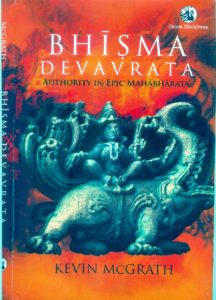
Kevin McGrath: Bhishma Devavrata—authority in epic Mahabharata, Orient Blackswan, 2018, pp. 180, Rs. 945/-

So far there have been only two novels on the patriarch of the Mahabharata (MB): M.M. Thakur’s “Thus Spake Bhishma” (1991) and Kamesh Ramakrishna’s “The Last Kaurava” (2015). McGrath’s is the sole book-length study of how Bhishma comes to be regarded as the supreme moral authority. So much so that Krishna, instead of advising Yudhishthira himself, has Bhishma from his death-bed lecture Yudhishthira on various aspects of dharma over an astonishing period of two months speaking as both prince and priest.

McGrath finds that in MB morality is fourfold: a behavioural value-system; variable depending upon conventions; transcendent (the Gita); and personal. The last aspect is also the most vexed because this “pitamaha” (grandfather) is celibate and does not continue his lineage. Ambivalence characterizes him. He is torn between duty to the throne and affection for the Pandavas and their right to the throne. McGrath argues that Bhishma’s understanding of right conduct stems not from tradition and shastras but from an epiphany. McGrath argues that the theophany to which Krishna exposes Bhishma in Dhritarashtra’s court engenders a detachment because of which he can fight against those whom his heart favours and accept death without a murmur. Drona underwent the same experience, but we do not find him evincing such “vairagya”. Both fall undefeated, voluntarily laying down their arms and enter into meditative trance to die.

His authority stems from his being the only true descendent of Kuru. True, his eldest paternal uncle Devapi became a sanyasi being denied the throne by Brahmins because of a skin defect. But how do we forget the existence of Shantanu’s brother Bahlika? He had a son named Somadatta who fought in the war. It is not clear how Bhishma getting Pandu married to Madri would restore the patriline as she has nothing to do with Bahlika.

McGrath does not resolve how Bhishma reconciles keeping Karna out of the war for ten days with loyalty to the throne. The parallel with Achilles sulking in his tents is pronounced. This is paralleled by Karna, despite his much-vaunted loyalty to Duryodhana, not capturing Yudhishthira after trouncing him, Bhima, Nakula and Sahadeva. Further, both Bhishma and Karna are displaced eldest sons, a leit motif in the epic. The two greatest philosophers, Krishna and Bhishma, are both eighth sons with their elder siblings murdered.

McGrath does not clarify how Duryodhana displays magus or shaman-like characteristics. Neither is it correct that the Dhartarashtras have no cult status. Temples to Duryodhana (and Karna), Shakuni and Gandhari exist in Garhwal, Kerala and Bangalore. Nor is it that Bhishma is not worshipped anywhere. Allahabad has a temple in Daraganj built in 1961 with an image of Bhishma on the bed of arrows. Special puja is conducted during the “pitri-paksha”. Narkatari Temple with a pond called “Bhishma Kund” is at Kurukshetra commemorating where Bhishma lay. It is not purely a Kshatriya view of the universe that is depicted. Bhishma’s discourses include a considerable portion portraying varying Brahmin views as well. Further, Sanjaya does not merely see and recount; he actually participates in the war, being almost killed by Satyaki. Sanjaya is the world’s first war-correspondent.

The reference to Vyasa as “chiranjiva” (p.5), ever-living, is puzzling as he is not described thus, unless it is taken as a reference to this appellative being given to the series of such editors/compilers of whom Krishna Dvaipayana belongs to the Dvapara epoch. Again, with the detailed description of the wondrous hall constructed by Maya, how can we say that MB depicts “an idealized culture where there is…no substantive architecture”?

McGrath’s point is well taken that precise portrayal of rituals is missing, as though these had become unfamiliar. Similarly, physical details of characters are few. They are mainly moral figures. Vyasa’s conjuring up of the shades of the dead who rise with “a great sound” from the Ganga is taken as a metaphor for the making of the “maha-kavya”. We, like Dhritarashtra, visualise in the mind’s eye what Vyasa (and Sanjaya) narrate.

It is curious that there is no reference to the Harappan culture (unless we count Shiva as one) and few to Shramanic tradition which would have been prevalent alongside. There is a solitary reference to a “kshapanak” (naked Jain mendicant) and to “pashanda” (Buddhist/Jain heretic) besides the lokayata Charvaka whom Brahmins kill for condemning Yudhishthira. Some of the stories Bhishma tells are similar to Buddhist jatakas. Romila Thapar has suggested that the Harappan was a matrilineal society. A late Buddhist text lists Gujarat as one of the “pancha-dravida” lands. The Kshatriya lineage destroyed by Parashurama is regenerated by its women who approach Brahmins for sons. Such progeny are “suta” by class, making all later royalty’s claim to Kshatriya-hood spurious, unless Parashurama’s annihilation was restricted to the Haiheya clan. In Hastinapura the matriline begins with Satyavati making her pre-marital son Vyasa (of mixed caste) continue Shantanu’s line.  It is also shown in the overwhelming influence of Satyavati over Bhishma and of Kunti, her nephew Krishna and Draupadi over the Pandavas. Finally, the MB portrays a Yadava take-over: the great-grandsons of Kunti and her nephew Krishna ultimately rule Hastinapura and Indraprastha. McGrath even argues, “it is his (Bhishma’s) role to advance this Yadava coup.”

McGrath is the first scholar to point out Kunti’s culpability in causing the partition that culminated in the war by concealing Karna’s identity. On a different level, Surya bears equal blame in not supporting his son effectively whereas Indra comes to the aid of Arjuna powerfully. Kunti’s causation of the “bheda” is structural, while Draupadi’s is temporal, constantly goading her husbands towards the holocaust. Their influence is far more pervasive than those of Kryseis and Briseis in the Iliad to whom McGrath compares them.

It is not only that we have no idea of which text of the MB Nilakantha (late 17th c.) was commenting upon, as McGrath says. In 1584-86 when it was translated into Persian as Razmnama, there is no indication of what text was used. The names of the scholars Akbar appointed indicate that they were drawn from all corners of India, showing awareness of the existence of different versions. However, we do know from the illustrations Akbar commissioned that for the Ashvamedha Parva the Emperor chose Jaimini’s composition instead of his guru Vyasa’s.

McGrath maps six crises in Bhishma’s story which bring about his fall: the abduction of Amba and its results; his advice to partition the kingdom; his offering the supreme honour to Krishna in the rajasuya yagya; his aloof stance in the molestation of Draupadi; his silence about Karna’s birth and his acceptance of marshal-ship in Kurukshetra. Thus heroic Bhishma is at the very core of the collapse of order in the narrative.

There is a seventh decision that plays a critical role in the plot: his appointing Drona as royal tutor knowing his obsessive animosity against Drupada. In the Harivansha (I.20) Bhishma recounts how the usurper of Panchala, Ugrayudha, demanded that the widow Gandhakali (Satyavati) be handed over to him. Bhishma killed him in a mighty war and restored the kingdom to Prishata, Drupada’s father. Vyasa never clarifies why Drupada holds a yagya seeking a son to kill Bhishma.

Bhishma’s regency is described in ideal terms, making him the authority for declaiming on governance. People clamoured for him to become their raja, he tells Durodhana (V.145.25). His description of Yudhishthira’s rule in the Virata Parva (IV.27) echoes this idealistic picture. However, later the people criticise him for not protecting the Pandavas against Duryodhana’s machinations and say that he “does not attend to dharma” (I.137.5). When the Pandavas depart on exile they revile him again, along with Vidura, Drona and Kripa (here McGrath mistakes “Gautama” as referring to Drona who is a Bharadvaja, whereas Kripa is a Gautama). The vow he takes gives Devavrata the appellative “Bhishma”, “terrific” and that is what characterises his speech. The only person to vilify him, and at length, is Shishupala. Bhishma’s response is to offer up himself as an animal sacrifice. Instead, it is Shishupala who is beheaded. Bhishma repeats this in the Bhishma Parva, and his offer is accepted. Although McGrath says that the killing in the rajasuya is not commented upon, Vyasa categorically prophesies calamities as a consequence on being asked by Yudhishthira.

It is, however, difficult to agree with McGrath’s repeated assertion regarding Bhishma’s “transcendental awareness” of dharma as truth attained through dhyana-yoga as it is not manifested in his conduct. The unique lucidity of behaviour that McGrath praises is nowhere in evidence in the dice game episode where he is the epitome of confusion. Even the code of battle he lays down is not observed during his marshal-ship. However, it is true that Bhishma stands as the moral standard in the poem as far as his discourses are concerned, which are in a didactic poetic tradition totally different from what has gone before. It is another matter that Duryodhana gives him short shrift, yet cannot escape making him the marshal.

By stating that Bhishma and Vyasa are descendants of the rishis Vishvamitra and Vasishtha, who were contemporaries, McGrath creates a chronological problem. Vyasa is Vasishtha’s great grandson, but Bhishma is many generations after Vishvamitra and is descended from his daughter Shakuntala, who is half-human as is Bhishma himself having Ganga for his mother. It is interesting that the three preceptors of the Dhartarashtras—Bhishma, Drona and Kripa—are born of apsaras. On the other hand, their opponents, the Pandavas, have devas for fathers, with Bhishma being the Vasu Dyaus (sky) reborn. Like Krishna, the other avatar, he is the eighth born with his elder siblings having been killed. Bhishma remains caught in the middle, a predicament that Krishna easily side-steps. Unlike Vidura, Bhishma never asks Dhritarashtra to reject Duryodhana. Karna, born of Surya, queers the pitch of the Dhartarashtra-Pandava balance. As with Karna, Bhishma’s sense of personal honour supersedes loyalty to Duryodhana. Neither will kill the Pandavas (Karna makes Arjuna the exception, as Bhishma does Shikhandi) though it may cost Duryodhana victory. The phrase, “egotistical sublime” can well describe both.

Beginning with driving Satyavati to Hastinapura to wed his father, Bhishma becomes the bride-supplier to its princes. Kunti is the only exception. The repeated rite of abduction whereby Bhishma, Arjuna and Karna (for Duryodhana) obtain brides raises the question why this form of marriage named “rakshasa” was approved for Kshatriyas. Why was the royalty adopting a custom of people they condemned?

McGrath makes the very striking point that the MB is about adharma as it deals with the onset of the “impoverished” Kali Yuga when dharma stands on just one foot. Thus, only a fourth of all action and speech is dharmic! All characters are, therefore, compromised, Bhishma most of all. He chooses to act on loyalty instead of upholding moral judgement. “Kinship is the absolute, not ethics.” That is why this is such an existential poem and in that inheres its tragic appeal to us.

It is interesting to find McGrath asserting that the battle in the Virata Parva is drawn from a different poetic tradition, very archaic in style, because many Western scholars opine that this is a burlesque added on later. Sri Aurobindo held that this parva shows the young Vyasa at work.

Bhishma is the warrior of unrivalled excellence and he describes his ability at length to Duryodhana.. When McGrath argues that Bhishma is never defeated, he forgets the Virata Parva encounter where he and everyone else is laid low by Arjuna. Bhishma Where Drona is called “the more experienced warrior” has not been cited. Nor does Bhishma call Karna “a half charioteer” (p. 71). The word he uses is “ardha-ratha,” i.e. “half-chariot-warrior”.  Bhishma’s supremacy as warrior is established by his victory over his guru Parashurama, the decimator of Kshatriyas. There is a contradiction here because Parashurama would not tutor anyone but a Brahmin, as Karna finds out to his cost. Further, in the beginning in the list of contents (I.2.79) Bhishma is described as guarding Chitrangad. No evidence of this is forthcoming as this young prince dies in a duel with no sign of his protector being around. Indeed, Bhishma’s regency is characterised by status quo, with no awareness of Jarasandha’s imperial designs reaching out from Magadha to adjoining Mathura and surrounding areas, imprisoning numerous kings.

McGrath alone has pointed out that Bhishma’s reluctance to fight his guru prefigures Arjuna’s predicament. Both events occur at Kurukshetra which is also the scene of the philosophical discourses of both Bhishma and Krishna. McGrath states that whereas Arjuna overcomes his qualms about violence, Bhishma does not (fn. 33). If that were so, Bhishma would not have gone on slaughtering ten thousand troops daily for ten days.

It is not only Bhishma’s charioteer who goes unmentioned, as McGrath remarks, but Drona’s too, which is very peculiar as the charioteer’s role is seen as crucial. It is as though Bhishma were totally alone in war, as solitary as in his celibacy, not needing another presence. He never loses control even when Krishna loses his composure and rushes at him twice over.  Apart from Vidura who is no warrior, he is possibly the only character truly detached from his own self, so much so that he reveals how he can be brought down. Karna, too, gives up his impenetrable skin-armour, and in doing so values adherence to his word over loyalty to Duryodhana, just like Bhishma. Both are altruistic, but Bhishma does not behave thus for sake of glory. That is the nature of his renunciation, “vairagya”. He never voices his emotional anguish and only announces that he is tired of his body and invites Yudhishthira to kill him.

The special death that he, Drona and Vidura undergo, suggests McGrath, is a result of the theophany experienced during Krishna’s embassy to the Hastinapura court. McGrath trips up here in writing that Vidura dies in the Mausala parva, whereas it is in the Ashramavasika Parva. McGrath feels that Bhishma “is the truest practitioner of Krishna’s Gita teaching…able to practise vairagya” in action, unconcerned about the fruits of his acts. Arjuna forgets the teaching and asks for a repeat performance in the Ashvamedha Parva. Bhishma alone sings paeans to Krishna, not Arjuna. His is a profound moral understanding of the cosmos, symbolised by the hamsa (swooses) who appear when he falls. No wonder that he should be the one to discourse on the paths to attaining moksha at great length. The adharma-centred eleven books are more than balanced by the two massive tomes on dharma.

McGrath asserts that Bhishma’s discourses on governance form the template of the Gupta imperial rule, being quite different from the type of kingship modelled by Yudhishthira, which is power shared with brothers and Krishna, and characterised by seeking revenge for justice. What Bhishma depicts at very great length is a codified system of judgement that we find in the dharmashastras and Kautilya. It is common in late Bronze Age cultures (Hittite, Assyrian, Judaic), none of which are anywhere as encyclopaedic. In doing so he also reveals a massive store of oral tradition replete with moral tales of incredible variety and speaks in multifarious voices (McGrath counts as many as 280) but without emotion, despite the anguish he has suffered far longer than anyone else. That lifelong suffering, despite which he has not deviated from his principles, also sets him on a moral pedestal because of which his authority extends well beyond the poem into all audiences.

McGrath is quite correct in positing that the Anushasana Parva was originally part of the Shanti Parva which thus consisted of four dharma-texts: raja, apad, moksha, anushasana. Indeed, the list of contents does not mention the Anushasana separately. Further, the oldest list of parvas found in the Spitzer manuscript (1st-2nd century CE) in a cave in Xinjiang province of northwest China does not mention it. Vyasa informs Yudhishthira that Bhishma learnt all this from Brihaspati, Ushana, Chyavana, Vasishtha, Sanatkumara, Markandeya and Indra. The discourses are in a style completely different from the preceding heroic mode.

Where Dharma’s avatar Vidura is only a speaker, except where he rescues the Pandavas, and where the son of Dharma Yudhishthira violates dharma at critical moments, Bhishma speaks most powerfully and also acts righteously. However, McGrath bypasses the issue that at crucial junctures he does violate morality by omitting to act, e.g. in failing to protect the young Pandavas from Duryodhana’s villainy and Draupadi from being publicly molested. We should add to this his deliberate obfuscation of the truth about Karna’s birth, which is surely not moral by any standard.

It is curious that McGrath should be unclear about the effect of Shiva in the narrative. His presence is quite pervasive. He sends the five Indras down to earth with Shri as their common wife; his boons to Amba and Drupada produce Shikhandi as Bhishma’s killer; he provides Arjuna with divine weapons; he precedes Arjuna’s arrows killing those he aims at; he empowers Ashvatthama to massacre the Panchalas and Draupadeyas; by his boon Krishna obtains Samba the source of his clan’s annihilation. Bhishma himself in his three paeans to Krishna refers to him as Rudra and Shiva, while Krishna sings Rudra’s praises in the Drona, Shanti and Anushasana Parvas as McGrath notes. Thus, Bhishma’s devotion to Krishna includes Shiva. We do not find any other hero displaying such devotion which is independent of ritual and this elevates him to a unique level of spirituality.

In the context of Shiva we should not overlook the symbolism conveyed by the names of the Kashi princesses: Amba, Ambika and Ambalika. All are names of the Supreme Devi. Vyasa rapes two of them. The consequence is defective progeny. In the affront to Amba, which leads to her invoking Shiva, and the omission to act to protect Draupadi, Bhishma is arousing the rage of Shakti. We find Kali appearing amidst the carnage of Kurukshetra. Since both Bhishma and Vyasa represent patriarchy (both are “pitamahas”), the extinction of both their lineages (Vyasa even loses his son Shuka) suggests that the final establishment of Yadava hegemony represents the victory of the matriline.

Following Russell Blackford, McGrath sees Bhishma’s authority in three dimensions: “objective moral” (the Pandavas’ right to rule); “inescapable practical” (loyalty as an employee of Duryodhana) and “transcendent” (gladly falling to Arjuna’s arrows). He infuses the epic with the overtone of normative action and expresses it in speech that influences the audience so powerfully even today. The beauty of the MB is that everyone believes he has a right to act as he does. It is the wide variation in these views that, McGrath holds, produces the clash between adharma and adharma, not dharma and adharma. But would that not mean that Bhishma’s “objective moral authority” favouring the Pandavas is adharma?

McGrath’s footnote admiring Narendra Modi has taken a vow of celibacy like Bhishma is intriguing. McGrath feels that as with Gandhi and Aung San Suu Kyi (married and separated), this feature lends great moral authority. In Bhishma’s case it is refraining from “biological union with all of life” that accounts for his moral authority even today. It is important that no judgement is passed on Bhishma’s decisions (Gandhi-like “experiments with dharma?”). This is left to the audience.

In an interesting section, modern perceptions of Bhishma are surveyed as in Tharoor’s The Great Indian Novel, Peter Brooks’ play and the several TV versions of the MB. Brooks’ five-finger exercise provides the least insights about Bhishma.  McGrath concludes that moral authority vests not in any character but in the MB itself which “remains a charter myth” for modern India.

McGrath shows that dhyana-yoga is the means whereby Vyasa composed the MB, veritably creating an entire world and portraying its destruction, just like kala-Time itself. By paralleling the action of cosmic time, the epic becomes the authority on dharmic awareness for its audience. It achieves this through speech which conveys thought and is then translated into action. It is Bhishma who is the most prolific speaker in the MB, charging it with power “that it intrinsically transcendental and suprahistorical”. That is why it remains the greatest commentary on adharma for the world.

The passage from the Bhishma Parva that McGrath quotes admiringly (p.135) depicting the radiant whiteness of his appearance has a parallel in the first tournament where the young princes face-off in Hastinapura. There Drona’s appearance is described in almost identical terms:-

White his robes

White his sacred thread

White his hair

White his beard

White the flower-

Garland on his body

White the sandal paste

Smeared on his body. (I.136.19-20, the P. Lal transcreation).


A very fine point is made in analysing the presence of violent death in the epic, a keynote struck from the beginning. That is why Akbar called it Razmnama, the Book of War. As in the Greek epics, its depiction is devoid of bodily pain. This is achieved through the multiplicity of metaphors used to turn a field of blood into a thing of beauty. It is a remarkable feat how death is made aesthetically appealing to the audience who come to realise that it is the ultimate truth. It is that truth which Bhishma encounters fearlessly and this is what makes for his moral pre-eminence. In celebrating Bhishma, the MB projects an awareness existing on the border of life and death. This dwelling upon the fine margin of transition from one state of existence to another constitutes the unique splendour of the MB. Very perceptively McGrath refers to the World War poets shrouding carnage in beauty and sadness instead of horror. He turns our attention to Anandavardhana’s assertion that the purpose of the MB is to generate disillusionment with worldly life and lead to peace and liberation. Hence the predominant presence of death. “Kurukshetra, the site of so much deadly and lethal violence, is the source and ground of generation for the lovely aesthetics and moral semantics of this work.”

The concluding section is a fascinating analysis of how the redactors arranged the poem to secure moral influence. Beginning with the voice of an anonymous poet (who speaks again after an interval), we find Ugrashrava reciting, Dhritarashtra lamenting, succeeded by Sanjaya describing, then revert to Ugrashrava. About the first two-thirds of the first book McGrath writes, “The evidence is of a rough and syncretic compilation…not a labour of inspiration but of …literary anthologists with a particular socio-politico agenda in mind” moving back and forth in time.” The Adi, Vana, Shanti and Anushasana Parvas cobble together numerous narratives like a patchwork quilt (the Bengali “kantha”) or bricolage. The others are inspired composition. It is questionable, however, that Ugrashrava is performing long after Janamejaya’s death since he states that he is just coming from that king’s snake-sacrifice. Nor does Vaishampayana state that the epic’s performance needed three years. Rather, that rising daily, Vyasa completed composing it in three years. Vyasa did not recite it to Janamejaya as McGrath states (p. 158) but asked Vaishampayana to do so in his presence. P.L.Vaidya, whom McGrath quotes, is mistaken in asserting that the recitations by Vyasa’s pupils retained the same contents with different wording. We have evidence of the vast difference in content that exists in Jaimini’s version of the MB, of which the Ashvamedha and Ashramavasika Parvas are extant.

In the considerable number of passages the Shanti Parva shares with the Manusmriti the Bhargava hand is clear, Bhrigu expounding the latter. His name occurs 135 times in Bhishma’s discourses. He is a paramount exponent of moral order whom Bhishma imitates. Indeed, the MB begins with tales of Bhrigu’s lineage, creating a world of mythical wonder. Through Bhishma’s defeat of the Bhargava superhero Parashurama were the editors projecting him as their icon representing the ideal of dharma expounded in the Shanti and Anushasana Parvas? Further, it is significant that the Gita is embedded in the Bhishma Parva. McGrath likens their work to that of Lonnrot with the Finnish Kalevala, of Virgil with the Aeneid and of Wagner with The Ring cycle.

McGrath is the only scholar after Andre Couture to bring to bear insights from the Harivansha on the MB. He points out Vyasa’s use of the word lekha, “signs” or “writing” (114.27) indicating that much after the epic’s composition its written form became authoritative instead of oral performance. That is why the merit accruing from listening to the MB includes gifting a copy of it.

In establishing Bhishma as the supreme moral figure, however, McGrath “doth protest too much” as in the repetitive assertions in the latter half of the book. One cannot also agree that Bhishma is “an icon of justice” because though he spoke of it profusely in action he did not exemplify it.

“Between the idea
And the reality…
Between the conception
And the creation
Between the emotion
And the response…
Between the potency
And the existence
Between the essence
And the descent
Falls the Shadow.”

Pradip Bhattacharya

A shorter version of this review was published in The Sunday Statesman of 3rd June 2018 in the 8th Day Literary Supplement.


Filed Under: BOOK REVIEWS, MAHABHARATA Tagged With: Bhishma, Dharma, Mahabharata

“The Dharma of Moksha–the Way of Liberation” a Review by Shekhar Sen

April 30, 2018 By admin

The Mahabharata of Vyasa: The Complete Shantiparva Part 2: Mokshadharma 
translated from Sanskrit by Dr. Pradip Bhattacharya,
Writers Workshop, Kolkata, 2016, pp. 1107, Rs. 2000/-

Padma Shri Professor Purushottam Lal, D. Litt., Jawaharlal Nehru fellow, began transcreating the Mahabharata in 1968 in free flowing English verse. It was indeed a mammoth effort and unique because no one else had attempted a translation of the epic in verse before him. Unfortunately, he could transcreate and publish sixteen and a half of the epic’s eighteen books before he breathed his last in 2010. Mokshadharma Parva of Shanti Parva and the Anushasana Parva remained to be completed. Perhaps, like a true guru, he wished to test the abilities of his shishyas to take up the challenge of completing his unfinished project. And Dr. Pradip Bhattacharya, a worthy shishya of a great guru, took up the challenge of translating, and not transcreating as he says, the remaining part of the Shanti Parva, the Mokshadharma Parvadhyaya. It is indeed very brave of Bhattacharya as this part, in my opinion, is the most difficult section of the epic revealing the essence of Vyasan philosophy. In many ways, Bhattacharya is the right person to undertake this work, given his deep and extensive scholarship about the epic. Besides, he has his own reasons. He writes in the Preface:

‘Professor Lal was my much-admired guru and beloved acharya in every sense. He gifted me a copy of his extensively revised edition of the complete Adi Parva (2005) with the inscription, “for Pradip, chelaextraordinaire, shubham te astu,” leaving me overwhelmed. It was therefore, a wonderful opportunity to offer dakshina when his son, Professor Ananda Lal, handed me the Professor’s copy of the Gita Press Shanti Parva volume and asked me to complete the project – a signal honour and a great challenge.”

The book under review has a short preface, the main text and a few interesting annexures. These include maps of Aryavarta and of India at the time of the Mahabharata sketched by Prof. Lal, a list of stories narrated in the Moksha Dharma Parva (courtesy Madhusraba Dasgupta’s Samsad Companion to theMahabharata) and reviews penned by Bhattacharya of Karna Parva, StreeParva and Shanti Parva, Part 1, (Raja Dharma) transcreated and published by Prof. Lal earlier. These elegant reviews were published in The Statesman’s 8th Day literary supplement and provide interesting reading. The Preface explains the methodology followed: keeping to the original syntax as far as possible, in free verse and prose faithful to Prof. Lal’s objective of providing the full ragbag version. “The text is a conflation of the editions published by the Gita Press…Aryashastra and that edited by Haridas Siddhantabagish Bhattacharya with the Bharatakaumudi and Nilakantha’s Bharatabhavadipa annotations, cross-checked with Kaliprasanna Sinha’s Bengali translation, the first English translation by K.M.Ganguly and the shorter Bhandarkar Oriental Research Institute edition.”

After the Kurukshetra holocaust, Yudhishthira, stricken with sorrow and guilt, receives instruction from Bhishma on three aspects: Rajadharma, principles of governance, Apaddharma, principles to be followed in extremity and Mokshadharma, principles for attaining liberation. The book under review deals with Mokshadharma. It starts from Section 174 of the Shanti Parva (Section 168 of the Pune Critical Edition).

Having been instructed on the principles of governance, Yudhishthira shifts gear and ascends to the higher level of philosophy with the question,

“O Pitamaha-grandfather, you have
spoken on auspicious
Rajadharma, the dharma of governance.
O Earth-lord, speak.
now of the best dharma of ashramites!”

He follows it up with a series of questions which reveal a supremely disturbed mind trying to find solace, seeking a way, a method by which he can get over the guilt, the sorrow and the confusion arising out of losing all his relations and friends in the pyrrhic battle for which he holds his own greed responsible. Bhishma tells him that everyone must try to obtain moksha, liberation, by way of detachment which can only come if one remains unaffected by worldly emotions and possessions. One must rise above sorrow and happiness as these are ephemeral. True nature of the Self, atma–gyana, must arise before liberation can be achieved. That emancipates him from the liability of rebirth and that is the highest goal of human existence. That is the only cure for the affliction Yudhishthira suffers from.

Easier said than done! So, for the next two hundred and one chapters, Bhishma holds forth on how to succeed in obtaining liberation, answering myriad questions from the troubled Yudhisthira, opening up the vast expanse of epic philosophy, proceeding from one concept to the other. He talks about removal of sorrow and attainment of supreme joy, removal of attachment and giving up of desire, renunciation, truth, samadarshana-equity, importance of japa, reciting the name of god, dhyana, dana (gift) and tapasya-ascesis. He talks about the four ashramas and due observation of the duties prescribed for each, underlining the importance of sadachara, virtuous conduct. Non-violence must be practised and therefore slaying of animals in sacrifices cannot be approved (even though we observe the continued performance of Ashvamedha!). To explain each concept Bhishma narrates stories and dialogues. There are fifty-five such engaging stories (with, of course, many sub-stories, stories within stories), in the MokshadharmaParva establishing a tradition followed later perhaps by works like Panchatantra, Hitopadesa, etc.

Samkhya philosophy has been dealt with at some length because ignorance is the root cause of misfortune. An ignorant man can never achieve moksha. Therefore, knowledge is of primary importance. In this Parva we find the Samkhya theories of Devala and Panchasikha, a detailed delineation of the cosmic principles by Yagyavalkya to Janaka and also discussions on concepts like avyakta, gyana, buddhi, manas, mahat, ahamkara, prakriti, pancha-bhuta, vikaras – the twenty-four principles later modified to twenty-five and then to twenty-six, in short. Panchasikha of course had thirty-one principles in his conceptualisation. It assumes the three gunas and that everyone comes under the influence of these. Therefore, Samkhya basically emphasises that renunciation and knowledge of all these principles are necessary preconditions for obtaining moksha. Dharmadhvaja-Janaka says to Sulabha, disciple of the Samkhya philosopher, Panchasikha,

“…renunciation is the supreme
means for this moksha and
indeed from knowledge is born renunciation
which liberates.
…That supreme intelligence obtained, I
free of opposites,
here indeed, delusion gone, move free of attachment.”

Though this is the basic tenet of samkhya, interestingly Sulabha takes this far deeper in response to his question, who she was and from where she had come, saying,

“Who I am, whose I am, from where I have
come, you asked me.
…If you are free from dualities of
“This is mine,” perhaps
“This is not mine,” O ruler of Mithila,
then what need of
words like, “Who are you? Whose? From where?”

She goes on to deliver a very lengthy lecture on Panchasikha’s Samkhya, saying,

“Not attached am I to my own body.
…Not, surely, did you hear the entire moksha
from Panchasikha,
with its means,its Upanishad, its adjuncts
and its conclusions.”

For Sulabha, nothing is one’s own. One’s self is part of the same self in any other body which is composed of the elements that revert to the unmanifest source. For Asita Devala the ultimate goal is Ananda in the state of Brahman.

Yoga is a necessary addendum of Samkhya. Mahabharata describes two kinds of yoga: the Raudra and the Vedic ashtanga, laying down the rules of diet etc., and the methods of attaining ultimate bliss. Samkhya gives knowledge and Yoga, health. Through Samkhya one attains knowledge and through Yoga one attains direct perception. According to the epic, both are complementary and both are equally efficacious.

In course of the Brahmanisation of the epic, many stories were added almost deifying the Brahmins. But the epic still reflected thoughts displaying a great extent of catholicity. One becomes a Brahmin not by birth but by his gunas, qualities and consequent karma, not by birth. In the Vana Parva Nahusha tells Yudhishthira,

“Truth, self-control and charity,
non-violence, tapasya,
and the practice of dharma –
not caste and not family –
are the means to perfection.” (Vana Parva, 181-42/43).

The Gita displays similar catholicity and the same generosity is displayed in the Mokshadharma Parva too. Having described the characteristics of variousgunas, Bhrigu tells Bharadvaja,

“If these characteristics exist in
a shudra and
they are not in a twice-born Brahmin,
that Shudra is
indeed no Shudra and that Brahmin is
not a Brahmin.” (Shanti Parva, 189.8)

That is the reason why even in a strong Brahmin-dominated society this Parvacelebrates non-Brahmins like Sulabha the Kshatriya, Pingala the prostitute, Tuladhara the merchant, etc. and bestows great wisdom on them.

In fact, a major part of the Gita is included in the Mokshadharma Parvadhyaya. The concepts of Karmayoga, Gyanayoga, Rajayoga, etc are more or less covered in this Parva and though Bhakti is not specifically mentioned, it flows as an undercurrent through the Parva. Many of the protagonists mention bhakti in passing as an essential element for achieving success. The resplendent Bhagwan appeared before Narada and told him that the maha-rishis Ekata, Dvita and Trita craved for his darshan, but

“They were unable to see me. None can
see me save those
excellent ones exclusively devoted
to me, and indeed you
believe in the ultimate.”

Bhishma’s total surrender to Krishna is sufficient to indicate that Bhakti was never far from his thought process.

While going through Bhattacharya’s translation, two things appear to be worthy of specific note, viz., the emergence of Shiva and the Nara-Narayana duo as important deities in this Parva in the Krishna-dominated epic. Though we have seen Shiva earlier in the Samudra-manthana (Adi Parva), Kirata and Arjuna episodes (Vana Parva) and the Ashvatthama-Shiva encounter (Sauptika Parva), it is in this Parva that Shiva gets his due place as a principal deity. In the story of Vritra, it is Shiva who infects Vritra with fever and empowers Indra with his energy which enables Indra to slay Vritra. This is immediately followed by the Daksha-sacrifice episode in which Shiva creates Virabhadra and Parvati, Bhadrakali, born of her anger. The two together destroy the sacrifice. Most importantly, at the conclusion of the sacrifice Shiva, who till now was not entitled to a divine share in sacrifices, a mark of godhood, becomes entitled and consequently gets recognition as a deity. Daksha sang a paean to Shiva describing his greatness and reciting his one hundred and eight names. In the Shukracharya episode Kubera approaches Shiva requesting him to recover his wealth from the usurper, Shukracharya. Shiva subdues Shukracharya in the most interesting manner, confirming his divine powers. In the story of Shuka, Vyasa himself prays to Shiva for a son, as pure as the five elements. By Shiva’s boon Vyasa gets Shuka as his son.

The Supreme Soul Narayana incarnated in four parts as Dharma’s sons, Nara, Narayana, Hari and Krishna. Of these, Nara and Narayana performed severe ascesis in Badrikashrama where Narada met them. To behold Narayana’s original form Narada, with the permission of Nara and Narayana, went to Shvetadvipa where he met the divine inhabitants, supermen who were totally dedicated to Narayana. Narayana was pleased to appear before him in his cosmic form. Some scholars locate Shvetadvipa somewhere near Egypt or Asia Minor and claim that the legend is influenced by Christian thought. Winternitz however says, “In my opinion, the description of Shvetadvipa…does not remind us of the Christian Eucharist, but of heavenly regions such as Vaikuntha, Goloka, Kailasa and the Sukhavati paradise of Buddha Amitava (History of Indian Literature, Vol. 1, p 440).”

However, Narayana goes on to describe his characteristics, incarnations and activities which involve removal of evil and establishment of good, etc. During that dialogue he mentions that when he, with Arjuna, destroys the Kshatriyas in Kurukshetra, it will be said that Nara and Narayana destroyed the Kshatriyas. So, Nara and Narayana are incarnations of the Supreme Soul and, therefore, gods. To establish that concept on firm footing, the duo are depicted as defeating Shiva-Rudra in a battle. Narada returned to Badrikashrama, spent a thousand years there and worshipped Nara-Narayana. Since then Nara and Narayana are worshipped as gods.

At the end of it all, Yudhishthira asks his last question of MokshadharmaParvadhyaya:

“Grandfather, the dharma relating to
the auspicious
moksha-dharma you have stated. The best
dharma for those
in the ashramas, pray tell me, Sir!”

In fact, that was his first question too! Bhishma then proceeds to tell him the story of the Brahmin Dharmaranya and the Naga chief Padmanabha. The Brahmin faced a dilemma: there are so many dharmas; for moksha, which one should he follow? Padmanabha told him the story of the Brahmin who obtained moksha by unchhavritti, gleaning, once again by the grace of Shiva. The Brahmin’s doubts were removed and he took up unchhavritti. Unchhavritti seems to be the favourite option for Vyasa as through it all the behavioural parameters for mokshacan be achieved. He not only ends the Shanti Parva with such a story but also the Ashvamedhika Parva. There, too, another Brahmin attains moksha by practicingunchhavritti.

But all of Bhishma’s wise discourses fall on deaf ears. Yudhishthira is not fully convinced and tells Bhishma, “You have described to me many fine tenets by which to obtain peace. But even after listening to all of it attentively, I am not getting peace.” So, Bhishma continues with the Anushasana Parva. But that is another story.

The most important quality of any translation is its readability and authenticity. Most translations suffer from the use of extraneous verbiage and loss of material. Bhattacharya has very carefully avoided these traps. He has stuck to the text diligently. Moreover, he has managed to communicate the content and meaning of the concepts, which are, to say the least, very difficult to comprehend. One can move easily with the easy flow of language of the text. Bhattacharya has worked hard indeed to bring Mokshadharma to the readers’ easy comprehension.

The second quality that strikes one is the excellent poetry of Bhattacharya. It is rich yet simple. The reader never stumbles as he goes along. The use of rhetoric is fetching. It has the easy flow of a river and the cadence of raindrops and that is what makes the translation so attractive. Consider just one stanza,

“Wrapped in many-fold threads of delusion
self-engendered,
as a silk-worm envelopes itself, you
do not understand.” (329.28)

Also, it must be remembered that Bhattacharya is the first scholar who has translated the Mokshadharma Parva in verse.

Lastly, the depth of research that has gone into this translation is amazing. He has gone through so many other editions, viz., the Mahabharat of Haridas Siddhantabagish, the Critical edition of BORI, K.M.Ganguly’s English translation, Kaliprasanna Singha’s Bengali translation, the Southern recension, etc. The additional stories and verses that he found have been included in the translation, justifying Prof. Lal’s objective of providing the reader with a “full ragbag version”. The additional stories that he has included are two from the Southern recension (Narada and Rishi story), four from Haridas Siddhantabagish (Nibandhana-Bhogavati, Narada, Garuda and Kapila-Asuri) and many verses not found in the Gorakhpur edition. This has given the book the kind of comprehensiveness which even Prof. Lal did not achieve.

Now a few words about the annexures. The map of India at the time of Mahabharata gives us the location of all the principal monarchies in the country. Similarly, the map of Aryavarta gives us a detailed description of the places and kingdoms in the northern part of India where the main events of the epic took place. These are very informative and help us to visualise the events as they occur while reading the text.

The production of the book is excellent. The readers will be pleased to see that Writers Workshop continues Prof. Lal’s innovation of handloom sari-bound production with gold-lettering in his unique calligraphy. In his own words, “Gold-embossed, hand-stitched, hand-pasted and hand-bound by Tulamiah Mohiuddin with handloom sari cloth woven and designed in India, to provide visual beauty and the intimate texture of book-feel…Each WW publication is a hand-crafted artifact.” Happily, it still is.

What makes the reviews penned by Bhattacharya most interesting is his frequent references to characters and events from folk literature, literature of other Indian languages and world literature, which he uses to draw comparisons. Comparing Karna with Achilles (Iliad) and Edmund (King Lear), reference to Karna in Gujarati songs, comparing and contrasting Hecuba and Gandhari, reference to the works of Hiltebeitel and Fitzgerald, Haribhadra’s Jain text, the text engraved on the Garuda pillar of Heliodorus, David’s lament, Deor’s Lament, reference to Arthashastra and various Dharmashastras etc are fascinating. Besides enriching the knowledge of the reader, these make the reviews multi-hued, enhancing the readability level manifold.

The Mahabharata, like the ocean, hides many gems in its huge bulk, generally not available in the popular editions offered in the market. It requires deep insight and study to find them. Bhattacharya has these in good measure. He has brought out information not easily perceived by the reader. Karna, considered “the never-retreating hero” by Dhritarashtra, who haunted Yudhishthira wherever he went and of whom Krishna himself was apprehensive, actually fled the field thrice during Drona’s command, was knocked unconscious by Yudhishthira and Bhima and mangled and dazed by Abhimanyu’s arrows during the war. Even before that he was bested by the Gandharvas in the Vana Parva and by Arjuna in the VirataParva. In Vana Parva he becomes infused with the Asura Naraka and in the Tullala songs of Kerala he is the demon Sahasrakavacha reincarnated! Chitrangada is actually a Pandya (not Manipur) princess in the Southern recension. Interestingly, in the epic the slayer of Mahishasura is Skanda, not Durga. We also are informed about a mini-myth of Shiva engaging Parashurama to annihilate the Daityas. We come to know that Karna was 168-finger length taller than Arjun. Bhattacharya has also identified the possible interpolations at various places of the Parvas reviewed. No one really knows who slew Abhimanyu. Bhattacharya informs that Sudarshana, son of Duhshasana, slew him. He points out how Vidura’s concept of the dama-tyaga-apramada triad forms the basis of Buddhist teaching. Even though Yudhisthira fears Karna and is angry with him for his misconduct, his anger strangely dissipates when he looks at Karna’s feet because they resemble Kunti’s! Sibling instinct? Or an interpolated afterthought?

Some of us may feel somewhat uneasy to know that cow-slaughter in honour of a special guest is a Vedic practice and King Rantideva killed 20000 cows to feed guests. We also are informed by Bhattacharya that the insect that bores through Karna’s thigh resulting in Parashuram’s curse, is in fact the demon Damsha cursed by Bhrigu for raping his wife. Administrative policies appear to be both catholic and practical. Shudras could hold the exalted position of a minister and daughters could become the ruler if and when necessary. Lying, prohibited in the Gita, is permitted to save a life, for sake of one’s guru, to win over a woman and to arrange a marriage. Krishna’s lament giving vent to his frustrations over the despicable behaviour of his kith and kin is another unknown but moving vignette Bhattacharya draws our attention to. The most telling observation however comes in the last review (on Rajadharma) in which Bhishma equates the ruler with Fire, Sun, Death, Yama and Vaishravana. The ruler must have the qualities of these gods. As Bhattacharya says, “There is more than enough guidance available here (Bhishma’s advice in Shanti Parva) for our own times – provided we are interested.” He has also underlined Prof. Lal’s philosophy reflected in the Introduction to the Shanti Parva, his last transcreation, where he explains the implication of Chaturvarga: Artha, Kama, Dharma and Moksha. Each of these have two distinct alternatives, individual and universal. Which one should be chosen? “…it is our disciplined choice that changes one into the other.” Says Prof. Lal. How true!

The reviews of Bhattacharya have these and many more insights. These make the reading informative as well as interesting. After reading these the reader will no doubt wish to read the text and find out for himself.

The only problem I perceived was the inclusion of what Bhattacharya calls “memorable shlokas”. These cause the reader to stumble; he must pause and try to read and comprehend, which causes a break in the continuous reading. These perhaps were not really needed. Also, while discussing the appearance of Karna on the Bengali stage (review of Karna Parva), he could have mentioned Buddhadev Basu’s remarkable play, “Pratham Partha”. However, these are minor issues. In short, Dr. Bhattacharya, a difficult and colossal job, well done!

The Spitzer manuscript, a highly-fragmented Sanskrit manuscript discovered in Qizil in Eastern Turkestan, does not have the Virata and Anushasana Parvas. Most probably, the texts of these two parvas were included in the preceding Vanaand Shanti Parvas. That appears to be logical since the story of the secretly-lived one year, the Virata Parva, is just a part of the Pandavas’ stipulated period of exile (the Vana Parva) while the Anushasana Parva, Bhishma’s continued instruction of Yudhishthira, is merely an extension of the Shanti Parva. We hope Bhattacharya will go on to complete his guru’s project by translating the Anushasana Parva too. Having done the Mokshadharma, it should not be difficult for him at all.

(A shorter version was published in The Sunday Statesman’s literary supplement 8th Day on 25 December 2016.)

Filed Under: BOOK REVIEWS, MAHABHARATA Tagged With: Mahabharata, Mokshadharma, Sen

The First Bengali Mahabharata in Verse and in Prose

March 17, 2018 By admin

Towards the end of the 13th century A.D. we notice a common literary feature emerging in eastern India that becomes very prominent by the 16th century not only in the east but also in the south. Vyasa’s Mahabharata was translated first into Bengali and then into Assamese, Oriya, Telegu and Kannada. The reasons for this remarkable synchronicity deserve further study. For the present, let us look at the picture in Bengal.

According to Dinesh Chandra Sen, the renowned historian of Bengali literature,  it was a Muslim ruler of Bengal, Sultan Nusrat Khan or Nasir Khan (1285?-1325) who commissioned the first translation of Mahabharata in Bengali entitled “Bharat Panchali.”[1] The work is not traceable but Kabindra Parameshwar states in his Bengali Mahabharata: “The glorious leader Nasrat Khan had the panchali[2] composed, the ultimate in merit.” However, history is ignorant of any sultan of Bengal by this name ruling for forty years at that time. After examining the evidence, Major General S.K. Sen suggests that the reference might actually be to Nasiruddin Nusrat Shah (1519-1531 AD) who succeeded his father Sultan Alauddin Hussain Shah of Bengal (1493-1519 AD). Nusrat Shah went to Chattagram (Chittagong) with general Paragal Khan as the king’s representative in 1515-1516. Paragal became governor there and got the Mahabharata translated by Kabindra Parameshwar, which came to be known as the Paragali Mahabharat. Hussain Shah was a distant ruler while Nusrat, the crown prince, was a powerful patron at hand in Chittagong as is evident from the verses of Shrikara. Kabindra would be referring to this Nusrat and to Srikara’s panchali, not to a distant ruler. Paragal’s son Chhuti Khan succeeded him as governor and got the Jaiminiya Ashvamedhaparva translated by Shrikara or Shrikaran Nandi which came to be known as Chhuti Khaner Mahabharat. Part of it was included in Kashiram Das’ Bengali Mahabharata (composed 1604-1610) and Krittibas’ Ramayana (c. 1st half of 15th century).

Kabi Sanjay is the first translator of the complete Mahabharata into Bangla for regaling rustic audiences, composed in payar metre in the first half of the 15th century, prior to the rule of Sultan Hussain Shah in Bengal. He precedes Chaitanya (1486-1533), unlike most other vernacular renderings of the epic, as there is no trace of Vaishnava bhakti in his work. His date is uncertain, but he might be a contemporary of Krittibas, the translator of the Ramayana (not later than the 15th century).[3] However, on the basis of language and style some scholars place him in the 17th century AD.[4] A resident of Laur in the Sunamganj subdivision of Shrihatta district in East Bengal, he belonged to the Bharadvaja gotra. An interesting point is that he praises Bhagadatta as the ruler of Laur and also calls him ruler of Bengal, although Vyasa’s Mahabharata does not do so, because Shrihatta was at one time part of Pragjyotishpura, the capital of Bhagadatta. While his version is almost unaffected by the devotional movement, it contains several unusual Shakta-influenced episodes. He departs quite freely from the Sanskrit epic’s contents, unlike Kashiram Das a later translator. The narration is interspersed with laachari to be sung and various ragas and raginis are indicated in the text such as Vasant, Kamod, Bhatiyal (not a raga, but the typical boatman’s song of Bengal), Shri, Barari, Pathamanjari.

Kabi Sanjay created a new genre, the Pauranik fairytale in his translation of the epic. The key elements are given below:-

  • Sanjay provides a novel start to the epic. Janamejaya (J) charges Vyasa with failure to prevent his ancestors from the fratricidal battle of Kurukshetra. Vyasa laughs and says that people do not listen to prohibitions. As an example he issues an injunction that to avoid misfortune J must not make Kantavati his chief queen, which is precisely what he proceeds to do. He also insults sage Rishyashringa who curses him to be afflicted with bhagapida, syphilitic sores, all over his body. Vyasa reappears and tells him that to be cured he should listen to the epic recited by Vaishampayana. That is why the recital begins. At the end of Svaragarohana parva, J is cured, rounding off the narrative.
  • In Astika parva he adds a new story of Takshaka, pursued by Garuda, marrying his daughter Sarada to Parikshit and thus escaping death. A folktale of the ojha (curer of snake-bite) of Shankhapura is added and a novel treatment of J’s serpent sacrifice.
  • The Shantanu-Ganga story is given a novel twist. Brahma curses Mahabhisha for his shameless ogling of Ganga’s nudity to be born a vanara. He worships Shiva who grants his wish to possess Ganga. Shiva commands Ganga who takes the vanara aside and tells him that first he must become hairless like her and can do so by entering fire. To persuade him she magically protects him when he tests a finger in a flame and remains unhurt. When he enters the fire she does not protect him and he dies. King Kuru is performing a sacrifice and finds a dry place overflowing with hot water which he and the sages cannot cross. The monkey’s corpse comes floating by and they use it as a bridge. Thereupon the vanara is liberated and is born as Kuru’s son, Shantanu. Shiva berates Ganga and forces her to wed Shantanu.
  • Amba’s love for Bhishma is a creation of Sanjay’s who makes of it a long love-story.
  • Chitrangad dies of TB. Vichitravirya violates Bhishma’s injunction against entering his palace in his absence and is crushed there by the elephant with which Bhishma used to wrestle daily to exercise.
  • Dhritarashtra plots with Duryodhana to build the house of lac.
  • In the Khandava conflagration the survivors are sage Lomasha, Surabhi the cow, Danavendra lord of demons and Vishvakarma.
  • The Rajasuya yagya is held because Pandu, insulted in Swarga, sends Narada to urge his sons to hold this sacrifice so that he can regain status. During the conquests, on his return from Lanka Arjuna encounters Hanuman. This becomes an interesting folk-tale.
  • Duryodhana and Drona send a band of fasting sages to Yudhishthira in exile but Krishna’s miracle saves the Pandavas.
  • In Udyoga parva a folktale is added about Kakalilasura.
  • In Bhishma parva the story of Brahmachandala is added and the beauty and valour of horses are elaborated at great length.
  • In Drona parva after Abhimanyu’s death Draupadi leads an army of women against the Kauravas. Karna refuses to fight them. Duryodhana is routed.
  • In Karna parva the story of Tarakaksha and Makaraksha is added.
  • Ashvamedhaparva mostly follows the composition of Jaimini, Vyasa’s disciple, omitting the retelling of the Rama story. Sanjay adds Yadava and Pandava women fighting the enemy when the Pandavas are defeated. He has Surya give Vrishaketu a chariot during the battle with Anushalva. Jaimini’s Jvala is turned into Jana and glorified in particular. She dies and turns into an arrow that lies in Babhruvahana’s quiver with which he kills Arjuna. Girish Chandra Ghosh, the father of Bengali theatre, wrote an extremely popular play, Jana, about her in 1894. The battle descriptions surpass Vyasa’s. The stories of Jana, Sudhanva, Babhruvahana, Chandi, Chandrahasa are magnificently related. Chandrahasa’s story has been substantially changed, especially Vishaya’s subterfuge in replacing the word visha (poison) with her name, Vishaya. Jayadratha’s son does not die of fear but fights bravely with Arjuna. Jaimini’s Bakadalbhya has become Bakradanta and he steals the horse so that he can see Krishna. Viravarma becomes Virabrahma and his daughter Malini becomes Ratnavati. Uddalaka is renamed Udyana in the story of Chandi and the curse is dispelled when both the horse and Arjuna touch the stone. The remarkable story of the many-faced Brahmas is absent. Sanjaya describes Chitrangada as a veshya, a prostitute, while in Jaimini Arjuna says that Babhruvahana must be a son of a vaishya. The description of the horse required for the sacrifice is different too and the parva ends with Krishna’s return to Dvaraka with the Yadavas which is a departure from Jaimini.
  • In Ashvamedhaparva Sanjay goes beyond Jaimini to invent the grand episode of Vivek, son of Sudhanva, who immediately after birth takes on Arjuna and Krishna to avenge his father’s death, routs Arjuna’s army, vanquishes Arjuna and Krishna, defeats Bhima, Nakula and Sahadeva and the combined army of Yadava and Pandava women. Finally, on his grandfather Hamsadhvaja’s request, Bibek surrenders to Krishna.
  • Certain incidents are taken from Vyasa: the Pandavas go to Kailasa with Krishna to obtain the wealth of Marutta, the story of Parikshita’s birth, Arjuna’s horse goes to Kirata and Yavana lands, Trigartya, Pragjyotisha, Chedi, Magadha, Kashipura, Deshartha, Nishada, Kirata again, the kingdoms of Ugrasena, Kuntibhoja, Panchala, Gandhara, etc.
  • Mausala parva has Arjuna accompany Krishna at the end and, as they rest together, Krishna is shot and killed.
  • Svargarohana parva has new tirthas come up where each Pandava falls. The route is along the Ganga. Meghanada Daitya tries to abduct Draupadi and is slain by Bhima.

In Bengal the influence Jaimini’s Ashvamedhaparva was felt most powerfully. According to Dinesh Chandra Sen, Sanjaya, Kabindra Parameshwar, Shrikara Nandi and almost all the later translators have recorded that they translated the Mahabharata following the Jaimini-Samhita. Little is taken from Vyasa, except a few references. Jaimini was a leader among the revivalists of Hinduism (Shankara came later). His disciple, Bhattapada, defeated the Buddhists in King Sudhanva’s court. Many ancient Bengali books contain references to the Jaimini Bharata.

In the early 16th century AD Kabindra Parameshwar translated the Mahabharata in brief (so that it could be heard in a single day) up to Stri Parva[5] under the patronage of Paragal Khan. This came to be known as the Paragali Mahabharata and also as Pandab Bijoy.[6] This includes basically the battle stories, especially in the Ashvamedhaparva which, as in Sanjaya, is taken from Jaimini. Most of the stories of the original epic are omitted.  

Dinesh Chandra Sen states that after this there are many translations of which the important ones are Dvija Abhirama’s Ashvamedhaparva, Ananta Mishra’s Ashvamedhaparva, Nityananda Ghosh’s Mahabharat, Dvija Ramchandra Khan’s Ashvamedhaparva, Kabichandra’s Mahabharat, Shashthibar Sen’s Bharat, Gangadas Sen’s Adi and Ashvamedhaparva, Rameshwar Nandi’s Mahabharata, Kashiram Das’s Mahabharat, Trilochan Chakravarty’s Mahabharat, Nimai Das’s Mahabharat, Dvija Krishnaram’s Ashvamedhaparva, Dvija Raghunath’s Ashvamedhaparva, Bhriguram Das’s Bharat, Dvija Ramkrishnadas’ Ashvamedhaparva and Bharat Pandit’s Ashvamedhaparva.[7] W.L. Smith[8] mentions complete Bengali versions of Ashvamedhaparva by Ghanashyam Das and Dvija Premananda and more recent versions by Rajaram Dutt (19th century), Kaliprasanna Vidyaratna (Jaiminibharata in verse, 1884). Chandranath Basu’s Ashvamedhaparva in free prose came out in 1317 B.S. i.e. 1910-11 AD.[9] Munindra Kumar Ghosh mentions Nandaram Das, Dvija Govardhan, Bhabani Das and Dvija Srinath among others. Asit Kumar Bandyopadhyay mentions the name of Dvija Haridas too. It is not clear whether these works are based on Vyasa or on Jaimini.

The most popular Bengali verse translation remains Kashiram Das’ Mahabharat which follows Jaimini’s Ashvamedhaparva. In him the influence of Chaitanya’s Vaishnavism is overwhelmingly perceptible. The work was a major influence on Bengali literature.

Kaliprasanna Singha (1840 or 1841 to 24 July 1870) authored the first prose translation of the Mahabharata. Educated in Sanskrit, Bengali and English, he left school in 1857 at the age of 16 and established the Vidyotsahini Theatre in his own house where he enacted Venisamhara. Encouraged by its success, in the same year he translated Kalidasa’s Vikramorvashiya. In 1858 he wrote the play Savitri-Satyavan and in 1859 Malati-Madhava. These plays were staged in his theatre with him in the main roles. Purana-sangraha, a collection of Puranic stories from the Mahabharata was published between1860-66. His greatest literary feat was translating the Mahabharata into Bangla in 17 volumes, for the first time in Bangla literature. The work was begun in 1858 with a team of seven pandits and completed in 1866, omitting and adding nothing. 3000 copies of each parva were printed, being unsure of the reception. He excluded Harivamsha as he found its composition to be plainly later than the epic. However, he had a plan to publish its translation along with those of the Puranas, as the title page indicates.

What the BORI editors of the critical text of the Mahabharata have done now, Kaliprasanna began at the age of 18 in 1858 all by himself, collating manuscripts from the Asiatic Society, Shobhabazar Palace, the collections of Asutosh Deb, Jatindramohon Thakur and his own great-grandfather Shantiram Singha’s collection in Kashi. He acknowledges with gratitude the help he received in resolving contradictions in the texts and making out the meaning of knotty Vyasakuta verses from Taranath Tarkavacaspati teacher at the Calcutta Sanskrit Vidyamandir. He records with profound gratitude that Ishvarchandra Vidyasagar began a translation of the epic and had published some parts of it in the Brahmo Samaj’s Tattavabodhini magazine, but stopped the work on hearing of Kaliprasanna’s project. Vidyasagar not only went through Kaliprasanna’s translation but supervised the printing and the work of translation in his absence. Kaliprasanna writes that he has no words to express the benefits Vidyasagar showered upon him. Apparently, Vidyasagar provided him seven pandits for the project.[10] Kaliprasanna gives special thanks to several friends viz. the famous poet Michael Madhusudan Dutt for promising to turn the best parts of the translation into Amritakshar metre and a play; the Purana expert Gangadhar Tarkabagish, Raja Kamalkrishna Bahadur, Jatindramohon Thakur, Rajendralal Mitra, Dvarkanath Vidyabhushan (editor of Somprakash), Rajkrishna Bandopadhyay (professor of Bengali literature in Presidency College), Nabinkrishna Bandopadhyay (former editor of Tattvabodhini), Dinabandhu Mitra (the playwright of Nil Darpan) and Kshetramohon Vidyaratan (editor of Bhaskar). Deploring the death of ten members of his team of translators, he thanks by name those engaged till the end and the proof readers (mentioning all their names).

Daily in the evening the translation, as it progressed, was read out to Raja Radhakanta Deb and other prominent leaders of Hindu society like Raja Kamalkrishna Bahadur and Rajkrishna Mitra. In villages, he writes, the translation is read out in important gatherings morning and evening. He pays a fulsome tribute to Kashiram Das’ translation in Bengali verse, regretting that details of his life and dates are not recorded anywhere. He leaves out discussion and summaries of Sanskrit literature based on Asiatic researches and Max Muller’s edition of texts to avoid any controversy that might harm the unrestricted acceptance of his translation.

The work took eight years to complete and was printed at his Tattvabodhini Press. It was provided to readers who wrote in, free of charge. Readers were advised not to send any postage stamps. In every district an agent was appointed to distribute the book so that it could be obtained without spending anything. It was and remains a unique project of making wisdom literature available without charging anything for it.

Many laughed his herculean effort to scorn, ascribing it to a quest for immortal fame by buying up pandits to translate. In response he merely stated that he had no craving for public fame, but only that should, by the grace of God, the Bengali language exist anywhere and this book fall into someone’s hands who might be able to make out its meaning and understand the pillar of glory of the Hindu race that was the Bharat, then all his labour would have been successful.[11]

Kaliprasanna dedicated his translation to Empress Victoria in gratitude for the British rescuing Bharatavarsha from the mortal clutches of the Mughals. He compared his offering to the gods offering the Parijat flower churned out of the ocean to Purandara-Indra. The intention behind the translation was a faith that it would redound to the country’s good. He hoped that Hindusthan would be lit up during her reign by hundreds of lamps of Sanskrit literature as it was during Vikramaditya’s reign by Kalidas etc. and in Queen Elizabeth’s reign by Shakespeare etc. to make her reign unforgettable.

Today one is surprised that there is no mention of the 1857 Mutiny although the translation was started the next year. The elite of Bengal were not enamoured of the aborted effort, preferring to proclaim their loyalty to the British Empress as vociferously as possible.

* This article draws heavily on the research by Maj.Gen. S.K.Sen VSM whose generous assistance is acknowledged with gratitude.

[1] Dinesh Chandra Sen, Bangabhasha O Sahitya, Gurudas Chattopadhyaya & Sons, Kolkata, 7th edn, 1st edn. 1896

[2] Rhyming verse that can be sung.

[3] Sen op.cit. and Munindra Kumar Ghosh, Kabi Sanjaya birachita Mahabharata, Calcutta University, 1969, p. 153

[4] Asit Kumar Bandyopadhyay, Bangla Sahityer Itivritta, Vol 1, Modern Book Agency, Kolkata, 2006, p. 462

[5] According to Munindra Kumar Ghosh up to Ashvamedhaparva, the later parvas being interpolations.

[6] Asit Kumar Bandyopadhyay, op. cit. p. 441-2

[7] Dinesh Chandra Sen, ibid, p. 455-456

[8] W.L. Smith, “The Jaiminibharata and Its Eastern Vernacular Versions,” Studia Orientalia, The Finnish Oriental Society, Vol 85, Helsinki, 1999, p. 402

[9] Asit Kumar Bandyopadhyay, op. cit. p. 434

[10] Binod Ghoshal, “Kaliprasannar Katha Amrita Saman,” Binodon supplement to Ananda Bazar Patrika, 20.8.2016, pp. 10-4.

[11] Binod Ghoshal, op.cit.

Filed Under: Kavi Sanjay, Mahabharata, MAHABHARATA, STORIES, ESSAYS & POSTS Tagged With: Bengali, Kaliprasanna, Kavi Sanjay, Mahabharata

  • « Go to Previous Page
  • Page 1
  • Interim pages omitted …
  • Page 4
  • Page 5
  • Page 6
  • Page 7
  • Page 8
  • Go to Next Page »

Footer

Recent Posts

  • MAHABHARATA’S SECRETS
  • Test
  • Revising the Critical Edition of the Mahabharata: An Approach through the attempt to strip Draupadī

Tags

Bangladesh Bankimchandra Bengali Bhishma Book Reviews Bulcke Critical Edition Desire Dharma Draupadi Draupadi Dream Trust Drona Essays glb Grantha script Harivansha Hiltebeitel Homer Indraprastha Jaimini Jaiminiya Mahabharata. Journal Kalpataru Karna Kauravas Kavi Sanjay krishna Mahabharata McGrath memoir Mokshadharma News novel P. Lal Panchakanya Pandavas Ramayana refugee Satya Chaitanya shakuni Sri Aurobindo Vande Mataram video Vyasa Yudhishthira

Follow Me

  • Facebook
  • Linked In
  • Twitter

CONTACT ME

Search

Archives

  • October 2026 (1)
  • September 2026 (3)
  • June 2026 (1)
  • April 2026 (1)
  • February 2026 (2)
  • December 2025 (1)
  • November 2025 (1)
  • October 2025 (1)
  • July 2025 (1)
  • June 2025 (1)
  • May 2025 (1)
  • September 2024 (3)
  • May 2024 (3)
  • February 2024 (1)
  • October 2023 (2)
  • September 2023 (1)
  • March 2023 (4)
  • February 2023 (1)
  • January 2023 (1)
  • September 2022 (1)
  • August 2022 (2)
  • July 2022 (1)
  • June 2022 (2)
  • February 2022 (1)
  • January 2022 (2)
  • November 2021 (1)
  • September 2021 (5)
  • January 2021 (2)
  • December 2020 (1)
  • September 2020 (1)
  • July 2020 (3)
  • June 2020 (1)
  • March 2020 (1)
  • January 2020 (2)
  • December 2019 (12)
  • October 2019 (1)
  • September 2019 (1)
  • August 2019 (2)
  • April 2019 (2)
  • March 2019 (4)
  • February 2019 (1)
  • January 2019 (2)
  • December 2018 (1)
  • November 2018 (4)
  • October 2018 (2)
  • September 2018 (2)
  • August 2018 (4)
  • July 2018 (4)
  • June 2018 (5)
  • April 2018 (3)
  • March 2018 (2)
  • February 2018 (1)
  • January 2018 (1)
  • November 2017 (2)
  • October 2017 (7)
  • August 2017 (1)
  • July 2017 (2)
  • June 2017 (11)
  • May 2017 (19)

Copyright © 2026 Dr. Pradip Bhattacharya