• Skip to main content
  • Skip to footer

Pradip Bhattacharya

Indologist, Mahabharata scholar

  • BOOKS
    • MAHABHARATA
      • The Mahabharata of Vyasa – Moksha Dharma Parva
      • The Jaiminiya Mahabharata
      • The Jaiminiya Ashvamedhaparva
      • The Secret of the Mahabharata
      • Themes & Structure in the Mahabharata
      • The Mahabharata TV film Script: A Long Critique
      • YAJNASENI: The Story Of Draupadi
      • Pancha Kanya: the five virgins of India’s Epics
      • Revisiting the Panchakanyas
      • Narrative Art in the Mahabharata—the Adi Parva
      • Prachin Bharatey ebong Mahabharatey Netritva O Kshamatar Byabahar
    • LITERATURE
      • Ruskin’s Unto This Last: A Critical Edition
      • TS Eliot – The Sacred Wood, A Dissertation
      • Bankimchandra Chatterjee’s Krishna Charitra
      • Shivaji Sawant’s Mrityunjaya: A Long Critique
      • Subodh Ghosh’s Bharat Prem Katha
      • Parashuram’s Puranic Tales for Cynical People
    • PUBLIC ADMINISTRATION & MANAGEMENT
      • Leadership & Power: Ethical Explorations
      • Human Values: The Tagorean Panorama
      • Edited Administrative Training Institute Monographs 1-20. Kolkata. 2005-9
      • Edited Samsad Series on Public Administration. Kolkata, 2007-8
    • COMICS
      • KARTTIKEYA
      • The Monkey Prince
    • HOMEOPATHY
      • A New Approach to Homoeopathic Treatment
  • BOOK REVIEWS
    • Reviews in The Statesman
      • Review : Rajesh M. Iyer: Evading the Shadows
      • Review : Bibek DebRoy: The Mahabharata, volume 7
      • Review :The Harivansha – The Significance of a Neglected Text
      • Review : Battle, Bards and Brahmins ed. John Brockington
      • Review : Heroic Krishna. Friendship in epic Mahabharata
      • Review : I Was Born for Valour, I Was Born to Achieve Glory
      • Review : The Complete Virata and Udyoga Parvas of the Mahabharata
      • Review : Revolutionizing Ancient History: The Case of Israel and Christianity
    • Reviews in BIBLIO
    • Reviews in INDIAN REVIEW OF BOOKS And THE BOOK REVIEW New Delhi
    • Reviews in INDIAN BOOK CHRONICLE (MONTHLY JOURNAL ABOUT BOOKS AND COMMUNICATION ARTS)
  • JOURNALS
    • MANUSHI
    • MOTHER INDIA
    • JOURNAL OF HUMAN VALUES
    • WEST BENGAL
    • BHANDAAR
    • THE ADMINSTRATOR
    • INDIAN RAILWAYS MAGAZINE
    • WORLD HEALTH FORUM, WORLD HEALTH ORGANIZATION, GENEVA
    • INDIA INTERNATIONAL CENTRE QUARTERLY
    • ACTUALITIES EN ANALYSE TRANSACTIONNELLE
    • THE HERITAGE
    • TASI DARSHAN
  • STORIES, ESSAYS & POSTS
    • Chakravyuha by Manoranjan Bhattacharya
    • The Head Clerk. A short story.
    • BANGLADESH NEW-BORN: A MEMOIR
  • GALLERY
  • PROFILE
    • About the Author
    • IN THE NEWS
      • Epic discovery: City scholars find lost Mahabharata in Chennai library – The Times of India (Kolkata)

Mahabharata

Dharma Rejected in the Mahabharata!

December 22, 2019 By admin

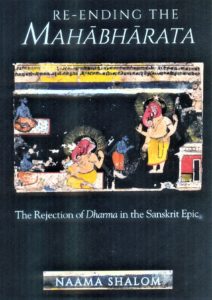
Re-ending the Mahabharata

Naama Shalom, Re-ending the Mahabharata: The Rejection of Dharma in the Sanskrit Epic. Albany: State University of New York Press, 2017. 266 pages.


This is an important work, being the first study to focus solely on how the Mahabharata ends. Naama Shalom’s thesis is that instead of extolling Dharma—the general presumption—the last book actually denounces it in the persona of Yudhishthira. She uses the word garh (condemn) as a “Mahabharata search engine” to achieve three goals: unravel the thematic structure; survey its doubts about dharma; and define how dharma operates in different contexts. Exploring the paradox of dharma’s “garhification” (denunciation) is the agenda.

Shalom shows how re-tellers of the epic altered the ending to provide a pleasant closure. Of them, only three epitomes, all medieval, deal with the ascent to heaven: Kshemendra, Amarachandra, and Agastya in the eleventh, thirteenth, and fourteenth centuries CE. Earlier adaptations neglect the last book, possibly because it is deemed too unsettling. She analyzes the stance adopted by the three Kashmiri Sanskrit aestheticians Anandavardhana, Abhinavagupta, and Kuntaka (ninth to eleventh centuries CE). The first two stress that the ending creates the rasa (emotional experience) of shanti through rejection of the rasas of heroism, wonder, and horror created earlier, thus dissociating it from the rest of the epic. Kuntaka condemns the ending as a prime example of a faulty conclusion that future poets should alter.

Dharma is referred to by both Bhıshma the patriarch and Yudhishthira the son of Dharma as very subtle, as secreted within a cave, hence difficult to determine. At crucial junctures there is doubt about what it is. Shalom does not explore the fact that only three persons are never troubled by such doubts: Krishna, Dharma’s avatar Vidura, and Bhıma. The first two die miserable deaths. Yudhishthira abandons dying Bhıma but will not abandon a dog. Then he rejects Svarga, electing to stay in horrific Naraka with the siblings and the wife he had abandoned. The confusion this ending creates, Shalom argues, has to date not been explored.

Reviewing the research, she concludes that the ending formed part of the epic from at least the third century CE as in the damaged Spitzer Manuscript where the seventeenth and eighteenth serials in the parva-list are intact, though the Mahāprasthānika and Svargārohaṇa parvas are not mentioned. Here she refers to the initial Jaya epic of 8,800 verses, while in fact this is the number of riddling slokas.

She claims to have discovered “a hitherto unknown retelling” entitled Bhārataprabandha by the Malayali poet Melputtur Narayana Bhatta (ca. 1550–1650 CE), which includes the Svargārohaṇa. However, Kalamandalam Eswaranunni, A.Harindranath and A.Purushothaman have edited scholarly editions with detailed explanations and introductions, self-published from 2014 to the present. Bhatta is the only re-teller who has Yudhishthira denounce Indra, Dharma, and the other gods for the illusion of hell.

Shalom concludes that the epic does in fact reach an organic resolution, being a tapestry into which many “garh” episodes are interwoven. Part of this tapestry is the disrupted sacrifice motif introduced in the beginning. The core of the thematic matrix is the examination of what constitutes right action through experimentation with the concept of dharma. She argues that finally Dharma turns in on itself through self-denunciation (Dharma’s son condemns Dharma) voiced by its protagonist Yudhishthira, which scholars have previously overlooked.

Is a later, more “sophisticated” audience uncomfortable with the unabashed existential stance of Vyasa instead of appreciating its nuances, as Shalom claims? Perhaps not. Her study is heavily influenced by Emily T. Hudson’s one-sided Disorienting Dharma: Ethics and the Aesthetics of Suffering in the Mahabharata (Oxford University Press, 2013), showing no awareness of James Hegarty’s balanced exploration of the topic in Religion, Narrative and Public Imagination in South Asia: Past and Place in the Sanskrit Mahabharata (Routledge, 2012).

Being so focused on validating her claim, Shalom overlooks the Bhārata Sāvitrī of four slokas at the end containing Vyasa’s final message. Is he a voice in the wilderness, ignored by all, shouting aloud with upraised arms “From Dharma flow Profit and Pleasure; why is dharma not practised?” In the very next verse he stresses that dharma must not be discarded; for, while joy and sorrow are fleeting, dharma and the jīva–ātman alone are eternal, not the body. The composer himself thus reasserts Dharma’s validity after its “garhification.” And a host of phantom listeners are listening, their stillness answering his cry.

This compelling work needed a good editor. The argument running to 174 pages is supplemented by 50 pages of elaborate endnotes, much of which should have been included in the text. The reader is irritated having to flip back and forth frequently between them. Moreover, there is avoidable repetition: each chapter begins with a summary and ends with a conclusion, both repeating in brief what will be/has been stated. However, Shalom’s book will stimulate fresh thinking about the enigmatic ending of the Mahabharata and as such open up fresh avenues of research.

International Journal of Hindu Studies (2019) 23:355, https://doi.org/10.1007/s11407-019-09268-x

Filed Under: BOOK REVIEWS, IN THE NEWS, MAHABHARATA Tagged With: Mahabharata, Shalom

The “Lost” Mahabharata of Jaimini

March 21, 2019 By admin

This paper features on pp. 33-67 of IGNCA’s journal of arts, KALAKALPA, Basant Panchami 2019, vol.III, No.2. The Editor-in-Chief, Dr. Sachchidanand Joshi, Member Secretary of the IGNCA, writes in his editorial, “Professor Pradip Bhattacharya is an acclaimed scholar on Mahabharata…Professor Bhattacharya’s contribution is stupendous.” The paper has been published with 3 colour plates of photographs I took of frescos on the walls of the Silver Pagoda in Phnom Penh, 3.65 metres high, illustrating the episodes contained in these 2 manuscripts of Jaimini which retell unknown episodes from the Ramayana in the Ashramavasika Parva of the Mahabharata.

This was also delivered as the K.K. Handique Memorial Lecture in The Asiatic Society, Kolkata on 4th August 2017 and published the monograph, “Mananena Hi Livati–K.K. Handique Memorial Lectures” edited by Nabanarayan Bandyopadhyay in 2019.

THE “LOST” JAIMINĪYA BHĀRATA

Pradip Bhattacharya[*]

An anonymous narrator tells us that the wandering bard Ugraśravas Sauti told the rishi Śaunaka and his group of sages in the forest of Naimiṣa that Vyāsa composed the Mahabharata after mastering the Veda and what its original compass was (Bhārata of 24,000 slokas without the peripheral tales), the length of its other versions (Mahabharata) and who recite them to different audiences:[1]

“Ṛṣi Vyasa presented this storehouse of knowledge in detailed as well as condensed forms, because the learned of the world are eager to know it at length and in abridgment….

Originally the Bhārata, without the fringe episodes, consisted of twenty four thousand slokas: this, to the learned, is the real Bhārata.

Later he added a list of contents, summarising the epic in a hundred and fifty slokas.

He taught this summary first to his son Śuka, and then to such of his pupils as possessed the same qualifications.

After which, he added another collection of sixty lakh slokas. Of these thirty lakhs are known in the world of the gods.

Fifteen lakhs are known in the world of pitṛs, fourteen lakhs in the world of the gandharvas, and one hundred thousand – one lakh – in the world of men.

Narada recited them to the gods, Asita and Devala to the pitṛs, and Śuka to the gandharvas, yakṣas, and rakṣasas.

Vaisampayana, a pupil of Vyasa, a sage of firm principles and deeply learned in the Vedas, recited them to the world of human beings. I might add that I, Sauti, have also recited one hundred thousand slokas.”—I.1.52, 101-107.

The human world, therefore, has heard a Mahabharata of one lakh slokas recited. In response to Raja Janamejaya’s request, Sauti has heard Vaiśampāyana recite it at Takṣaśilā at Vyāsa’s bidding during the intervals of the king’s snake-holocaust-rite:[2]

“Repeat, exactly as you have heard from me,

The story of the discord between the Kauravas

and Pandavas.”—I.1.60.22

Vaiśampāyana offers a very significant insight into how different recensions of Vyāsa’s composition came to be. He states that Vyāsa had five disciples: Sumantu, Jaimini, Paila, his own son Śuka and Vaiśampāyana himself: [3]

“He compiled the Vedas.

And was called Vyāsa, the Compiler.

Next he taught the four Vedas

And the fifth Veda, the Mahabharata,

To Sumantu, Jaimini, Paila,

His own son Śuka, and to me,

His disciple Vaiśampāyana.

And the Bhārata Saṃhitā

He published through them

Each separately….” –I.63.93-95

Thus Vyāsa had bidden his five pupils to propagate their individual versions based upon what he had taught them. Only the one recited in his presence by Vaiśampāyana at Janamejaya’s sarpa-sattra is extant in full in18 books as recited by the wandering rhapsode Ugraśravā Sauti to the rishi Śaunaka and his group of sages in the Naimiśa forest during intervals of their 12-year-long yajna. Of Jaimini’s version, only his Aśvamedha Parva exists in full where he, not Vaiśampāyana, recites it to Janamejaya. That other parvas by him did exist is sure because at the end (section 68.14-15) Jaimini states that he has narrated 14 parvas to the raja and will now recite the Āśramavāsa Parva. Further, in Section 36, slokas 84-85.5, Sūta (not “Sauti” who transmits Vaiśampāyana’s recital) addresses an audience of ascetics, presumably identical to Śaunaka and his community of sages in Naimiśāraṇya, stating that he has described all that Jaimini had told the son of Parīkṣit. The spelling of the name of Janamejaya’s father (Parīkṣit instead of Parikṣit) provides a clue to Jaimini’s period, as this spelling occurs first in the Bhāgavata Purāṇa. It means, “to look around,” while the Mahabharata spelling means, “remnant (of a ruined family).”[4]

The legend goes that Vyāsa rejected all the other compositions. According to Śrīdhara’s Pāṇḍavapratāpa (Marathi, 17th century), Vyāsa condemned Jaimini for introducing his own material critical of the Pandavas.[5] This Aśvamedha Parva is of great significance because when Akbar commissioned a Persian translation of the Mahabharata naming it Razmnama (The Book of War, 1584), for the Book of the Horse Sacrifice he chose Jaimini’s version instead of his guru Vyāsa’s, as is evident from the illustrations. We do not know if he made similar choices for the other parvas because his personal copy lies inaccessible in the Jaipur Palace museum.

The Government Oriental Manuscripts Library and Research Centre of the Tamil Nadu State Department of Archaeology has palm-leaf manuscripts in Grantha script ascribed to the “lost” Jaimini Bhārata. Of 15 manuscripts, two that were complete, viz. Sahasramukharāvaṇacaritram (The Deeds of the Thousand-Faced-Rāvaṇa), and Mairāvaṇacaritam (The Deeds of the Dark Rāvaṇa) were critically edited with a sloka-by-sloka English translation in free verse for the first time by Major General S.K. Sen VSM and myself.[6] The Lava-Kuśa manuscript was not included, though complete, as the episode is part of S.K. Sen’s translation of Jaimini’s Aśvamedha Parva.[7] The Setumāhātmyam manuscript from the Āraṇyaka Parva is incomplete, having only four chapters.

The Enigma of Jaimini

Jaimini is the celebrated author of the Pūrva Mimāṃsā and the Jaimini Bhārata. Mairāvaṇacaritam appears to be an independent work included in the Jaimini Bhārata, not claiming to be part of any parva. On the other hand, Sahasramukharāvaṇacaritram, also called Sītāvijaya, claims to be a part of the Āśramavāsa Parva of the Jaiminīya Mahabharata. The way in which Jaimini’s Sahasramukharāvaṇacaritram begins, with Janamejaya’s queries following the return of Sita and her sons to Rama, indicates that it is a sequel to Jaimini’s Aśvamedha Parva account of Lava-Kuśa’s battle with Rama. Unfortunately, those other parvas are yet to be found.

The link with Vyāsa is apparent as in both manuscripts Sita and Hanuman use mantra-infused grass to consume the demons. In Vyāsa’s Udyoga Parva (94. 27-30) Nara demolishes the army of Dambhodbhava by launching iṣīkābhir (blades of grass). Again, in the Śānti Parva (330. 48) Nārāyaṇa takes an iṣīkā, transforms it into an axe with a mantra and flings it at Rudra. Jaimini seems to have taken this concept from his guru.

Further, the invocation to Jaimini’s Aśvamedha Parva repeats Vyāsa’s with a significant difference: he adds his guru’s name in the introductory namaskar:

nārāyaṇaṁ namaskr̥tya naraṁ caiva narottamam /

devīṁ sarasvatīṁ vyāsaṁ tato jayamudīrayet //

Vyāsa is said to have assigned Jaimini the Sāma Veda. In the Mārkaṇḍeya Purāṇa (c. 250- 550 CE), Jaimini is the interlocutor. According to Monier-Williams, Kautsa is his other name.[8] However, in the Mahabharata, Sauti tells Śaunaka that in Janamejaya’s snake-sacrifice, “The learned old Brahmin Kautsa became the udgātṛ; Jaimini the brāhmaṇa.”[9] In Yaska’s Nirukta, Kautsa is a commentator questioning the meaning of Vedic mantras and his arguments are presented in Jaimini’s Mimāṁsā Sūtra (4th to 2nd century BC).[10]

Bulcke[11] assigns Jaimini’s Aśvamedha Parva to the period after the composition of the Bhāgavata Purāṇa (8th-10th century CE). It was translated into Kannada[12] in the 13th century. Its Kuśa-Lava episode is very similar to that in the Padma Purāṇa’s Pātālakhaṇḍa[13] (c. 10th century CE). Surely, different Jaiminis existed writing under the same name, as with Vyāsa, creating different texts across the centuries following the time-honoured tradition of the guru-śiṣya paramparā.[14] The author of Mairāvaṇacaritam and Sītāvijaya (if they are the same person) would be one such “Jaimini.”

The concluding chapter of Mairāvaṇa provides a clue towards the probable time of its composition. There is a reference to the “six syllable mantra” in sloka 6 of chapter 20. This is rāṁrāmāyanamaḥ that is found in the Rāmarahasya Upaniṣad, which is possibly of the 17th century. In it, Hanuman instructs Sanaka and other sages how to worship Rama. Again, the paean to Hanuman (sloka 24 of chapter 18) as adept in the Vedas and its limbs and the shastras is paralleled by Tulsidas (1532-1623) in his Vinayapatrikā, where he calls Hanuman vedavedāntavid.[15] His Ramacharitmanas contains the Ahirāvaṇa tale. There is also a Sītopaniṣad celebrating Sita as Shakti but, unfortunately, its period cannot be determined.[16]

Language and Style

The language of Mairāvaṇa and Sītāvijaya is quite pedestrian, strangely devoid of alaṃkāras and rasas.[17] The flamboyant poetry characterizing the Aśvamedha is entirely missing. Though one does come across the usual similes e.g., “burnt like trees in a forest fire,” or bathed in blood “looking like an Ashoka tree in full bloom,” or “arrows raining like rain from clouds,” the Aśvamedha’s striking use of metaphors and rhetoric is absent. The unexpected juxtaposition of opposites, the conceits, which the Jaimini of the Aśvamedha merrily uses, appears to be unknown to the Jaimini of Mairāvaṇa and Sītāvijaya. Consider this from the Aśvamedha Parva:

Nandi could not seize Garuda as an angry elephant cannot seize cotton-wool in a courtyard (21.32); or,

…armour destroyed, Sita’s son stood on the battle-field like the newly-sloughed king of serpents (34.6); or,

Rama’s glowing iron arrows were as useless as a poor man’s desires in a miser’s home (36.58).

Mairāvaṇacarita and Sītāvijaya are bereft of such interesting conceits. The only common feature is the use of hyperbole, especially in battle. The Jaimini of the Aśvamedha exaggerates outrageously. However, in Mairāvaṇa and Sītāvijaya people do not grow on trees, horses do not turn into mares and tigresses, and no rakshasi uses her eight-mile-long breasts as weapons in battle!

The Aśvamedha effectively uses all the nine rasas. In Sītāvijaya and Mairāvaṇa, only vīra (heroic) and bhayānaka (terrible) with a sprinkling of raudra (fury) are seen, with adbhuta (wondrous) prevailing. In Mairāvaṇa, Hanuman increases and decreases his body at will, creates an impregnable fort with his tail, Brahma constructs an amazing defence for Mairāvaṇa’s palace, Mairāvaṇa shape-shifts continually in battle like Mahiṣāsura fighting Durga. In Sītāvijaya, Rāvaṇa has a thousand heads and two thousand arms, his brothers have hundreds of heads, eyes, bellies and hands, the diseases fight a terrific battle, Hanuman is given five heads, grass columns turn into blazing missiles, and so on.

A major difference between the Aśvamedha and these two manuscripts concerns variety. The Aśvamedha has many peripheral stories, tales within tales, e.g. Agni and Svāhā, Uddālaka and Caṇḍī, Mālinī and Yama, Candrahāsa, Bakadālbhya, the golden mongoose, the quarrelling Brahmins, Babhruvāhana’s exploits, etc. Almost all its chapters contain different narratives. The battle sequences, the mainstay of all three texts, are singularly dissimilar. Those in Sītāvijaya are monotonous. The characters change, but the sequence of events is more or less the same in all, except for the last battle in which Sita kills Sahasramukharāvaṇa with a grass-missile. Hanuman also uses mantra-infused blazing grass against Mairāvaṇa, but ineffectually. Here the battle-descriptions read more like the reports of a war correspondent than literature. The exuberance and creativity of the Jaimini of the Aśvamedha’s is missing.

Besides the heroic, the other ruling sentiment of the Aśvamedha Parva is Vaishnava bhakti. All the protagonists worship Krishna even as they fight him, their bhakti masked by the animus they display outwardly as they wish to receive death as his grace. The battlefield is their temple where they worship their deity with weapons. Krishna is worsted by them because the essence of the concept of bhakti is that the deity must be overcome by the intensity of the bhakta’s bhakti.

On the other hand, in Mairāvaṇa and Sītāvijaya there is little bhakti. While the former is dedicated to the glory of Rama and the latter incongruously to Krishna, there is but a single paean to Rama at the beginning and at the end of the former. The latter has paeans to Hanuman and to Sita’s wondrous form towards the end. How can an author, so immersed in Vaishnava bhakti in one work, be almost completely bereft of it and extol Hanuman and Shakti in the two others?

An underlying current of Shaivism runs through the Sahasramukharāvaṇacaritram. The crisis it deals with is precipitated by two insults: the first is by the Trinity to Anasuyā; the second is to Shiva’s avatar Durvāsā at Māndhāta’s yajna. The latter parallels the insult to Shiva at Dakṣa’s sacrifice, which Vīrabhadra and Kālī destroyed, routing all the sages and devas. The names of Durvāsā’s sons who rout the devas are among the thousand names of Shiva in Section 284 of the Mokshadharma Parva[18] of the Mahabharata. The presence of Shiva in Vyāsa’s Mahabharata is quite significant, though understated. Therefore, Jaimini is not blazing an altogether new trail here. The dreadful destructiveness of Durvāsā’s sons is of a piece with other demons originating from Shiva such as Andhaka, Bhasmāsura and Jalandhara. Here Hanuman is a product of Shiva’s seed and is five-faced like him. However, the heads of lion, horse, boar and eagle represent avatars of Vishnu and his mount Garuḍa. This is, therefore, a Hari-Hara image, a fusion of Vishnu and Shiva. Parallel to the pair of Vīrabhadra and Kālī, we have here the pair of Hanuman and the shadow-Sita.

There is a feature that indicates the somewhat casual attitude of the author of these two works. The names of the characters take different forms at different places. Mātaṅgī becomes Sītā, Uṣṭramukha becomes Oṣṭhamukha, Vakranāsa becomesVakranetra and so on. This is a defect noticed in both the texts. The sincerity with which the Aśvamedha was created is missing in these. However, these could very well be copyists’ errors.

The Aśvamedha Parva is characterised by flamboyance of description, be it of a road, a palace, or nature. Consider the rhetoric of the passage in which Vriṣaketu describes a lake to Bhīma (4.11-14):

“…the enjoyment the elephants are getting from these waters is like the pleasure the lustful men get from making love to women. The life-giving water is tinted deep red with the vermilion falling from the temples of these elephants. Since the temples of the elephants are now bereft of charity, the bees have now forsaken them and entered the clump of lotus plants. There is no loyalty among the mean. Picking up the lotus-stalks, the swans are generously offering them to the bees, like those who know the principle of equity among beings. The fish are leaping in the lake as poor people do on getting riches.”[19]

There are many such instances throughout the text.

In Mairāvaṇa, there are only two descriptions: one of Ayodhyā (section 1) and the other of a forest in Laṅkā (section 10, verses 2-6), of which the latter is superior:-

“Having gone up to thirty yojanas,

a maha-forest was afar,

filled with bears, lions, tigers and

other animals and birds,

Nārikela, panasa, āmra,

          pāṭala, tinduka,

kapittha, jambū,nipa, jambīra,

also nimbaka.

Filled with different trees it was like

Nandana.

Entering the forest, they saw a lake

of two yojanas,

Adorned with red and white lilies, crimson

and blue lotuses,

thousand-petalled lotuses and hundred-

petalled water-lilies,

All filled with cackling, teeming with

intoxicated bees,

the lake appeared like a sea adorned with

leaves all around.”[20]

In Sītāvijaya there is only one description, that of the palace that Viśvakarmā built for Rāvaṇa (section 8.33-41):

“In width a lakh yojanas, double that

in length, a fifty-

yojana high excellent wall adorning it,

With four ornamented towers, four gates,

maha-roads, adorned with

ten million palaces each with a

hundred horned doors.

On four sides four lakh maha-markets stood

adorning. The maha-

royal road was provided with countless

large seats.

Five thousand yojanas long was the king’s

palace, furnished

with an unfathomable moat impassable

for enemies,

Many śataghnīs and equipped with

all weaponry.

On four sides, placing Sudharmā and the

other halls with care,

In the centre an immaculate

assembly hall

endued with wondrous attributes, with

a hundred gardens

filled with flags and garlands of pennants,

With qualities superior to the world

of devas, abounding

in markets and shops, mixed herds of maha-

elephants like

the Meru and Mandara mountains,

Inhabited by divine horses swift

as thought, adorned

with lotus lakes full of swans and cranes,

Better than the Trinity’s abodes,

radiant as

newly arisen Bhānu…”[21]

The qualitative difference between the excerpts is obvious. How can a poet capable of describing so beautifully in the first instance hardly display his talent in two of his own works? So is it with the dialogues, of which there is profusion and variety in the Aśvamedha. Dialogue is used to establish characters and situations effectively. In Mairāvaṇa and Sītāvijaya there is only martial talk and the occasional paean. These two texts cannot stand beside the poetic elegance and expanse of the Aśvamedha Parva. It is unlikely, therefore, that their author is the same, although they might belong to the same “Jaimini” school.

Is it the Same Author?

Were Mairāvaṇa and Sītāvijaya composed by the same author? The language and the style seem similar. As in Mairāvaṇa Rama and Lakṣmaṇa are abducted when asleep, so, too, in Sītāvijaya are Bharata and Śatrughna. In both, mantra-infused grass is used as a missile and the supernatural prowess of Hanuman is celebrated.

However, an interesting difference in the colophons of these two works raises a doubt. The colophons in Mairāvaṇa mention Śrī Jaiminibhārata without stating the parva concerned. The colophons of Sītāvijaya ascribe it to the Āśramavāsa Parva of the Jaiminīya Mahabharata. Would the same author composing two stories use different names in the colophons denoting the principal work of which these are parts?

It is pertinent to recall that Vyāsa first composed the Bhārata of 24,000 slokas, without the fringe episodes:-

“Originally the Bhārata, without the fringe episodes, consisted of twenty four thousand slokas: this, to the learned, is the real Bhārata.”[22]

caturviṁśatisāhasrīṁ cakre bhārata saṁhitām /

upākhyānair vinātāvad bhārataṁ procyate budhaiḥ //[23]

Is Mairāvaṇacarita part of Jaimini’s version of the Bhārata? But, then, is it not a fringe episode?

Parallels and Variations

Indian tribes have analogous versions of both the stories Jaimini relates.[24] About the Mundas of Chhotanagpur, K.S. Singh notes that they believe the vānaras were forest dwelling tribes who wore part of their dhoti trailing loose as a tail, as the Mundas and Savaras still do on their dancing ground.[25] The episodes also occur in Ramayana retellings and plays in South East Asian countries. However, there is no mention of these two stories in the Rama tales of Sri Lanka, Tibet, Khotan, Mongolia, China, Japan and Vietnam (Champā).

Sahasramukharāvaṇacaritam or Sītāvijaya

The Agarias, an ironsmith tribe of Madhya Pradesh, tell a tale in which Sita tells Rama about a thousand headed Rāvaṇa in Pātāla. He pulls out from his foot the arrow Rama shoots at him and despatches it to kill the sender. Rama falls. Sita, frightened, goes to Lohripur and asks Logundi Raja to send Āgyāsur and Lohāsur with half an earthen pot of charcoal. By its smoke, she turns black. Carrying the pot in one hand and a sword in the other, she cuts off Rāvaṇa’s heads. Āgyāsur and Lohāsur lick up the blood.[26] Thereafter, according to a tale in Braja literature, Sita becomes Kālī-māī (Mother Kali) in Calcutta.[27]

The Marathi Śatamukharāvaṇa Vadha (19th century) by Amritrao Oak also narrates the killing of this demon.[28] There are two Tamil tales relating to the hundred-headed and thousand-headed Rāvaṇas, Sadamuka Ravanan Kathai, Sahasramuka Ravanan Kathai, that do not not occur in Kamban.[29] In Telegu, there is a similar Śatakaṇṭha tale, which occurs in Assamese, Oriya and Bengali Ramayanas too.[30]

Both Sāralā Das and Bārānidhi Das wrote a Bilaṅkā Ramayana. In the former, Sita challenges Rama to kill the thousand-headed Ravana whom she ultimate kills. In the latter, Vibhīṣaṇa begs Rama to kill the thousand-headed Ravana.[31] Sarala Das in his Mahabharata’s Vanaparva has Agastya recount how in different aeons Rama slew Ravanas with one lakh, one thousand, one hundred and ten heads. According to the 17th century Oriya Bilaṅkā Rāmāyaṇa (pūrva khaṇḍa) by Siddheśvara, Bilaṅkā lies 120 yojanas south of Laṅkā. Its ruler, Sahasraskandha, defeats Rama, Lakṣmaṇa and Hanuman. Then Sita obtains a flower-bow and five arrows from Maṅgalā Devi, assumes an enchanting form and shoots the five arrows at the rakshasa, who gets besotted with her. Thereupon, Rama and Lakṣmaṇa cut off his thousand heads with five arrows. In the Uttara Khaṇḍa, assuming the form of Kālī, Sita kills the Rāvaṇa with one lakh heads. In the Bilaṅkā Khaṇḍa by Bārānidhi Das (or Balarāma Das), first Aṅgada and then Hanuman are sent with a truce proposal to Sahasraskandha, who rejects it and flings them far away. Jāmbavān encourages the depressed Rama to fight. Sahasraskandha knocks Rama and Lakṣmaṇa unconscious with his śakti and tries to abduct Sita. However, a gandharva army emerges from her body and slays him.[32]

In Assamese, there is the play Śataskandharāvaṇa Vadha, the killing by Sita of the hundred-headed demon, which re-casts the Adbhuta Ramayaṇa account as a drama. Here Sita mocks Rama who has been boasting of his prowess in killing ten-headed Rāvaṇa and challenges him to kill the hundred-headed ruler of Siṃhala. Twice the demon picks up Rama with his chariot and places it back in Ayodhyā. The third time he sends his son Ardhaśata (half-hundred) who knocks Sugrīva and Vibhīṣaṇa unconscious, seeing which Rama faints. Hanuman is also struck down and returns to bring Sita. Becoming the fierce Devi, she beheads both demons. To calm her, at Vishnu’s behest, the devas revive Rama and Lakṣmaṇa. Hanuman asks Rama to appease the Devi who will destroy creation otherwise. Terrified at Sita’s form, Rama hides among the devas. The gods ask Hanuman to pacify her. He paeans her; she becomes ashamed and all return to Ayodhyā.[33]

In Bengali, Jagatrāmarāya wrote an Adbhut Rāmāyaṇa (c. 18th century) with eight instead of seven cantos as in the Sanskrit original. Its Puṣkarakāṇḍa, placed before the Uttarakāṇḍa, describes the killing of the thousand-headed Rāvaṇa by Sita.[34] Further, in the Uttarakāṇḍa of Rāmamohan Bandopādhyāya’s Ramayana (1838), the tale is retold along the lines of Caṇḍī’s killing of the demons Śumbha-Niśumbha.[35]

Narrated to Bharadvāja by Vālmīki, the Adbhut Rāmāyaṇa[36] (c. 15th century) in Sargas 17-27 narrates the killing of the thousand-faced Rāvaṇa, living in Puṣkara, north of Mānasa, by Sita. This Sahasravadana Rāvaṇa, with two thousand arms and eyes, is a son of Viśravā and Kaikasī. Once Viśvāmitra and other rishis visit Ayodhyā and praise Rama for killing Rāvaṇa. Thereupon, Sita smiles and tells them about his elder brother Sahasravadana who has imprisoned Indra and the other gods in Puṣkara, as she had heard from a Brahmin guest in her father’s court. Hearing this, Rama proceeds with his brothers, the apes and rakshasas, an army and Sita to Puṣkara.

Sahasraskandha blows away the entire army to Ayodhyā (the men), Kiṣkindhā (the apes) and Laṅkā (the rakshasas) with the vāyavya (wind) missile. When Rama shoots the Brahmāstra at him, he catches it with his left hand, snaps it in two and with his own arrows knocks Rama unconscious. Incensed, Sita laughs loudly and assumes the terrifying form of Devi with sunken eyes, ravenous, lolling tongue, garlanded with heads, girdled with bones, terribly swift, with a piercing voice, horrifying in appearance, long-nosed, four-armed, bearing bell, noose, sword and skull, matted-haired, with blazing ornaments on her head. She slices off Rāvaṇa’s thousand heads and, tearing off the heads and ripping open the bodies of his warriors with her nails, she dances frenziedly, throwing all creation into turmoil. From her pores emerge terrifying mother-goddesses who accompany her, playing with skulls as balls.

To prevent the earth from sinking into pātāla, the devas pray to Shiva who, assuming the form of a corpse, lies under her feet, bearing her weight. Brahma and all the devas, rishis, the manes and lords of the quarters beg her to stop. She refuses to think of the world’s welfare since Rama lies unconscious. Then Brahma resuscitates Rama, who shuts his eyes at the terrifying sight of Kālī. Brahma tells him this is Sita. Rama, trembling, pranams her. She informs him that she is Maheśvara’s Shakti Śivā and grants Rama divine vision to see her true form. He paeans Sita with 1008 names as the Supreme Shakti and begs her to abandon her terrible form. Sita then resumes her ordinary form. The parallel with Arjuna’s viśvarūpadarśana is clear. Sita remains in the terrible form north of Mānasa and returns in blue-and-red form with Rama to Ayodhyā on the Puṣpaka aerial vehicle. There Rama relates to all how the thousand-faced demon was killed. Saudāmini Devi composed a Bengali version of this in rhyme in the late 19th century,[37] and Chandranath Basu in prose in 1902.[38]

Rāmadāsa’s Ānanda Rāmāyaṇa[39] (c.15th century) in the Rājya Kāṇḍa, pūrvārdha, sarga 4, verses 80-85, has the hundred-headed Rāvaṇa with two hundred hands living in Māyāpurī on the bank of Śroṇa river. Kumbhakarṇa’s grandson Pauṇḍraka, born to Nikumbha, asked for his help and the two threw Vibhīṣaṇa out of Laṅkā. Approached by Vibhīṣaṇa, Rama, with Sita, went there and killed both, re-establishing Vibhīṣaṇa in Laṅkā.

Later (sarga 4 verses 85-143, sargas 5 and 6), Vibhīṣaṇa again approached Rama and informed him that Kumbhakarṇa’s son Mūlakāsura, leading rakshasas from pātāla, had driven him out of Laṅkā after besieging it for six months and had pledged to take revenge by killing Rama. This asura was so named having been born under the Mūla asterism and was reared at the roots of trees by bees on drops of honey. Vibhīṣaṇa had to flee at midnight with his entire family through a tunnel. Ordered by Rama, Lakṣmaṇa assembled Sugrīva and all kings save those aggrieved with Rama.

With his brothers and seven sons, Rama flew on the Puṣpaka aircraft to Laṅkā. The battle raged for seven days. Hanuman revived dead monkeys with medicine from Droṇācala mountain. The entire army of the asura was destroyed. Then Mūlakāsura knocked unconscious all the kings with their armies. Kuśa’s arrows flung the asura back into Laṅkā. He sheltered in a cave and began an abhicāra (black magic) rite to obtain weapons and a chariot. Noticing the smoke, Vibhīṣaṇa advised Rama to send monkeys to impede it. At this point Brahma appeared with many devas and informed him that by virtue of his boon the asura could not be slain by any man. However, in an assembly of Brahmins he had abused Sītācaṇḍī as the cause of his clan’s destruction. A rishi had cursed him to be slain by that same Caṇḍī. Hence, only after Sita had arrived should the monkeys disturb the rite. Then Rama directed Garuḍa to bring Sita there, escorted by Hanuman.

Sita, miserable at being separated from her husband for so long, was greeted by Rama who embraced her, kissing her lips and caressing her breasts. Then he instructed her in the art of aiming and releasing all weapons and Lakṣmaṇa prepared a fully equipped chariot driven by Dārūka (Krishna’s charioteer—an anachronism). Rama asked her to ride that chariot and kill the asura.

Thereupon, she despatched her tāmasī (dark) shadow, which got into the chariot. The apes created chaos in performance of the rite now. Furious, the asura rushed to the battlefield. On the way, his crown fell off and he, too, fell down, but went on to face the shadow-Sita. She had large teeth, terrifying eyes, hair like yellow lightning, thighs like palm trees, feet like winnowing baskets, mouth cloud-black and cavernous, lolling tongue, and a huge head. The asura was terrified. She declared her identity as Caṇḍāsītā, the cause of his clan’s destruction. A tremendous battle was waged between the two for seven days, watched from the Puṣpaka aircraft by Rama, Sita and many kings. Finally, using a maha-missile, Caṇḍikā beheaded the asura. Pranam-ing Rama and Sita, she merged into the latter. Brahma, with all the devas, apsaras and bards, paeaned Sita at length.

Rama Brahmānanda’s Tattvasaṃgraha Rāmāyaṇa (17th century) states in canto 7 that sages complained to Rama about a hundred headed Rāvaṇa living with an asura named Raktabindu beyond the seven seas. Sita wished to kill him, so Rama sent her off with Hanuman and a huge army on the Puṣpaka aerial vehicle. In the battle, Hanuman assumed the terrifying forms of Narasiṃha, Garuḍa, Hayagrīva, and was a manifestation of Shiva. He was paeaned as Pañcamukha Hanuman. Sita assumed a terrible form with 18 arms and slew the hundred-headed demon. The devas chanted a paean to her thousand names.[40]

Jaimini’s version, running to fifty chapters, is very different.[41] The interlocutor is Janamejaya and the narrator is Jaimini. However, in slokas 10-11 of the first chapter, the last verse of the second chapter and slokas 30-31 of chapter 50 at the very end, there is someone who is narrating what Jamini told Janamejaya. This would be a sūta, a wandering rhapsode who remains nameless.

Jaimini alone provides the cause for the birth of the thousand-headed demon along with his brothers, with hundred heads, hundred bellies, hundred tongues and hundred eyes, viz. the insult to Anasūyā by the Trinity and to Durvāsā in Māndhātā’s sacrifice. Bharata and Śatrughna are abducted and married off (without any demur) to the demon’s daughters. In the battle the devas, monkeys, rakshasas, kshatriya kings with their armies, Rama and even the Trinity fall. That is when Sita takes the field, bestowing five heads on Hanuman with which he devours the demonic army. With fiery grass columns she despatches the thousand-headed demon. Rama is not terrified of her, as her form is not horrifying, though wondrous. In Mairāvaṇacaritam Hanuman too uses mantric sacred grass to consume the demon.After being paeaned at length, Sita joins Rama and all return to their abodes. The demon’s city is divided between Citradhvaja and Citraratha, the sons of Bharata and Śatrughna, who are not mentioned in any Ramayana. There is no mention of Bharata and Śatrughna being accompanied by their new wives when the four brothers meet their mothers back home.

What is of great interest is that here Sita does not abandon Rama and her sons to disappear into the bowels of the earth. All kings condemn the washerman (there is only this cryptic mention) and praise Sita, whom Rama embraces. He is given a span of eleven thousand years to rule by Brahma, as in Vālmīki.

Janamejaya is eager to know what further deeds Rama did after the return to Ayodhyā.Jaimini responds by telling Janamejaya that what he has been narrating so far is (part of) the story renowned as Āśramavāsa Parva beginning from the victory of Sita till the death of King Dhṛtarāṣṭra. The closing benediction anachronistically dedicates the work to Krishna, again displaying the Vaishnava bhakti tradition.

Mairāvaṇacaritam

The tale is completed in twenty chapters. Jaimini’s creation is quite distinct from other versions. It is an episode composed not by Vālmīki, but by Jaimini and is narrated by Agastya to Rama to celebrate a wondrous nocturnal deed of Hanuman. He rescued Rama and Lakṣmaṇa who were overcome by enchanted sleep and abducted by Mairāvaṇa to the nether world. According to Jaimini, it is not Lakṣmaṇa but Rama who, enraged with Śūrpanakhī’s amorous advances, cuts off her nose, as Rāvaṇa informs Mairāvaṇa. Indeed, in the entire story, neither brother has any role to play, being asleep throughout.

The story of Mahī (earth) or Mai (collyrium, or black in Tamil) Rāvaṇa is a celebration of Hanuman’s prowess and intelligence. It was far more popular than tales about multiple-headed demons other than Rāvaṇa. Besides Sanskrit, it exists in Gujarati, Marathi, Malayalam, Kannada, Tamil, Nepali, Bengali, Oriya, Assamese, Hindi, Thai, Lao, Khmer, Malay and Burmese and has many tribal variations. It is not surprising that some manuscripts are entitled Hanumadvijaya, the victory of Hanuman.[42]

Acccording to the Birhors of Chhotanagpur, Lakṣmaṇa is able to kill Rāvaṇa as he had taken no food for twelve years, which was the boon Rāvaṇa had obtained. Then Kumbhakarṇa appears, seizes the brothers and takes them to a sacrificial pit before the goddess Kālī-māī. He asks them to eat grains from the ground as animals do before being sacrificed. The brothers ask him to show them how to do this. When he prostrates himself, Lakṣmaṇa beheads him. Kālī-māī laments and asks who will sacrifice to her. Rama asks her to wander all over earth. Thus her cult spreads.[43]

The Ālu Kurumba tribe in the Nilgiri hills of South India have a prose version of the Ramayaṇa in which, when Lange (Laṅkā) is burnt by Alumaru (Hanuman), Cīde (Sita) is burnt to ashes which someone puts into a box and throws into the sea.[44] The box lands up with a Pāṇḍya prince who finds Cīde miraculously alive within it. He sends her to Ayi and Mayi Rāvaṇa, two elder brothers of Rāvaṇa, who live underneath Lange. Rāvaṇa had turned Emme Daruma Raja (Dharmaraja-Yama) and his followers into beetles and forced him to grant immortality to his elder brothers. Gumbagaruna (Kumbhakarṇa) was his younger brother. Rāmaru and Laccumaṇa were told about Cīde’s whereabouts by Gumbagaruṇa who submitted to them after Rāvaṇa’s death.

Seeking her, Alumaru faced a demoness Mangea-Karaci who had a crocodile’s head and hands bound by the curse of Ayi and Mayi. She could become free by devouring Alumaru. He tricked her by expanding his body, then suddenly contracting it, entering her jaws and jumping out. Freed, she obtained him as her husband, told him that Cīde was hidden in Ayi and Mayi’s fort and showed him the path to it. She became pregnant by a drop of his sweat that had fallen upon her. She had a son called Maccavala (strong man-fish). Alumaru succeeded in bringing Cīde back to Rāmaru.

Rāmuru and Laccumaṇa reached a forest seeking to fight Ayi and Mayi, who were waiting for them. Disguised as beggars, they had tracked Cīde to Ayodi. At night, Alumaru made a cone of his tail and hid them within it. Ayi and Mayi, as priests, requested him to show Rāmaru as they wished to offer puja to him. He allowed them entry. Instantly they overpowered the brothers and took them to the underworld through a tunnel, imprisoning them in their Kālī temple.

Next morning, discovering this, Alumaru went down the tunnel but was stopped from entering the fort by Maccavalla. They fought a lengthy duel, neither winning. The demoness Mangea-Karaci appeared and called out, whereupon Maccavalla stopped and Alumaru felled him. The demoness used to gather flowers daily to garland the icon of the goddess. She hid Alumaru, who had taken a miniscule form, in the flowers. Within the temple, he took the form of a priest and located the brothers who were to be sacrificed on Friday. That day Alumru hid behind the idol and ordered everyone to provide food. Huge amounts were poured on the idol from a hole in the roof of the temple. Alumaru ate everything and declared that the next Friday the brothers should be sacrificed. On that day, Alumaru freed the brothers and gave them weapons he had procured in the meantime.

For 22 days the brothers fought Ayi and Mayi, who revived every time they were killed, and doubled on each occasion. Mangea-Karaci told Alumaru that a woman named Āravali could tell him their secret. Alumaru flew to her. She agreed to reveal the secret provided Rāmuru married her. Alumaru agreed provided the litter on which they would sit for the ceremony did not break in two. Āravali agreed and told Alumaru about a lake visited by seven beetles who sprinkled its water on a dead person, whereby he revived and doubled. Alumaru killed six of them and caught the seventh who took human form. He was Emme Daruma Raja who with his followers had been turned into beetles by Rāvaṇa to ensure immortality to Ayi and Mayi. Alumaru asked him to break the litter of the wedding rite. Thus, Ayi and Mayi could be killed. Alumaaru brought Rāmaru and Laccumaṇa to Āravali. The litter broke during the marital rite, whereupon Rāmaru refused to wed her. He installed her as princess of Lange and left for Ayodi. After his return, he was crowned king and Alumaru left for his own land.

In Tamil there is a Mayilirāvanan Kathai. Mayil kidnaps the brothers in a box; Vibhīṣaṇa guides Hanuman to Pātāla Laṅkā where he meets his son Maccagaraban (Matsyagarbhan). After his birth, Vayu Deva had named him and told him of his father.[45]

According to a Tamil tradition,[46] Rāvaṇa approached the demon, Māyil (peacock) or Mai (collyrium, darkness)[47] and sought his help to win the war. The demon, using black magic, took away Rama and Lakṣmaṇa and planned to kill them after conducting rituals in a secret place. Hanuman learnt from Vibhīṣaṇa that the demon’s life in the form of five wasps was kept inside a box in a cave, far away from the seven seas. He went there and brought the casket to the place where the demon was conducting puja. As all the five wasps had to be killed simultaneously to annihilate the demon, he assumed the form of Viśvarūpa Pañcamukha Āñjaneya, with divine powers of all the gods. His form radiated the brilliance of one crore suns and he killed all the five wasps, thereby killing Māyilirāvaṇa. Further, according to “Sudarsana Samhitai,” Mayilrāvaṇa took away the Sudarśaṇacakra and Āñjaneya was asked to retrieve it. He fought a fierce battle with the demon who resorted to maya. The Lord told Hanuman that to kill the demon, who might take the form of an animal or bird or snake, he should possess the powers of all his earlier incarnations like boar, man-lion and horse-headed, as also of his mount Garuḍa. It was then that Hanuman assumed the five-faced form with three eyes in each face. Pārvatī bestowed upon him the lotus, Rama the divine bow and arrow, Garuḍa the pot of amṛta and his wings, and Yama, the noose. Other gods bestowed their entire powers and blessed him. Hanuman killed Mayilrāvaṇa and returned the Sudarśaṇacakra to the Lord.

Mahirāvaṇacaritra in Telegu was written by Madayya Kavi in the 16th century.[48] In Malayalam there is a Pātālarāmāyaṇam epic in which Pātālarāvaṇa abducts the brothers. Hanuman kills him and rescues them. A killippattu (c.18th century) also exists on this theme.[49] In Marathi Mukteshvar wrote Ahi-Mahirāvaṇa-Vadha in the 17th century.[50]

In Assamese there is the poem Mahirāvaṇa Caritraaru Betālacaṇḍīra Upakhyāna by Chandra Bhārati based on book 1 of the Sāra kāṇḍa of Ānanda Rāmāyaṇa, or on Krittibasa’s Bengali Ramayana, or on the Mahānāṭaka. Mahirāvaṇa (sometimes called Mairāvaṇa), son of Rāvaṇa, in conference with his father is spied upon by Hanuman—who has been sent by Jāmbavān who fears the arrival of Mairāvaṇa—in the form of a crow. Despite the advance information, the demon succeeds in putting everyone to sleep, binds the brothers with his snake-noose and abducts them for sacrificing in pātāla to Betāla Caṇḍī.

Hanuman, becoming a kingfisher, questions birds who tell him of the abduction. They carry him to pātāla as a gadfly on the back of a fish-hunting bird machroka (matsyaranka). Staying as an old Brahmin in a flower girl’s house, he gets information that the sacrifice is on the next day. He turns into a crow, is discovered by other crows whom he kills. He reaches Dolani Nagara, the demon’s city. Becoming a fly he lands on the distraught Rama’s thigh within the prison. He finds that the goddess is his mother’s sister. When she refuses to save Rama and Lakṣmaṇa, he spins her about seven times with his tail and flings her a hundred yojanas, splitting open her head. He assumes her form and summons Mahī to bring the brothers for the sacrifice. As a flea, he advises the brothers to tell Mahī to show them how to prostrate. When he does so, Hanuman beheads him with his own sword.

The demon’s queen attacks him and Hanuman kicks her in the belly. She dies, aborting a slippery foetus (named Garbhāsura), shaped like a pumpkin, who fights and Hanuman cannot grip it. His tail flares up with brahma-agni, reducing Dolani Nagara to ashes. The storm of dust and ashes enables him to catch hold of the foetus with his tail and fling him at Rama’s feet. By Shiva’s boon he does not die. Rama curses him to go to earth as a dirt-eating bird, never touched by Brahmins, wandering in Laṅkā uttering his cry. Hanuman returns with the brothers riding the same bird, which unsuccessfully tries to drown them in the sea.[51]

Birendranath Datta refers to the Assamese Rama-Kathā in the Kamrup region about Mahit Rāban and his son Ahit Rāban who is also called Tolka or Telka (slippery) Rāban, a slimy foetus fighting Hanuman who is unable to grapple with it. So he calls upon his father Vāyu who blows dust on foetus so that Hanuman can catch hold of it. However, he cannot be killed, so Hanuman bangs him on ground cursing him to become a cock. Hence cocks always itch to fight.[52]

Anant Kandali (c. 16th century) has a poem in Assamese, “Mahirāvaṇa Vadha” describing how Rāvaṇa’s son Mahī abducts the sleeping brothers to Pātāla and is about to sacrifice them to Kālī when Hanuman kills him and saves them.[53]

Sabin (Sita) Alun or Rama-Lakhan Alun (song) is the Karbi Ramayana of Assam. It has the same tale of Mahirāvaṇa disguised as Vibhīṣaṇa abducting the brothers to pātāla through a hole in the ground, which Hanuman enters. Finding a sea, he weeps in distress. The sea god’s daughter, as a crocodile, catches the tears. With her help, Hanuman reaches pātāla where, as a crow, he searches and finds the brothers. He tells them to ask Mahirāvaṇa to show how to prostrate. Hanuman asks the deity Singdi if it wants Mahirāvaṇa’s head or those of the brothers. Singdi wants the brothers’ heads, so Hanuman crushes Singdi’s head and throws it into the Khasi hills. Pretending to be the deity, he calls for much food. Finally, when Mahirāvaṇa prostrates, Hanuman crushes his head and carries the brothers on his shoulders to Laṅkā.

Similar is the Bajong-Phura version of Rama-Lakhan Alun sung by the fishermen of Bey in Karbi-Anglong, except that a bird tells Hanuman about the plan to sacrifice the brothers to Singdi. In disguise, Hanuman meets Mahirāvaṇa who tells him about Singdi puja. Advised by the god, Hanuman kills Mahirāvaṇa with a sword and carries the brothers back on his shoulders.[54]

In Assamese there are several works dealing with Hanuman’s adventures in the netherworld with serpents, e.g. Dhananjaya’s Gaṇakacaritra, Vidyāpancānana’s Pātāli Kāṇḍa, Raghunāth Mahanta’s Adbhuta Rāmāyaṇa and Satruñjaya.[55]

In Oriya, in Bikram Narendra’s version,[56] the devas command Nidrā, the goddess of sleep, to overcome everyone in Rama’s camp because they want Mahīrāvaṇa dead. Rama is abducted. The first place that Hanuman searches—we are not told why—is where Sita is imprisoned. Taking the form of a bee, he sees that when Trijaṭā tells her of the abduction, two tears fall from Sita’s eyes from which two devis with four arms and three eyes named Tārā and Tāreṇī appear whom she commands to guard the brothers.

In Mahīrāvaṇa’s prison, Rama is singularly distraught and Lakṣmaṇa has to boost his morale. Getting inside the temple as a bee hidden in a flower garland, when it is placed on the icon of the deity, Hanuman assumes a thousand-armed viśvarūpa and crushes the devi’s head under his left foot. When the demon raises his sword to behead the brothers, the two devis deflect it so that he kills his attendants instead. Hanuman then protects the brothers with his tail and kills the demon’s attendants. However, every time he beheads the demon, the head re-grows. Vāyu deva advises him to tear Mahī in two, and that is how he kills the demon. This portion is anachronistic and has been influenced by the way in which Bhīma—the Wind-god’s other son—killed Jarāsandha in the Mahabharata.

In Balarāma Das’ Oriya Jagamohana/Dakṣiṇī/Dāṇḍi Rāmāyaṇa, Mahīrāvaṇa is Indrajit’s son, killed on the eleventh day of the siege of Laṅkā.[57] Here it is Lakṣmaṇa who kills the demon in Sulaṅkā after being imprisoned there with Hanuman and Suṣeṇa. The story also occurs in Bishvanātha Khuntiā’s Bicitra Rāmāyaṇa almost in the same form, in Bikram Narendra’s Oriya Śrīrāmalīlā and Shishu Ishvara Das’ Nala Carita. In the Bicitra Rāmāyaṇa, when the devi refuses to aid Hanuman, he assumes his terrible form and crushes her, placing his left foot on her head. It is the Wind God who advises the brothers to ask to be shown how to prostrate, and when the demon demonstrates this, Hanuman beheads him. Tārā and Tāreṇī play no role.[58]

According to the Rama Kathā of the Bhils of Northern Gujarat, while crossing the sea, Hanuman rested on an arrow Rama had shot. On that occasion, he ejaculated and his semen was drunk by a fish which gave birth to a boy called Matsyarāja, an aquatic warrior.[59]

The Giradhara Ramayana in Gujarati (19th century) narrates the birth of Ahi and Mahī Rāvaṇa according to the Agni Purana, Makaradhvaja’s birth from Hanuman’s sweat drunk by a makarī, how Hanuman tricks Candrasenā, Mahī’s wife, who wishes intimacy with Rama, after terrorising the wasps who revive Mahī and Ahi whenever they are killed. He also narrates Hanuman’s hesitation in accepting, as Bhadrakālī, puja from Rama in the nether world and how he rescues the brothers.[60]

The Mewat community’s “Ram-Katha” mentions the killing of Rāvaṇa’s brother Ahirāvaṇa.[61]

The Mizos have “Khena Leh Ramate Unau Thawnthu,” the story of Khena and Rama. Mahirāvaṇa is called Luphirabon, a priest of Lusariha (Rāvaṇa with seven heads).[62] Luphirabon takes the brothers away to a distant land beyond the sea, but Hawlawman crosses the sea and rescues them.[63]

Tulsidas’ Rāmacaritmānas (late 16th c.) in Awadhi contains the “Ahirāvaṇa Kathā.”[64] After the death of Indrajit, Rāvaṇa summoned his son Ahi. He was so named being born with snakes, because of which he was buried underground. Reared by Rāhū’s mother, he was named in Pātāla by Śukrācārya. He performed ascesis in Nāgaloka worshipping Kāmad Devi for 14 years. He received the boon of being unslayable, except by monkeys whom he regarded as his food. He ruled in Pātāla.

Ahi, put off by Hanuman’s tail-rampart, got in by becoming Vibhīṣaṇa. Putting all to sleep by a mantra, he leapt off with the brothers. Vibhīṣaṇa identified the abductor, as none but Ahi could assume his form. Hanuman, en route, overheard vultures saying that human flesh would be available after the brothers were sacrificed that day.

He proceeded to Ahi’s city where Makaradhvaja as guard refused to give him way. He told Hanuman of his birth from him and where the brothers were. They fought and Hanuman bound him with his own tail.

In tiny form, Hanuman entered the temple, hiding in the flowers being offered to the devi. At the touch of his feet, the devi sank into the earth. Hanuman assumed a terrible form. All felt that the devi had manifested. He devoured all offerings. Ahi, glad, brought the brothers to be sacrificed. Roaring, Hanuman placed them upon his shoulders and seizing a sword sliced off the arms and heads of the demons, binding them all with his tail. Ahi struck him with a sword. Snatching it, Hanuman beheaded him and threw his head into the fire as oblation. While leaving, he made his son Makaradhvaja the ruler.

Krittibās’ Bengali Ramayaṇa (early 15th century) contains a section named, “Mohīrāboner Pālā” (Mahīrāvaṇa’s Turn or Tale).[65] After Indrajit had been slain, Rāvaṇa was miserable. His mother Nikaṣā reminded him of his pātāla-dwelling son Mahī who was blessed by the goddess Kālikā with the power of invincible maya. Summoned, appearing through a tunnel, he assured his father that he would sacrifice the brothers in pātāla.

Vibhīṣaṇa entered Laṅkā as a bird and overheard the talk. He warned about Mahī’s invincible maya and advised keeping watch all night. Hanuman made a fort with his tail and asked Rama to cover the top with Vishnu’s discus. Sugrīva took Rama on his lap, Aṅgada took Lakṣmaṇa on his. Vibhīṣaṇa told Hanuman not to let through even his own father. Mahī assumed in turn the forms of Daśaratha, Bharata, Kauśalyā and Janaka, but Hanuman refused entry. Finally, as Vibhīṣaṇa, Mahī got entry. He cast magical dust on Sugrīva, Aṅgada and the brothers who fell unconscious along with all monkeys. Through a tunnel, he took them home. Vibhīṣaṇa arrived, was threatened by Hanuman, reassured him about his identity and discovered the tunnel. Sugrīva pointed out to Hanuman that to restore his reputation, he must bring back the brothers.

He entered the tunnel, investigated Pātāla and saw the palaces of Bali, Bhogavati city of the Nāgas, Kapila rishi and, finally, Mahī’s city. He perched atop a tree as a small monkey on the bank of a lake. An old man noticing him told others that the devi did not grant immortality to Mahī but a boon that he would not be slain by any except his food, viz. humans and monkeys. Now both had arrived here. An old palace maid came to fill water and told other women that two young humans who lay imprisoned in the king’s palace would be sacrificed to Mahāmāyā that day.

Hanuman went there in the form of a fly and reassured the brothers. As a fly, he went to Yogādyā Devi and told her that if she had ordered Mahī to make this sacrifice, he would sink her with the temple in water. The devi smiled and said that when Mahī asked Rama to do pranam to her, Rama should say he did not know how to do so and ask Mahī to show him. When Mahī performed pranam, Hanuman should take the devi’s khaḍga and behead him. Hanuman informed the brothers of the plan.

At this stage Krittibās narrates that Brahma informed Indra and the devas that a gandharva Śakradhanu, who used to dance and sing before Vishnu, once laughed at Aṣṭāvakra rishi’s twisted limbs and was cursed by him to be born a terrible rakshasa and be liberated by Hanuman.

All happened as planned: the attendants fled, Hanuman freed the brothers, killing Mahī. Hearing this, Mahī’s queen was furious, declared that she was discarding the devi and with an army showered arrows on the brothers. Hanuman kicked her in the belly, killing her. Her ten month old embryo Ahirāvaṇa was born with 8 arms and 4 heads. He attacked Hanuman with his hands and feet. Hanuman could not grip him and called upon his father Pavana, who raised a dust storm. Hanuman could then grab the infant by his legs and smash him on the ground. He killed all others who attacked. The devi asked who would serve her in pātāla. Hanuman then took her out of pātāla. Through the tunnel, they returned to the camp.

Balarāma Bandyopādhyāy’s introductory hymn to his Bengali Ramayaṇa states that after Mahīrāvaṇa had been killed, Devi Yugādyā, whom he worshipped, was taken by Hanuman to Kṣīragrām in Bengal where she is offered puja.[66] The episode also occurs in the poems on Rama by Shankara Kabichandra, Jagadrāma and Dāsharathi Rāya. In Jagadrāma’s Bengali Ramayana, Mahīrāvaṇa is a secret devotee of Rama. Hanuman enters the temple as a bee and, knocking down the goddess, assumes her place. After Mahīrāvaṇa and Ahirāvaṇa have been killed, Makaradhvaja is made ruler of the kingdom.[67]

Eknath’s (late 16th century) Marathi Bhāvārtha Rāmāyaṇa (canto 6, verses 51-54), the Kannada Mairāvaṇa Kālaga and the Gujarati Narmakathā Kosha also contain the tale of Mairāvaṇa.[68]

Greater India

Curiously enough, the stories of Sita killing Rāvaṇas with more than ten heads do not occur in the Ramayanas of South East Asian countries, which celebrate Rama and Hanuman (as his son) most of all, nor is the episode depicted in any sculptures.

Jayata of Pāṭan, Nepal, in 1337 wrote a Sanskrit play, Mahīrāvaṇavadha Nāṭaka. According to W.L. Smith, it ispossibly “the oldest datable version of the story in any language.”[69] In it, before Laṅkā is attacked, Vibhīṣaṇa receives warning from the rakshasa Nīla that Mahīrāvaṇa has been summoned by Rāvaṇa. Hanuman, thereupon, encircles the camp with his tail-rampart. Vibhīṣaṇa goes to bathe in the sea. The demon, assuming his form, gains access to the brothers and, binding them in his nāgapāśa, abducts them for sacrificing to devi Kālikā. Hanuman, in tiny form, hides in flowers taken to the temple. When asked to prostrate, Rama answers he does not know how to do so. The brothers then argue over who should be sacrificed first. Hanuman manifests and kills the demon. Garuḍa is summoned to free the brothers from the snake noose. Then the three return to their camp.

The abduction of Rama and Lakṣmaṇa by Mairāvaṇa is found in numerous Lao, Thai and Malaysian versions.[70]

In the Thai Rāmakien Rāvaṇa sends his mermaid daughter Suvannamacchā (Golden Fish, called PuteriIkan in the Wayang Kulit Siam) to destroy the causeway. Hanuman catches and weds her.[71] Their son Hanuman Ikan or Matchanu is adopted by the demon Maiyarap, the grandson of Sahamālivan (Mālyavāna?) whom Rāvaṇa asks for help. He abducts Rama, putting the monkeys to sleep with his magical powder. Hanuman meets his sister Virakvan who has been ordered to fill a jar with water in which her son will be boiled alive. She hides Hanuman in her upper garment in the form of a lotus fibre, reaches him to Rama and tells him how to kill the demon whose life has been kept on Citrakūṭa mountain in the form of a fly by his guru Sumegha. Hanuman beheads Maiyarap and brings Rama back, installing Virakvan’s son Vaiavika as king and Matchanu as crown-prince of the underworld. This is the Tamil story of Mayilirāvaṇa.[72] The Thai Khon (masked play) invariably features Maiyarab the magician and the Floating Lady (Vibhīṣaṇa’s daughter who is forced to assume Sita’s form and float as a corpse in a river near Rama’s camp).[73] There is mention of Hanuman’s son Asurāphad too in chapter 25 of the Rāmakien.[74]

In the Malaysian Hikayat Seri Rama,[75] during the journey to Laṅkā, Hanuman’s sperm falls into the sea and is swallowed by a fish, producing his son Hanuman Tuganggah who is raised by Rāvaṇa’s son Gangga Mahasura, ruler of the sea. He becomes the guard of the pātāla fortress ruled by Rāvaṇa’s son Pātāla Mahārāyan (the Tamil form of “maharaja”) who assumes Hanuman’s form to enter the monkey army, puts Rama to sleep with a magical ointment and abducts him. Following him, Hanuman meets a princess who has come to collect water for her son’s bath. It has been foretold that her son will succeed Pātāla Mahārāyan (this is clearly taken from Jaimini’s tale). Hence, the demon has decided to kill him along with Rama. Hanuman promises to make her son king and she hides him in the form of a lizard in her vessel, taking him within the fort. At the entrance, Hanuman duels with his son Tuganggah, defeats Pātāla Mahārāyan and rescues Rama who awakens only when Vibhīṣaṇa washes off the magical ointment. The next day, Rama kills Pātāla Mahārāyan.

According to the Shelāber recension of the Seri Rama, the demon first despatches two chiefs (as in Jaimini). Later, as a worm he gains entry, takes Rama away by way of a lotus-stalk to the netherworld (as in Jaimini). The princess here is the sister of Ameer Arab (perhaps the Islamicization of Ahirāvaṇa) who is Rāvaṇa’s maternal uncle and has imprisoned his sister’s son. Hanuman hides as a bird in the princess’pot,then kills Ameer Arab and makes his nephew the king.[76] These incidents occur in Jaimini’s composition.

The Indonesian Hikayatcheritera Maharaja Rāvaṇa[77] has Hanuman Turagangga (or Tugangga) as the son of Hanuman Panchasona (long-lived) born of his sperm that dropped when he jumped to Langkāpura. Sent by his mother, he tears to bits with his nails a water demon (Gangga Serayan) and his wife who are destroying the bridge being built from Ligur to Langkāpura. He also kills with his nails Rāvaṇa’s son Gangga Mahaya Sura who lives in the sea, along with his four ministers Sura Gangga, Indera Gangga, Wira Gangga and Singa Gangga. Rāvaṇa sends forth his son Petala Maharayan from the underworld, who appears by the power of God (dengankudrat Allah tala—showing the Islamicization without changing the character). The battle continues for three months. First Sura Petala and Wira Petala are killed and finally Hanuman Turagangga kills Petala Maharayan. He magically abolishes the fire and rain of tin that Indrajit creates and then creates an iron fort to protect Rama’s army from Kumbhakarṇa’s fiery arrows. After the battle, he returns to his land, presumably under the sea.

The Javanese wayangs (puppet plays) have Kuntala Mariyam as the son of Rawana, and his brother Trigannga, a white monkey. He abducts Rama and Lesmana and battles Anoman till discovering that he is Anoman’s own son. His mother was Rawana’s wife.[78]

In the Malaysian Wayang Siam ranting (branch story), Hajal Sri Betara Nala captures Seri Rama and Lakshmana, then abducts Sita Dewi. Pak Dogol, taking the form of Dewa Sang Yang Tunggal, fights Hajal who is created from a drop of his sweat, and reverts to that form. Seri Rama, Lakshmana and Sita Dewi are rescued.[79]

In another ranting story, Hanuman Bongsu is Hanuman Kera Putih’s son by Puteri Bongso, daughter of Perbuana, younger brother of Rawana. He kicks his way out of her womb on hearing her weep over her father who has been pierced in the chest by Raja Sibigadong, ally of Rawana, who takes over Langkapuri. Hanuman Bongsu seeks out Seri Rama, who realizes this is his grandson (Hanuman KeraPutih is Seri Rama’s son) and with his help re-establishes Perbuana in Langkapuri.[80]

In the Laotian Ramayana, Hualaman (Hanuman) expands his palm to protect the camp. The king of Pattalum from the underworld abducts and imprisons Rama in an iron cage. Hualaman rescues him.[81] The Rāma Jātaka (c. 15th-16th century) of Laos also has the episode of Miarab (Mairāvana).[82]

In the Burmese Mahā Rama (late 18th-early 19th c.), Gombadina (Mahirāvaṇa) carries Rama away to the underworld by magic.[83] In the drama Thiri Rama (late 18th-early 19th c.) by Nemyo Nāṭaka Kyaw Gaung, Mahirāvaṇa is the son of Rāvaṇa by his second queen Appathari.[84]

Among Balinese Wayang plays there is the Hanoman Watuganggain which Hanoman meets his son Watugangga.[85]

In Cambodia, on the walls of the Silver Pagoda in Phnom Penh, extending for 642 metres, reaching a height of 3.65 metres, frescoes of scenes from the Ramayana were painted during 1903-04 by a team of 49 artists led by Oknha Tep Nimith Theak.[86] Among these is a huge fresco depicting Waiyreab’s (Mairavana’s) abduction of Rama and his rescue by Hanuman. Hanuman, becoming huge, placed Rama within his mouth. Guards were outside awaiting the morning star. Waiyreab shot a lighted glass sphere into the sky at midnight to make it seem that the morning star had risen. So the guards slept. Waiyreab’s sleeping potion drugged Hanuman who fell asleep and from his open mouth Waiyreab stole the sleeping Rama putting him in a cage. Mairavana flies off with the sleeping Rama. There is no sign of Lakṣmaṇa. Waiyreab also captured the Yeak (Yaksha) Waiywaet who tried to stop him from engaging Rama. Hanuman is shown entering the temple by breaking its spire and killing the demon with a sword. At the extreme right are two Rama and Waiywaet asleep. The foreground is badly damaged, but people can be seen milling about and two cages, one with the sleeping Rama and another with a small monkey (Hanuman?). He enters the prison by becoming a tiny insect and hanging from the skirt of an old woman, Dara Khuorn. The guards weigh her and the balance breaks, whereupon Hanuman becomes huge and flies away with Rama’s cage leaving him on Mount So Kan Chan in the care of goddesses. Rama is shown fast asleep, within a cage on a mountain (as in the Ānanda Ramayana) while Hanuman sits with joined palms and four gods or goddesses keep watch. Returning, he killed Waiyreab by locating his soul, whose location was revealed by Dara Khuorn, and gave the kingdom to Waiywaet and his own son Machanub to rule. Returning, he broke open the cage and carried the sleeping Rama to his abode. On waking, Hanuman reported all that had happened, but Rama did not believe him.[87] In the Thai, Laotian, Burmese, and Malaysian Ramayanas too it is only Rama who is abducted.

Many films have been made about the story since 1922[88] in Marathi, Tamil, Hindi and Telegu: Ahiravan-Mahiravan Vadh (Marathi, silent, 1922), Mahiravana (silent, Tamil, 1923), Chandrasena (Mahirāvaṇa’s wife who helps Hanuman) by V. Shantaram (Marathi 1931, remade by him in Marathi, Tamil and Hindi in 1935), Mahiravana (Telegu, 1940 and 1957), Hanuman Patal Vijay (Hindi, 1951 and 1960) by Homi Wadia who also made Chandrasena (Hindi, 1959), Hanuman Vijay (Hindi, 1974). Not a single film, however, has been made about Sita and the Thousand-Headed Rāvaṇa. In the recent television serial on Star Plus channel, Siya-ke-Ram (2016), however, this incident features as episode 256.[89]

In Sanskrit, Canto 8 of Advaita’s Rāmaliṅgāmṛta (1608) recounts how Ahirāvaṇa and Mahīrāvaṇa take Rama-Lakṣmaṇa to the netherworld and how Hanuman kills them with the help of his son Makaradhvaja and a Nāga’s daughter in love with Rama. According to Rāmadāsa’s Ānanda Rāmāyaṇa (c.15th century), Rājyakāṇḍa, sarga 14, slokas 23-24, the two Aśvinīkumāras on being cursed by Vishnu’s doorkeepers Jaya and Vijaya were born as Airāvaṇa and Mairāvaṇa, friends of Rāvaṇa.[90] The Sārakāṇḍa, sarga 11, slokas 72-129 narrate their story. After Hanuman had revived Lakṣmaṇa and the monkeys by bringing Droṇācala from the sea of milk—in the process meeting Bharata who decided to go to Rama’s assistance with all the rajas—Rāvaṇa sent emissaries to Pātāla to summon his friends, the mighty, great and savage Airāvaṇa and Mairāvaṇa. Hearing the state of affairs, they rushed to Laṅkā and proceeded to Rama’s camp to abduct the brothers, only to find that an unassailable rampart had been made by Hanuman with his tail. By the skyey path, the two entered the monkey army. Finding the brothers asleep on a slab of stone, they lifted them with the stone and took them to Pātāla.

Hanuman, discovering them gone, proceeded on foot to Pātāla. On the way, in the south of Laṅkā in Nikumbhila cave, a pregnant pigeon told her spouse of her desire to eat human flesh. He told her that Rama and Lakṣmaṇa would be sacrificed by the daityas before the Devi and then their flesh would be available. Hearing their words, Hanuman went ahead and at the entrance found Makaradhvaja who seized him and asked him who he was. Hanuman stated he was Rama’s emissary and had come to find them as they had been abducted to Pātāla by two demons. He sought information about them. Makaradhvaja then asked him after the welfare of his father, Añjani’s son. Astonished, Hanuman asked him who was Hanuman’s wife and how he was born. He answered that after burning Laṅkā, when Hanuman was cooling his tail in the sea, he spat out the phlegm congealed in his throat, which a makarī swallowed, whose son he is. Hanuman revealed his identity. Makaradhvaja pranam-ed him and informed that before leaving for Laṅkā, the asuras had resolved to sacrifice the brothers to Kāmākṣī Devi. Accordingly, this would be done the next day. He advised Hanuman to go to the temple and rescue them.

Hanuman shrank to the size of a mote of dust in a sunbeam and quietly entered the temple. From there, in a devi-like voice he commanded that puja be offered through the window that day and, thereafter, by any means, the brothers be sent in with their bows and quivers, adorned with forest flowers. He threatened that anyone who had a glimpse of the devi would be struck blind. Hearing this they were assured that the devi was pleased and contented that day and through the window offered puja and poured in piles of food and sweets, crores of jars of pañcāmṛta and fruits. Devouring them, Mārutī roared again that this was too little food and she was still very hungry. Astonished, the daityas sent messengers to collect all foodstuffs from shops and citizens’ homes and poured all that mountainous heap into the temple. No food was left even in the palace. Children had nothing to eat. Tremendous tumult broke out in all households.

Then, with bow and quiver, adorned with forest flowers, the brothers were sent in. Seeing them, Mārutī embraced them. Opening the doors, he challenged the demons and, coming out, the brothers in a moment slew the daityas raining arrows. But they rose repeatedly, every time they were slain, even a hundred times.

Surprised, Mārutī wandered through the city seeking for a way to kill them. In a solitary place, he found a woman who was a nāga’s daughter and the mistress of Airāvaṇa, having been raped by him. She said that Mairāvaṇa also looked upon her with wicked intentions. She did not have the strength to please them both sexually. One was a friend, the other an enemy. The death of both would content her. If Rama made her his wife, she could tell Mārutī how they could be slain. Hearing that, Mārutī said that provided her bed did not break under Rama’s weight, he would become her husband. Satisfied, she said in the past some children were piercing bees with thorns. The two daityas freed the bees. Pleased, the bees said they would protect the daityas from death. The bees remained in the demons’ bedroom and brought excellent amṛta, sprinkling its drops on them at the moment of death. They were crores in numbers and would have to be killed. Mārutī did so and directed one bee, who took shelter with him, to hollow out the bed of Airāvaṇa’s mistress. The two daityas being thus slain by the brothers’ arrows, Makaradhvaja was anointed king in their place.

As they were about to leave, Mārutī requested Rama to proceed to the nāga maiden’s apartments to see its wondrous beauty, smilingly take the lovely, beautifully dressed and ornamented lady by the hand, sit on her bed and break it by his weight. After this happened, in response to her anguished prayer Rama said that having discarded this body she would become a Brahmin maiden and conduct lengthy ascesis. As Kanyākumāri, a Brahmin’s daughter, she would be born on earth. In her third birth in the Dvāpara Yuga she would become his wife Jamavantī.[91]

Rama climbed on Mārutī’s shoulder happily. Assigning the kingdom to ministers, Makaradhvaja carried Lakṣmaṇa, avatar of Śeṣa who carries the universe, on his shoulder. Thus, the brothers reached Lankā and were greeted by Sugrīva and the monkeys.[92]

The matter of Jaimini’s Mairāvaṇacaritam[93] is virtually the same, except that:-

  • There is no Airāvaṇa.
  • Mairāvaṇa gains access to Rama and Lakṣmaṇa by assuming the form of Vibhīṣaṇa and carries them off in a magical box.
  • Entry to the underworld is via a lotus-stalk known to Vibhīṣaṇa.
  • Hanuman’s son by a makarī is named Matsyaraja.
  • The entry to the palace is through a magical bridge Brahma made that collapses if an enemy steps upon it.
  • The demon is killed a hundred times but keeps resurrecting. His life lies in the seven horns of a seven-headed bee, which Hanuman destroys and then pulverises him.
  • Rama and Lakṣmaṇa remain asleep.
  • Mairāvaṇa’s sister Durdaṇḍī is the helper here, not a serpent princess.
  • Her son Nīlamegha is crowned king of the netherworld and marries Mairāvaṇa’s daughter.
  • Matsyaraja becomes Nīlamegha’s general.

The bard states that this narrative was not related by rishi Vālmīki, who considered that the bringing of the medicinal herbs by Hanuman was heroic enough, but was narrated by Jaimini.

The final benedictory verses state that the Ramayana or the Mahabharata must be in every village, otherwise an expiatory vow must be observed. Hanuman’s twelve names are given as the mantra for success.

One would have expected the Hanumannātakam[94] or Mahānātakam to narrate these wondrous exploits of Hanuman alongside Sita and his rescue of Rama and Lakṣmaṇa. Strangely enough, they do not feature in this Sanskrit play whose author is supposed to be none other than Hanuman himself.

[*]An Indian Administrative Service officer, he retired as Additional Chief Secretary to the Govt. of West Bengal. The only Indian selected as International HRD Fellow by Manchester University and the Institute of Training and Development, UK, he has over 40 published books on various subjects and specialises in Comparative Mythology, Public Administration and Transactional Analysis. His PhD is on the Mahabharata.

[1] P. Lal: The Mahabharata of Vyasa: The Complete Ādi Parva, Writers Workshop, Calcutta, 2005, p. 19.  I have amended verse 101 to conform to the original Sanskrit.

[2] Ibid. p. 256.

[3] Ibid. p. 282. I have amended the last two lines to make it a faithful translation.

[4] S.K. Sen, (ed. Pradip Bhattacharya), The Jaiminīya Aśvamedha Parva, Writers Workshop, Calcutta, 2008, p.303, fn.435.

[5] Ibid. pp. 17-18.

[6] Pradip Bhattacharya & Shekhar Kumar Sen, The Jaiminiya Mahabharata, A Critical Edition with English translation, 2 vols, National Mission for Manuscripts, New Delhi, 2017.

[7] S.K. Sen op. cit.

[8] M. Monier-Williams: English-Sanskrit Dictionary, Clarendon Press, Oxford, 1960, p. 316.

[9] P. Lal op.cit. p. 233. BORI edition Adi Parva, 48.6.

[10] David B. Zilberman:The Birth of Meaning in Hindu Thought, Springer, 1988, p.101

[11] C. Bulcke: Rama Kathā: Utpatti aurVikas, Hindi ParishadPrakashan, Allahabad, 2009 reprint p. 140.

[12] D. Sanderson: Jaimini Bharata in Canarese with translation and notes, 1852.

[13] Bulcke, op.cit. p. 569.

[14] Sen, op.cit. pp. 19-24 has an excellent discussion of this.

[15] Bulcke, op.cit. p. 540-541.

[16] Bulcke, op.cit. p. 119.

[17] This section draws upon the insights of Shekhar Kumar Sen.

[18] Pradip Bhattacharya, The Mahabharata of Vyasa, Book Twelve, Part Two: Moksha-Dharma, Writers Workshop, Kolkata, 2016, p.592 ff.

[19] S.K. Sen, op.cit. pp. 98-99.

[20] Bhattacharya & Sen, op.cit. vol. 1, pp. 115-116.

[21] Bhattacharya & Sen op.cit. vol.2, pp. 442-443.

[22] Lal, op.cit. p. 19.

[23] Mahabharata, Adi Parva, 1.106, BORI edition.

[24] K.S. Singh & B.N. Datta (ed): Rama-Katha in tribal and folk traditions of India, Anthropological Survey of India & Seagull Books, Calcutta, 1993.

[25] K.S. Singh ibid., p. 50.

[26] T.B. Naik, in K.S.Singh ibid. p.35.

[27] Bulcke, op.cit.p.500 fn. 1.

[28] Bulcke, op.cit. pp. 204, 501.

[29] Saraswathi Venugopal, p. 103 ibid., quoting T.P. Meenakshisundaran, TamilumPiraPanpadum, 1974, p. 118.

[30] W.L. Smith, Rāmāyaṇa Traditions in Eastern India, Munshiram Manoharlal, New Delhi, 2nd edition, 1995, p. 137.

[31] Nilmoni Mishra, “Ramayana in Oriya literature & Oral Tradition,” in V. Raghavan (ed.) The Ramayana Tradition in Asia, Sahitya Akademi, New Delhi, 1980, pp. 624, 626.

[32] Bulcke, op.cit. pp. 193, 500, 501; W.L. Smith, op.cit. p. 145.

[33] W.L. Smith, op.cit. p. 141.

[34] Ibid. p.192. D.C. Sen, The Bengali Ramayanas, p. 251

[35] D.C. Sen ibid. p.228.

[36]Adbhut Rāmāyaṇa, with Hindi translation by Ram Kumar Rai, PrachyaPrakashan, Varanasi, 2010; with English translation by Ajai Kumar Chhawchharia, Ayodhya, 2009.

[37]http://poetry.sangamhouse.org/2014/10/the-adbhuta-ramayana-by-saudamini-devi-translated-by-arjun-chaudhuri/

[38] Chandranath Basu, Adbhut Rāmāyaṇa.

[39] https://archive.org/details/HindiBookAnandRamayan, pp. 412-422; W.L. Smith, op.cit. pp. 136-137.

[40] Bulcke op.cit. pp. 136, 501; Raghavan, Studies onRāmāyaṇa, p. 161.

[41] For synopsis cf. Introduction to the Critical Edition by Bhattacharya and Sen, op.cit., pp.xlviii-li.

[42] Mss nos. D 12215 and 12216 in the Government Oriental Manuscripts Library, Madras, vide D.B. Kapp, “The Ālu Kurumba Rāmāyaṇa,” p. 124.

[43] T.B. Naik in K.S. Singh ibid., p.47

[44] D.B. Kappop.cit. pp. 125, 129, 132-137.

[45] Saraswathi Venugopal, in K.S. Singh, p.101 ibid.

[46] T.A. Srinivasan, “Hanuman’s special avatar as Annihilator,” The Hindu, 7 March 2003.

[47] W.L. Smith, op.cit., p. 146.

[48] Mukherjee, Sujit, A Dictionary of Indian Literature, p. 219

[49] N.V. Krishna Warrior, “Rāmāyaṇa in Malayalam literature & folklore,” in Raghavan ibid. p.213. K. Satchidanandan, “Ezhuthaccan’s Adhyātma Rāmāyaṇa and the Rāmāyaṇa Tradition,” in A.K. Singh (ed): Rāmāyaṇa through the Ages, p. 186.

[50] Bulcke op.cit. p. 204.

[51] S.N.Sarma in K.S. Singh ibid. p.114-115. W.L. Smith, op.cit. pp. 149-151

[52] K.S. Singh ibid. p. 125.

[53] Biswanarayan Shastri, “Rāmāyaṇa in Assamese Literature,” in V. Raghavan ibid., p.591.

[54] Rong Bong Terang, Prem Kanta Mohonta, B.K. Gohain, Swami Bangovinda Parampathi, p.198, 208 ibid.

[55] W.L. Smith, “Mahiravana and the Womb Demon,” IndologicaTaurinesia 10, 1982, p. 223.

[56] W.L. Smith, Rāmāyaṇa Traditions in Eastern India, pp. 148-149, 180.

[57] W.L. Smith op.cit. p. 148.

[58] W.L. Smith, “Mahiravana and the Womb Demon,”op.cit. p. 223.

[59] Bhagvandas Patel, “Rom-Sitmani Varta, the Rāmāyaṇa of the Bhils”, in A.K. Singh ibid., p. 255.

[60] U.N. Dave, “The Girdhara Ramayana,” in A.K. Singh ibid. p.293.

[61] Umar Farookh Mewati & Satyendra Singh, “Mewat Jogiyon ki Ramkatha”, in M. Kaushal, A. Bhalla & R. Pant: Ramkatha in Narrative Performance and Pictorial Traditions, IGNCA, New Delhi, 2015, p.296.

[62] K.S. Singh ibid., p. 179.

[63] Lalruanga & B. Datta, p. 222 ibid.

[64] Tulsidas’ Rāmacharitmānas pp.727-741

[65] D.C. Sen, op.cit. pp. 180, 252-283 provides a translation. Bulcke provides a summary, op.cit. p. 479.

[66] Ibid. p. 118

[67] W.L. Smith, op.cit. p. 152

[68] Bulcke, op.cit., pp. 479, 154

[69] W.L. Smith, op.cit. pp. 147-148.

[70] K.R. Srinivasa  Iyengar (ed.): Asian Variations in Rāmāyaṇa, p.269; V. Raghavan, ibid. p.8

[71] Bulcke, op.cit. p. 440.

[72] M.C. Subhadra Diskul, “Valmiki’s Rāmāyaṇa and the Thai Rāmāyaṇa of King Rama-I” in L.P. Vyas (ed): The Rāmāyaṇa: Global View, pp.146, 149, 150. Ghulam-Sarwar Yousof, “Ramayana in Southeast Asian Traditional Theatre Performances,” in Kaushal op.ciṭ. p. 92. Bulcke, op.cit. p. 480.

[73] Chamlang Saraspadnuke, “Rāmāyaṇa in Thai Theatre,” in Raghavan ibid., p.255 and Raghavan, Studies on Rāmāyaṇa, p. 412.

[74] Bulcke, op.cit., p.481.

[75] S. Singaravelu, “The Literary Version of the Rama Story in Malay,” in Iyengarop.cit. p.283.

[76] Bulcke op.cit. p. 480

[77] R.K. Ramakrishnan, “Hikayat Maharaja Rāvaṇa in the Indonesian Version of the Indian Rāmāyaṛa,” in his Rāvaṇa and Laṅkā, pp. 145-149.

[78] M. Saran and V.C. Khanna, The Ramayana in Indonesia, p. 162.

[79] Ghulam-Sarwar Yousof, “Rāmāyaṇa branch stories in the Wayang Siam shadow play in Malaysia”, in Iyengar, ibid., p.307.

[80] Yousof, p. 318 ibid.

[81] S.Sahai, “The KhvayThuarophi”, in Iyengarop.cit., p.294.

[82] V. Raghavan, Studies in Ramayana, Dr. V. Raghavan Centre for Performing Arts, Chennai, 2009, p. 406

[83] U Thein Han & U KhinZaw, “Rāmāyaṇa in Burmese Lit. and Arts,” in Iyengarop.cit., p.305.

[84] Ibid. p.307.

[85] I. Nyoman Sedana, “Rāmāyaṇa in Balinese Performance,” in Kaushalop.cit. p.139

[86] Personal communication from Ms. Chan Monirasmey, Tourist Guide of Phnom Penh, who has provided an excerpt from Chatomuk Mongkul’s The Royal Palace, Phnom-Penh that mentions the frescoes.

[87] Preap Chanmara, Chan Vitharin, San Phalla, The Reamker painted by Chet Chan, Reyum institute of Art and Culture, Phnom Penh, 2002, pp. 19-20.

[88] http://www.imdb.com

[89] http://www.siyakeramsp.com/2016/08/siya-ke-ram-30th-august-episode-256-hd-images.html The episode can be seen at  http://www.hotstar.com/tv/siya-ke-ram/sita-kills-sahastra-ravan/1000151036, https://www.youtube.com/watch?v=X93FgkwqmhA and https://www.youtube.com/watch?v=iMfUrc7enh8

[90]Ānanda Rāmāyaṇa, p. 475; Bulcke op.cit. p.478 summarises.

[91] Bulcke, op.cit. p. 479 fn. 1 notes that the Tattvasaṃgraha Rāmāyaṇa (6.6) also indicates this.

[92] Bulcke, op.cit. p. 154.

[93] For a detailed synopsis cf. the Introduction (pp. xlvi-xlviii) in Bhattacharya & Sen, Critical Edition, op.cit.

[94] Mannalal Abhimanyu ed.: Hanumannāṭakam, ChowkhambaVidyaBhavan, Varanasi, 1992 2ndedn.

Filed Under: IN THE NEWS, Ramayana, STORIES, ESSAYS & POSTS Tagged With: Hanuman, Jaimini, Mahabharata, Mairavana, Ramayana, Sahasramukharavana, Sita

Review in IJHS by S.K. Sen of Pradip Bhattacharya, trans., The Mahabharata of Vyasa. Book 12: The Complete Shanti Parva. Part 2: Moksha-Dharma

December 17, 2018 By admin

International Journal of Hindu Studies (2018) 22:523–549
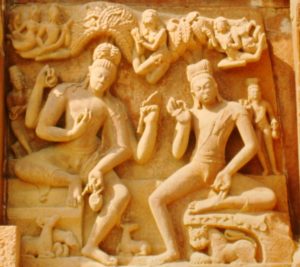
Pradip Bhattacharya, trans., The Mahabharata of Vyasa. Book 12: The Complete Shanti Parva. Part 2: Moksha-Dharma. Kolkata: Writers Workshop, 2016, 1112 pages.

In 1968 Purushottam Lal began transcreating Vyasa’s Mahabharata in free flowing English verse—indeed a mammoth enterprise. No one before him had attempted a translation of the complete epic in verse. Before his death in 2010, he had transcreated and published sixteen and a half of the eighteen books, leaving the Mokshadharma part of Shantiparva and the Anuśāsanaparva untouched. Pradip Bhattacharya took up the challenge of translating the former. This was indeed very brave of Bhattacharya as this is the toughest section of the epic, containing the essence of Vyāsan philosophy. In many ways Bhattacharya was the right person to undertake this work, given his deep and extensive study of the epic.

The book comprises a short preface, the text, and some interesting appendices: two maps, a list of stories in the Parva, and Bhattacharya’s eloquent reviews of Professor Lal’s transcreations of the Karṇaparva, Strīparva, and Shantiparva (Rājadharma). Bhattacharya’s methodology is to keep to the original syntax, translating sloka-by-sloka in free verse and prose, faithful to Lal’s objective of providing “the full ragbag version.” It is the most complete translation to date and the first in verse, conflating the editions published by the Gita Press, Aryashastra, and Haridas Siddhantavagish, cross-checked with the shorter critical edition (including the supplements), Kaliprasanna Singha’s Bengali translation (1886), and K.M. Ganguly’s first English translation (1896).

Yudhiṣṭhira, having been instructed on the principles of governance, shifts gear from Section 174 of Shantiparva (Section 168 of the Critical Edition) to ascend to the higher levels of philosophy with the question,

“O Pitamaha-grandfather, you have

spoken on auspicious

Rajadharma, the dharma of governance.

O Earth-lord, speak

now of the best dharma of ashramites!”

A series of questions follow that reveal Yudhiṣṭhira’s supremely disturbed state of mind as he tries to find solace, a method for getting over the guilt, the sorrow, and the confusion arising from the loss of all his relations and friends in the pyrrhic battle for which he holds his own greed responsible. Bhīṣma tells him everyone must try to obtain moksha, liberation, by way of detachment which can only come if one remains unaffected by worldly possessions and rises above emotions like sorrow and happiness as these are ephemeral. The true nature of the Self,     ātmajnana, must be realized to obtain liberation, which emancipates from the liability of rebirth and is the highest goal of human existence. This is the only panacea.

Easier said than done! So, for the next two hundred and one chapters, Bhīṣma holds forth on how to obtain liberation, answering myriad questions from the troubled Yudhiṣṭhira, through which the vast expanse of epic philosophy is opened up. To explain the difficult concepts involved Bhīṣma uses fifty-five engaging stories and dialogues, thus establishing a tradition to be followed by Pañcatantra, Hitopadeśa, and so on. Four additional stories from the Siddhantavagish edition and two from the Southern recension are included which Bhattacharya found during his extensive research.

Devala and Pañcaśikha’s Sāṁkhya philosophy is dealt with at length. Ignorance being the root of misfortune, knowledge of the twenty-six principles is a precondition for obtaining moksha. Yajñavalkya delineates the cosmic principles in detail to Janaka who tells Pañcaśikha’s disciple Sulabhā,

“…renunciation is the supreme

means for this moksha and

indeed from knowledge is born renunciation

which liberates.

…That supreme intelligence obtained, I

free of opposites,

here indeed, delusion gone, move free of attachment.”

Interestingly, Sulabhā takes this much deeper, saying,

“Who I am, whose I am, from where I have

come, you asked me.

…If you are free from dualities of

“This is mine,” perhaps

“This is not mine,” O ruler of Mithila,

then what need of

words like, ‘Who are you? Whose? From where?’ ”

Yoga is a necessary addendum of Sāṁkhya. Through Sāṁkhya one attains knowledge and through Yoga one attains direct perception. They are complementary and equally efficacious.

Despite the Brahmanization of the epic, it reflects considerable catholicity. One becomes a Brahmana not by birth, but by gunas and consequent karma. This Parva celebrates non- Brahmanas and women like Sulabhā, Piṅgalā and Tulādhara. Much of the Bhagavad Gita is included here, covering Karmayoga, Jñānayoga, and Rājayoga, with Bhakti as an undercurrent climaxing in the Naran    ārāyaṇiya.

The emergence of Shiva and the Nara-Nārāyaṇa duo as important deities are the salient developments. Shiva is established as a principal deity by getting a share of the offerings after destroying Dakṣa’s sacrifice. By Shiva’s boon Vyasa gets his son Śuka. Nara and Nārāyaṇa are incarnations of the Supreme Soul who defeat Rudra. Nārada has their darshan and initiates their worship as supra-Vedic deities.

Finally, Yudhisthira asks the last question of Mokshadharma Parvādhyāya, which was his first question too!

“Grandfather, the dharma relating to

the auspicious

moksha-dharma you have stated. The best

dharma for those

in the ashramas, pray tell me, Sir!”

Bhīṣma then narrates the story of the Brahmana Dharmāraṇya and Nāga Padmanābha. Moksha is obtained by uñchavṛtti (gleaning), by the grace of Shiva. Uñchavṛtti seems to be Vyasa’s favourite option for attaining moksha. He ends the Aśvamedhikaparva too with such a story.

The most important quality of any translation is its readability and authenticity. Most translations suffer from the use of extraneous verbiage and loss of material— traps which Bhattacharya has carefully avoided. Moreover, he has succeeded in communicating the meaning of concepts that are difficult to comprehend. One moves easily with the easy flow of his language. His poetry is excellent. It is rich yet simple and never causes one to stumble. It has the smooth continuation of a river and the cadence of raindrops, and that is what makes the translation so attractive. Consider:

“Wrapped in many-fold threads of delusion

self-engendered,

as a silk-worm envelopes itself, you

do not understand (329.28).”

The depth of research that has gone into this translation is very impressive. The only problem I perceived was the inclusion of “memorable shlokas,” which break the continuous flow. These perhaps were not really needed. The production of the book is excellent. The readers will be happy to see that the Writers Workshop continues Professor Lal’s innovation of handloom sari-bound production with gold-lettering in his unique calligraphy.

Major General Shekhar Sen Independent Scholar Kolkata, India

Filed Under: BOOK REVIEWS, IN THE NEWS, MAHABHARATA Tagged With: Mahabharata, Mokshadharma

Phalguna-Katha and the Yadava Hegemony

November 18, 2018 By admin

Nara-Narayana, Deogarh 5th c.AD

Kevin McGrath: Arjuna Pandava: The Double Hero in Epic Mahabharata, Orient Blackswan, 2016, pp.207, Rs. 835/-

Dr. Kevin McGrath, poet and Harvard professor of Sanskrit, engaged in fieldwork in the Kacch on kinship and migration, began investigations into the Mahabharata with his study Karna: the Sanskrit Hero in 2004. Thereafter, in Stri (2009) he switched to Vyasa’s women, following up with performance in the Mahabharata in Jaya (2011). Then, in swift succession, came his studies of Krishna (2013), Arjuna (2016) and Yudhishthira (forthcoming, though completed earlier). An irritation in the book under review is the repeated references to his study of Yudhishthira which cannot be fully appreciated as it is under publication. McGrath follows the Harvard school of epic poetics founded by Milman Parry, Gregory Nagy and Albert Bates Lord which concentrates on the text qua text and envisages epic society as a Bronze-Age-Indo-Aryan-pre-literate-pre-monetary culture.

The only other full-length study of Arjuna is the 1989 book by Ruth Katz who found him to be triple-layered as hero, human and devotee. She rejected the idea that contradictions in his character are a result of layers of composition, accepting them as indicative of the complexity of his nature.

McGrath, however, looks at Arjuna as dual in nature, uniquely godly and humanly heroic, wherein lies the secret of his cult status. He provides a fascinating appendix on Achilles who, a late Bronze Age hero like Arjuna, attained cult status by virtue of the same characteristic of bestriding two worlds, the mortal and the celestial. One might well enquire why it does not hold equally true for Bhima and Karna, shrines to both of whom exist. Well, Arjuna alone lives at length in Swarga and interacts repeatedly with the devas and Rudra-Shiva. He alone shares Indra’s seat, rides in his chariot and slaughters the demons whom the Devas cannot defeat. Achilles may interact with gods, but he never lives in Olympus. Of the others, Kunti has intimate contact with four gods, Madri with two, Karna with Indra in disguise, and Yudhishthira with Dharma as a crane and as a dog. McGrath overlooks Devavrata, brought up by celestial Ganga, taught by deva-guru Brihaspati and uniquely blessed with the supernatural gift of death-at-will.

Arjuna is defined by dualistic patterns: with Krishna (often referred to as a compound, or as the two Krishnas, or as Nara-Narayana); with Karna as his chief adversary; with Yudhishthira (as wielder of his danda, rod of chastisement); and finally in his double deaths. Further, he is uniquely ambidextrous, savyasachin. Even sexually, he is both male and neither-male-nor-female, like Ardhanarishvara Shiva, a persona in which his double is Shikhandi, born as Shiva’s boon to Drupada. McGrath finds that a similar dual pattern with Krishna and Balarama is “strangely obscured”. However, the Harivansha does develop this, which is why it is called the khila, appendix, to the epic.

McGrath’s argument is that doubling is typical of the poetic thought process of pre-literate-pre-monetary cultures while fashioning their poetry. The Iliad has similar sequences of counterpoised speakers presenting dual acts and thoughts. But is it so with the Odyssey too, whose hero has much in common with Arjuna? Such a culture’s literature operates more in terms of metaphor, barter, poetry and syntax, whereas a literate society’s favours metonymy, money, prose and grammar. “Polymorphic duality” or “twofold bivalence” lies at the core of the Arjuna narrative, reaching its acme in the Gita where Arjuna simultaneously experiences two worlds: the human and the cosmic. He is the sole liminal figure in the epic. Moreover, while here he achieves enlightenment and supposedly engages in nishkama karma, detached action, yet he is called “Bibhatsu” for his terrifying violence. Repeatedly Krishna has to shake out of depression. He even forgets the Gita, is soundly berated for it by Krishna who has to impart to him the Anugita. McGrath proposes: “This kind of polarity is an aspect profoundly inherent to both the psychic and the narrative composition of heroic Arjuna.” He suggests that perhaps there was a Phalguna–Katha (a name by which he is called whenever weapons are concerned) which was woven into the Mahabharata. But how can he argue that Arjuna is not a moral figure in the context of his repeated reluctance to proceed against his elders?

Is it not curious that this unique hero is never considered for kingship? Even more intriguing is that Bhishma does not enumerate him among the atirathis (supreme warriors) or maharathis (great warriors) but mentions him as an ordinary rathi(chariot-warrior). A similar triple ranking occurs in Book 12 of the Iliad. Yet, it is Arjuna’s grandson—whose grandmother is a Yadava—who is installed in Hastinapura. Parikshit, like Arjuna, dies twice and is resurrected. Why were the sons of the elder brothers Yudhishthira (Yaudheya) and Bhima (Sarvaga) not considered, nor his sole living son Babhruvahana who alone laid Arjuna low?

The argument that Parikshit’s investiture is “the victory of the matrilineal clan system—Pandavas—over the patrilineal model—Dhartarashtras—represent(ing) the triumph of the indigenous over the intrusive Indo-Aryan,” is founded upon the premise that Arjuna’s marriage to Subhadra “is a Dravidian type,” being matrilineal, while patrilineal marriage is Indo-Aryan. The proposition is questionable being based upon the discarded Aryan invasion hypothesis. McGrath suggests that bheda (division) between two lineage types represents two separate traditions of heroic poetry which were combined early in the 1st century CE. Evidence for substantiating this challenging notion is not produced. It is undeniable, however, that the Yadava link is crucial: through Kunti Arjuna is half-Yadava; he marries Kunti’s Yadava niece; he is devastated by the death of his son by his Yadava wife, not by those of his other two sons; the Yadava Vajra is installed in Indraprastha and Parikshit—part-Yadava in lineage—at Hastinapura. McGrath mistakenly calls Vajra Krishna’s son (p. 78, fn.10) while he is his great grandson, being Aniruddha’s son by Usha. McGrath is the first to call the Mahabharata, “the charter myth of the victorious Yadava clan,” and the Gita “a truly influential Yadava song,” statements that invite vigorous discussion. Hopefully, we will see this in the near future.

According to McGrath, Arjuna alone has sexual relations with three females of whom only one is human (Chitrangada) “and with an apsara” (p. 9). What about the human Subhadra? Moreover, Arjuna refuses to be seduced by Urvashi in Swarga. In abiding by the mortal value of regarding the ancestress of the Lunar Dynasty as a mother, despite her curse, Arjuna abjures his godly heritage from the libertine Indra. Similarly, Gilgamesh refused the advances of the goddess Ishtar, thus inviting her wrath. Arjuna is also the only one to rescue the apsara Varga and her four friends from the curse of a crocodile existence. In Tamil ballads, he is very much of an inveterate philanderer, even masquerading as a snake to seduce three princesses with the help of Krishna during this period of self-imposed exile.

McGrath is incorrect in asserting that none of the Dhartarashtras receive cult status except one temple to Duryodhana in Uttarakhand. Karna is worshipped in Netwar village of the Tons valley in Uttarakhand. Down south, a Duryodhan temple exists in Edakkad Ward (Kara) of Poruvazhy village in Kunnathoor Taluk of Kollam District, Kerala. The legend is that tracing the Pandavas in exile, Duryodhana reached Malanada hill. Tired, he went to Kaduthamsserry Kottaram, where Malanada Appoppan, the priest and ruler of the land was staying. An elderly woman gave him toddy, the customary mark of respect. He enjoyed the drink, but realized after seeing the ‘Kurathali’ worn by the woman that she belonged to an untouchable caste named ‘Kurava’. He appreciated the divinity of the place and its people who possessed supernatural powers (Siddha). Thereafter, he sat on the hill and worshipped Shiva, praying for the welfare of his people. As an act of charity, he gave away hundreds of acres of agricultural land and paddy fields as freehold to the temple. The land tax of this property is still levied in the name of ‘Duryodhanan’. The king also ensured that Gandhari, Duhshala, Karna, Drona and the other members of his family were worshipped nearby by the Kurava caste. There is a temple dedicated to Shakuni in Pavitreshwaram in the same district. Shakuni travelled with the Kauravas and when they reached the place where the temple is situated, they divided their weapons amongst themselves, whence the place came to be known as ‘Pakuteshwaram’, which later became Pavitreshwaram. Shakuni returned here after the battle and attained moksha with the blessings of Shiva and became Lord Shakuni. The other deities of the temple include Bhuvaneshwari Devi, Kiraat Murti and Nagaraj. Further, there is a Gandhari temple in Hebbya village, Nanjangud, Mysore. A Duryodhana (Periyantavar) festival enacting his death is held at T. Kuliyanur village near Dharmapuri in Tamil Nadu. Draupadi is said to have granted permission for him to be worshipped for a single day.

The half-divine nature of Arjuna, along with his celestial arms and chariot and the avatar as charioteer, makes him a hero in the ancient Indo-Aryan tradition. When he speaks to Sanjaya in the Udyoga Parva, the verse is in irregular trishtubhform, the oldest part of the epic, with frequent mention of chariots, indicative of the Bronze Age (the chariot evolved at the end of the 3rd millennium BCE). Significantly, with the spontaneous combustion of the chariot after the war, Arjuna begins to lose the superhuman qualities characterizing the old Bronze Age hero, becomes more and more mortal and even suffers death. McGrath does not explore his unheroic pettiness vis-à-vis Ekalavya, nor his obsession with Jayadratha though Drona made the inviolable discus formation. Why is he not vengeful against the seven chariot-heroes who combined to kill Abhimanyu? McGrath writes that Arjuna alone is so furious with Yudhishthira as to draw his sword to kill him, overlooking Bhima’s command to Sahadeva in the dice-game to bring fire to burn Yudhishthira’s gaming hands.

According to McGrath, Arjuna alone is able to overcome the moral dilemma of killing a guru, but so is it with Yudhishthira regarding Drona, and he suffers from the guilt throughout, expiating it through the vision of hell at the end. Equally, he is tormented by the death of Karna, unlike Arjuna. On the other hand, despite his name “Bibhatsu” (as when violating the warrior-code by cutting off Bhurishrava’s arm when he was fighting Satyaki) Arjuna rejects Krishna’s advice to lie so that Drona abandons his arms. There is also his peculiar Bhishma-like adherence to a number of vows that no one is aware of, e.g. feeling compelled to pursue the Samsaptakas despite his commitment to guard Yudhishthira against Drona’s machinations, and drawing his sword to kill Yudhishthira. These McGrath does not deal with.

In his chapter on the Gita, McGrath describes its doctrine as departing from the pastoral Bronze Age Indo-Aryan culture and approaching the “urban beliefs” of Jainism and Buddhism with their stress on puja with bhakti for salvation instead of sacrificial offerings. How this is “urban” in nature has not been explained. However, we must not forget that the doctrine-of-the-hero emerges from the interaction of a warrior duo, and that Buddha too was a Saka Kshatriya prince. The Gita’s teaching was initially imparted to King Ikshvaku, whence it became hereditary knowledge of seer-kings. The Mahabharata tells of the supreme knowledge of liberation being known only to such rajarshis whom moksha-seeking Brahmins approached for instruction. Significantly, as the Gita prepares Arjuna for the battle of Kurukshetra with the assurance that the atman does not die, so does the Anugita precede his journey protecting the dedicated horse, during which he dies and is resurrected. Why McGrath describes Ulupi here as a “spiritual figure” is not clear. This time Arjuna neither has his divine chariot, nor Krishna as charioteer. He is Nara, man, without Narayana, the Divine. At least twice the Gandiva bow drops from his hand and he is knocked unconscious.

McGrath finds it significant that Krishna announces he is Bhrigu among the maha-rishis in the context of the argument that the Bhargava community inhabiting the area around Dvaraka dominated by the Yadavas redacted the Song of Arjuna (viz. Jaya, covering the four war books), embedding it in the Mahabharata. He also suggests that the books following Kurkshetra where Arjuna is merely a “meme,” a pale copy of the earlier glorious figure, come from a different poetic tradition far removed from the original heroic one, more concerned with evoking pity and fear than horripilation and heroism. Indeed, Krishna describes Arjuna as bahusangramakarshitam, “much emaciated by battle,” on his return with the horse. Also, the picture of kingship after the Stri Parva is of an urban polity, not the earlier archaic form. This assertion requires elaboration. Arjuna, having reached his nadir against staff-wielding Abhiras, consults Vyasa who tells him that the time has come for departure, kalo gantum gatim. The last words Arjuna speaks are, kalah kalah, “time, time,” reminding us of his cosmic vision of Krishna as Kala-Time. Giving up his bow and quivers, he shrinks to the purely human and collapses silently, shorn of the duality that characterized him so memorably. Earlier, Krishna has died an ordinary, human death. In hell Arjuna mutters, “I am Arjuna” to Yudhishthira who ultimately sees him, dazzlingly brilliant, in Swarga adoring Krishna (McGrath gives the reference here as XII.4.4 which should be XVIII.4.4).

The Arjuna-Krishna duo, one semi-divine, the other born of human parents, is an archaic Indo-European “twinning” archetype that we see in Mitra and Varuna and in the Greek Castor and Pollux, Heracles and Iphicles. Vyasa tells Satyavati that he will provide Vichitravirya with sons like Mitra and Varuna while Madri has twins by the Ashvinikumaras. McGrath is mistaken in stating that Krishna receives his discus from Mitra, for it is given to him by Agni. Nor is Krishna’s bow called “Srinjaya” (p. 120); it is “Shaaranga”. McGrath proposes that Arjuna and Krishna’s bows made of horn (as their names signify) connects with the Kushanas who settled at Mathura, whence the Yadavas migrated to Dvaraka.

The origin of the “two Krishnas” is the ancient duo of Nara and Narayana who rush into our sight in the very first book during the churning of the ocean for amrita, Nara wielding a celestial bow and Narayana the Sudarshana discus, slaughtering the demons. Here Nara is the human while Narayana is the Divine. The Khandava massacre is a doubling of the same scenario with the nature of the two reversed. The Vedic deities attacking them withdraw on hearing that they are that ancient duo. In the Nara-Narayana myth narrated by Parashurama in theUdyoga Parva, Nara counters a king’s attack with deadly reeds, while Narayana remains still. McGrath does not notice that this is reversed in the Mausala Parvawhere reeds are what Krishna uses to slaughter the Yadavas. This use of reeds recurs in the Jaimini Mahabharata’s Sahasramukharavanacarita where Sita uses mantra-infused reeds to destroy the thousand-headed Ravana who has knocked down Rama. Such “twinning” is also seen in Achilles-Patroklos and Achilles-Diomedes. Like Krishna driving Arjuna’s chariot and speaking to him, Athena drives Diomedes’ chariot and talks to him.

We can see the Nara-Narayana duo represented in sculpture in the oldest Indian temple which is located in Deogarh, (circa 5th century CE). The antiquity of the Mahabharata is seen in the solitary reference to images of divinities in the Kaurava temple shaking, laughing, dancing and weeping. The first statuary found in India is Buddhist in the 3rd century BC, co-terminus with the appearance of writing. McGrath is wrong in saying that there is no reference to writing in the epic. There is explicit mention of the benefits accruing from gifting a copy of the Mahabharata.

In the very beginning, Dhritarashtra states that Narada declared to him the divinity of Arjuna and Krishna as Nara-Narayana. Then, in the Vana Parva Krishna announces that Arjuna is Nara and that they are inseparable, indistinguishable. In the Shanti Parva they speak in unison—a unique phenomenon. Thus, this epic duo replaces the Vedic Mitra-Varuna pair. At the end of the Drona Parva, Vyasa declares Narayana as a deity “older than the oldest,” born of Dharma, who deludes the world. Nara is a product of his ascesis. McGrath suggests that this duo is Dravidian in origin, turning an archaic concept of divine twins and double heroes into a later idea of conjoint deity-and-hero. To him this becomes “a perfect metaphor for how the preliterate and the literate aspects” of the Mahabharata were combined in early Gupta times. The world of the Shanti Parva “is of a historically later order of culture and society.” Indeed, in the Puranic world Narayana becomes the Supreme Being, equated with Vishnu, giving rise to Vaishnavism. McGrath further proposes that this represents a union of the Kshatriya and the Brahmin orders, of worldly puissance and ritual power. A parallel is visible in the figures of Parashurama, Drona and Kripa—all Brahmins who choose to be mighty warriors and teachers in warcraft.

A character who shares in the doubling of Arjuna and Krishna is Narada, incessantly moving through the celestial and earthly worlds and joining the past to the future through his speeches, knowing all the done and the undone in the world, loke veda kritakritam. Narada also forms a duo with his sister’s son Parvata—again a matrilineal connection. He is the first to use the term omkara(XII.325.83) and is the first to interact with Nara and Narayana, being virtually their first priest. Krishna declares that among the deva-rishis he is Narada. Like Krishna’s theophany to Arjuna, Narayana’s to Narada is hundred headed and thousand armed, vishvarupadhrik, containing all forms, divine and otherwise. As such, opines McGrath, Narada is “thoroughly imbued with that inchoate world of emergent Hinduism” representing “the poem’s own internal oral tradition,” for others recollect what he had said in the past. Vyasa— whom for some unexplained reason McGrath calls a rajarshi although he is no royal seer— and Narada shape the epic narrative “towards crisis and resolution.” Just as Narada understands Narayana and is closest to him, so is Vyasa an avatar of Narayana.

As Vyasa is to the Kuru clan, so is Narada to the Yadavas. He advises Yudhishthira, who promptly complies, to perform the rajasuya yajna. Conversely, when he advises Duryodhana in the Udyoga Parva to ally with the Pandavas, he refuses. In the Stri Parva Dhritarashtra regrets having ignored the advice of Narada and Vyasa. After advising Yudhishthira, Narada leaves for Dvaraka, reappearing during the rite, satisfied that Hari-Narayana, the Supreme Lord Self-Born, will destroy the Kshatriyas in the form of the human Krishna. Then Krishna kills Shishupala, following which Vyasa foretells the apocalyptic Kurukshetra war. It is Narada who informs Bhishma about the true gender of Shikhandin, because of which he does not fight the transvestite and dies. Just before the Gita, it is Narada who makes the renowned pronouncement: yatah krishnas tato jayah, “where is Krishna, there is victory.” Narada narrates Vyasa’s composition to the devas and summarizes the eighteen days of war for Parashurama in the Shalya Parva. The Vyasa-Narada pair informs Bhishma of Karna’s true identity and stands between the all-destructive missiles of Ashvatthama and Arjuna, speaking in unison—like Nara-Narayana—to prevent annihilation. Narada tells Yudhishthira of Karna’s deeds which are unknown elsewhere in the poem. McGrath does not mention that it is only to Narada that Krishna confesses the misery he is subjected to by the Yadavas. Narada foretells when Dhritarashtra, Gandhari, Sanjaya and Vidura will die, tells Yudhishthira of having witnessed Dhritarashtra’s death, and predicts the destruction of the Yadavas. He is, thus, part of the epic’s process of closing the bheda, alongside Vyasa who sends the Pandavas off on their last journey. Finally, it is Narada who brings about “calm of mind, all passion spent,” telling Yudhishthira, distressed on seeing Duryodhana, “This is Swarga; there is no enmity here.”

On the other hand, McGrath points out, Narada’s quoted speeches do not influence the narrative. His is thus a twofold presence: one that is effective and another that brings past oral tradition to comment on the present. His presence derives from the Puranic tradition, “indicating a late acquisition” featuring most in the Shanti and Anushasana Parvas (the latter is the richest in Bhargava material and at some time formed part of the former). He is unique in that no other character is mentioned and quoted so much. To McGrath, “He is a fine exemplum of how preliterate Mahabharata poets once functioned, as they in their performances likewise drew upon what had been formerly heard.”

McGrath asserts that there are three figures of a-temporal consciousness influencing the poem’s movement: Krishna who conducts the political narrative, Vyasa the maker of the poem, and Narada who omnisciently draws upon the past and the future to perfect the narrative. The epic is entirely retrospection and recollection, a characteristic typical of Narada. However, McGrath is mistaken when he says that the only two figures alive when the epic is being sung are Vaishampayana and Janamejaya. Vyasa is very much there, granting permission to the former to recite his composition. In the Jaiminiya Ashvamedhaparva, he grants it to Jaimini. As at the beginning, so at the end we find the statement that Narada recites the Mahabharata to the devas. For McGrath, through Narada’s performance the poem becomes an imperishable, unmatched tradition making Arjuna the epitome of the ancient heroic warrior to be worshipped.

While scholars like J.A.B.van Buitenen feel that the Virata Parva is a burlesque composed later, according to McGrath its account of chariot fighting is highly archaic, as also the scenes about Draupadi and Bhima. Unfortunately, he does not explain how. Sri Aurobindo was also of the opinion that the style here is typical of Vyasa’s style that is “bare, direct and (of) resistless strength (going) straight to the heart of all that is heroic in a man.” Vyasa, Narada and Krishna do not appear in it. More variant readings exist for this book than for any other. Is it, then, a combination of various Bharata traditions inserted after the Vana Parva?

McGrath makes a number of telling points regarding the character of the Mahabharata. The absence of reference to the Indus civilization and to Buddhism suggests a purposeful avoidance. The references to Hari and his being four-armed, to Krishna as maha-yogi, to bhakti (when such devotional practice is depicted nowhere) are all typical of classical Hinduism. Yet, Vedic figures like Indra, Agni, Surya and Rudra move easily in and out of the narrative, showing a remarkable conflation of cultures and periods. McGrath proposes that the poem supports a heroic religion that based itself on chariot warfare characterizing the old Bronze Age heroic world to express new views exemplified by the duo Arjuna-Krishna and Nara-Narayana, semi-divine and immortal. Arjuna, a late Bronze Age persona, is initiated into cosmic knowledge so that he becomes a myth of ritual devotion, connecting “as a metonym…the mortal with the supernatural,” fading out once bheda, the partition, has ended. Hence he is still worshipped. The Yadavas, the Bhargavas and the Gupta rulers changed the Mahabharata “from an old and polymorphic verbal and performative tradition to a uniform and synoptic written text.”

McGrath’s book is a fascinating slim volume that everyone interested in the Mahabharata will benefit from.

A shorter version of this review was published on 20th November 2016 in the 8th Day supplement of The Sunday Statesman.


Filed Under: BOOK REVIEWS, IN THE NEWS Tagged With: Arjuna, Mahabharata, McGrath, Yadava

JAYA by Devdutt Pattanaik

October 31, 2018 By admin

Devdutt Pattanaik: Jaya, Penguin, 350 pages, Rs. 499/-.

How shall vibrant shoots of the future come forth unless we go to our roots? That is why Janamejaya, king of Hastinapura, requests Vyasa, his ancestor, to tell him about his lineage. Retellings of Indian mythology have been many but for the first time we have a medical doctor ministering to the spirit by evoking archetypal memories through his retellings. Of his work, the most significant is this attempt to re-tell the Mahabharata in a new way.

A.K. Ramanujam spoke of 300 Ramayanas—and was taken off the Delhi University syllabus for it. There are possibly as many Mahabharatas; each of our languages with its own version, besides the Indonesian and Malayan. Retellings of it are legion, from 12-year old Samhita Arni’s to economist Bibek Deb Roy’s, but none includes glimpses of regional variations like this one which, hopefully, will not attract the ire of fundamentalists. For instance, for the horse-sacrifice; Pattanaik—like Akbar in1592 for the Razm Nama and the Bengali and Assamese Mahabharatas—follows the composition of Vyasa’s pupil Jaimini. Sensitively split into 18 chapters like the original, with a prologue and an epilogue, each has a bulleted addendum in a grey box—management manual style—providing insights, commentary and additional information. Lest the “maha”-ness of the work put off the modern reader, the style is kept simple, unpretentious and focused on communicating the significant events clearly (though calling Shiva “the great hermit” is awkward, as is “the father of the planet Mercury is the planet Jupiter”). Fine sketches by the author (assisted by his chauffer), and an attractive, reader-friendly layout enliven the read. His interpretation of the difference between “vijaya” and “jaya” is meaningful indeed: the former connotes victory over others; the latter is spiritual conquest of oneself.

A few omissions detract from the retelling’s dramatic effect, e.g. Keechak chasing Draupadi into Virat’s court and kicking her before Yudhishthir and Bhim. More important is the absence of the overarching themes that are so crucial to Vyas’ weltanschauung: Time, Desire and its fruits, the eidetic image of the cosmic tree that occurs in the Shanti Parva and the Gita. And what about the Bharata-Savitri, that unforgettable anguished cry with which Vyasa ends his great epic, asking a question which remains as pertinent today as millennia ago: “From dharma flow wealth and pleasure. Then why is dharma not practised?”

While making this very commendable effort to reach the world’s longest epic to today’s reader whose attention span is so short, misleading distortions of fact could have been avoided. Vyas’ Shakuntala is not Kalidas’ love-smitten teenager who promptly succumbs to Dushyant’s blandishments, as Pattanaik retells. She first gets him to promise that their son will inherit the throne. For the story of Chitrangada Pattanaik abandons Vyas for Rabindranath. There are departures from the original without any indication of the source for such a different account, e.g. the gods, instead of Shantanu as in Vyas, decree that Bhishma will be able to choose the time of his death. And when was he ever engaged to marry the Kashi king’s sister? It is Pandu, not Kunti, who speaks of women in olden times being promiscuous yet blameless and it is he who worships Indra for a son. Kunti never invokes any god on her own after the fiasco with Surya. All her sons are called “Partha”, not just Arjuna.

Satyavati does not elect to retire to the forest; it is Vyas who asks her to do so as “the green years of the earth are gone/do not be a witness to the suicide of your race.” How is Nanda the brother of Vasudev’s wife Rohini? It is not Balarama’s plough but his pestle (musala) that possibly became Vishnu’s club. Krishna has no role in Dhritarashtra’s giving Khandavprastha to the Pandavas. It is before and not after the burning of the forest that Agni gives Krishna and Arjuna their weapons and chariot, obtaining them from Varuna, which they use in the massacre.

The bard who listens to Vaishampayan’s recital of Vyas’s composition at the snake-sacrifice is not Romaharshan but his son Ugrashrava Sauti, who narrates it to Shaunak (not “Shonak”) and other sages. Shuk narrates it to Parikshit not “as he lay dying”, but while he ekes out the days till he is fated to die.

Bhim’s marriage with Hidimba occurs immediately after the Pandavs escape the house-of-lac, not after the killing of the ogre Bak as Pattanaik has it. Kunti is not uncomfortable with the Hidimba-Bhim marriage; actually, she welcomes it so that the friendless Pandavs obtain allies.

As precedents for Draupadi’s polyandrous marriage Yudhishthira cites Varkshi and Jatila, not Vidula. The Pandavs are not sent to Varanavata at Vidura’s instance to create a safe distance between the cousins, nor does he visit the inflammable dwelling. It is Dhritarashtra who insists the Pandavs go there to celebrate the festival of Shiv. Yudhishthira does not stake Draupadi on his own but only when Shakuni suggests it. The Brihannala-Uttara episode is not just burlesque but anticipates Arjuna’s refusal to fight and Krishna’s exhortations. If Abhimanyu married Balaram’s daughter Vatsala, then what happened to their progeny who and not still-born Parikshit should have been the successor? Parikshit’s revival occurs after the Pandavs return with the treasure of Marutta to perform the horse-sacrifice, not before it.

The account of Parikshit’s resuscitation is disappointingly drab, particularly where the original is so inspiring. Krishna performs an act-of-truth, “If have I turned away from battle; if truth and dharma are ever firm in me; if I am ever devoted to truth and Brahmins; if I have never I quarrelled with my sakha Arjuna; then, by the power of these truths, may Abhimanyu’s dead son live!” Krishna’s miraculously saving the Pandavas from the hungry Durvasa and his disciples occurs after the magical cooking vessel is given by Surya to them, not before as retold. After Ulupi resurrects the dead Arjun, there is no question of his not recognizing her. He thanks her for purifying him of the sin of killing Bhishma by devious means and sends her with Chitrangada and Babhruvahan to Hastinapur for the ashvamedha ceremony after which Yudhishthir loads his nephew with wealth.

Lakshman does not chop off Surpanakha’s breasts, but her nose. It is not Indra but Vishnu who humbles Garuda and prevents him from devouring Sumukha. Drona does not trap Pandava warriors within the wheel formation. They find it impossible to break into it. That is why they cannot follow Abhimanyu who alone knows how to enter it. Arjuna does not slice off Bhurishrava’s arm on his own but only on Krishna insisting he intervene to save the supine Satyaki. At no stage does Krishna shout “Kill him!” about Drona, certainly not after he lays down his weapons. Arjun rushes towards Dhrishtadyumna shouting in vain that he must not kill the guru. Everyone on the battlefield condemns the beheading of meditating Drona.

Pattanaik contradicts himself by writing that Krishna stands before Uttari (sic.) and prevents the unborn child from being harmed by Ashvatthama’s missile, while later he speaks of her delivering a dead child. The Mahabharata does not know of the former incident. Pattanaik attributes Markandeya’s vision of an infant on a banyan tree leaf sucking its toe, afloat on the waters of dissolution, to Arjun. Krishna’s great grandson was Vajra, not Vajranabha, a demon whom Pradyumna killed and married his daughter Prabhavati. After Krishna’s death all the Yadavas were not settled in Mathura by Arjun. He established Vajra in Indraprastha and Satyaki’s son Yauyudhani in the plain of Sarasvati.

There are several misspellings: “Vishaparva”, “Hastinapuri”, “Adiratha”, “Yudhishtira”, “Jayadhrata”, “Uttari”, “Lakshmani”, “Arshitsena”, “Vajranabhi” are not the correct names of Vrishaparva, Hastinapura, Adhiratha, Yudhishthira, Jayadratha, Arshtisena, Uttara, Lakshmana and Vajranabha.

Pattanaik enriches the proceedings by including stories from puranas and regional sources, e.g. Abhimanyu marrying Balaram’s daughter Vatsala with Ghatotkach’s help (made into a landmark film “Maya Bazar”), Krishna’s son Samba marrying Duryodhan’s daughter Lakshmana, Arjun and Krishna confronting each other over Gaya, Arjun and Hanuman at odds. He could have mentioned the Bengali “Dandi Parba” [presented on stage as “Pandab-Bijoy” by Girishchandra Ghosh] in which the Pandavas and Kauravas jointly oppose Krishna who attacks Raja Dandi for possession of a mare that is actually the apsara Urvashi. There is a similar bhakta-vs-bhagavan episode from a regional source regarding Hanuman protecting Raja Shakunt of Kashi from Rama. Krishna reprimanding Draupadi in exile for being responsible for her misery is Pattanaik’s own concoction. However, he provides a new insight by comparing Vikarna and Yuyutsu with Kumbhakarna and Vibhishan. He includes the remarkable tale of Krishna as Mohini marrying Iravan for a night before the Pandavas sacrifice him that is not known outside south India. Sensitively, he includes the fascinating tale of Bhangashvana who experienced life as male and as female and the riveting parable of the drop of honey Vidura tells that found its way into medieval biblical lore as the tale of the man in the well in Barlaam and Joshaphat. Pattanaik concludes on a profound note, evoking the lesson that anrishamsya, non-cruelty, universal compassion, is the secret of a meaningful life.

Filed Under: BOOK REVIEWS, IN THE NEWS, MAHABHARATA Tagged With: Jaya, Mahabharata, Pattanaik

Kurukshetra as Adharmakshetra: Hitler mirrors Arjuna’s thinking

October 21, 2018 By admin

Meena Arora Nayak: Evil in the Mahabharata, Oxford University Press, 2018, pp. 355, Rs. 650/-

Lately one has noticed a trend among American scholars of arguing that ancient Indian texts instead of celebrating the primacy of Dharma as the foundation of a meaningful life are actually subversive. Beginning with Emily Hudson’s Disorienting Dharma in 2013, it has been followed up by Naama Shalom’s Re-ending the Mahabharata: The rejection of Dharma in the Sanskrit epic in 2017, and in 2018 by Wendy Doniger’s Against Dharma and the book under review. One is reminded of Lytton Strachey’s debunking of Eminent Victorians by highlighting their warts.

“Where there is Dharma, there is victory,” so says the Mahabharata (henceforth, MB). Nayak, professor of English in the USA and a novelist, has marshalled a long litany of accusations to prove that MB “calls all in doubt.” Her thesis is best stated in the words of Karna (which strangely she does not quote):-

“Those who know dharma

Have always proclaimed

That dharma protects those

Who cherish dharma.

I have always cherished dharma

As best as I could.

It has harmed me.

It forsakes its bhaktas.

It protects no one.” –VIII.90.88 (The P. Lal translation)

What she chooses to overlook is Krishna’s comprehensive demolition of Karna’s claim in the very next section. Of course, she sees Krishna and the semi-divine Pandavas as metaphors created by Brahmins to absolve people from accountability for immoral acts. She sees “dharmayuddha” as a dangerous paradigm for the ends justifying the means. She claims that the (MB) has been used to exploit women and “the others” by deifying characters exemplifying unrighteous conduct; that people never realise that the Gita tradition and the narrative do not tally. She begins by making much of the long discredited Aryan invasion hypothesis propounded by Mortimer Wheeler in the 1920s. She splits this into three waves: Old (pre-5th century BCE); Middle (5th century BCE to 100 CE) and New (post 1st century CE). To this she adds a euhemeristic interpretation of the Devas being these Aryans who split from the Ahura-mazda worshippers, invaded India, demonised the indigenous people and “usurped” the wealth of these Asuras, Nagas and Rakshasas, i.e. the “others”, the Nagas being targeted as devotees of Buddha (there is no such reference in the MB). The original inhabitants were the “dasyus”, later called Asuras and assigned the Shudra caste. In that process she makes some astonishing claims such as, “the atheistic, amoral Vedic system” (despite all the hymns lauding multiple deities); the epic was first “2,400 verses” (actually 24,000); eating beef was “considered reprehensible” (the MB celebrates Rantideva  for his sacrifices of cattle so huge that the river running red with their bloody skins was named Charmanavati); there is little evidence of moksha-dharma (it is as large as the raja-dharma portion of the Shanti Parva); the Aryans moved “westward from the Indus Valley…(to) Kashmir” (the geography is puzzling); “myth is empirical truth”; The first Kaurava to fall is “Bhima”.

She asserts that the Vedic ethical “rita” (she has just called the Vedas amoral) was replaced by a theistic, “desire-oriented concept of purushartha” in the MB and that dharma “subverts” the cosmic rita to “a wholly earthly scheme.” By extolling sacrifices, the MB “promote(d) violence against the ‘other’…resurrected evil practices that the system had already expunged.” This in the face of constant exhortations to pursue righteous conduct, as it leads to Svarga, and non-attachment leading to moksha. She refers to M.N.Dutt (1934) while the bibliography has “P.N.Dutt”. There are Sanskrit spelling mistakes: “Shanti” with both vowels elongated instead of only the first; “daivya” where “daiva” is meant; “mahatamaya” instead of “mahatmya”, “vasva” instead of “vasava”; “asidharavrata” is not “fine-edged as an arrow” but “sharp as a swordblade”. Despite being a professor of English she uses peculiar words like “egoity”, “capsuled”, “intestine feuds”, “slayed”. What happened to the editors of OUP (India)?

Nayak takes flagrant liberties with the text, possibly presuming that the general reader will accept her assertions as facts. The snake sacrifice is “diabolic” because it is “necrophilic” (coitus with corpses of snakes?). In the Uttanka story he is said to create fire from the “horse’s nostrils” whereas smoke issues on blowing into its anus. She turns the moon and soma into the “lunar earth goddess slandered as Nirrti”, whereas it is always a male deity. In the myth of Garuda she interprets the slavery of Vinata as the time the Aryans took to replace indigenous female deities by their solar male gods, although her slavery is to her co-wife Kadru, not to any male. She has Gandhari abort herself by hitting her belly “with an iron rod” which is nowhere in the text.. Nayak invents this to link up with the iron bolt causing the destruction of the Yadavas and, more far-fetched, as “a reversal of Eliade’s sacred pole symbolism” of consecration. She misquotes the Vana Parva where Markandeya does not tell Yudhishthira in the first person that he will create a new yuga, but that Kalki will do so. There is no use of the first person singular in the passage at all. When Brihaspati rapes his sister-in-law Mamata, he does not curse her but the son in her womb to be born blind.

The logic followed is also flawed: following dharma means doing good; the idea of goodness leads to attachment (why?) i.e. ignorance and therefore to evil! Since nishkama karma has liberation as the goal, it injures those in relationships, which is adharma! She ought to have paid attention to the story of how Shuka attains moksha. She asserts that by linking detached action with accomplishing wealth and pleasure “an ethical trap” was created. A person was encouraged to enjoy worldly life while karmic life condemned it. The only solution is to cease to act, or to follow desireless action, both being impossible.

Nayak makes an excellent point that while the ethics envisage pursuit of four-fold “purushartha” (dharma, artha, kama, moksha), morality is left to the individual and is situational. It is more “apad-dharma” being practised—when anything is justifiable for saving one’s life and property—than a Hegelian adherence to a superordinate goodness. However, her definition of morality as “what is done” as opposed to ethics which is “what ought to be done” is questionable. Further, she holds, the MB hardly follows the tenets of the Gita, which, along with the didactic Shanti and Anushasana Parvas, were interpolations. The concept of Karma she finds realized not in the Pandavas but in the Kauravas, and that the former are held accountable, condemned to suffer after the war while Duryodhana goes to Svarga. The Pandavas are morally depraved, killing cousins “for wealth on sanctimonious grounds”. So Duryodhana’s attempts to murder them and cheat them of their inheritance are above board. Nayak finds that the MB has deepened the differences between traditional beliefs leading to creation of “morally corrupt customary laws” and “societal inequities”. Further, with no evidence she asserts that the Shaivic elements (Shiva’s presence is quite significant) are “all later interpolations”. Arjuna’s acts in Khandava forest are heinous, being purposeless violence, while Ashvatthama’s nocturnal massacre of sleepers is avenging his father and fighting for victory. In his condemnation Nayak sees Vaishnava condemnation of Shaivism, and the epic’s bias justifying violence by Krishna and his followers as necessary. To her, Shishupala is another Shaiva and Shiva’s collaboration with Krishna and Arjuna is an interpolation, for which no evidence is advanced. Arjuna’s release of the Brahmashiras to counter Ashvatthama’s makes him culpable as “it reeks of abuse of power” reflecting “how Vaishnavas behaved whenever they gained advantage.”

Nayak even misreads the epic as when claiming that Bhishma refuses to let Karna fight being jealous that he may turn out to be the greater warrior. The reason is very clearly stated by Bhishma from his bed of arrows to Karna. Karna, she claims, was only paying Draupadi back for humiliating him although he brought down the mark in her svayamvara. Actually, he never shot the arrows, nor does Draupadi ever insult Duryodhana as “the blind son of a blind father”. Krishna’s violence in response to Shishupala’s abuses “is shocking; no mythical justification…excuses it.” Duryodhana, she finds, has no free will to change his karma and, therefore, no matter what he does he is condemned as evil! That flies in the face of his deliberate machinations from adolescence to destroy his cousins. For Nayak, despite his adharmas, he is distinguished by “secularity” and “purusharthic dharma” in pursuing dharma, wealth and pleasure. But where is his pursuit of dharma and secularism seen? Duryodhana, she asserts, is portrayed as “a warrior supreme” but never Arjuna. Duryodhana is “aghast” at Yudhishthira staking Draupadi. Bhasa portrays the true nobility of Duryodhana not the Brahmin-redacted MB. Is all this not special pleading? Finally, “Krishna not only makes the victory of dharma imperfect, he also makes the dharmakshetra an adharmakshetra.” In teaching society how to act the MB tradition fails because its “exemplars of dharma…are deeply deficient dharma heroes.”

As dharma is ambiguous the characters are guided not by universal ideals but by their relationships. Universal good being fought for would be dharmayuddha—but that is not so. In this, Nayak overlooks the very reason for the war having been structured to relieve the earth sinking under the burden of oppressive rulers. She argues it is a war against a previous form of dharma by the new Vaishnavism. She asserts that by epic times animal sacrifice was seen as adharmic vide ahimsa paramo dharma. The repeated emphasis placed on this implies the existence of widespread violence and leads to sanction of himsa as “good violence”! Violence being approved in emergencies, the idea of goodness was in flux then as now. She posits a clash between the ethics of Kshatriya conduct justifying lying and morality whereby such action is immoral and lands one in Naraka. Arjuna fails to resolve his moral dilemma: he will not kill Drona, hesitates to kill Bhishma and grieves for Abhimanyu, failing to sunder his relationships of self. He does gain freedom from doubt and the victory of unequivocal dharma. Unquestioning practice of inherited traditions like varnashrama led to varna-based dharmayuddhas against peoples beyond the vedic fold named by Bhishma and Karna. Nayak confuses race with caste in asserting that the concept of ‘the other’ was based on people’s birth, whereas it is clearly those following non-Vedic practices. She even says, “Hitler’s words almost mirror Arjuna’s warning about deterioration of Aryanism” from miscegenation (p. 292) and equates Nazis with twice-born Hindus perpetrating violence upon lower castes. Sectarian violence based upon religion is another facet of Nayak’s dharmayuddha e.g. Vaishnavism vs. Shavism and Shramanic traditions.

Nayak finds that the MB proves that claim to ownership can cause dharmayuddha (cf. Kunti’s advice to her sons via Krishna). The question of who is the legitimate ruler of Hastinapura remains unresolved, hence the Pandava claim to dharmayuddha is negated. Further, for the Pandavas the end justifies the means: “just the fact that the Pandavas destroy the peace and happiness of an entire land proves that their yuddha is an adharmayuddha.” (p. 309). Bhishma’s advice to Yudhishthira never to forgive an enemy plunges people into a cycle of endless wars, almost wiping out a race or community: “The whole MB war is a series of so many blood feuds that it reduces the ideology of a dharma war to gratuitous war-mongering.” The code of conduct in war laid down by Bhishma is constantly violated. Nayak quotes Cicero in “Pro Milone”: silent enim lēgēs inter arma— silent is law during war. What Kautilya recommends is what both Kauravas and Pandavas practise. Nayak’s presentation of this is very interesting, specially breaking the enemy by ruining his reputation (constantly condemning Duryodhana as wicked) and spreading rumours about one’s own power e.g. Pandavas being born of gods, Krishna’s divinity.

Finally, Nayak points out that the MB is an allegory of the yuddha of the self, destroying the baser impulses for self-realization. It is the only MB tradition that succeeds. Opponents disguise themselves as goodness, hence the need of deceit to destroy them. Preserve the Higher Self by destroying the baser self. The violence is figurative. War is a metaphor acting “as a catalytic goad to elicit deep questioning about moral and immoral behaviour.” In that case, is it a parallel “Pilgrim’s Progress”? Duryodana is evil because he knows only his social self, has no internal life. Only after winning the internal war should the external war be undertaken, otherwise it will have an evil causality injurious to self and others. The victories will be those of the lower self. Conflict with desire is yuddha.

The greatest tragedy, according to Nayak, is that when clear guidance is needed the MB tradition supplies ambiguities leading to confusion but no clear answers. However, its internal war is relevant today to lead everyman to victory over the lower self. Actually it convolutes the path. Thus, “the dharmayuddha of the Mahabhrata fails in its practicability…The only tradition the Mahabharata actually institutes is one that makes enquiry customary.” As Dharma is subtle, only the consequence of conduct reveals whether it is right or wrong and this is often different from the expectations of the agents. Not only are their intentions unrealized but the ideologies are also not uniform or absolute. Incomplete executions of good and evil action create paradoxes. The MB provides not answers but ways of contextualizing enquiry according to place, time and circumstance.

Nayak plots the evolving thought through the example of Vritra, an evil power withholding waters in the Rig Veda, but in the MB a Brahmin whose murder is condemned. Nahusha asks gods why they did not stop Indra from cruel and vicious deeds. He even says Vedic hymns are not authentic. Nothing was sacrosanct during the melting pot situation when social changes were occurring. There was conflict between old Vedic dharma and the new Krishna-ized dharma. The Purusharthic goals of artha and kama are misused for selfish gain because dharma’s parameters were flexible. Misogyny is disguised as wisdom when Bhishma denounces women as sunk in tamas who stupefy men, objectifying them as to be blamed for men’s immorality.

The MB calls itself “collyrium” which is the wisdom of questioning what is right and wrong, eradicating the ignorance of narrow-mindedness. It created a tradition of fluid enquiry to question evils in every era. Its becoming a Shastra stopped its evolution. Nayak argues the necessity “to re-examine the text as a chronicle of its time…not binding traditions but metaphors of enquiry into the changeable human condition.”

Filed Under: BOOK REVIEWS, IN THE NEWS, MAHABHARATA Tagged With: Book Reviews, Mahabharata

  • « Go to Previous Page
  • Page 1
  • Page 2
  • Page 3
  • Page 4
  • Page 5
  • Page 6
  • Page 7
  • Go to Next Page »

Footer

Recent Posts

  • MEMORY OF 15TH AUGUST 1947
  • A.R.Orage on The Mahabharata
  • POLICE FIRING AT ISLAMPUR IN MURSHIDABAD DISTRICT

Tags

Bangladesh Bankimchandra Bengali Bhishma Book Reviews Bulcke Critical Edition Desire Dharma Draupadi Draupadi Dream Trust Drona Essays glb Grantha script Harivansha Hiltebeitel Homer Indraprastha Jaimini Jaiminiya Mahabharata. Journal Kalpataru Karna Kavi Sanjay krishna Mahabharata McGrath memoir Mokshadharma Murshidabad News novel P. Lal Panchakanya Ramayana refugee Satya Chaitanya shakuni Sri Aurobindo Statesman Vande Mataram video Vyasa Yudhishthira

Follow Me

  • Facebook
  • Linked In
  • Twitter

CONTACT ME

Search

Archives

  • June 2026 (1)
  • April 2026 (1)
  • February 2026 (2)
  • December 2025 (1)
  • November 2025 (1)
  • October 2025 (1)
  • July 2025 (1)
  • June 2025 (1)
  • May 2025 (1)
  • September 2024 (3)
  • May 2024 (3)
  • February 2024 (1)
  • October 2023 (2)
  • September 2023 (1)
  • March 2023 (4)
  • February 2023 (1)
  • January 2023 (1)
  • September 2022 (1)
  • August 2022 (2)
  • July 2022 (1)
  • June 2022 (2)
  • February 2022 (1)
  • January 2022 (2)
  • November 2021 (1)
  • September 2021 (5)
  • January 2021 (2)
  • December 2020 (1)
  • September 2020 (1)
  • July 2020 (3)
  • June 2020 (1)
  • March 2020 (1)
  • January 2020 (2)
  • December 2019 (13)
  • October 2019 (1)
  • September 2019 (1)
  • August 2019 (2)
  • April 2019 (2)
  • March 2019 (4)
  • February 2019 (1)
  • January 2019 (2)
  • December 2018 (1)
  • November 2018 (4)
  • October 2018 (2)
  • September 2018 (2)
  • August 2018 (4)
  • July 2018 (4)
  • June 2018 (5)
  • April 2018 (3)
  • March 2018 (2)
  • February 2018 (1)
  • January 2018 (1)
  • November 2017 (2)
  • October 2017 (7)
  • August 2017 (1)
  • July 2017 (2)
  • June 2017 (11)
  • May 2017 (19)

Copyright © 2026 Dr. Pradip Bhattacharya