• Skip to main content
  • Skip to footer

Pradip Bhattacharya

Indologist, Mahabharata scholar

  • BOOKS
    • MAHABHARATA
      • The Mahabharata of Vyasa – Moksha Dharma Parva
      • The Jaiminiya Mahabharata
      • The Jaiminiya Ashvamedhaparva
      • The Secret of the Mahabharata
      • Themes & Structure in the Mahabharata
      • The Mahabharata TV film Script: A Long Critique
      • YAJNASENI: The Story Of Draupadi
      • Pancha Kanya: the five virgins of India’s Epics
      • Revisiting the Panchakanyas
      • Narrative Art in the Mahabharata—the Adi Parva
      • Prachin Bharatey ebong Mahabharatey Netritva O Kshamatar Byabahar
    • LITERATURE
      • Ruskin’s Unto This Last: A Critical Edition
      • TS Eliot – The Sacred Wood, A Dissertation
      • Bankimchandra Chatterjee’s Krishna Charitra
      • Shivaji Sawant’s Mrityunjaya: A Long Critique
      • Subodh Ghosh’s Bharat Prem Katha
      • Parashuram’s Puranic Tales for Cynical People
    • PUBLIC ADMINISTRATION & MANAGEMENT
      • Leadership & Power: Ethical Explorations
      • Human Values: The Tagorean Panorama
      • Edited Administrative Training Institute Monographs 1-20. Kolkata. 2005-9
      • Edited Samsad Series on Public Administration. Kolkata, 2007-8
    • COMICS
      • KARTTIKEYA
      • The Monkey Prince
    • HOMEOPATHY
      • A New Approach to Homoeopathic Treatment
  • BOOK REVIEWS
    • Reviews in The Statesman
      • Review : Rajesh M. Iyer: Evading the Shadows
      • Review : Bibek DebRoy: The Mahabharata, volume 7
      • Review :The Harivansha – The Significance of a Neglected Text
      • Review : Battle, Bards and Brahmins ed. John Brockington
      • Review : Heroic Krishna. Friendship in epic Mahabharata
      • Review : I Was Born for Valour, I Was Born to Achieve Glory
      • Review : The Complete Virata and Udyoga Parvas of the Mahabharata
      • Review : Revolutionizing Ancient History: The Case of Israel and Christianity
    • Reviews in BIBLIO
    • Reviews in INDIAN REVIEW OF BOOKS And THE BOOK REVIEW New Delhi
    • Reviews in INDIAN BOOK CHRONICLE (MONTHLY JOURNAL ABOUT BOOKS AND COMMUNICATION ARTS)
  • JOURNALS
    • MANUSHI
    • MOTHER INDIA
    • JOURNAL OF HUMAN VALUES
    • WEST BENGAL
    • BHANDAAR
    • THE ADMINSTRATOR
    • INDIAN RAILWAYS MAGAZINE
    • WORLD HEALTH FORUM, WORLD HEALTH ORGANIZATION, GENEVA
    • INDIA INTERNATIONAL CENTRE QUARTERLY
    • ACTUALITIES EN ANALYSE TRANSACTIONNELLE
    • THE HERITAGE
    • TASI DARSHAN
  • STORIES, ESSAYS & POSTS
    • Chakravyuha by Manoranjan Bhattacharya
    • The Head Clerk. A short story.
    • BANGLADESH NEW-BORN: A MEMOIR
  • GALLERY
  • PROFILE
    • About the Author
    • IN THE NEWS
      • Epic discovery: City scholars find lost Mahabharata in Chennai library – The Times of India (Kolkata)

Mahabharata

Raja Yudhishthira by Kevin McGrath

January 15, 2018 By admin

“Because he ranjita-delighted

all his people,

he was called a raja.”

Models of Monarchy in the Mahabharata[1]

“There was a raja named Uparicara, a dharma-following monarch, fond of hunting,”[2] is how Vaishampayana begins the detailed recital of his guru Vyasa’s Mahabharata (MB) at Janamejaya’s request, striking what McGrath regards as the keynote of the epic: kingship. Buddhadeb Basu was the first to argue that Yudhishthira, not Krishna or Arjuna, was the protagonist of the MB in Mohabharoter Kotha (1974), Englished by Sujit Mukherjee as The Story of Yudhishthira (1986). McGrath’s sixth book on the MB studies Yudhishthira as a model of dualistic monarchy, shared with Krishna and his brothers, in a “pre-Hindu,” pre-monetary, pre-literate Bronze Age society of the first millennium BC. This monarchy, based upon agreement of the family, the clan and the people, is juxtaposed with the Shanti Parva’s paradigm of autarchy (“more classical, early Hinduism”). McGrath strongly feels that it is Mauryan and, even more so, Gupta epitomes of kingship that are represented here. Vaishampayana ends saying that this “itihasa” named Jaya is to be heard by one who desires to rule the earth. The epic, therefore, is focussed on kingship.

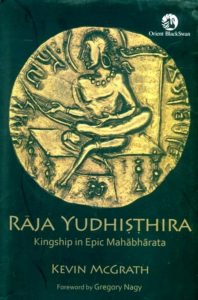
McGrath also explores how pre-literacy is portrayed, again dually. Externally, there is the drama of recitation before an audience; internally, the narrative of Yudhishthira’s kinship group which is the foundation for preliterate poetry. The great variations in style are evidence of different poetic traditions that are amalgamated into a single vast poem: Vedic, pre-Hindu, Hindu, Jain, and Buddhist. McGrath believes that MB became a written text in the time of Samudragupta, which is why a coin of that king features on the cover. However, he falls into the trap of believing that one person could not have composed the MB. What about the enormous output of Isaac Asimov in almost all branches of knowledge in modern times and of Shakespeare in the past with wide stylistic variations?

In a time long long ago north of the Vindhyas lived communities who for protection chose from among Kshatriya families a ruler. The Shanti Parva chapters 57, 59, 67 have this to say:-

tena dharmottaraś cāyaṁ kr̥to loko mahātmanā /

rañjitāś ca prajāḥ sarvās tena rājeti śabdyate //

That mahatma ensured

the sway of dharma

in the world.

Because he ranjita-delighted

all his people,

he was called a raja.


First find a raja.

Then get a wife.

Then wealth, they say.

Without a raja—

Your wife and wealth,

What good are they?


There is only one Sanatana Dharma

for a raja

who wishes to rule a kingdom:

the welfare of his subjects.

Such welfare

preserves the world.

The raja drew his authority from the people who, in return for his protection, gave him one fiftieth of their animals and gold, a tenth of their grain and the loveliest of their daughters (Shanti Parva, 67.23-24). It was a time when money did not exist and writing was unknown. Wealth acquired by the raja consisting of precious metals, gems, cattle, but not land, was distributed by him during yagyas and other ceremonies. Succession to the throne was not by primogeniture alone and needed ratification by the people.

For instance, Bharata disinherited his nine sons finding them unfit to rule and adopted the Brahmin Bharadvaja as his successor, naming him Vitatha. Yati, Nahusha’s eldest son, was not his successor but the younger Yayati. Yayati had to explain to the people why he gave the throne to his youngest son Puru. Brahmins did not agree to enthrone Pratipa’s eldest son Devapi who became a sanyasi. So the youngest, Shantanu, became king.  Again, it was Vichitravirya’s younger son Pandu who was made king.

McGrath makes out a strong case for the MB being about the establishment of Yadava hegemony ( pointed out in 2002 in my paper “Leadership and Managing Power: Insights from the Mahabharata”). The displacement of Yayati’s eldest son Yadu in favour of the youngest Puru comes full circle. However, it is not “a son of Krishna” (an error repeated twice) who becomes king at Indraprastha, but his great grandson Vajra, while his sister’s grandson rules at Hastinapura. McGrath expands this idea to envisage a conflict in which a matriline defeats a patriline. Actually, it is Satyavati’s line that is displaced by her daughter-in-law Kunti’s. McGrath appears to be supporting the idea that the matriline represents “indigenous” Dravidian traditions that defeat “intrusive” Indo-Aryans. Thankfully, he refrains from stepping further into this morass.

We find here a new insight: royal authority is portrayed as dualistic, being shared by Yudhishthira with Krishna in both the major rituals of rajasuya and ashvamedha. Before that, authority is shared between Satyavati, Bhishma and Vyasa. Royal power depends upon support of the community who are represented in the group of ministers chosen from all four classes. Yudhishthira’s is also a fraternal kingship shared with his brothers and even with Dhritarashtra. Thus, after Karna is dead, Yudhishthira tells Krishna that now he is raja of the world along with his brothers. McGrath pertinently points out that “kingdom” has its origins in the Old English “cyn” standing for “kin” and means “the situation or location of kinship” which does not connote rule by one person, which is the model Bhishma presents in the Shanti Parva.

When Vyasa is called “brahmarshi kavih” McGrath has problems finding an English equivalent for “rishi”. Not happy with “wizard” he leans towards “shaman”. The Oxford English Dictionary glosses “rishi” as “A Hindu sage or saint”. The exact equivalent would be “seer” in the sense that MB uses it. The “kavi” is a seer-poet.

Shantanu is the only one called “adhiraja”, superior monarch. This is significant because it is the dynasty of his step-father with which Vyasa is concerned, having been inserted into it by his mother to carry it forward. The royalty of the bloodline, therefore, becomes dubious, particularly when Pandu’s wives gets sons from multiple devas. It is interesting that McGrath does not examine this aspect of Yudhishthira’s claim, despite Duryodhana questioning it bluntly. The need for the people’s acquiescence to legitimise the kingship seems to be more implicit than voiced explicitly. McGrath overlooks that Yayati has to explain to the people why he is choosing his youngest son. However, we do not see Shantanu doing the same in the case of Devavrata, nor do the people protest. They only object vociferously when the Pandavas are exiled, but this carries no weight with Duryodhana who appears to represent the “later” type of autocrat, though not a tyrant since the people tell Dhritarashtra they were happy under his reign. The installing of Yudhishthira as crown-prince requires no consent from the public. Their applauding him is not evidence of public opinion featuring as a crucial element in making that decision as McGrath asserts. When he refers to Krishna in his peace-embassy appealing to the kings in the assembly to speak as evidence that Dhritarashtra has to heed the “sangha”, this would be because that is the mode of governance obtaining among the Yadavas. No one in the court responds to this appeal, because the modality of Hastinapura’s monarchy does not envisage such consultative rule. Duryodhana is not bothered about Krishna’s exhortation to behave so that the great warriors install him as crown-prince. He successfully asserts his right singly.

The dharma of a raja had three qualities: punishing, protecting, donating. He rules, as Kunti tells Krishna, by conciliation, giving gifts, causing division, using force and strategy. Yudhishthira always speaks in terms of not just himself but always including his brothers (the most significant being sharing a wife). All decision-making is fraternal for him, except for the game of dice twice over.

Krishna is referred to as sanghamukhyo, leader of the association. According to V.S. Agrawala, in Panini’s time the Bharatas’ profession was ayudhajivin (weaponry) and they lived as a sangha. The MB seems to be showing political systems changing from an oligarchic sangha and a kinship type of rule to absolute monarchy. Neither Parikshit as full-fledged monarch nor Janamejaya shares power with anyone. The Yadavas end up with Krishna’s great grandson Vajra ruling in Indraprastha, and the sons of Satyaki and Kritavarma ruling in nearby kingdoms.

McGrath argues that three forms of time coalesce in the MB. There is the recalled pre-monetary, pre-literate time of sanghas; the time poetry creates representing an ideal; and both are conveyed through the time of actual performance. Thus there is “a compounding of the historical, the mythical and the performative which coalesce into a single instance or event that has been simply transmitted and then recorded in our present text of the poem.” An impressive thesis indeed.

A very interesting proposition in the book is that Parashurama’s genocide of Kshatriyas might represent destruction of Buddhist kingdoms east of the Ganga-Yamuna doab. But where is the evidence for this? J. Bronkhorst proposed that the MB’s earliest written text is from the time when Brahmanism was imposing itself on eastern regions viz. Magadha. The Bhargava Brahmins, whose tales feature prominently in the MB, would have been linked to this expansion.

It is not clear why the MB should be recalling “an imagined former era” of war-chariots, when Persian armies used them against Alexander. Nor is there a shift away from the Rigvedic sacrifice which remains central to the MB. In the Shanti Parva, however, other ways of achieving liberation are described such as Sankhya and Yoga. Ritual sacrifice is even shown as of no consequence compared to the life of unchavritti (gleaning). These, as McGrath writes, could certainly be a response to Buddhism and Jainism. There are references to caityas (funeral monuments) and edukas (ossuaries) in the kingdom of Gaya. Bhurishrava is said to be meditating on mahopanishadam and engaged in yoga. The earliest Upanishads are dated to the middle of the first millennium BC. McGrath points out that Arjuna’s sword is described as akashanibham (blue like the sky). This is the wootz steel which was produced in North India in the 3rd century BC. Further, prior to the battle Uluka refers to the rite of weapon-worship (lohabhihara). Loha means “coppery, red.” McGrath interprets this as indicating bronze weaponry, thus bolstering his thesis about this being a bronze-age heroic culture.

A significant point is that the term chakravartin, turner-of-the-wheel, is only applied to ancient rulers, never to Yudhishthira, who, therefore, was never given the status of an emperor despite the rajasuya yagya. When finally installed at Hastinapura, he is called patim prithvyah, lord of the earth. Other terms used are mahipati, nripa, bhumipa, narendra, nareshvara, synonymous with “raja”. Chakravartin is a term that was used by Buddhists and Jains, particularly in the Andhra region along the Krishna River.

There is a curious incident usually overlooked which McGrath points out as an indication that kingship was oligarchic. After the Pandavas have been exiled, Duryodhana, Karna and Shakuni offer the kingdom to Drona considering him as protector, ignoring Dhritarashtra and Bhishma who appears nowhere at the close of the Sabha Parva. Where is the consent of the public? This recurs when Duryodhana, rescued by Pandavas from the Gandharvas, offers the kingship to Duhshasana. McGrath proposes that this is the consequence of the rajasuya having gone wrong so that royal authority seems to have become mobile. The Udyoga Parva has the subjects discussing Duryodhana’s destructive thoughtlessness (as citizens do in Shakespeare’s plays), a feature that never occurs in the type of kingdom Bhishma describes in the Shanti Parva. The mobile nature of kingship is seen when Karna tells Krishna that Yudhishthira would not accept the kingdom were he to know about Karna’s birth. Gandhari, however, is quite categorical that the Kuru kingdom passes by succession. The rajasuya instead of making kingship permanent for Yudhishthira completely upsets it. The MB seems to be presenting different claims to kingship without projecting a single model. It is subject to family, kinship, the clan, the public etc.

The king’s primary duty is as a sacrificer, which McGrath analyses at length. The primary model is Indra, shatakratu (performer of a hundred sacrifices) the rain-bringer, promoting fertility. Satyavati urges Vyasa to provide a successor to the throne as a kingless kingdom gets no rain. As an offshoot of this, in old age the king finally takes to the forest as a renunciant, which does not form part of the paradigm of the later “classical” model of monarchy where he rules till death.

Besides the pattern of the displaced eldest son in the line of succession, there is the feature of sons being born to queens not from their husbands (Ambika, Ambalika, Kunti, Madri). Further, the earliest kings did not take princesses as wives. Yayati has sons from Brahmin and Asura women; Uparichara from Girika, a riverine woman; Shantanu from Ganga and Satyavati, both riverine women. Only in subsequent times we find the practice of restricting the choice to royal families.

McGrath is mistaken in stating that during Pandu’s rule Dhritarashtra declares Yudhishthira’s right of succession. By the time Duryodhana is born—which is the context of Dhritarashtra’s comment—Pandu  has long given up the throne to his elder brother, retreated to the Himalayas, been cursed by the deer-sage and has persuaded Kunti to beget a son by the god Dharma. It is interesting that Yudhishthira is referred to as “ajatashatru” (whose foes are unborn), since this is name of Bimbisara’s son (491 BC) who killed his father and founded Pataliputra. It is not a name shared with Ashoka’s father, as McGrath states, who was Bindusara. Both expanded the Magadha kingdom considerably. Without conquering Magadha, Yudhishthira cannot become samraj (emperor). There is a historical memory here.

Regarding the dice game, McGrath quotes Yudhishthira as having vowed never to refuse a challenge, which overturns the “fraternal kingship” paradigm. He seeks to cover this in a footnote pointing out that on the second occasion all the Pandavas were invited, not just Yudhishthira. He observes that while Draupadi was treated contemptuously, “there is no overt violence and a certain etiquette is observed.” What about being dragged by the hair and sought to be stripped naked?

McGrath points out a fact that has been overlooked by others: Krishna’s report to Yudhishthira about what Dhritarashtra and Gandhari said supporting his rightful claim to the throne do not tally with what we have heard in the Hastinapura court! Similarly, Krishna’s report to Uttanka and to Vasudeva about the events of the war differ significantly from what Sanjaya has reported. Why?

Another interesting sidelight is provided: Karna tells Krishna that Brahmins will recount the Mahabharata sacrifice. Why not the half-kshatriya sutas? This hints at the Bhargava redaction of the epic.

Yudhishthira is said to have been guilty of lying only once although there is a series of lies all the brothers tell Virata. A very rare example of the fury Yudhishthira is capable of even against his own family is the curse he lays upon all women after finding out that Karna was his elder brother. In his aversion for the kingdom his parallel is Balarama who avoids the war. Yudhishthira’s renunciant bent has parallels in Buddhism and Jainism. In the Shanti Parva he uses a metaphor to describe worldly predicament which Shakespeare’s King Lear repeats: “Thus on this various wheel of samsara, like a chariot wheel…” A similar disgust for the kingdom won by slaughtering kinfolk is voiced by Arjuna the perfect kshatriya in the Ashvamedha Parva.

McGrath holds that Vyasa is older than Bhishma and is not mortal. The timeline does not indicate that. Devavrata is returned to Shantanu as a teenager. Four years after that Shantanu weds Matsyagandha who has given birth to Vyasa earlier. Vyasa would be around the same age as Bhishma. Further, he is definitely mortal, not chiranjivi like Ashvatthama and Kripa. He is divine only in the sense that much later he tells his disciples that he is an avatara of Narayana.

On page 107 there is a curious error: “Shalya’s driver is killed by Kripa”. This is a good example of the sort of mistake the editors of the critical edition made by ignoring logic to follow blindly the maximum manuscripts agreeing with the Sharada script version. It is Bhima who does this, following up by killing the horses and cutting away Shalya’s breastplate. Further, though displeased, Yudhishthira does not reprimand Bhima for kicking prone Duryodhana’s head, despite being urged by Krishna who does not justify this act as McGrath has it (p.108). Rather, Yudhishthira justifies Bhima’s kicking.

It is good to find McGrath speculating about why the movement of the narrative was impeded by introducing the didacticism of the Shanti, Anushasana and Anugita portions instead of peremptorily rejecting them as interpolations. It is necessary to find out what possibly motivated the redacteurs to do this, and how it happened. Why stitch together such widely divergent types of poetry? This could only happen in a literate period.

The manner in which Vyasa exhorts Yudhishthira to be king-like and emerge from depression by drawing upon traditions of ancient monarchy can be seen in the Old English poems “Deor’s Lament” and “The Wanderer”. McGrath compares this to the Gupta dynasty seeking to revive the ashvamedha rite to legitimise power and using the MB recital for this purpose. Why should we not see this as valid for the revival five centuries before that by Pushyamitra Shunga, a Brahmin general who assassinated his king and attacked Buddhists? The wrongs a raja commits are said to be removed by performing such yagyas and distributing donations.

The archaic nature of MB culture is further exemplified by the absence of icons of deities. There is just a solitary mention of images of devas shaking, laughing, dancing, weeping before Bhishma’s fall. Yet, McGrath mentions Yudhishthira offering puja to deities before entering his palace after investiture. The first statues come in Ashoka’s time and are of animals and yakshas. In the late Shunga period (the closing years BCE), we find decorative sculptures depicting human and mythical figures. The MB makes no references to worship of deities in homes or temples or to building of memorials. McGrath opines, “This is because stone sculpture at that time was a solely Buddhist or Jaina phenomenon.”

McGrath points out what is seldom realised, viz. that the warrior’s way, kshatradharma, is first spoken of by Hanuman and is similar to the catalogue in Arthashastra. The raja’s dharma is first enunciated by Narada at the beginning of the Sabha Parva. The Gita does not touch upon this, being directed solely at the hero. McGrath examines three instances when Yudhishthira is advised in practical terms how to function as a raja. Arjuna propounds practical tenets of governance; Draupadi holds forth on what is to be done in crisis; Yudhishthira has his own craving for liberation of the spirit. There is no mention of any ministers counselling him in Hastinapura. This characterises Bhishma’s picture of kingship. However, it overlooks the episode in the Adi Parva where the Machiavellian counsellor Kanika expounds his niti to Dhritarashtra for getting rid of the Pandavas.

McGrath argues that the shift in oligarchic monarchy of the earlier books to a single person’s rule in the Shanti Parva is matched by development of a pre-monetary barter economy into one where currency is exchanged for goods. This is the time dominated by Jain and Buddhist merchant classes when fraternal kingship is replaced by autarchic rule. It is also the time of urbanisation when coins gradually replace land, agricultural produce and cattle as mediums of exchange. The lack of mention of coinage in the Shanti Parva is explained away as because it is describing a mythical time, “blurring historic and poetic reality.” That is not a satisfactory explanation and undermines the argument.

When McGrath believes that the culture MB depicts is primarily a pre-monetary, pre-literate Bronze Age one as Homer’s epics do, why does he contradict himself by saying that it is only “an idealised old world” and “not a portrait of an historical reality, but a pictured heroic time”? Hasn’t evidence of the Homeric world turned up?

The peculiar incident of the Brahmin Charvaka condemning Yudhishthira, which McGrath finds so puzzling, becomes clearer if we look at Duryodhana’s dying speech. Here he says that if the ascetic Charvaka, master of eloquence, hears how he has been killed in unfair combat, he will definitely avenge him. Even more intriguing is how Kripa, despite his role in the massacre of the Panchalas and Draupadi’s sons, goes unpunished and continues as guru to Parikshit. McGrath proposes that perhaps Sauptika Parva was a later phase of the epic’s growth featuring Kripa in assisting in the massacre.

Vidura’s precepts and Bhishma’s discourses on kingship come to be collected in Kautilya’s Arthashastra, which is also an action-less monologue. This picture is an urban one of a classical king and his entourage. What is particularly shocking is Bhishma’s advice that Yudhishthira ought to fear kinsmen like death, because Yudhishthira’s is all along a familial kingship. But why is the use of spies Bhishma advocates “a new practice” (p. 156) when Duryodhana had all along been using them to track the Pandavas in exile? The two parvas are concerned with the king’s morals and are devoid of dramatic effect on either Bhishma or Yudhishthira. Only at the very end the Anushasana Parva says that Yudhishthira was anointed having obtained the kingdom. The heroic epic re-starts with the Ashvamedha Parva. These two books surely belong to a radically different poetic tradition, being upanishadic, not heroic.

In sum, Yudhishthira is not the king Bhishma describes, for he shares his power with Krishna and with his brothers, with approval of his public. He is incredibly gentle and intensely humane. The only instance in which he does not involve his brothers is the disastrous decision to participate in the game of dice. Only twice he displays anger: against Arjuna and Kunti. He is unique for the world-renouncing remorse he feels, unwilling to be king even after the horse sacrifice. Curiously, he shows no signs of spiritual liberation despite the massive discourses of Bhishma. As McGrath pertinently writes, “dharma for him concerns praxis, and it is in no way a medium of enlightenment. He is a moralist, not a mystic.” This is tellingly brought out in his encounters with Dharma-as-crane and Nahusha-as-python. His counterpoint Duryodhana might have been drawn from a different tradition because of the paradoxical presentation of his death. Why McGrath feels this could be Buddhist or Jain is not clear, nor why “his truculence and minatory belligerence…have been laid upon another kind of earlier character.”

Vyasa presents us with three portraits of kingship: Dhritarashtra, Duryodhana and Yudhishthira. All display a dependence upon public opinion and the subjects appear to have been happy under the rule of all three. When Yudhishthira exits, he hands over the throne to the dual authority of Yuyutsu and Parikshit (the courtiers surround the former; the women the latter). He advises Subhadra to protect Vajra in Indraprastha and not follow adharma (i.e. seek to supplant him by her own grandson Parikshit). Like Arjuna much earlier, Yudhishthira enters heaven in his mortal frame—and yet he does not, because he has to experience hell. He is said to be filled with bitter rage here. He will not accept heaven without his brothers, just as he shared earthly power in their company. Only thereafter, having discarded his mortality, is he taken to Swarga.

McGrath makes the very interesting point that the MB is recited at Takshashila, the capital of Gandhara (Kandahar), the land of Gandhari and Shakuni. Kautilya composed his Arthashastra here. Ashoka was viceroy here. The oldest manuscripts of the MB are from Kashmir. In his conclusion McGrath puts forward a very important suggestion for studying how the commentator Nilakantha prepared his edition of the text. While McGrath very rightly points out the puzzling omission of the Sindhu-Sarasvati civilization’s urban heritage in one place, in another he asserts it is “obviously recalled” without citing evidence.

Just as in late 6th century BC Athens, in the Panathenaia festival, brought a re-conceived Bronze Age epic poetry into a single Pan-Hellenic form, so the MB integrated all available material on social living in a single collection. McGrath sees it depicting a religion of hero-worship which continues today. He is certain that the war books and parts of the Virata Parva are older, depicting an ancient Bronze Age warrior tradition, than the Shanti–Anushasana Parvas. Does the poem hark back only to the older world of Vedic deities? Does it not stress repeatedly the primacy of the Nara-Narayana duo and the underlying presence of Rudra-Shiva? Nor does it elide all Buddhist and Jain experience. There are negative references to kshapanaka (naked Jaina mendicant) and pashanda (Jains/Buddhists). The Mokshadharma Parva incorporates much of their concept of world-abandonment for the sake of individual salvation, quite contrary to the stance of the Gita and the kingship the MB portrays. The very concept of the supreme value of yagya is completely undercut at the end of the horse-sacrifice where the half-golden mongoose shows it is much inferior to what is achieved by those living by gleaning. The archetypal seer-king, rajarshi Janaka is thoroughly debunked by the female sanyasi Sulabha! In Yudhishthira’s intense remorse and obsession with dharma much of Ashoka is surely assimilated.

Despite the MB’s final message that in Swarga there is no animosity, the entire epic has presented mutually destructive rivalry between cousins for the throne. Its message is dualistic like the model of monarchy it presents of a ruler making decisions in consultation with kin and with implicit, if not explicit, approval of the public. This portrait undergoes a development summarising “all the historical possibilities, if not temporal developments, of kingship in Northwestern India” around 950 BCE onwards.

There are two appendices on epic time and on epic pre-literacy. McGrath suggests that the war books plus the Sauptika Parva amounting to 23,795 stanzas are the 24000 slokas constituting the Jaya that is mentioned by Ugrashrava Sauti. The archaic Bharata legends were combined with Bhargava myths of the classical period. This stitching together occurs within a ring structure: Sanjaya recites to Dhritarashtra; Vaishampayana recites this to Janamejaya; Sauti recites all this and more to Shaunaka. Sanjaya’s recital uniquely combines past and present, always beginning with death of a general and then going back to describe how it happened. Time is projected triply: Dhritarashtra’s lament summaries most of the action in 56 verses; the anukramanika gives a digest of 100 mini-tales; the parvasangraha lists the books and chapters. There is the crucial importance of fertilising women at the right time that is reiterated repeatedly, and it is the violent disturbance of this in the assault on Draupadi that engenders the sterility of war and of the Kuru and Yadava lineages. Narrative time, chronological time and mythical time are “compounded in one unitary sequence of worlds or poetic montage.”

McGrath’s description of the krita yuga as a timeless, changeless, deathless utopia is not correct because monarchs and sages of that period are shown as dying. It is the passage of time that leads to the onset of the treta yuga. While acknowledging that no dates with full astrological data are supplied, McGrath seems to accept A.N. Chandra’s date for the battle as 3137 BCE. Based upon the same data, widely different dates have been arrived at by a range of scholars, showing that interpretation is highly dubious. McGrath estimates the time-span for the core narrative as spanning fifty years from the infancy of the Pandavas to the investiture of Parikshit. Into it are interwoven tales from the past featuring Vedic divinities as well as the ethos of early Gupta monarchy. The poem oscillates between the microcosm and the macrocosm. Centripetal in form, the stories are narrated in manifold voices creating a tapestry of coruscating brilliance that evokes willing suspension of disbelief.

Just as time in the MB is an illusion, so is space. There is very little description of interiors and topography except in very general terms. It is place-names that feature, not details of terrain. Similarly, details of physique are elided. Individuals are made out mostly by their speech, for it is a world of drama. It is not a poetry of realism but of emotional theatre and didacticism. There is no reference to plastic and visual arts (except a single mention of Shikhandini being adept at “lekhya” i.e. writing or painting), which might be because the first statuary is Buddhist, mention of which the MB seems to avoid.

In the appendix on epic pre-literacy McGrath takes the position that the MB was first written during Samudragupta’s reign combining the pre-literate and literate. Writing is dateable to Mauryan times. The different parvas exhibit great stylistic differences, incorporating popular songs about heroes, folklore and formulaic compositions of professional poets. Sanjaya’s inspiration, which is visual, differs from Vaishampayana’s which is a recital of remembered text. Sanjaya’s is filled with formulaic terms and comparatively little narrative. An excellent example of such epic inspiration is found in the Russian bylina recorded in 1925 by N. Misheyev.[3] Different periods of theological and political thought have been combined along with varied cultural strands. Preliterate narrative is not chronological but proceeds structurally, which we see in the MB. Further, it is based upon the functions of kinship, and its performance is dramatic and metaphorical. Preliterate poetry is also characterised by a pattern of duality (as seen in the Iliad too) which is a function of pre-monetary culture where no single currency existed. Society functioned on exchanging services and loyalties defined by rites. Value depended upon kinship. Wealth was distributed in great yagyas and weddings in the form of jewels, weapons, cattle, servants, but not land (gambling is the exception). Writing and coinage seem to have occurred together. This, of course, begs the question about Harappan culture which had seals and a specific system of weights, neither of which the MB mentions despite featuring Jayadratha as king of the Sindhu area.

McGrath’s slim volume is a densely written book offering new and rich insights into an aspect of the MB that has not been researched so thoroughly in the past. No one interested in the MB can afford not to read it.

Pradip Bhattacharya

[1] Kevin McGrath: Raja Yudhishthira—Kingship in Epic Mahabharata, Orient Blackswan, 246 pages, Rs.1050. A shorter version of this review was published on 14.1.2018 in the 8th Day literary supplement of The Sunday Statesman.

[2] All quotations are from the P. Lal transcreation (www.writersworkshopindia.com )

[3]A woman of 80 in the far north of Russia in an out-of-the-way village suddenly created a new lay, “How the Holy Mountains let out of their deep caves the mighty Heroes of Russia” after reciting the traditional tale of “Why the heroes have vanished from Holy Russia.” http://www.boloji.com/articles/49556/a-modern-russian-bylina

Filed Under: BOOK REVIEWS Tagged With: Mahabharata, Yudhishthira

The Last Kaurava

November 23, 2017 By admin

Re-imagining the Mahabharata

Kamesh Ramakrishna: The Last Kaurava, Frog Books, 2015, pp. 533, Rs. 525/-

Considerable control is called for while reimagining myth so that it does not degenerate into fantasy. The first successful attempt at this with the Mahabharata was by the Bengal civilian Nabin Chandra Sen in his Bengali epic trilogy, Raivatak, Kurukshetra, Prabhas (1887-1896). Gajendrakumar Mitra did so in the novel Panchajanya (1963), a trend continued today by Dipak Chandra. In Gujarati, K.M. Munshi recreated Vedic India and the Mahabharata in Bhagwan Parashuram and the unfinished octology Krishnavatara. In Hindi, Gurudutt, Acharya Chatursen and Narendra Kohli novelised Vedic and Puranic India. Marathi, Kannada and Malayalam fiction drew upon both mahakavyas. In English, in the 1980s came Maggi Lidchi-Grassi’s magnificent Mahabharata trilogy exploring the psychological quests of its characters. Ashok Banker started off a rediscovery of Indian myth as fiction with his Ramayana heptalogy. This stream has grown from a trickle in the late 1990s to a gushing river by 2015. What is particularly interesting is that now engineers and management executives are turning to this massive narrative heritage to create novels. Unfortunately, except for Krishna Udayasankar’s Aryavarta trilogy and Rajiv Menon’s Thundergod, the rest leave much to be desired in terms of language and style. Since most Indian publishers scrimp on editors, these flights of mythic fiction are riddled with errors of idiom, spelling and grammar. This is where Ramakrishna’s debut novel—the first of a trilogy—comes as a welcome surprise. A software architect with a doctorate in computer science from Carnegie-Mellon, reading him is a rare pleasure. He reimagines the events as occurring in 2000 BC. This is India north of the Vindhyas with a non-literate oral culture, bereft of iron, horses and chariots, with onager and cattle drawn carts, mud wattle cottages, bows, arrows and bronze weapons. There are no missiles, no aircraft, no huge gem-encrusted palaces and gleaming silken attire. But why are there no ornaments when archaeological evidence exists?

Beginning with the reminiscences of the dying Kuru patriarch Bhishma is not a new device. Pratibha Ray used it very dramatically, opening Yajnaseni with Draupadi’s life flashing before her dying eyes. In somewhat similar fashion, the dead Karna speaks to us in Shivaji Sawant’s Mrityunjaya. The Mahabharata is a series of extended flashbacks at several levels, beginning with Dhritarashtra’s plangent lament over past incidents that presaged no hope for victory—tada na shamse vijayaya sanjaya! However, Ramakrishna does start with a shock: Bhishma, ambushed by Shikhandin (his son by Amba), kills him and is shot by Arjun. Vengeful Amba drives the arrow deeper into him.

Ramakrishna creates the Kavi Sangha, a guild of bards, functioning as the memory of over 2000 matriarchal communities led by the Purus, trading with Mesopotamia, Persia and Egypt. Ramakrishna calls Egypt “Pitri-vihara-naad”, the land of temples to ancestors, although its original name still remains “Misra”, a mixed people, harking back to the Bhavishya Purana which speaks of sage Kashyapa with his son Misra going to that country and Brahminising the people. As the Sarasvati basin dried-up, the Purus migrated from Panchanad (Indus etc.) to the banks of the Yamuna and Ganga, establishing Hastinapur as a trading outpost to the east. In the process, they pushed out the slash-and-burn Naga culture and clashed with the hunter-gatherer Rakshasa tribes. A transition occurred from a matriarchal trading and forest-based life to a patriarchal urban society with an army of farmers. Ramakrishna is quite the geographer, drawing a clear picture of the how the changing courses of rivers brought about changes in prehistoric cultures. He is an ethnographer too, providing details of the matriarchal, matrilocal and matrilineal cultures at tedious length. He is also a linguist discoursing on the Phoenician alphabet used by the trading “Baoga” (Sanskritised “Bhargava”) and the development of a phonetic, metrical script (Sanskrit) by Vaishampayana, who is prejudiced against writing. He is persuaded to dictate the memorised archives to a Bhargava scribe, as narrated by Bhishma to the archivist Lomaharshana in the presence of the Vyasa named Shukla, Satyavati’s brother.

The problem is one of verisimilitude. Nowhere in Indian myth are the Nagas depicted as matriarchal. Ramakrishna could easily have kept to the original Nishada descent of Satyavati without any problem. The Nagas were an ethnic group living in and around the original kingdom of Yayati at Khandavprastha which the Pandavas reclaimed as Indraprastha. Ramakrishna creates a siege of this city by Suyodhan who cuts off the water supply, foolishly allowing the Pandavas to escape into the forest. He goes to great lengths to set up Bhishma as the dynast of a trading family who builds an army to establish a comity of communities along the Himalayan foothills against Saka inroads. The proposition may not be difficult to swallow for readers unfamiliar with the Mahabharata.

The Kavi Sangha’s chief is called “Vyasa”. Anachronistically, Ramakrishna makes Vasishtha and Vishvamitra precede Bhrigu as Vyasas. This guild functions as the Chanakya-like advisor to the ruler, imposing a one-child norm on migrants from Panchanad to the Kuru habitation and upon the Nagas who are the crop-growers. To set an example, Shantanu has to do away with all his sons from Ganga born after Devavrat. Ganga commits suicide in despair. Devavrat, though taken with Satyavati of the Meena-Nagas (also called “Matsya”), sacrifices his desires for his father’s sake. Satyavati’s brother Shukla spins the plot whereby her sons get the throne instead of Devavrat—an interesting twist. Another innovation is in the death of her son Chitrangad, rashly attacking marauding horse-riding Sakas. Ramakrishna paints a gruesome scene in which Devavrat, finding that the Sakas have blinded Chitrangad and torn out his tongue, secretly cuts his throat to spare him further agony and spreads the tale that he was killed by Gandharvas. Devavrat acquires the sobriquet “Bhishma—Terrible” because of his horrific torture of captured Saka families in revenge. From the Sakas he rescues the Naga maiden Amba, falls in love with her and brings her with her two sisters to Hastinapur. Satyavati constantly upstages her co-regent Bhishma, even forcing him to have the widowed queens live in his palace so that they imbibe the true Kuru aura, pleading that physicians have so advised! Bhishma is shown to be clueless about what was happening within the palace, always busy with constructing water-works and building an army to establish an empire. There is no mention of the levirate custom. Amba, driven away Satyavati when pregnant with Devavrat’s child, delivers Shikhandi among the Panchals, the traditional foes of the Kurus. Ramakrishna’s Panchals are a standing Naga army set up to tackle the rogue Naga band led by Takshaka. Draupadi is the matriarch of the Panchals, Krishnaa Agnijyotsna, the Dark Lady. Whatever happened to King Drupada and what is gained by naming Drona “Kutaja”?

Unaccountably, Ramakrishna makes Dhritarashtra the son of the younger Ambalika instead of Ambika, whose son he names Mahendra, called “Pandu” being an albino. Disagreeing with Bhishma’s policies, Mahendra exiles himself. Duryodhan repeatedly shouting “Shut up!” at his father jars because in the Mahabharata he does not insult Dhritarashtra, as he draws all his authority from him. The grand heroic scale of Devavrat’s vow is diminished drastically. There is an incongruous reference to the Roman deity Saturn as arbiter of fate on page 415.

The novel ends with Bhishma’s shock at discovering from the Vyasa Shukla that Dhritarashtra and Pandu were not of Vichitravirya’s blood, but are progeny of the son of Parashara, the earlier Vyasa, and Satyavati. This is a signal departure from the original where it is Bhishma who advises resorting to levirate by an eminent Brahmin and assents to Satyavati summoning her illegitimate son Vyasa. However, Ramakrishna’s insight is correct, that neither of the contending cousins had any Kuru blood in them. At least Dhritarashtra was Satyavati’s grandson, while the Pandavas are not her grandchildren, each having a different, unknown father. Thus, the Kavi Sangha, guild of bards, came to wrest the throne from the trading dynasty of Purus. Ramakrishna may have drawn inspiration from the Brahmin Pushyamitra Sunga wresting the throne of Pataliputra from his Mauryan master.

The book has an excellent map, a helpful family tree and a descriptive glossary of names. For a welcome change, there are practically no typos and the novel reads very well, except that it could have been tighter by omitting the excursions into geography, linguistics and ethnography which the appendices cover in detail. We certainly look forward to the sequels.

Filed Under: BOOK REVIEWS, MAHABHARATA Tagged With: Bhishma, Mahabharata, novel

Indraprastha Revisited

November 19, 2017 By admin

Neera Misra, Rajesh Lal ed.: Indraprastha Revisited, B.R. Publishing Corporation, Delhi, 2017, pp. 264

The Draupadi Dream Trust founded and chaired by Smt. Neera Misra of Kampilya—Panchali’s birthplace—organized the first Indraprastha Festival in November 2016 to highlight the need for recovering and showcasing evidence of this millennia old city. Besides a performance of the Indonesian “Wayang Kulit” depicting how Indraprastha was built according to the legend in Bali, an international conference was held covering a variety of topics centred on Indraprastha. 23 of these papers have been published in this large format volume along with a host of sketches and plates that make it an important book for anyone interested in the heritage of ancient India.

There are several papers by eminent archaeologists led by their doyen Dr B.B. Lal who was the first to locate and excavate both Hastinapur (in Meerut district) and Indraprastha (in Purana Quila) 60 years back. Unfortunately, since then only desultory digging has taken place. So far nothing earlier than Painted Grey Ware pottery (around 1000 BCE) has been found at sites associated with the Mahabharata. It is puzzling why there is no reference to Dr. Gauri Lad’s thesis on the archaeology of the Mahabharata for which the renowned Dr. H.D. Sankali was the guide.

However, J.N. Ravi’s extremely valuable study of Balarama’s pilgrimage along the Sarasvati reveals the links that would have existed between Harappan culture along this river (e.g. Rakhigarhi, Bhirrana dated around 3000 to 2000 BCE), Hastinapur on the Yamuna and Indraprastha on the Ganga. That is why it is puzzling why no excavation has been carried out at Kurukshetra, the site of the bloodiest of all carnages where eleven armies were decimated. Surely some metal artefacts ought to turn up if there is any historical basis to the “itihasa”. Ravi’s paper unaccountably omits the tirthas named after the Vriddhakanya (old woman) who could attained Swarga only after marrying and the Kanya who went to heaven remaining a virgin throughout. The latter half of his paper is an excursion in Euhemerism with Yayati’s sons migrating to become Danaans, the Irish (Danavas), Avestans (Daityas), only missing out on linking Ila with Elam in ancient Iran! Acharya Chatursen had presented a far more evocative picture in his great Hindi novel, Vayam Rakshamah.

“Archaeo-astronomy” is a new term coined by those dating the Mahabharata war by using astronomical data from the text. This book exposes the mutually contradictory dates arrived at. Narhari Achar fixes it in 3067 BCE, along with precise dates for Draupadi’s birth, marriage and the lacquer house episode. As the editors have not provided the bibliography for his paper, the references cannot be verified. A.K. Bhatnagar decides upon 14 October 1793 BCE for the start of the war, besides fixing dates for Varanavat, Krishna’s embassy, the deaths of Bhishma, Drona, Karna and Duryodhan. Besides interpreting the same data differently, Koenraad Elst favours post-1900 BCE because the Sarasvati “must have” (?) dried up around that time and as S.R. Rao dates Dwarka to 1700-1500 BCE. They are all unaware of Dr. Sita Nath Pradhan’s research finding that the war occurred in 1150 BCE. Clearly, no firm date upon which twelve good people and true agree can emerge!

A.D. Mathur draws only upon the Shanti Parva for the principles of governance instead of linking it to what is found elsewhere, e.g. the Machiavellian advice Kunika tenders to Dhritarashtra for getting rid of the Pandavas, or the questions Narada puts to Yudhishthira at Indraprastha. Come Carpentier skips all over the immense span of comparative mythology, compares Indraprastha to Angkor and can come to no conclusion about the historicity of the city. In asserting the existence of copper weapons for the war he is mistaken as no such weapons have been found in any site of that antiquity in this region. Shashi Tiwari’s account of Kaliyuga dynasties with reference to Indraprastha is disappointing as it merely paraphrases Pargiter’s research instead of looking at the different findings of Sita Nath Pradhan in his Chronology of Ancient India (1927) and Kunwar Lal Jain’s Chronology of India in the Puranas (1993). She even mis-attributes a list of puranas to the Mahabharata. She assigns the last date for them to 7th century AD whereas the Bhavishya Purana includes references to the British, the Brahmavaivarta Purana is of the 16th century and the Linga and Shiva Puranas are 10th to 11th century. The most flagrant error is her assertion that Yudhishthira’s line ruled in Indraprastha whereas it is Arjuna’s dynasty that ruled in Hastinapura while Krishna’s great grandson Vajra (and his descendants?) ruled in Indraprastha. What the Kurukshetra War achieved was the establishment of the hegemony of the Yadavas in the heartland of Northern India. The bloodline of Puru/Kuru died with celibate Bhishma. Actually, even Kuru is not a Bharata by blood because King Bharata disinherited all his sons, adopted the Brahmin Bharadvaja re-naming him Vitatha and put him on the throne. It is this Brahmin’s lineage that ends with Bhishma.

There is an important paper by Chahan and Pachauri on the role NGOs and citizens can play in preserving and promoting our cultural heritage. This deserves wide dissemination for implementation. Renu Khanna contributes an architect’s vision with pictures on showcasing Indraprastha as a tourist destination. She refers to having studied “the detailed English illustration of the Mahabharata” which does not exist. The editors should have corrected this to “translation” and provided the reference.

Swapna Liddle’s paper is a valuable presentation of how local builders introduced traditional Hindu motifs even while constructing Muslim edifices, e.g. the Kirtimukha, the lotus and the water pot but did not adopt the true arch till 1280 (cf. Balban’s tomb). She shows a picture of the invocation to Vishvakarma and the name of the Hindu architect inscribed on the Qutub Minar. Unfortunately these fascinating aspects are not highlighted in the ASI plaques, although these provide excellent instances of communal harmony. Sudha Satyawadi contributes an illuminating paper on art and architecture in the Janapada period while Arundhati Dasgupta summarises how modern art depicts the Mahabharata. Rupali Yadav describes the dice-game scene in a mural of the Chattar Mahal of Kota Palace, Rajasthan. Unfortunately, the plate only shows the full mural with no enlargement showing the detail of Duryodhana consulting an astrologer. The editors should have ensured this.

Somnath Chakraverty writes on the ethnography of the epic. He draws upon B.S. Upadhyaya and H.D. Sankalia without citing the references and asserts that names of nagas are drawn from Assyrian kings and therefore they came from that region. Without citing any evidence he asserts that the Yadavas were from Western Asia and Iran. He also says that “there are enormous evidences” from Indus towns of serpent worship, again without supporting reference. It is disconcerting to find him claiming that rock art at Bhimbetka and elsewhere records “mass genocide and battle” that is replicated throughout India. While he states that these belong at least to the Gupta period if not earlier, actually rock art is dated much earlier (10,000 BCE at Bhimbetka).

Major General G.D. Bakshi’s paper on the geo-politics of that time is a superb analysis showing that the autocratic royalty banded together to crush the nascent “democratic” (actually oligarchic) government of the Yadavas. Krishna kept the Yadavas out of the war so that when the field was swept clear, they could take over Indraprastha under Krishna’s great grandson Vajra. Kritavarma’s son and the Bhoja women were given Marttikavat (unknown) while Satyaki’s son was settled on the banks of the Sarasvati, both nearby. K.T.S. Sarao’s very interesting paper describes little known data from Buddhist sources regarding Indraprastha, e.g. that Buddha’s razor and needle were deposited there and its ruler was Dhananjaya Koravya of the Yudhitthila gotra.

Several of the contributors make the common error—not expected from Indologists—of asserting that initially the Mahabharata consisted of only 8,800 verses. This is the number of riddling, knotty slokas Vyasa composed to gain time to compose more while Ganesh scratched his head trying to understand them. The “Jaya” version was 24,000 slokas without ancillary tales, which Vyasa expanded to several lakhs of which one lakh verses were recited to Janamejaya by Vaishampayana in his guru’s presence during the snake-sacrifice in Takshasila.

Neera Misra’s paper presents an overview of the archaeological and other data on the subject, most of which has been featured in individual papers. Hers is a fervent plea for opening up the Purana Quila site for displaying the excavations which ought to be taken further and making it a tourist destination. The editors should have added a line or two about each contributor instead of merely providing their e-mail addresses. The large number of colour plates and sketches of archaeological finds, maps and paintings make this volume a collector’s item. Hopefully the publication will stimulate excavations in key sites mentioned in the Mahabharata and lead to the setting up of a Mahabharata tourist circuit.

Pradip Bhattacharya


Filed Under: BOOK REVIEWS Tagged With: Draupadi Dream Trust, Indraprastha, Mahabharata

The Mahabharata as a Whole

October 24, 2017 By admin

RECONSIDERING THE MAHABHARATA

Vishwa Adluri (ed.): Ways and Reasons for thinking about the Mahabharata as a Whole, Bhandarkar Oriental Research Institute, Pune, 2013, pp. xxv+201, Rs.500/-

One of the signal achievements in Indology that Indian scholars can be proud of is the publication by the Bhandarkar Oriental Research Institute, Pune, of the Critical Edition (CE) of the Mahabharata (MB) and the Harivansha (HV) in 22 volumes, along with a Pratika Index and a Cultural Index. However, scholars the world over have turned this into another instance of “Others abide our question; thou art free!” It was the French scholar Madeline Biardeau who, in the 1990s, stated her preference for the Vulgate text, free of the CE’s excisions and for treating the MB as a whole instead of as a hotchpotch of materials. Actually, way back in 1901-2 Aurobindo Ghose, had done this in his Notes on the Mahabharata” which scholars are unaware of. A case for taking a second look at the CE was made out by Alf Hiltebeitel, the American scholar and the most prolific writer on the MB. Wendy Doniger and David Shulman “have also expressed reservations about the CE.” A justification for revising the CE was advanced by me in a national conference held by the National Mission for Manuscripts in 2007. Papers relating to this trend of thought, which is gathering momentum, have been compiled in this important publication edited by Vishwa Adluri of Hunter College, New York, with an elaborate Introduction and a 16 page Bibliography. Two essays bring out the thematic unity of the epic while others explore historico-textual issues and the question of Greek influence.

In a thought-provoking lengthy Introduction, Adluri critiques the tradition of “higher criticism” (a philological term denoting matters influencing the text) and prefers the “hermeneutic method” which focuses on the CE text to interpret it. This approach takes the epic as a whole, discounting the theory of “layers” and the search for the “Ur text” exemplified by Hopkins and German scholars who were importing Biblical research methodology on the Old Testament into the MB.

The first essay is a riveting study of the Uttanka story at the beginning of the MB, recurring in the Book of Horse-Sacrifice, which apparently has nothing to do with what follows, bringing out its symbolism as an “education in becoming” and its relevance in the epic. All on a sudden, why should Sarama, the hound of heaven, curse Janamejaya that his sacrifice will face a serious impediment? Here Adluri painstakingly lays out the narrative structure of the Adi Parva, the Book of Beginnings, showing how Vyasa’s epic has two sacrifices (Shaunaka’s and Janamejaya’s) in two tales, one embedded within the other. There are other sacrifices he overlooks: Parashara’s to annihilate rakshasas, Drupada’s two rites birthing Shikhandi, Dhrishtadyumna and Draupadi leading to the Kurukshetra war, repeatedly referred to in terms of a holocaust. And it all has its origins in yet another yajna: the sacrificial ritual the gods hold in Naimisha forest with Yama as the butcher-priest. Adluri highlights the multiple levels of the text: Vaishamapayana’s narrative; the allegorical sacrificial rites and, thirdly, Uttanka’s interpretative tale, the last providing the key to how the story is to be read. Besides this, however, the Uttanka tale also contains Vedic symbols related to a spiritual journey, which Adluri does not touch upon. Vyasa states he has retold the secrets of the Veda in the MB, an aspect explored utilizing nirukti (etymology) in my Secret of the Mahabharata (1984).

Hiltebeitel’s fascinating paper investigates the possibilities of the MB as history, itihasa, as it calls itself 8 times (which the Ramayana never does, always referring to itself as kavya). From 2001 onwards, several Western scholars besides himself, like Biardeau, Fitzgerald and Sutton, have agreed that the MB is a post-Ashokan composition. He argues that references to Cinas suggest a date post 221 BC of China’s first emperor. It is curious that he does not cite the reference to denarius, which would also date the MB to early Roman times in the 3rd century BC. Hiltebeitel shows why the MB predates Ashvaghosha’s Buddhacharita (1st-2nd century AD), suggesting that it was composed between 150 BC and 100 AD.

Hiltebeitel accepts T.P. Mahadevan’s thesis that the MB was composed by Purvashikha Brahmins (wearing tufts on the front of their heads) of the Kuru-Panchala area, taking historical data from the Vedas, between 300 and 100 BC. The Yuga Purana dated around 60-25 BC has 12 slokas on the MB, refers to Greek-Panchala-Mathura forces sacking Pataliputra (the end of the Mauryas c. 190 BC), to Shaka invasions and to safe havens in the south where the Purvashika Brahmins migrated during the Tamil Sangam culture, carrying the MB. From this, written on bark or palm-leaf in Brahmi script, the elaborate Southern recension was created, drawing upon the HV, in Grantha script in the Tanjavur area. A subsequent migration from eastern Haryana and Malva, fleeing the Huna raids c. 6th century AD, occurred in the 7th century AD by Aparashikha Brahmins (wearing tufts on the back of their heads) carrying the Northern Recension of the MB text in a northern variety of Brahmi that influenced Tamil script. under the Pallavas who produced the inflated version in Telegu Grantha script. Meanwhile, in the 5th century AD, in the context of the Kalabhra Interregnum, a chaotic period in Tamil history, some Purvashikha Brahmins (the future Nambudiris) moved to Malabar region carrying the MB where it is found in the Aryaeluttu script. Here an entire section, the Sheshadharmaprakaranam, was added to the Harivansha (available thanks to Purshothaman Avaroth at http://www.dvaipayana.net). One branch of the Purvashikhas remained under the Cholas creating the Krishnaism of the MB borrowing from the HV. Mahadevan analyses as a case in point the presentation of argha to Krishna in the Sabha Parva (2.35.6-29). He shows that around 300 CE three texts exist simultaneously in the Sangam Tamil region: a Sharada text (the foundation of the Critical Edition) with an additional Krishna-bhakti portion called “A-21”, a similar section in P.P.S.Sastri’s Southern Recension in the process of construction drawing upon the Harivansha’s sections 38, 41 and 42 in response to the Alvar bhakti movement. The killing of Madhu and Kaitabha is the main part of this insertion.  Mahadevan draws attention to an untraced complete text of the MB lying in the Bharat Itihasa Sanshodhaka Mandal of Pune referred to by Edgerton, editor of the Sabha Parva of the CE. It is a great loss that the National Mission for Manuscripts has not pursued this. An exciting development is mention of a joint project by Hiltebeitel and Mahadevan to compare the Sastri southern recension with the CE to reveal how the text took shape.

Taking off from an earlier paper by Adluri on Ruru and Orpheus using etymology (nirukti) to plumb the symbolism, Joydeep Bagchee shows that the myth of Ruru is part of the epic’s response to the philosophical problem of time and eternity. The introduction itself states that one who knows the etymology of the MB is liberated from all sin, niruktam asya yo veda sarvapapaih pramucyate (1.209). Salvation inheres in turning to self-knowledge. The entire Bhrigu cycle (Pauloma and Astika Parvas) is about a fall from being into becoming. It is the snakes who form the interpretative apparatus for comprehending the action of time amongst humankind.

Simon Brodbeck analyses the analytic and the synthetic approaches to the MB suggesting that with the CE it is the latter that is appropriate. The former seeks to outline the historical process by which the MB came to be built, varying from a thousand years (400 BC to 400 AD) to a couple of generations (150 BC to 100 AD). The focus is on the “original” form of the MB. He critiques Tokunaga’s paper on Bhishma’s advice to Yudhishthira to expose weaknesses in the analytic approach, such as Yudhishthira being enthroned twice, which does not occur. The search for historical clues within the text blinds the analyst to narrative subtleties within it. Brodbeck points out the basic flaw in the assumption of the CE, viz. that scribes only add to and do not subtract from texts they copy. There is a case for re-examining the decisions of the CE’s editors about including and leaving out passages.

The book ends with F.W. Alonso’s paper arguing that the MB drew upon a vast quantity of Greek materials, particularly the Homeric cycle and the myths about Heracles. He finds as many as seven parallels between the former and the design of the MB. There are numerous commonalities between Achilles and Bhishma, Helen and Draupadi, Alcmaeon and Parashurama, the lament of Yudhishthira over Karna and of Menelaus over Agamemnon, Arjuna and Rama with Odysseus in the contest for Draupadi/Sita/Penelope. Alonso finds as many as 11 themes common to the tenth book, the Sauptika Parva, and the tenth book of the Iliad. He claims there are 8 clear borrowings from the account of the fall of Troy. But why can it not be the other way around? From this evidence, Alonso suggests that the epic was written after Alexander’s invasion which provides the historical basis for relationships with Greek and early Roman culture. During the same time (1st century BC), writing pervades Roman culture and the Aeneid is composed with Greek materials.

This is truly a very important book, which every Indologist dealing with the epics ought to study. Unfortunately, for such a significant collection, BORI has produced a disappointingly shoddy publication. There is not a word about the editor and any of the six contributors, nor any index; the cardboard covers are of the poorest quality; the typeface used is shabby; some articles are followed by a blank page, others by none, suggesting that each article was printed separately and the lot stitched together without regard to consistency in composition and printing. For an institution that will be a hundred years old in 2017, this is a lamentable display indeed.


Filed Under: BOOK REVIEWS Tagged With: Critical Edition, Mahabharata

The Bhishma and Drona Parvas–the P. Lal Transcreation

October 19, 2017 By admin

A Zero-Sum Game:
Where Ignorant Armies Clash by Night

The publication of the P. Lal transcreation of the first two of the five battle-books is an important event. After K.M. Ganguli’s prose translation in the late 1890s, followed by M.N. Dutt’s replication, the world has not had access to an English version of these in their entirety. J.A.B. van Buitenen passed away without touching them and his successors have, so far, published part of the Shanti Parva. The Clay Sanskrit Library’s diglot edition has brought out half of the Drona Parva. The Lal transcreation stands apart from all others particularly because of none of them dare to set the translations to poetic rhythm, something that comes so naturally to Prof. Lal, who brings to the work a unique Indian flavour by working into the transcreation many Sanskrit words. The great Ganguli had a P.C. Ray to take care of the manifold problems of publishing such a gargantuan work; van Buitenen had the University of Chicago Press; the Clay series has the New York University Press’all well established institutions with trained manpower. Here is another Abhimanyu taking on the awesome challenge of transcreating-and-publishing Vyasa’s hundred thousand verses, working through the epic-of-epics steadily, relentlessly.

Reading the first two battle-books together is rewarding because of the varied insights such an approach provides. In the first place, the second book, despite covering half of the duration of the first, is longer by half because the battle is far more sanguinary and varied. Both the Kaurava commanders-in-chief’appointed by Duryodhana reluctantly because of Karna’s refusal’are Vyasa’s expose of deeply flawed elders and their narrow dharma. We have here a patriarch who signally fails to provide protection to his foster brother’s wife and sons from murderous attacks in childhood and youth. Later, he and the two gurus of the grandnephews remain silent onlookers to the spectacle of a granddaughter-in-law being molested publicly by their employer, the heir-apparent. It is supremely ironic that the prince who earned the sobriquet of ‘Bhishma’ and came to be renowned as the greatest of renouncers should be so hopelessly bound to his father’s throne as not only to preside over the suicide of the dynasty, but to actually participate in it on the side he knows to be in the wrong! Indeed, Devavrata-Gangadatta-Bhishma is another Prometheus, bound in adamantine chains to the icy Caucasian peaks of the Hastinapura throne, wracked in immortal agony as the Dhartarashtra-Pandava fratricidal strife eats into his vitals endlessly. For, perversely, he cannot, or will not, die till liberation comes in the form of mortal arrows showered by a grandchild who loves him. And the person whom the Indian government holds up as the model of a guru is one who unhesitatingly indulges in sharp practice to ensure that his son gets exclusive tuition and his favourite pupil is not outdone by a talented tribal; who abandons his calling as a non-violent Brahmin to take up arms to acquire power and pelf for his son’no different from the blind king of Hastinapura in his paternal obsession.

It is in the first war book that both patriarch and guru acknowledge, ‘I am tied to the Kauravas by need.’ Bearing out Gandhari’s warning to her son in the Udyoga Parva, Bhishma and Drona fight for Duryodhana, but not with their hearts, announcing that they will not kill any of the five Pandavas. Duryodhana is caught in a zero-sum game: he has no option but to appoint them as the commanders-in-chief. His best bet, Karna, sulks Achilles-like in his tents, determined not fight so long as the patriarch is in command. Yet, this same Karna rushes to the fallen Bhishma begging his permission and blessings to fight against his brothers’what a marvellous vignette Vyasa presents us with! Even thereafter, aware that everyone is unlikely to accept his overlordship and for once letting his discrimination prevail over his egotism, he advises that Drona be made supreme commander. Fifteen days pass and every other day Duryodhana’s desperation mounts and he berates first Bhishma, then Drona for not killing the Pandavas’all to no avail. He directly indicts the guru (VII.94.14) in gravely insulting terms:

‘We ensure your livelihood
Yet you harm us.

I did not know
You are a honey coated razor.’

Drona’s flawed character is exposed as Sanjaya tells Dhritrashtra that in order to impress Duryodhana (VII.94.40) Drona encased him in golden armour made impervious mantrically. In the duel that follows, Arjuna, unable to pierce this armour, displays his unique bowcraft by wounding Duryodhana’s palms and underneath his finger-nails, forcing him to retreat (VII.103.31-32). However, this incident of encasing in magical armour seems to be an interpolation because in sections 116 and 120 Satyaki and in section 124 even Yudhishthira have no problem in wounding his chest so grievously that he is forced to flee the field.

Dhritarashtra’s perplexity over the failure of his army provides the reader with interesting information about how it was administered (VII.114): ‘We treat our soldiers well’Only after passing extensive tests’has their pay been determined, Not because of family connections, personal favour or nepotism. None is conscripted, none is unpaid’we spoke to them sweetly. Not one’has been unfairly treated. Each, according to his ability, gets paid and receives rations’we give presents, we honour them with the best of seats. Even these veteran warriors face defeat.’

In the duels with Dhrishtadyumna we are treated to martial acrobatics of a special type as he jumps on to the guru’s chariot and rapidly shifts position, foiling all Drona’s attacks (VII.97.26-28). Bhima’s duel with the guru is also memorable as he overturns Drona’s chariot repeatedly’as much as eight times! If he is defeated and spared by Karna (VII.139), he also succeeds in forcing the latter to retreat twice (VII.131, 145) and after Drona’s death Karna flees the battlefield out of fear (VII.193.10). The battle for Jayadratha reaches a high point with Arjuna single-handedly holding back the entire army while Krishna refreshes the horses in a hall-of-arrows. Sanjaya exclaims (VII.100.12, 21):

‘O Bharata! Krishna, smiling,
stood gracefully in the arrow-hall
created by Arjuna,
as if he was in the midst of women’
In a single chariot, clad in armour,
facing the Kshatriyas,
the two played with our warriors
like children with toys.’

As we wade through rivers of blood and gore these 15 days, we notice a gradual breaking down of codes of conduct as the stress mounts steeply. Chariot, cavalry and elephant divisions no longer refrain from attacking infantry and even unarmed charioteers and fleeing soldiers or from killing the charioteer to perplex the chariot-rider. After Bhishma’s fall, the battle even carries beyond midnight first by torchlight, then by moonlight, with warriors killing their comrades in the confusion:

‘And we are here as on a darkling plain
Swept with confused alarms of struggle and flight,
Where ignorant armies clash by night.’

As in Shakespeare’s Henry VI, fathers slay sons, maternal uncles kill nephews and vice-versa. Warriors intervene in duels, attack from behind, many encircle a lone fighter: ‘Dignity was lost/In that crazed clash’ (VII.169.50).

The Udyoga Parva had closed with Yudhishthira taking a measure of his strength after hearing from his spies that Bhishma and Drona had announced that each could wipe out the Pandava army in a month, Kripa in two months, Ashvatthama in ten days, Karna in five. He puts the question specifically to Arjuna who claims that using Shiva’s weapon he can annihilate all opposition in a flash, but adds that its use is improper against humans. He avoids declaring how many days of normal warfare he would take to defeat the opponents. It is Arjuna’s initial assurance that constitutes the backbone of Yudhishthira’s morale because he knows full well that Arjuna’s fulsome estimate of Virata and Drupada equaling Bhishma and Drona is nothing but bombast. The former was cowed down by Kichaka and routed by the Trigartas, as was the latter by the teenaged Pandavas. Sanjaya exclaims to Dhritarashtra:

O raja! Then erupted the battle
Between the Kauravas and Pandavas
Whose origin was the dice-game,
Whose end was all-embracing doom. ‘VI.103.44

Planning for a war is one thing; coming face-to-face with the imperative of killing a beloved patriarch and a revered guru is quite another. It is this existential angst that pierces through Arjuna’s moral armour, effectively unmanning him and becoming the occasion for the recital of Krishna’s Gita transcreated by Prof. Lal in 1947 in rhymed verse, in 1952 in prose, in free verse in 1965, revised in 1968. Intrigued by Arjuna’s uncharacteristic collapse and not finding answers in theGita, he embarked upon the epic journey of transcreating the entirety of Vyasa’s composition verse-by-verse. I will skirt this much-commented-upon text and deal with the rest of the parva. Both in VI.51.6 and in the Gita (1.10) there is a verse that remains intriguing. Duryodhana tells Drona that his forces led by Bhishma are ‘aparyapta’, inadequate, while the Pandava army led by Bhima is ‘paryapta’. This has been transcreated as ‘vast’ and ‘limited’, which is to twist the natural meaning of the word. If Duryodhana feels his army is innumerable, why should it be necessary for Bhishma to revive his spirit in the very next verse?

Prof. Lal’s Preface to the first war-book deals only with the Gita, seeing it as the core of the Bhishma Parva. Reading it is a gripping experience as the reader follows a sensitive and incisive modern mind grappling with Krishna’s recital to extract meaning, savours the delight of the memorably retold parable of the Kalpataru and is surprised by joy to come across gems of insight through a spectrum spanning Vyasa, Dante, T.S. Eliot and Ramprasad Sen. The Preface to the Drona Parva is another scintillating piece teasing out the many shades of the guru-chela relationship: neither will harm the other, yet ‘both must face each other, courtesy of Mahakala’. Against the ideal of the guru-shishya bond given in the Bhagavata Purana, here Vyasa shows us the ground reality of excruciating dilemmas: Drona trying to balance Arjuna-Ekalavya-Ashvatthama; Bhishma caught between Duryodhana-Karna-Pandavas-Krishna. And was Vyasa himself not the greatest victim of this, asks Prof. Lal, when his son almost drove him to suicide by not following his wishes?

Section 1, verse 7’describing the vast empty field of battle’is virtually identical to verse 25. The critical edition overlooks this duplication. Historically, Vyasa’s reference to icons of gods in 2.26 is of interest, as prior to the epic such references are almost absent.

For making sense of the divya drishti gifted by Vyasa to Sanjaya we need not conjure up theories of India having television cameras recording the war. The secret of the supranormal vision is revealed in Vyasa’s announcement at the very beginning that none will harm Sanjaya and his access to everything and everyone will be unfettered. In sections 4-12, Sanjaya gives the king a cosmography that theVishnu Purana copies. There is a detailed description of 7 continents (dvipa, i.e. land with seas on two sides) with their mountains, the countries (varsha) in-between the mountains, 6 oceans. Man is associated with Bharatavarsha, which has 7 ranges, 161 rivers and 228 peoples among whom there is an intriguing reference in 9.56 to Romanah people in the northern region. In 6.14-15 we find a mini-myth of Garuda leaving Meru because all birds there are golden plumaged like him. 8.10 mentions Shandili living at Shringavat, winging us back to Garuda’s traumatic meeting with her in the Udyoga Parva. However, in 8.16 the reference to Hari’s golden chariot of eight wheels has no puranic correspondence. There is a moving reference in 9.5-8 introducing Bharata as a land loved by Indra and 16 famous kings, ‘all these kings and other powerful Kshatriyas/Have deeply loved the territory of Bharata.’ Astronomical data provided in these parvas are hopelessly garbled and have led to a wide variety of dates being fixed by scholars keen to pin down the date of the war, each claiming to have interpreted the dubious references correctly. Deliberate changes appear to have been made in the data around the time of Devabodha’s commentary (mid-18th century CE), each statement conflicting with the others.

Section 13 is virtually a new beginning of the Bhishma Parva as though the lesson on geography had not occurred at all. Reverting to the original narrative pattern of the epic, we find Vaishampayana stating that Sanjaya rushed back to the king to announce that Bhishma ‘lies dead, sprawled on a bed of arrows’. This is repeated in section 1 of the Drona Parva. In both cases, as well as in Dhritarashtra’s extended laments, the references are quite plainly to death and not to awaiting death. Therefore, it is in later times that the concept of Bhishma waiting for the auspicious stellar conjunctions for giving up life was added along with the elaborateShanti and Anushasana Parvas. From Day 1 to Day 10, from the 11th day till the death Abhimanyu, then till the 15th evening and from Day 16 till the end of the 17th day, Dhritarashtra had no news till Sanjaya rushed back to report that Abhimanyu, Drona, Karna and Shalya had fallen. Sanjaya’s narration begins from VI.15 stating that ‘this long-distance hearing and vision, this insight into people’s mind and into past and future, this power of flaying in space, this immunity to war-weapons’ are his by Vyasa’s grace. His presence on the battlefield is testified to in VI.94.46 where he says, ‘though I and Devavrata kept shouting’ at the soldiers not to flee from Ghatotkacha’s illusions, they paid no heed. In section 30 of the Drona Parva he mentions hearing the twang of the Gandiva to his right and speaks of joining Drona’s division as the Kauravas are beaten back, of facing Chekitana in the field and in section 200 of witnessing Bhima’s incredible tackling of Ashvatthama’s attack. He is one of the five (the others being Arjuna, Kripa, Krishna and Yudhishthira) who alone saw the ascent of Drona’s soul to Brahma’s abode (VII.192.57-58). An intriguing bit of information contained in theDrona Parva is usually overlooked amid the welter of action: the blind king was not closeted in Hastinapura but was at least sometimes in Kurukshetra. After Abhimanyu’s death Dhritarashtra’s enquires of Sanjaya why he cannot hear any joyous sounds of dancers, bards and minstrels from the Kaurava camp as he used to while sitting in Somadatta’s camp.

Before the battle begins, we are given detailed descriptions of the Kaurava array led by Bhishma in a white helmet, white armour, under a white umbrella, in a silver chariot with his white palm-tree-symbolled flag fluttering. It is not Arjuna but Yudhishthira who is demoralised, vishadamagamad, at the sight of Duryodhana’s huge army and, as with Uttara, it is Arjuna who restores his morale, drawing upon on an ancient god-vs-demon battle narrative whose lesson is, ‘Victory is where Krishna is’ (VI.23). The next section is abruptly cut off at the seventh stanza with the exultant adversaries about to clash and the Gita begins, continuing till the fifth stanza of section 43. In the sixth shloka we find armies surging forward, as though the 20 sections in-between had not occurred, and are treated to a unique spectacle: Yudhishthira steps down armourless and weaponless from his chariot and proceeds on foot to the Kuru elders! Were Arjuna’s vishada and laying down the bow suggested by this? Each patriarch repeats a formulaic phrase: ‘a man is the slave of need’I am tied to the Kauravas by need’I say this like a eunuch.’ Later Drona and Bhishma recall the bread eaten in Duryodhana’s house (VI.77.71; 109.29). As with Krishna and Kunti’s master stroke of strategy that succeeded in weakening Karna’s animosity, this action of Yudhishthira’s wins him a signal moral advantage. By obtaining the blessings of the elders for victory, Yudhishthira fulfils Gandhari’s prophetic warning to her son in theUdyoga Parva that though the elders may fight for him with their bodies, their hearts and good wishes will ever be with the Pandavas. At this stage Krishna once again approaches Karna, trying to persuade him that since he will not fight so long as Bhishma is alive, he might as well fight on the Pandava side. Karna resolutely refuses to be part of such sophistry and undermine his friend in any way. Then, in a final master stroke aiming at demoralising the enemy, Yudhishthira openly invites defection and succeeds with Yuyutsu, born of a Vaishya handmaid to the blind king, of whom we have not heard anything till now. The reader would expect Vikarna, who spoke up so powerfully against his elders in the dicing match, to have responded instead, but his fraternal loyalty obviously holds, ending finally when Bhima reluctantly kills him. In the Drona Parva we suddenly find Dhritarashtra revealing a heroic feature about Yuyutsu that is never mentioned elsewhere: there was a bitter six-month-long battle in Varanavata where he remained undefeated and slew the Kashi king’s son, a notorious philanderer (VII.10.58-60). He is specifically mentioned by Krishna as severely rebuking the Kauravas for rejoicing after killing a boy (VII.72.63-67).

Sanjaya, in VI.9.74-75, uses an image that recurs at significant points of the epic, spoken by different protagonists: ‘Like dogs snarling over a chunk of meat,/These rajas are squabbling over this earth./And they cannot be satiated.’ The dice-game image is brought in towards the end (VI.115.45): ‘It was victory or defeat, with Bhishma as the stake,/It was a game of dice played by two armies.’ Drona shows Duryodhana the battle in terms of the dice-game (VII.130.20-21) with warriors as gamblers, arrows the dice, Jayadratha the pawn.

As with Abhimanyu later, Arjuna is unaware of his son Iravat’s death till informed by Bhima and then he tells Krishna that though he may be branded a weakling (VI.96.5, 11):

‘This has been a heinous war’
all for the sake of wealth’
we have killed for property!
Dhik! Shame on the wealth that comes
from killing kinsmen!…
But this killing of my kinsmen
is not to my liking.’

This could be referring to Krishna’s reprimand in the Gita. He curses the Kshatriya code and himself again in abject disillusionment after knocking Kripa unconscious:

‘Is there anyone
Like me
Hating a Brahmin and an acharya?…
My karma today deserves that hell’ (VII.147.16-27).

Following Drona’s death, he laments that the little of life left to them will be stained permanently because they killed their guru

‘to enjoy briefly a kingdom’
Because I too
Lusted for a kingdom
I failed to prevent
The murder of my guru.
Head lowered in shame,
I will go to hell’ (VII.196.46, 53).

This is hardly the Gita’s ‘sthitaprajna’ in practice! Arjuna will repeat this sentiment to Duhshala in the Ashvamedhika Parva blaming the warrior’s way of life in the same terms. In its 15th verse the Drona Parva states that the cousins re-examined Kshatriya dharma after Bhishma died, each condemning his sva-dharma. This introspection recurs after Abhimanyu’s death with Dhritarashtra exclaiming (VII.33.23), ‘How terrible is this war-code called Kshatriya dharma/that makes power-hungry men kill a small boy!’

In section 23, at Krishna’s instance, Arjuna invokes Durga for blessing him with victory, a passage occurring only in the Bengali and Devanagari manuscripts. The episode is repeated at greater length in the Mahabhagavata Purana where Krishna is an incarnation of Kali or Bhadrakali (the first appellatives by which Arjuna invokes Durga in the epic passage). Arjuna’s invocation resembles that in the Devi Mahatmya and markedly differs from Yudhishthira’s to Durga in the Virata Parva, where she is addressed as Krishna’s sister and of Nandagopa’s family.

Day 1 goes in favour of Duryodhana. We, who usually shrug the eldest Pandava away as a pacifist, are surprised to find Yudhishthira complaining to Krishna that Arjuna fights like uninvolved spectator (possibly following the letter, not the spirit of detached karma!), indifferently watching the destruction of own forces. That is when he announces that Dhrishtyadumna will command the Pandava forces and all ponder the meaning of the announcement till he explains that Dhrishtyadyumna is ordained by Shambhu to slay Drona. We now come to know that Drupada’s black-magic abhichara rite had invoked Shambhu, producing Dhrishtadyumna and Draupadi. Similarly, in the Drona Parva we are told that Shikhandi was the result of Shiva’s boon to Drupada for a Bhishma-killing son as was Bhurishrava to Somadatta to take revenge on Shini. The shadow of destructive Rudra looms over Kurukshetra. Bhima is specifically compared to Shankar, Rudra, and trident wielding Shiva during his grisly exploits, as is Arjuna repeatedly in his destructive fury. Significantly, Ashvatthama is identified with Rudra, looking forward to the horrific carnage he perpetrates in the Sauptika Parva. The climactic touch comes at the end of the Drona Parva where Arjuna tells Vyasa that though the opponents thought they were being routed by him, it was really a dazzling male form, trident in hand, who preceded him and created havoc whichever way he turned. Vyasa reveals that this was the primal lord, Ishana-Shankara, carried by Durga in her arms in the form of a babe with five tufts of hair. The myth of Barbarika rings a change on this when his bodiless head tells the Pandavas’who are disputing over who routed the enemies’that he saw the Sudarshana discuss whizzing through the battlefield, beheading thousands, and Draupadi in Kali form running behind, drinking up all the blood.

The first major casualty is Virata’s son Shveta who, due to some differences with his father, sought refuge with Pandavas (VI.49.4-5). Shveta must have had some connection with eastern India as the episode is not known beyond a few Bengali and Devanagari mss and the 11th century Old Javanese recension. On the second day there is an interesting elaboration on the charioteer’s role and on Bhima’s grisly swordsmanship. We learn that eastern India was renowned for its war elephants and had no liking for Krishna and his instruments the Pandavas. The Kalinga and Vanga kings and Bhagadatta of Pragjyotishpura (Assam) are important allies of Duryodhana. The Tamraliptas (today’s Tamluk in West Bengal) are clubbed along with mlecchas like Shakas, Kiratas, Daradas, Barbaras’all on the Kaurava side. Finding Satyaki unstoppable, Duryodhana finally turns loose the hill-tribes (Daradas, Tanganas, Khasas, Lampakas, Kulindas) expert in stone-warfare, of which both armies are ignorant (section 121), but Satyaki routs them. Indeed, this parva becomes a celebration of Yadava prowess, represented by Abhimanyu and Satyaki who equal Arjuna and Krishna in their battlecraft. Krishna, seeing Satyaki chariotless and about to face Karna, provides him his own chariot driven by Daruka.

On Day 2 Yudhishthira advises adopting the krauncha formation, a never before used vyuha, and the day goes to the Pandavas. This is the only occasion on which all the conches of the Pandavas are named (VI.51.26-27): Krishna’s Panchajanya, Arjuna’s Devadatta, Bhima’s Paundra, Yudhishthira’s Anantavijaya, Nakula’s Sughosha, Sahadeva’s Manipushpaka. Day 3 sees a breakdown of the codes of battle, which recurs on the 10th day, with confusion prevailing and no quarter given regardless of the status of the opponent. Arjuna uses a celestial missile for the first time: Mahendra, followed by Vayavya and then Aindra. The reason is that Krishna, losing patience with Arjuna’s half-hearted fighting, leaps off the chariot and rushes to kill Bhishma, the discuss miraculously appearing in his hand. Without turning a hair, the patriarch welcomes him, glorying in dying at the hands of the Lord of all:

ehyehi devesa jagannivasa namohastu te madhava cakrapa’e
prashya ma’ pataye lokanatha rathottama’ sarvasara’ya sa’khye

The incident is repeated on Day 9, where the description is less elaborate and more realistic with Krishna flourishing his charioteer’s whip. Bhishma’s welcome to Krishna is less exaggerated:

ehyehi pundarikak’a devadeva namohastu te
mamadya satvatasre’ha patayasva mahahave

This later incident must have been the inspiration for a later Vaishanavite composer to insert the episode, with miraculous embellishments, into the third day. Krishna breaks his vow again in the Drona Parva when, to save Arjuna, he receives Bhagadatta’s Vaishnava missile on his chest, where it turns into a celestial garland. To assuage Arjuna’s bruised ego, he recounts the vyuha doctrine of his four-fold existence’ a sure indication of interpolation. Following Drona’s murder, the infuriated Ashvatthama releases the invincible Narayana missile which is neutralised by Krishna. The name of the weapon and Krishna’s intervention bereft of any miraculous transformation indicates that this was the incident on which the Vaishnava missile incident was modelled subsequently to introduce a miraculous element and deify Krishna.

On Day 4 Bhima makes his first kill of the Dhartarashtras: Senapati, followed by seven more. When Duryodhana asks Bhishma to explain the secret behind the Pandavas’ success, he is told about the Pancharatra cult. Bhishma’s account of the creation of the four varnas harks back to the hymn to Purusha in theRig Veda. An intriguing reference is made to Vishnu killing only Madhu, with no mention of Kaitava, and being called Janardana, the people-churner (it could be a reference to the wielding of the rod of punishment to control the wicked, which Arjuna later celebrates as the foundation of dharma). Duryodhana is uncharacteristically impressed and thinks highly of Krishna and the Pandavas’again a sure sign of interpolation.. The 3rd day incident, Bhishma’s discourse to Duryodhana, Dhritarashtra extolling Krishna’s divinity in VII.11 and, at the end of this book, Ashvatthama being similarly impressed by Vyasa’s explanation that Krishna is Narayana who is Rudra are obvious Vaishnavite interpolations.

Sanjaya minces no words in telling home truths to Dhritarashtra, reading him a lecture (VI.65.22-26) in the law of karma’ reaping as he has sown, suffering the fruits of his own misdeeds, tasting the fruit in this life and later. Often he repeats his admonition that the king is like a dying man refusing medicine and that he ought not to blame his son now for his own sins of commission and omission. He also explains that Krishna decided war was the only option on finding that despite his proposing peace the blind king was devious in dharma and, motivated by envy of the Pandavas, persisted in making crooked plans against them (VII.114.51-53).

In the battle descriptions certain formulaic metaphors occur frequently, such as of son and father, brothers, nephew and maternal uncle non-recognition and mutual slaughter, the horrific river of blood, wounded warriors looking like flames-of-the-forest etc. The reader is often taken aback by Vyasa’s use of conceits where two completely different objects are brought into violent conjunction: an arrow stuck in the forehead is like a lotus on a long stem; elephants drag chariots as if uprooting lotuses in a lake, the Kaurava army is vulnerable as a tipsy girl on a highway or standing senseless like a lovely limbed weak willed girl, the battlefield is as beautiful as the autumn sky flecked with red sunset clouds, or a haunting sight, glowing everywhere with softly flaming fires of blood stained armour and gold ornaments; littered with handsome faces with well-trimmed beards and ornamented, the earth looks like the sky scintillating with stars or like a lovely girl adorned with multiple jewels, strewn with golden girdles, glittering necklaces, gold-plated darts, golden breastplates. Arrows speed gracefully like flocks of birds settling on a tree with delicious fruit or slide into a body like swans gliding into the waters of a lake, or shoot up like birds from trees at early dawn. The princes slain by Abhimanyu are like five-year-old mango trees about to fruit shattered by a severe storm. Warriors pierced with golden-feathered arrows are like trees full of glow-worms. The transcreator lends a fine Shakespearean touch to the description of supine heroes who, ‘though dead, looked as if they were alive’ (VI.96.54). An unusual image surfaces on Day-9 of the Pandavas chasing Bhishma like the Asuras attacking Indra and, conversely, like the gods staring at Danava Vipracitti, facing Bhishma who is Death (VI.108.34, 39). The ineffable beauty of the description of exhausted warriors lying asleep and of the rising moon spreading its radiance over the battlefield (VII.184) is brought into violent clash with the blood-letting that follows. There is the unique passage of pathos embedded in the narrative when Duryodhana recalls the sweet childhood days Satyaki and he shared when he faces him in battle.

In VI.110.31 we come across a lost myth of Indra fighting the Asura Maya. The duel with Shrutayudha becomes the occasion for recounting the mini-myth of Varuna’s wondrous mace (Krishna’s Kaumodaki mace and Sudarshana chakra are also Varuna’s gifts). The brief battle with Shrutayu that follows has one of those extremely rare instances of Arjuna fainting (VII.93.12-19). VI.90 supplements the account of the Arjuna-Ulupi romance in the Sabha Parva. In recounting Iravat’s history, Sanjaya states that Garuda having killed Ulupi’s husband, she was in despair. Her father Airavata gave her to Arjuna, whom she desired. Iravat, abandoned by his wicked maternal uncle who hated Arjuna (possibly Takshaka), met his father in Indra’s realm and was requested to join the war. Curiously, Babhruvahana does not join his father in the battle. Iravat is the first Pandava scion to die, killed by the rakshasa Alambusha in the form of a garuda. Iravat is a very important figure in the south Indian cult of Draupadi, where, because his body carries all the auspicious signs, he becomes a willing sacrifice prior to the war to ensure the victory of the Pandavas. In the Drona Parva first Arjuna and then Bhima lose their sons, while Ghatotkacha loses his son Anjanaparva to Ashvatthama.

There is a misconception that Abhimanyu fighting six warriors alone is a unique situation. We find Bhurishravas taking on Satyaki’s ten sons simultaneously and beheading the lot. Bhishma is attacked by 6 or 7 warriors together frequently. In VI.86.16 there is a circular stranglehold of chariots around Bhishma, similar to what Abhimanyu faces. The difference is that where, in the Bhishma Parva, Abhimanyu pierces through the Kaurava ranks, leading Draupadi’s sons, the five Kekayas (sons of Kunti’s sister) and Dhrishtaketu in a needle-point formation to rescue Bhima, the latter is unable to replicate this in the Drona Parva where Jayadratha frustrates all attempts to aid Abhimanyu.

The special regard Krishna has for Arjuna is brought out more than once in these two books. In VI.107.36 Krishna tells Yudhishthira:

‘Arjuna is my sakha
my love-and-loving friend,
my relative and pupil.
I will cut off my flesh
for Phalguna.’

In VII.79 he tells Daruka that the world means nothing to him without Arjuna and whoever injures him, harms Krishna, for Arjuna is half of him. In VII.182.43-44 he tells Satyaki that his parents, brothers, his own life are less dear to him than Arjuna, and that he would not want to possess at the cost of losing Arjuna something more precious than all the three worlds. An interesting parallel to this duo (often called the two Krishnas on one chariot, as in VI.81.41) occurs when Dhrishtadyumna exclaims (VI.77.31-34) that life is meaningless without Bhima, ‘my sakha, my loved-and-loving friend, my devoted bhakta as I am his’. Like Arjuna in the Virata Parva, Dhristadyumna uses a special weapon to make the Kauravas fall senseless (VI.77.48).

At the end of Day 8, which goes very badly for Duryodhana, with many of his brothers slaughtered, he reproaches Karna for standing aside. Defying the much-touted virtue of undying loyalty to his friend, Karna’s pride takes precedence and he stands firm on not joining so long as Bhishma fights. It is this egotistical obduracy that erodes whatever chances Duryodhana has to win the war in the first ten days. Karna’s much-vaunted heroism stands exposed as he has to flee the field several times. Even Dhritarashtra exclaims that he has lost every battle fought against the Pandavas, ‘But my stupid son seems to be unaware of this’ (VII.133.9). Kripa mocks him for his empty bombast and when he insults Kripa, Ashvatthama pounces on him with drawn sword recounting how he has often been routed (VII.158).

Bhishma is truly a man at war with himself: he will neither kill any Pandava, nor will he stand aside from fighting for Duryodhana. He insults Karna grossly, ensuring that he opts out of battle. It is as if he were hoping to cause so much slaughter that, exhausted, both sides will agree to disengage. Otherwise why should he go on killing for the longest period among any of the Kaurava generals? Day 10 is a deeply moving narrative, with Bhishma repeatedly urging Yudhishthira to kill him as he has lost the desire to live (VI.115.15). The battle rages around him as if the patriarch were the stake in a dice-game. Turning away from Shikhandi, Bhishma smiles and tells Duhshasana that the arrows wounding him mortally must be Arjuna’s and cannot be Shikhandi’s for they strike his weakest spots deep, ‘Like baby-crabs emerging/after cannibalizing their mother/they are devouring me’ (VI.119.66). Ultimately, there is not even two-fingers-breadth of exposed skin left on his body!

Curiously, Dhritarashtra and Gandhari make no move to meet the fallen patriarch until the war gets over, which argues for his having been killed as indeed is often stated quite bluntly. At the end of the Bhishma Parva and again at the beginning of the Drona Parva Sanjaya describes Karna rushing to meet the fallen Bhishma to get his permission to fight. The patriarch unveils for him the secret of his parentage which Karna already knows from Krishna. Bhishma considers his birth adharmika,jatohasi dharmalopena. It may very well indicate that the story of the god Surya engendering him was not believed by the patriarch who frowned upon this instance of unwed motherhood. Bhishma tells Karna that such a birth warped his discrimination so that he chose to mix with the mean and was jealous of the noble (VI.122.12-13). Though Arjuna’s equal, these undermined him. This is substantiated in the Drona Parva when Arjuna berates Karna for his ignoble conduct in abusing Bhima although the latter had never spoken a harsh word to him despite uncharioting him repeatedly:

‘You must have a low mind
To speak as you do.
You say things
That should never be said.’ (VII.148.19-23)

Karna’s response to Bhishma is that of a tragic hero: fate is inevitable, struggle cannot overcome it, but he is obliged to pay with his life for the favours received. When Duryodhana complains about Drona’s failures, Karna’s reply sounds surprisingly like Krishna’s to Arjuna on performing kartavyam karma:

‘Do your duty,
And do it fearlessly.
Whether what you do
Succeeds or fails’
That’s in the hands of fate.’ (VII.152.31)

Envy of the much younger Arjuna is the driving force of his being and he remains obsessively true to his ‘sva-dharma’ of being the egotistical sublime till the bitter end. We recall that Duryodhana had declared him ruler of Anga, but here we come across Bhima killing the ruler of Anga who is called a ‘mleccha’ (VII.26.17).

Duryodhana’s soldiers can only imagine Karna as Bhishma’s replacement, not Drona. Karna discerns that he may not be universally acceptable as the commander and, for once swallowing his pride and listening to reason, advises the reluctant Duryodhana to install as Bhishma’s successor the guru: ‘Ear-long white hair,/shyama-dark the complexion, eighty-five years old,/Drona moved like a boy of sixteen’ (VII.125.73)’a description Sanjaya repeats when he is beheaded (VII.192.64-65). With this the horrors of war abruptly exacerbate. The first warning bell is rung with Satyaki beheading the armless, meditating Bhurishrava, presaging the manner of Drona’s death. That incident reveals that strong opposing views prevailed about the Vrishnis. When Arjuna suddenly intervenes in the duel and slices off his arm, Bhurishravas is astonished at his uncharacteristic conduct and attributes it to his keeping company with the Vrishnis and Adhakas who ‘are mean and vicious’ and making them his models (VII.143.16). Sanjaya counters this by extolling the nobility and virtue of the Vrishnis to explain their invincibility to Dhritarashtra (VII.144.26-32). Then there is the horrendous battle at night, fought by lamp-torch-and-moon-light. Next, six heroes combine to kill a sixteen year old. One cannot believe one’s ears when the revered guru advises Karna to cut Abhimanyu’s bow and armour from behind so that he can be killed. We recall how he played favourites, disabling Ekalavya and giving his own son special coaching, used his pupils to grab half of Drupada’s kingdom (if he was such a mighty hero, why did he not do this by himself?), uttered no protest when Draupadi was abused. Bhima brutally tells him to his face that, obsessed by love for his son, he forgot his dharma of ahimsa to chase after wealth and killed thousands (VII.192.38-40). Drona is no different from Dhritarashtra in this respect. This is the person after whom India has named the award for its best sports coach! His brother-in-law Kripa (a foundling reared by Shantanu) is no better. Despite being the first guru of the family, not only does he join in the killing of the youth, but assists Ashvatthama in the horrific carnage of sleeping combatants. Strangely, Vyasa has not a single word to say against Kripa!

After Jayadratha is killed, a gruesome picture of the battlefield is described to Arjuna by Krishna (VII.148) which is comparable to that in the Stri Parva. Ghatotkacha and Alambusha’s chariots are in a class apart, made of iron, of huge size, drawn by massive beasts and their duels are truly horripilating. Sauti may seem to be nodding when Alambusha, who has already been pummelled to death Bhima-style by Ghatotkacha (VII.109) is again beheaded by Satyaki (VII.140). However, in the latter instance, the rakshasa killed is ‘Alabala’ according to the Critical Edition.

There is no epic evidence for the popular tale of Abhimanyu learning the secret of penetrating the discus formation while in Subhadra’s womb. Arjuna’s behaviour is most curious. He knows that his primary responsibility is to prevent Yudhishthira from being captured by Drona, yet when the Trigarta suicide-squad challenges him, he suddenly announces his vow never to refuse a challenge and follows them far away, resulting in Abhimanyu’s death. Not only does Krishna remain silent, but later he praises Arjuna, as never elsewhere, for surpassing the gods in killing, single-handed, innumerable samshaptakas. Satyaki, Arjuna’s disciple, similarly suddenly recalls a vow to justify killing the meditating Bhurishrava. However, when Arjuna announces his vow to kill Jayadratha before sunset, Krishna does reprimand him for the rash decision taken without consulting him. In his dreams, Arjuna himself becomes apprehensive that he will fail and must commit suicide. This becomes the occasion for Krishna taking him to Shiva to obtain the Pashupata weapon. Once again at a critical juncture Shiva intervenes. However, it is a weapon never used except by Drona and is then ineffective! Similarly, when Ghatotkacha flings the spike-studded Rudra weapon at Karna, he throws it back at him incinerating the rakshasa’s chariot.

Then comes the gut-churning killing of Abhimanyu, grandfather of the yajamana of the snake-holocaust during which the epic is recited. The reader should note that there has been no lamentation earlier when Abhimanyu killed Duryodhana’s son Lakshmana. On Drona’s advice, Karna slices the youth’s bow from behind, Kritavarma kills his horses, Kripa slays his two escorts, Drona slices his sword, Karna shreds his shield, all jointly splinter the wheel he wields. Undeterred, Abhimanyu’Bhishma-like resembling a porcupine’attacks Ashvatthama who leaps away from his mace that pulverises his horses and both escorts. It is particularly puzzling that Duhshasana’s son, who smashes to pulp the recumbent Abhimanyu’s skull, should remain nameless and Vyasa never tells us what happened to him. One of the opponents Abhimanyu routs is of interest because of a possible historical reference: Paurava, whom van Buitenen links to Alexander’s Poros. Another instance is when Satyaki routs the Shurasenas referred to by Megasthenes (VII.141.9). In a rare instance of puranic irony, the Surya dynasty of Ayodhya is wiped out by Abhimanyu, incarnation of Chandra’s son, when he slays its last descendant Brihadbala. If we keep in mind theAmsavatarana, several conundrums surface where divinities clash, reminding us of the Iliad: Indra-Arjuna kills Vasu-Bhishma and Surya-Karna; Agni-Dhrishtadyumna kills Brihaspati-Drona and is killed by Shiva-Ashvatthama. Dhritarashtra’s lament over Abhimanyu’s death contains a cryptic statement in which lies the seed of a wonderful tale to be told later by Vidura to console the king that travelled over continents to be known in the Occident as the story of the man in the well told by Barlaam to Josephat: ‘In my eagerness to lick honey/I failed to foresee the fall from the tree.’ (VII.51.15)

The other major incident is Krishna getting Karna to expend his infallible missile on Ghatotkacha. Following this, Vyasa paints for us a picture that is literally horripilating. Krishna roars with joy, hugs Arjuna repeatedly, thumps his back and dances about ‘like a tree swaying in the wind.’ Arjuna is shocked and the explanation provided needs to be read carefully. With his skin-armour and earrings and then with Indra’s weapon, not even Krishna and Arjuna together could have defeated Karna. That is why Krishna did not allow Arjuna to face Karna so far (VII.147.34-35). In that context, section 148 is clearly inconsistent where, hearing Bhima’s complaint of being abused by Karna, Arjuna goes up to him and reads him a lecture on his meanness of mind. Perceptively, the blind monarch exclaims,

‘When a dog and a boar fight
It’s the hunter who gains.
In the clash between Karna
And Hidimba’s son Ghatotkaca,
The winner was Vasudeva-Krishna.’ (VII.182.8)

To his question as to why Karna never used the infallible missile against Arjuna, Sanjaya responds that night after night he, Duryodhana, Shakuni and Duhshasana used to advise Karna to use it against Krishna, ‘the root of the Pandavas’. But, during battle Krishna invariably confused them by making others face Karna. Sanjaya goes on to narrate that Satyaki also asked Krishna the same question and was told ‘It was I who confused/The son of Radha’ (VII.182.40). Krishna now reveals (VII.181) that in order to lighten the balance of forces against Arjuna, he had systematically got rid of Jarasandha (who could be killed because Balarama destroyed his infallible mace), Shishupala and Ekalavya (this remains an untold tale) and would have killed Ghatotkacha one day since he was a dharma-destroyer:

‘I will destroy all
Who destroy dharma’
Brahma-sacred texts, truth, self-
Control, purity, dharma, humility,
Shri-prosperity, patience, constancy’
Where these are,
There I am.’ (VII.181.28-30)

Krishna’s clarity of focus becomes unnerving at times, as when he urges Arjuna to kill Kritavarma’a Yadava’without consideration of the relationship. At such times we need to recollect that his career began with killing his maternal uncle, then his cousin Shishupala and that Ekalavya who is another cousin of his. Moreover, Kritavarma was a rival of Krishna for the hand of Satyabhama in the Syamantaka gem affair and was one of Abhimanyu’s killers.

As we read the parva it becomes clear that stoking the flames of the Pandava-Dhartarashtra rivalry is the animosity between two classmates, Drona and Drupada, fed by the smouldering embers of the ancient Brahmin-Kshatriya conflict that Parashurama had drowned in lakes of kshatriya blood. When pressed to use his celestial weapons for victory, Drona agrees to do so, though aware that this is ignoble because the warriors are ignorant of these, to please Duryodhana. As he assures Duryodhana (VII.185.12), Parashurama’s disciple Drona gives no quarter to the Panchalas. He kills his arch-enemy Drupada, the three sons of Dhristadyumna and Virata. The major allies of the Pandavas, two of their sons and one grandson are, thus, slaughtered by their guru and his son who will finally exterminate the entire Panchala clan. Curiously enough, none of the Pandavas mention Duhshasana’s son as Abhimanyu’s killer, not even Yudhishthira in his extremely significant complaint to Krishna that instead of attacking Drona, the architect of his son’s death, Arjuna targeted Jayadratha who merely prevented help from reaching the youth. Yudhishthira is so infuriated that he sets out to kill Karna and has to be restrained by no less a person than Vyasa. Thereupon he commands Dhrishtadyumna to kill Drona whom Arjuna always bypasses. It is as though Krishna’s sermon had not happened (which, indeed, may very well be the case in the Ur-text).

Sanjaya has a very revealing comment about the Pandavas when they jointly attack Drona. Bhima and the twins were ‘crooked-minded’ and separated the Kauravas from the guru so that the Panchalas could kill him. Dhrishtadyumna cuts off the head of the meditating preceptor, just as Satyaki had beheaded Bhurishrava. Here it is important to dispel the popular misconception that following Yudhishthira’s lie (it is interesting that Arjuna refused to do so), Drona laid down his weapons. Bankimchandra Chatterjee analysed the text at length in Krishnacharitra (1892) to show that Drona did not stop fighting but began using the Brahmastra unethically. When Drona was rebuked by seers for the heinous act of using celestial weapons against those not conversant with them and directed to discard his weapons, he continued to destroy thirty thousand soldiers and even defeated Dhrishtadyumna who had to be rescued by Bhima. It is only after Bhima abused him for abandoning his dharma out of greed for the sake of his son that he discarded weapons. There was, therefore, no impact of the false news of Ashvatthama’s death. Neither theAnukramanika nor the Parvasamgraha refer to it. Krishna’s narrative to his father in the Ashvamedhika states that the guru was worn out by the strain of battle. On a very sound basis, therefore, Bankimchandra classified it as an interpolation. After his father’s death, Ashvatthama erupts in fury but, disorientated at Arjuna foiling his Agneya missile, he flees to Vyasa for an explanation. Hearing that Narayana, who is Krishna, is one with Rudra (whose devotee Ashvatthama is), he retreats with his army. The parva ends, ominously, with an elaborate paean to Rudra, the shatarudriya chant.

Bhishma’s fall had not led to any acrimony, but now Arjuna bitterly berates his brother-in-law for killing the guru and is soundly reprimanded in return. The Pandava camp now erupts in violence, bursting through the lid of compromise Krishna repeatedly weighs down over the seething cauldron of hidden agenda. Arjuna blames Yudhishthira and Dhristhadyumna who retorts and then Satyaki and the Panchala prince trade insults and come to blows, having to be restrained by Bhima and Sahadeva with great difficulty. Dhrishtadyumna bluntly states that both sides have used adharma as convenient for the sake of victory. Worse is to come in the Karna Parva where the smouldering resentment among the brothers, only a spark of which emerged during the game of dice, bursts out into the open.

The Complete Bhishma & Drona Parvas transcreated from Sanskrit
by Padma Sri P.Lal, Writers Workshop, Calcutta.

Filed Under: BOOK REVIEWS, MAHABHARATA Tagged With: Bhishma, Drona, Mahabharata

Chakravyuha by Manoranjan Bhattacharya

October 9, 2017 By admin

“Chakravyuha” by Manoranjan Bhattacharya, with lyrics and music by Kazi Nazrul Islam, first performed on 23rd November 1934. The play is unique for three reasons:

The novel explanation it offers for the traditionally accepted “motiveless malignity” of Shakuni, the set-piece villain of the Mahabharata, depicting an intriguing understanding between him and Krishna, who appear almost as partners orchestrating the Kurukshetra holocaust.

The entrancing picture of the David-and-Jonathan-like “love passing that of woman” between Lakshman and Abhimanyu, sons of Duryodhan and Arjun respectively, who make a pact to share the kingdom between themselves, irrespective of what their elders do, if they ever become heirs to the throne. Ironically, one kills the other and is himself slain in the deadly discuss formation of the Kaurav army.

An outstanding scene in which, after Abhimanyu’s death, Draupadi confronts Jayadrath and her husbands in flaming agony.

The extracts that follow relate to the encounters between Shakuni, Bhishma and Krishna, and Draupadi, her husbands and Jayadrath.

Act I Scene I
(Bhishma, Abhimanyu, Lakshman and Shakuni)

Shakuni
Vasudev? Such a good boy!
When we meet, only jests
saying, “Uncle, Uncle”
Didn’t come himself? Could not, I suppose?
Pandavs’ incognito time is over,
Many tasks on his shoulders!
He, perhaps, knows where’s Yudhishthir.
If only he’d whisper it to me,
secretly the tricks of dice I could teach him.
He knows nothing at all;
only suffers defeat after defeat!
Trained by me,
Duryodhan he could defeat.
On return, the game shall be held,
again kingdom he’ll lose at dice.
Had he learnt it, this time Duryodhan
would be forest-bound.
Do not mind, Lakshman.
Kings’ exile is but luxury!
Harishchandra, Ramchandra,
Many Chandra-stories I hear in the Purans.
All forest-exiles are a fancy.
What would happen if one didn’t go
That I can’t understand.

Bhishma
The essence of vow-observance
passes your comprehension,
non-Aryan Saubala.

Shakuni
How true, Bhishma-dev
I had forgotten you are here
incarnate vow-observance yourself!
But, is it good to fulfill all vows?
That day, that moment
when father and brothers died
in the dark dungeon
like a fool
Kuru clan annihilation had I vowed.
But what is a non-Aryan’s vow?
That vow has been swept away
in the flood of Karurav love.
Hence, oblivious of all
I live only for dicing!
Dice, dice – dice is my bosom companion.
Ha! ha! ha! ha! (laughs demonically)
What these dice are made of
you’ll all laugh to hear.
My father died first.
In prison cremation wasn’t possible
flesh and skin melted; rotted, fell away
exposed pure white skeleton.
One by one fell ninety-nine brothers
I alone, eat, drink and pass time.
Time refuses to pass.
From father’s rib-cage
carefully breaking-off three firm bones
passed time grinding them on the stony floor.
Those bones turned into dice
Then Kauravs turned compassionate,
released me from prison.
When I die,
these dice will I leave Lakshman
to defeat Abhimanyu and send him to the forest.

Bhishma
Matters long past why recall?
Forget not, Gandhari’s brother are you . . ..

Act II Scene II
(Karna, Krishna, Shakuni)

Karna
Discussions are over.
I leave to salute father.

Shakuni
Most devoted to his father is Anga’s king:
In the tourney when Duryodhan
anointed Karna king of Anga,
leaning on a staff, barefoot,
Adhirath the charioteer
caught betwixt fear and wonder,
trembling in every limb, crying
“Son! Son!” burst into the royal presence,
Karna unperturbed fell prostrate
bowing lustrated head
in the dust at his bare feet.

Krishna
Your devotion to your father too
I know well.
The burden of his bones
you bear on your breast.

Shakuni
Never have I got you, Krishna, by myself.
In the sabha you look at me and smile,
I myself laugh and try to make all laugh.
This restless agony of mine
who comprehends, who doesn’t
I know not, don’t worry about.
That you, Krishna, have understood
makes my bearing this burden
worthwhile.
I realize, at long last it’s time
to offer father’s bones to Ganga.

Krishna
Do so, son of Subala.
Let peace come to this Bharata.

Shakuni
First let peace come to this Bharata.
Subala’s bones will reach Ganga thereafter.
Father’s refusal to marry his daughter
to blind Dhritarashtra
only this the crime,
for that cause, prison;
for that, death in neglect,
with ninety-nine sons, – you know!
Me alone they all kept alive by their share
of the morsels to repay the debt!
Father’s bones keep lidless watch
over my repayment efforts
While that debt remains,
peace will come to this Bharata you imagine?

Krishna
Can past crimes not be forgiven, hero?

Shakuni
I’d thought today I wouldn’t laugh.
Now you make me laugh, Keshav,
you speak of forgiveness?
Your father, too, was in prison;
in prison were you born
how much did you forgive Kamsa?
Kaliya, Putana, Chanura, Mushtika, Kamsa,
Shishupal and others
with stories of your forgiveness
Bharata’s history is replete.

Krishna
Now it seems perhaps I was mistaken.

Shankuni
Then such mistakes commit some more.
Kurukshetra finish off,
then raise the question of forgiveness
Because of your hesitation
quenching of all flames is delayed.
Your vow not to take up arms in Kurukshetra
is senseless egotism!
Sudharshan at rest will only delay justice.
And then this repeated useless
enacting of peaceembassies!
All over today?
The attempt to bind you – Shakuni’s scheme.
Now speed your way to Virata’s city,
seven armies swiftly assemble
on the plains of Kurukshetra.

Krishna
How much pain in how many quarters,
Mahamaya!
Great Creatrix of illusion!
Knot upon knot!
Will you not in compassion un-knot, Mother?

Shakuni
Knot upon knot,
revolutions of eras, of birth
inextricably intertwined!
Amba’s ascesis as Shikhandi targets Bhishma;
Drupad’s flaming agony birthed Dhrishtadyumna
to slay Dronacharya;
Draupadi’s flowing tresses – Bhim’s vow
against Duryodhan, Duhshasan;
Gandhar’s bones demand oblations
of Kaurav blood;
Amid eighteen armies, if you can seek out,
a wondrous skein
of flaming agonies interwoven
you’ll perceive!
How many knots will you unravel?
Sever asunder with an adamantine stroke,
Mahakal!
More the delay, more steely the stroke
will have to be tempered, Discuswielder!

Krishna
So much you see, Shakuni!
Heart’s profound agony has honed wisdom!
I understand why Dharmaraj’s dharma
mankind can’t accept even today!
In ever-new forms, new and newer coils
will ensnare man’s heart.
New blows will be needed
to sever them time and again.
Then, one day, man’s love
will shine forth piercing the mists of hatred.

Shakuni
That day is still afar, Krishna.
Today’s task do today.
Yet, that day’s hope time proffers today;
even in this age see Dharmaraj,
even within Shakuni the touch of softness
awakens when I see Lakshman,
like Prahlad among demons, in the Kaurav clan.
That this weakness cause me no anguish,
this little grant,
you, whom all call Narayan.
[ Laughing] Being Narayan is very problematic,
the thief wishes not to be caught. (laughs)
But where’s Lakshman?
Again will you take him to Virata’s?
I find the art of enchantment you’ve
gifted all to your nephew!
Lakshman he’s turned almost into a Pandav!
Binding leaf to leaf
you won’t succeed in uniting trees
meaningless, to create a fresh anguish for me.
Astonishing! so much weakness in me
for a Kaurav child?
I have sped here for his sake!
It seems I’ve grown old.
Delay no more, Keshav!
It seems I’ve grown old.
Delay no more, Keshav!
Before death my life’s debt
must be repaid………….

Act III Scene 1
(Bhishma and Shakuni)

Bhishma
Who? Saubala? Where is Duryodhan?

Shakuni
You know the Kuru King’s ego is hurt
Bhishma’s vow stands broken in today’s battle,
that’s not Bhishma’s shame alone,
but counted as the Kuru king’s insult.

Bhishma
My vow alone is not fruitless today,
Keshav’s resolve is fruitless
him have I forced to take up arms in
Kurukshetra today.

Shakuni
And what did that profit?
The Pandavs weren’t slain.
Only a fresh fear arose of Krishna’s arms
in the Kaurav army
But where are your five arrows
with which you vowed to slay the Pandavs?

Bhishma
At night’s end stolen by Keshav-Arjun,
my resolve frustrated.
That’s why Keshav’s vow
had to be broken.

Shakuni
Stole away arrows!!!?

Bhishma
In Duryodhan’s guise stole the arrows.

Shakuni
And you couldn’t recognize?
Grown so senile?
Or, senile you’ve been since long
only, you’ll not admit it to yourself.

Bhishma
Know you with whom you talk, Shakuni?

Shakuni
With Bhishma’s spectre!
You threaten Gandhar with fear of death?
Ever seen any Gandhar afraid of death?
If you wish, kill me,
Unarmed, alone, I stand before you.

Bhishma
What is it you wish to say?

Shakuni
Let the death wish awaken in you.
That you’ve died long ago, realize.
False flatterers lift you skyhigh
with cries of “Bhishma! Bhishma!”
Know yourself.
No longer truthvowed son of Shantanu,
nor Parashuram’s victor.
The unjust attack on Gandhar,
the torture in dungeons,
the day these occurred because of you,
that day you died.
Or Bhishma never would’ve tolerated
torture of woman in the Kaurav clan!
Or you, Bhishma, yourself could have stopped
the infantile rivalry of Kaurav-Pandav,
Or, in mockbattle over nine days in Kurukshetra,
destroying a few petty lives of mere soldiers
uselessly, never would Bhishma have done.

Bhishma
Such bitter words never have I heard
from any mouth!

Shakuni
Angry? Kill me.
You’re the general and armed.
Bitter surely my words
but true; think them over
if any sinews of thought remain.
The Pandavs you’ll be unable to destroy
or to defeat
then, to fight on Duryodhan’s side
is meaningless, senseless.
Stand aside, let Radheya come,
swiftly let the curtain drop on this play. . . .

Act V Scene 1
(Draupadi, Bhim, Yudhishthir, Jayadrath)

Bhim
Death, give me death, you Sindhu hound!
(off stage) Oh you, lustcrazed, greedy for others’ wives!

Jayadrath
Lustcrazed, doubtless,
(off stage) Draupadi I still crave for.

(Both enter)

Bhim
Life you’d gifted your relative,
death ask him to give me, O Dharmaraj,
from suicide’s sin save me.

Jayadrath
Yudhishthir I see here?
Salutations!
By your generosity,
glory in today’s battle is mine.

Yudhisthir
I had gifted you life, Sindhu king,
in return I beg
open the vyuhadoor. We’ll enter
to protect the child in battle
only against injustice,
not harm any of the Kaurav side.
In the slaying of a helpless child
do not assist, O hero.

Jayadrath
Hero I’m none.
Petty king of Sindhu, lustcrazed thief.
BhimArjun’s insults still etched on my body.
Only today have I found the chance
vengeance for the insult
I’ll extract to the hilt.
Tomorrow?
Tomorrow might be my death!

Draupadi
Death surely is yours tomorrow at Arjun’s hands, villain.

Jayadrath
But today?
The vyuhaentrance I can leave open, Bhim,
if today you give me your Draupadi.

Bhim
Oh, you wicked second Kichak!

Draupadi
Drop futile arrogance today, Vrikodar!
(stopping Bhim) Charioteer’s son bound you,
kissed your cheek,
Jayadrath defeated you,
yet empty vaunting won’t end even today?

Bhim
Krishnaa!

Draupadi
But Krishnaa is wanton!
Menstruating, singlecloth clad,
being stripped in court
you watched unmoved.
Today of my own will
I’ll choose the Sindhu king,
more precious than life,
more dear then honor,
dearer than all
son’s life to save,
that you’ll be able to bear.
Come, let’s go, Jayadrath, where you’ll take me.
Open up the vyuhagate.
Go Dharmaraj, go Bhimsen if you can, save
Subhadra’s and Uttara’s life’s treasure.
For me the wareffort,
in my dishonor let it end!
Let peace be established!

Yudhishthir
Mad woman!

Draupadi
Mad, insane,
repeatedly do not call me!
Come, Sindhuraja!

Bhim
Dead or alive am I, asleep or awake?
Dharmaraj, command I slay this wicked female!

Draupadi
Prowess only in killing women!
Even than awaits brother’s command!
So incapable, Bhimsen,
had I known would I have unbound my tresses?
Come, Sindhu hero,
with your own hands you’ll plait my hair

Bhim
Yes, oh yes! Go lovelyhaired one,
go, wed Jayadrath!
Heroic Jayadrath will open up the vyuhapath,
Abhimanyu I’ll bring back!
Then, thereafter! Thereafter?
No, no, what is this terrible dilemma?
Sindhubeast will bind up Draupadi’s flowing hair?
That flowing hair, that pennant
in joy and sorrow, victory and defeat
that led the Pandav expeditions!
That flowing hair whose history’s writ
in letters of blood in Bhim’s heart,
that flowing hair!
But within the vyuha imprisoned
lies five Pandavs’ life!
His life bought with mother’s dishonor
will heroic Abhimanyu ever forgive?
You, Yudhishthir, are still
unkind to Bhim ever!
Won’t you guide this imbecile to his duty
this moment?

Draupadi
Determine your own duty,
I have determined mine.
Come, Sindhuraja.

Jayadrath
Thus you inveigled Kichak into the dancing hall!
ensured his destruction.
Deception won’t fool me.
Your willing consent’s the most terrible!
Terrifying its flames,
even the Pandavs , I see, can’t bear!
Remain in the Pandavs’ home,
Burn them!
I’ve to attend to my duty. (Exit)

Draupadi
Then what will I do?
Kill me, Bhimsen. . . .
Act V Scene 2
(Karna, Krishna and Shakuni after Abhimanyu’s death)

Karna
I, King of Anga, Kauravally
slew in unfair battle son of the Pandavs!
What other son’s sacrifice do you desire,
Narayan?
Feel, now, the pain!

Krishna
Pain today the Pandavs comprehend,
pain today the Kauravs understand,
pain today Virat apprehends,
pain today the Yadavs realize.

Shakuni
How much pain, exposed and secret
in every limb of Bharata,
concentrated in Kurukshetra
as explosive eruption
if you have understood, masterphysician,
delay no longer the ultimate surgery!…
Arise in fury, O Pandavs,
launch a night assault on the Kaurav camp.
Slay Drona, Karna, Duryodhan, Duhshasan,
myself, all!
All slew your son in unjust battle,
slay all today!

Krishna
Mahakal, Lord of War, Annihilating Time,
at your feet we sacrificed our dearest treasure!
Pray to him,
may we not stray from Dharma in war,
we followers of Dharmaraj.

Karna
Whether Dharma or adharma is mine
Narayan, you know all.

Shakuni
Dharma! Dharma!
Dharma will stay no more, Krishna!
Chakravyuha churning has engendered
adharmavenom in Kurukshetra!
Today the Kauravs have drunk it,
tomorrow the Pandavs.
Slaying Drona, Karna in fair battle
is that possible, you think?
Drinking Duhshasan’s heart’s blood,
breaking Duryodhan’s thigh,
gross violations of Dharma
are Bhim’s vows, you know,
yet “dharma, dharma” you chant in deceit?
Hence this terrible blow
had to be hit at you,
had to be hit at Parth!
Don’t turn today’s blows fruitless, Krishna;
swiftly quench the burning!
Fruitful or fruitless, whatever it be,
today’s effort is my last,
no more strength is left.
In the dicegame sabha
casting my father’s ribs
I raised a storm;
today, shattering my own ribs,
have I cast them in Kurukshetra!
Pushed Lakshman into death’s maw!
Gave Kauravs the scheme to slay Abhimanyu!
Unmasked the real face of war!
Now at its own pace will war move
towards its own goal.
Only, you
must fulfil Abhimanyu’s last wish
light twin pyres in Kurukshetra.

Krishna
I will light twin pyres in Kurukshetra today
in that fire let everyone’s pain burn away.

Shakuni
Pain not only of now,
The accumulated pain of the age,
The era’s collected sickness
burn them in that fire, Keshav,
Then, if you can, usher in a new yuga
to lift men’s hearts above war,
above violence!
But,
so long as war exists
the pain of war do not assuage.
The more excruciating the pain of battle
the sooner will mankind forget war,
However,
that task is yours,
that worry is yours.
My work today is ended.
You had wanted it one day,
Today the time has come
to offer father’s bones
at the Ganga of your feet, Narayan!

(Places dice at Krishna’s feet)

Original Bengali Play by Manoranjan Bhattachrya
Transcreated by Pradip Bhattacharya, IAS

Filed Under: STORIES, ESSAYS & POSTS Tagged With: krishna, Mahabharata, shakuni

  • « Go to Previous Page
  • Page 1
  • Interim pages omitted …
  • Page 5
  • Page 6
  • Page 7
  • Page 8
  • Go to Next Page »

Footer

Recent Posts

  • MAHABHARATA’S SECRETS
  • Test
  • Revising the Critical Edition of the Mahabharata: An Approach through the attempt to strip Draupadī

Tags

Bangladesh Bankimchandra Bengali Bhishma Book Reviews Bulcke Critical Edition Desire Dharma Draupadi Draupadi Dream Trust Drona Essays glb Grantha script Harivansha Hiltebeitel Homer Indraprastha Jaimini Jaiminiya Mahabharata. Journal Kalpataru Karna Kauravas Kavi Sanjay krishna Mahabharata McGrath memoir Mokshadharma News novel P. Lal Panchakanya Pandavas Ramayana refugee Satya Chaitanya shakuni Sri Aurobindo Vande Mataram video Vyasa Yudhishthira

Follow Me

  • Facebook
  • Linked In
  • Twitter

CONTACT ME

Search

Archives

  • October 2026 (1)
  • September 2026 (3)
  • June 2026 (1)
  • April 2026 (1)
  • February 2026 (2)
  • December 2025 (1)
  • November 2025 (1)
  • October 2025 (1)
  • July 2025 (1)
  • June 2025 (1)
  • May 2025 (1)
  • September 2024 (3)
  • May 2024 (3)
  • February 2024 (1)
  • October 2023 (2)
  • September 2023 (1)
  • March 2023 (4)
  • February 2023 (1)
  • January 2023 (1)
  • September 2022 (1)
  • August 2022 (2)
  • July 2022 (1)
  • June 2022 (2)
  • February 2022 (1)
  • January 2022 (2)
  • November 2021 (1)
  • September 2021 (5)
  • January 2021 (2)
  • December 2020 (1)
  • September 2020 (1)
  • July 2020 (3)
  • June 2020 (1)
  • March 2020 (1)
  • January 2020 (2)
  • December 2019 (12)
  • October 2019 (1)
  • September 2019 (1)
  • August 2019 (2)
  • April 2019 (2)
  • March 2019 (4)
  • February 2019 (1)
  • January 2019 (2)
  • December 2018 (1)
  • November 2018 (4)
  • October 2018 (2)
  • September 2018 (2)
  • August 2018 (4)
  • July 2018 (4)
  • June 2018 (5)
  • April 2018 (3)
  • March 2018 (2)
  • February 2018 (1)
  • January 2018 (1)
  • November 2017 (2)
  • October 2017 (7)
  • August 2017 (1)
  • July 2017 (2)
  • June 2017 (11)
  • May 2017 (19)

Copyright © 2026 Dr. Pradip Bhattacharya